Regulations and control: Microbiological criteria
 Call Kai
 Learn
Learn Practice Test
 Spaced Repetition
 Match
Match Flashcards
 Knowt Play
1/22

There's no tags or description
Looks like no tags are added yet.
Name | Mastery | Learn | Test | Matching | Spaced | Call with Kai | Chat |
|---|
No analytics yet
Send a link to your students to track their progress
23 Terms
What is microbiological criteria?
A criterion defining the acceptability of a product, a batch of foodstuffs or a process, based on the absence, presence or number of microorganisms, and/or on the quantity of their toxins/metabolites, per unit(s) of mass, volume, area or batch
Outline the Food Safety Objective concept
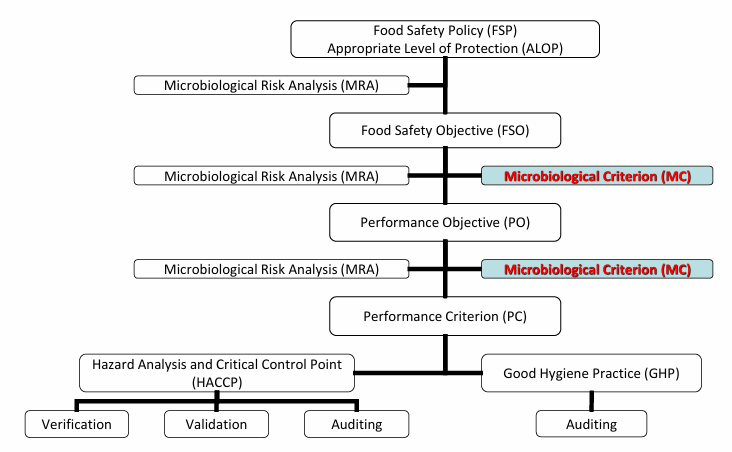
What is the key difference between FSOs and POs cf to MC
FSOs and POs represent limits
MC consists of several aspects
List the aspects that MC includes
The microorganisms of concern have to be stated,
Qualitative or quantitative analytical method validated and chosen to give a sufficiently reliable estimate
Critical limits based on data appropriate to the food, and
Sampling plan including the sampling procedure and decision criteria for a lot
What are the two different types of microbiological criteria in the EU?
Food safety criteria- acceptability of a product placed on the market
Response= whole batch will be destroyed
Process hygiene criteria- acceptability of function of production process
Response = HACCP plan will be increased
What is the purpose of microbiological criteria?
Validation and verification of HACCP based procedures
Assess acceptability of a batch of food
Communicate level of hazard control
Some assurance that particular pathogens are not present at unacceptably high concentrations (never guarantee of abscence)
What is needed in order for microbiological criteria to be applied?
Microbiological testing
What can microbiological testing be used for?
acceptance of a lot of raw materials, food ingredients or end products
establishment of shelf life of certain foods
monitoring of the production lines
monitoring of the hygienic status of the processing environment
verification of GHP and HACCP
baseline studies for the occurrence of specific microbes at a specific step(s) of production
surveillance at a specific step of production
outbreak investigations
What is the difference between mandatory and advisory microbiological criteria?
Microbiological standards = mandatory criteria
determine the acceptability of a food
not meeting the standard are subject to removal
Established by regulatory authorities
Microbiological specifications = advisory
Buyers of a food or ingredient establish specifications (e.g.- if they need certain things for what they are making)
Microbiological guidelines = advisory
indicate the expected microbial content of a food when best practices are applied
companies use as basis to design + assess control systems
established by either regulatory authorities, industrial trade associations or companies
What must be defined in a microbiological criterion?
Type of hazard (qualitative or quantitative)
Pathogen or
Indicator/ Index organisms (either quant or qual) e.g.- ACC, E. coli
Food category
Production or processing steps involved (Stage where the criterion applies)
Sampling plans (sample size, limits, analytical methods)
Two class sampling plan (Used almost exclusively for pathogens)
three class sampling plan (applied for indicator organisms)
Limits
Interpretation of the test results and action in case of unsatisfactory results
What are the specification used in two class sampling plan?
n = number of sample units from a lot to be examined
m = maximum acceptable number of relevant bacteria/gr
c = maximum acceptable number of sample units that may exceed the value of m; the lot is rejected if this number is exceeded
What are the two types of interpretation in a two class sampling plan?
satisfactory, if counts or values <m
unsatisfactory, if counts or values >m
Explain the additional specification in the three class sampling plan?
M is used to separate the acceptable from the unsatisfactory
c = number of sample units giving values between m and M
Satisfactory: <m
Acceptable: if a maximum of c/n values are between m and M, and the rest of the values observed are < m- (for example only one or two samples are >m but less than M don't get rid of entire batch)
Unsatisfactory: if one or more of the values observed are >M or more than c/n values are between m and M.
What are the different ways that microbiological sampling can be performed?
Can be destructive (excision with scalpel or borer) or non destructive (wet/dry swabs, contact):
Excision (carcasses)
Wet/dry swabbing (carcasses & surfaces/equipment)
Whole carcass rinse (poultry)
Meat sample (retail, 10g/25g)
Batch sample (food products, raw ingredients: 25g or 25ml)
Then the lab test can either be in house (common in poultry) or external/commercial lab
What are the stages in the sample processing?
Sampling
Transport the samples to the laboratory
Remove the bacteria from the sample (homogenisation)
Examine sample for target organism
Confirm suspect colonies
Calculate and report results
List the sample sites for TAC and enterobacteriae in cattle, sheep and pigs (swabbing or excision)
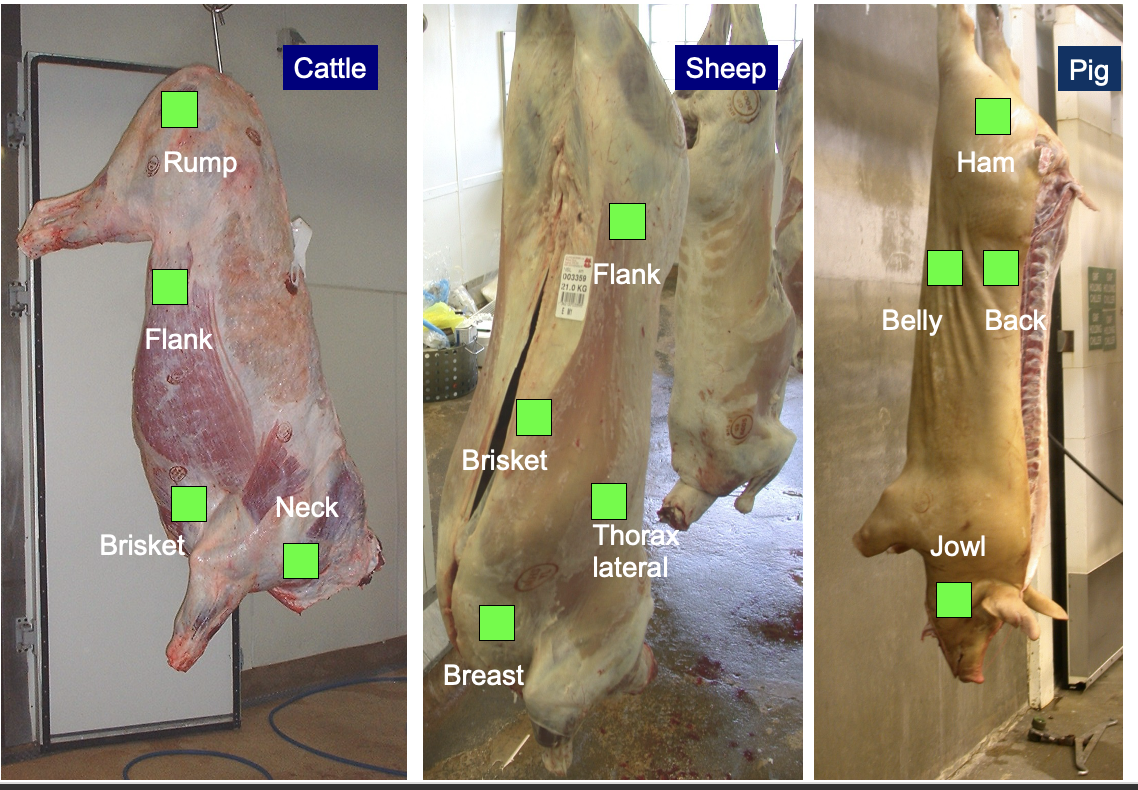
Areas more likely to be contaminated by environment
4 sample sites of each carcass
What is the sampling area for salmonella, in cattle, sheep and pigs when swabbing?
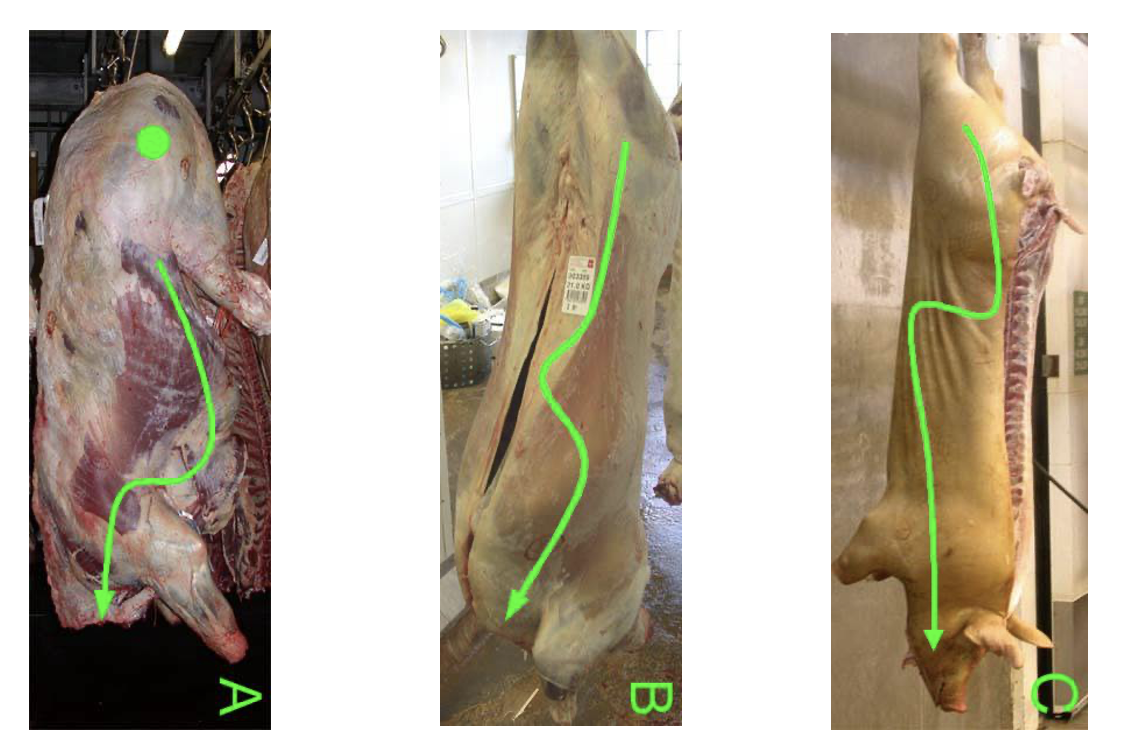
Limit is presence or abscence, so want to increase chance of pickign up bacteria
an abrasive sponge sampling method shall be used
Under what conditions should samples be transported to the lab?
Cool perishable samples to <4°C and maintain temp. during transport to avoid changes in the level of microbiota
Maintain frozen samples in a frozen state until analysis
Canned foods should be maintained at <40°C
Max time from sampling to exam often given in ISO methods
What are the problems associated with exam for pathogens?
Fastidious organisms
Low numbers and/or occurrence so require large no of samples
Negative result not necessarily abscence
non-uniformly distributed
Multistage methods takes up to a week to confirm
Expensive
What are the steps of pathogen samplig and ID?
pre-enrichment
enrichment
presumptive ID
ID
What must happen before any result can be reported and how is this done'
Confirmation
Gram staining
Biochemical tests —> Catalase, oxidase, urease, methyl red, Vogues-Proskauer, carbohydrate fermentation
Commercial biochemistry kits – API
Latex agglutination - E. coli O157, S. aureus
Serology testing - Salmonella spp.
Which factors may affect the results of a microbiological test?
All stages in sample processing:
Transport, homogenization, media, counting/calculation of bacterial numbers
Microorganism not detectable or damaged (“Viable but not countable” forms)
Human error throughout
What is the excision criteria for cattle, sheep, goat, horse and pig carcasses?
dont need to know numbers
