Fluids my cards
 Call Kai
 Learn
 Practice Test
 Spaced Repetition
 Match
 Flashcards
 Knowt Play
1/34

There's no tags or description
Looks like no tags are added yet.
35 Terms
Q=
AV for same density
V1=
Q/A1 (if you find Q you can use that to find V1)
m=
pQ
Momentum equation for Steady flow
Fx= Accumlation term
Accumlation integral simplifies to
p2A2V2- p1A1V1
Conservation of Energy Prob
cancel out internal energy if not given, Cancel out pressure if both are atm, cancel out gravity if horizontal, cancel out Q if no heat transfer
How is stream function derived for unique shape
superposition of simpler shapes such as uniform + doublet
When says 2a upstream
add the radius then the 2a
Angle for stream function
the upstream and downstream so horizontal is 180 up and 0 down if left to right
Velocity r in terms of stream
1/r partial derivative with respect to theta
Velocity theta in terms of stream
-partial derivative with respect to r
Velocity for equation after derivatives
use magnitude
If a cylinder was rotating how would it affect
would create lift on top if rotating clockwise and the bottom pressure distrubution would be uneven where theres more streamlines on the top and less on the bottom
How is stream function in respect to velocity potential
it is orthogonal (\[ u=\frac{\partial\psi}{\partial y}, \])
Irrotation Flow
Partial with respect to and x- partial with respect to u and y = 0 ( woudl equal a constant if spinning.)
V rel with moving control surfave
Vrel= V- Vref
F surf
pressure due to pipe bending or wall exerting on air
F surf equation
P1A1-P2A2 (add costheta or sin theta for each if bends)
Flux integral simplifies to
mu2-mu1 (u= x velocity component so if diagonal use Vcos(30)
if trying to find P1
could use atms bernoulli where p1=-1/2pv1²(if you know v1)
for energy equation
use pressure and velocities of inlet and outlet for the equation
Stream Uniform
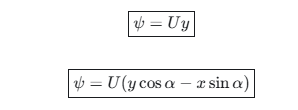
Stream source/sink

stream vortex

stream doublet

stream cylinder

internal streamlines

wake
pocket with no streamlines directly after an object due to viscous effects
realistic flow for viscous effects

conservation of mass compressible flow

conservation of mass incompressible flow
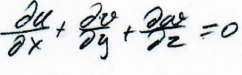
Differential convservation of mass for
infinitesimally tiny fluid element at a point
use differential cons of mass for
velocity field where x y and w take partial of that with respect to each
when asked to solve for streamlines
use points given and sub into function then set equal to and solve for y
for steady flow simplification remember
F= muout-muin (can have multiple outlets or inlets)