Biochemistry
 Call Kai
 Learn
 Practice Test
 Spaced Repetition
 Match
 Flashcards
 Knowt Play
1/36

There's no tags or description
Looks like no tags are added yet.
Name | Mastery | Learn | Test | Matching | Spaced | Call with Kai | Chat |
|---|
No analytics yet
Send a link to your students to track their progress
37 Terms
Organisms
Made up of matter
Matter
anything that takes up space and has mass
types- liquid, solid, gasses
-can’t be created or destroyed, can be rearranged and recycled
made up of elements
Elements
pure substance that can’t be broken down into simple substances.
there are 90+ that naturally occur on Earth
each elements has its own characteristics/emergent properties
when you combine elements they produce new characteristics
Important Elements to Know
Oxygen, Carbon, Hydrogen, Nitrogen, Phosphorus
Subatomic Particles
Protons, Neutrons, Electrons
each element is made up of a different # of protons, neutrons, and electrons
Identifying What the Numbers and Symbols of a Element of the Periodic Table Mean

Atomic Number
number of protons and electrons in a neutrally charged atom, #p = #e
Atomic mass
weight of protons and neutrons(they weight about the same)- electrons are every light so no point in adding the
(you can find the # of neutrons by atomic # subtracted from atomic mass)
Protons
Positively charged
make up the nucleus
#stays stable
- same # among all atoms of the same element
weighs 1 amu
determines an atoms characteristics
Neutrons
Neutrally charged
make up the nucleus
- The number stays stable
- not the same # among all atoms of the same element(isotopes)
weighs 1 amu
determines an atoms stability
Electrons
negatively charged
make up the cloud
# can change
- can be gained or lost by an atom
causes an atom to become an ion(cat/anion)
Weighs 0 amu
determines an atoms reactivity
Valence Electrons
Atoms 1-20 prefer to have a full outer shell (called the octet rule)
we can predict how atoms will charge based on the electronegativity of an atom
The outer shell holds a Mac of 8 e-
if atoms tend to have a full outer shell, they tend to be nonreactive
it they don’t they they are reactive
when atoms bond with each other their electrons are interacting
Electronegativity
We can predict how atoms will share electrons based on how electronegative the atom is (how attracted the atom’s nucleus is to electrons)
Highly electronegative elements (top half more towards right side of the periodic table):
Fluoride
Oxygen
Sulfur
Nitrogen
Chlorine
Bonds
Covalent, Ionic, and Hydrogen
Covalent Bonds
2 atoms can be shared
How many electrons are shard
- single (sharing 2 electrons)
-double (sharing 4 electrons)
-triple (sharing 6 electrons)
How equally electrons are shared
- nonpoplar= shared
-polar = not shared
Charges: It creates a dipole with a partial negative charge (\(\delta-\)) on the stronger atom and a partial positive charge (\(\delta+\)) on the weaker atom.
shared
Ionic Bonds
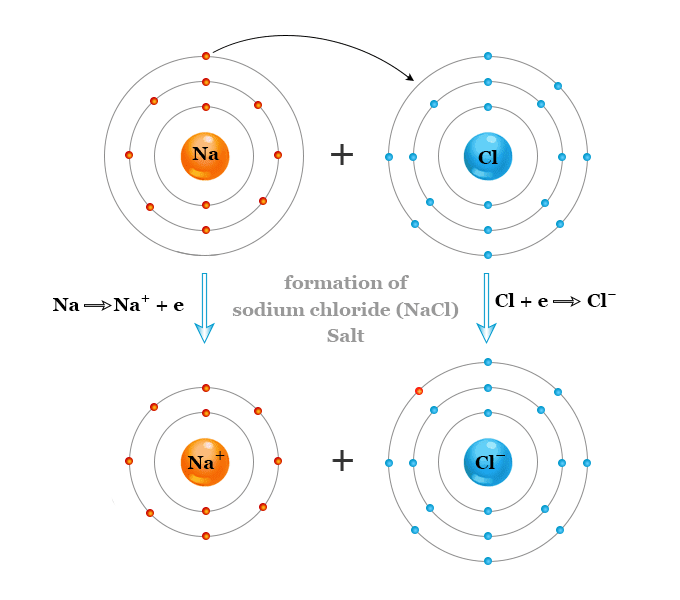
electrons can be transferred from one atom to another
forming Ionic bons and ions(atoms that are not neutral/have a charge due to gained (-) or transferred electrons(+)
one positive and one negative
transferred
Hydrogen Bonds
Between the hydrogen of 1 molecule and the fluorine, oxygen, or Nitrogen of another (FON)
when hydrogen bond is a covalent bonded to FON ; a polar covalent bond is formed
meaning the e- spends more time around the FON causing H to become slightly more positive. This males H more attracted to other because they are slightly negative
INTERMOLECULAR
Chemical Reactions
They occur when a bond makes or breaks with each other
when atoms bond with each other their electrons are interacting
Water Molecule
Oxygen would like to have 8 valence electrons while hydrogen would like to have 2.
even though oxygen and hydrogen are sharing electrons in a covalent bond, oxygen has a higher electronegativity (pull for electrons) than hydrogen.
- this causes the oxygen atom in water to have a partial negative charge while the hydrogen atoms in water have a partial positive charge.
THIS IS POLARITY
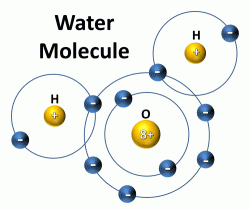
Polarity
even though water is an electrically neutral molecule (rather than charged ion), each end of the molecule has a slight charge
when a partially positive hydrogen of one water molecules is close to a partially negative oxygen of another water molecules, hydrogen bonds are formed
Hydrogen Bonds
weak, but still enable water to have unique properties. Because of these bonds, water is attracted to itself and other polar molecules.
Capillary action
the spontaneous flow of a liquid through narrow spaces, pores, or thin tubes without the help of external forces like gravity.
Key forces of Capillary Action
Cohesion- water molecules are attached to themselves
Adhesion- water molecules are attracted to other polar substances
Surface Tension- cohesion- results in surface tension, water has high surface tension.
Cohesion
- water molecules are attracted to themselves
Adhesion
water molecules are attracted to other polar substances
Surface Tension
Cohesion- results in surface tension, water has high surface tension.
Specific Heat
Heat Capacity and Vaporization
Heat Capacity
Polarity and hydrogen bonding result in waters high heat capacity (high specific heat)
where water can absorb large amounts of heat energy before it rises in temperature.
Vaporization
High heat capacity results in a high heat Vaporization
where water absorbs a large amount of heat before it becomes a gas.
How Hydrogen Bonds Work- Heat Capacity
Absorbing Heat: When heat energy enters water, much of that energy is used to break hydrogen bonds rather than immediately increasing the speed (kinetic energy) of the molecules. Because energy goes into disrupting these bonds, the actual temperature rises very slowly. [1, 2, 3]
Releasing Heat: When water cools down, the hydrogen bonds re-form, releasing a large amount of stored energy back into the environment. This keeps water temperatures remarkably steady
Evaporative cooling
the process where a liquid (like water or sweat) absorbs thermal energy from an organism's surface and transitions into a gas, lowering the remaining surface or body temperature
Evaporitive Cooling
Attraction (Hydrogen Bonds): Water molecules are naturally magnetic-like; the positive (hydrogen) side of one water molecule is weakly attracted to the negative (oxygen) side of a neighboring water molecule. These sticky forces keep liquid water pooled together.
Kinetic Energy (Motion): When you add heat or energy, the water molecules vibrate, spin, and zoom around faster. Their kinetic energy (energy of motion) increases. [1, 2]
Breaking Free ("Overcoming"): Once the molecules move fast enough, that forward momentum is greater than the pull of the hydrogen bonds. Instead of sticking to each other, they snap the bonds, fly apart, and escape into the air as invisible water vapor or steam. [1, 2, 3]
Density
Polarity + hydrogen bonding also in water being less dense as a solid than a liquid
usually solids are more dense
liquid state, water molecules are closely held together by weak hydrogen bonds
reaching solid state, hydrogen bonds become stable, arranging molecules far apart from each other.
Solution
When one substance is dissolved in another
Has 2 parts
Solute- substance being dissolved in liquid
solvent- substance doing the dissolving (usually a liquid)
water is the universal solvent because of its abikoty to dissolve most substances
- attracted to anything with a partial or full charge - neutral pH