ESCI 225 Final
 Call Kai
 Learn
 Practice Test
 Spaced Repetition
 Match
 Flashcards
 Knowt Play
1/30

There's no tags or description
Looks like no tags are added yet.
31 Terms
Principle of Competitive Exclusion
two species cannot persist in the same niche in the same habitat
(two species requiring the same limiting resource cannot coexist; one species will inevitably be better adapted to its environment and outcompete the other)
when each species in the same niche have identical characteristics, the species became extinct in different orders with a different surviving species each time, indicating that random chance determines which species will survive
states that two species using the same resources cannot persist in the same niche in the same habitat. This is shown because every time the simulation is ran, only one species ends up surviving since they are all trying to use the same niche.
Fundamental Niche
describes the sum total of the organism’s basic (fundamental) ecological properties
broader than the realized niche
Realized Niche
usually species cannot exist in the same niche, but when two species niches overlap and if one or both restricted its niche to minimize overlap the two species could potentially coexist within the same community. The restricted version of a species’ niche—restricted usually because of interactions with another species—is called its realized niche. When organisms coexist in environments with limited resources, we generally assume that the niches we observe are realized niches; we often find that their fundamental niches are broader
Paradox of enrichment
phenomenon in population ecology that occurs when food availability for a prey species increases dramatically, and results in the destabilization of the predator population or the entire food chain
Evolution takes a long time. How could scientists determine whether a particular prey adaptation evolved in response to the presence of a predator?
By comparing populations exposed to predators with populations that have not been exposed to predators and determining whether the trait is more common in populations exposed to predators.
AND
By demonstrating that individuals with the trait have higher survival and reproductive success when predators are present.
Red Queen Hypothesis
species must evolve fast enough to keep pace with or outpace their enemies, explains sexual reproduction
sexual reproduction evolved in part due to the advantage it confers by increasing the speed of evolution (through genetic recombination). Exploiters (e.g., predators and parasites) reproducing sexually can then better take advantage of weaknesses in their victims' defenses, and those who are exploited (e.g., hosts and prey) can faster evolve such defenses. Results in coevolutionary arms race
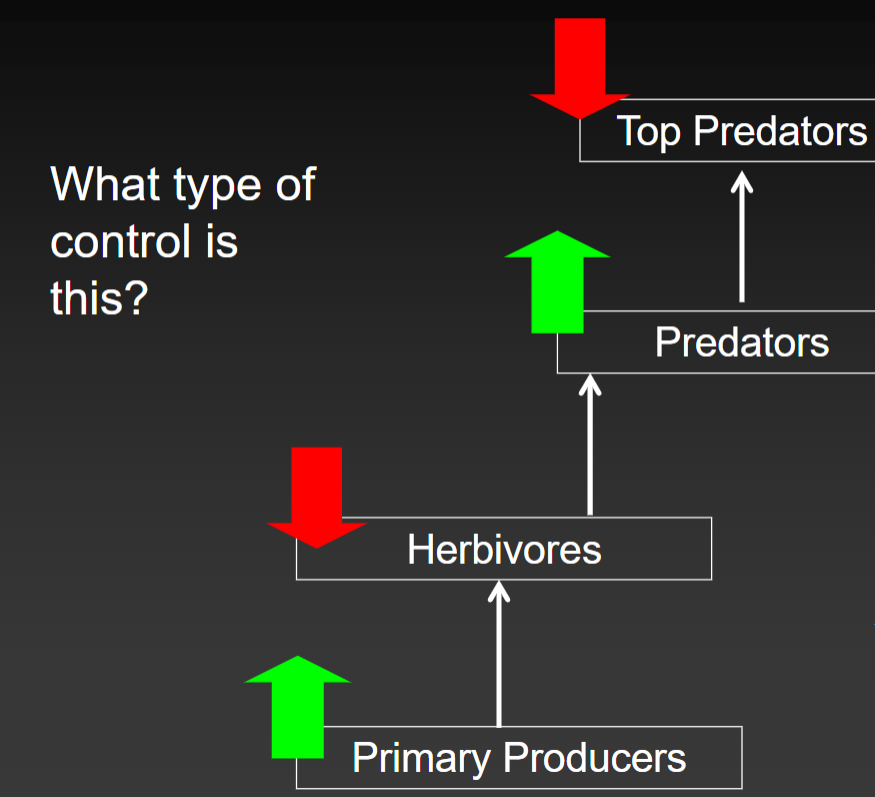
both?
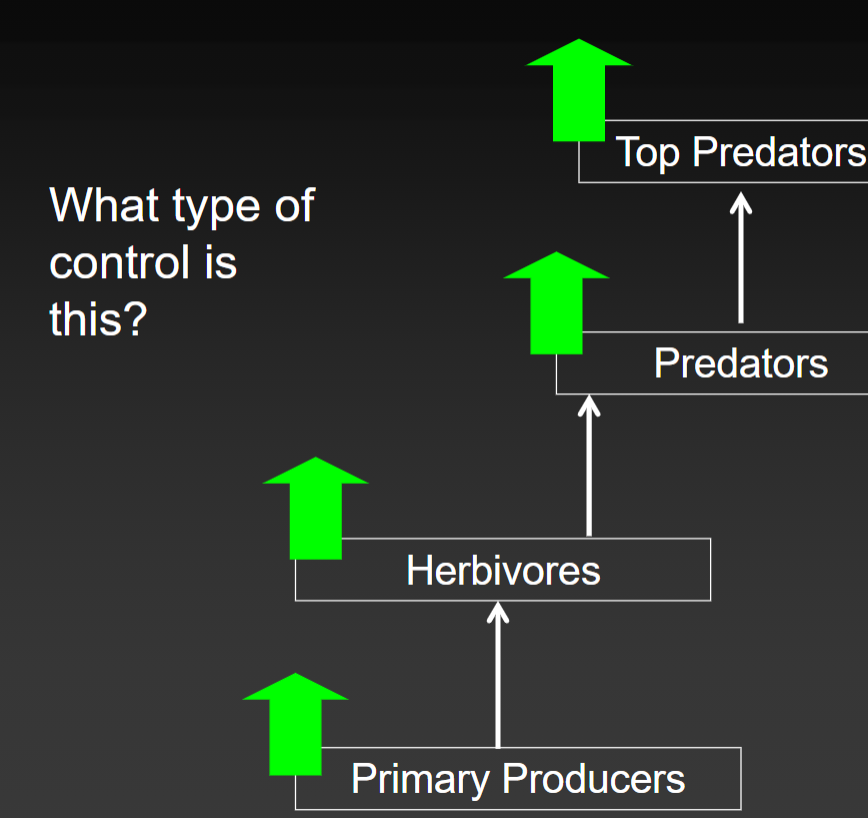
bottom up

top down

both?
Epizoochory
seeds get transported by sticking to the outside of an organism
both types (epi and endo) of transportation bring together (link) otherwise isolated plant communities
Endozoochory
seeds get transported through digestion by herbivores (scat)
both types (epi and endo) of transportation bring together (link) otherwise isolated plant communities
influence of predators on prey populations
predators influence the mortality/population sizes of prey, their distributions, and natural selection
predation is also a form of exploitation (usually herbivory counts but in this case, we’re focusing on an animal eating another animal)
prey can also alter predator pops
density-dependent factors can reduce hare pops
search efficiency
how good are the predators at finding their prey?
proportion of the encounters the predator population has with the prey population that result in the death of a prey item, helps find consumption rate in LV equations
some predators are more efficient at finding prey, some prey are more efficient at evading certain predators, some predators become more efficient when they have more prey
coevolution
two species that live in close association and both adapt in response to selective pressure from each other
evolutionary effects of predation
physical and chemical defenses
Lotka-Volterra predator-prey equations
Prey pop growth: dNprey/dt=rpreyNprey-aNpreyNpredator
Predator pop growth: dNpredator/dt=abNpreyNpredator-mNpredator
b: conversion factor, m: predator death rate
rprey: prey growth rate, a: search efficiency, N: population size
describe a two-species system in which prey and predators interact, predicts regular, even cycles of predator and prey populations, with predator cycles following prey cycles
exponential growth of prey is reduced by the predator's consumption rate, which is a function of the rate at which predator and prey encounter one another and the predator's search efficiency
predator growth is determined by their consumption rate (how quickly a predator population kills members of its prey population), their conversion factor (the number of prey items a predator must consume in order to produce a new predator), and their mortality rate (rate at which predators die).
not most accurate, more accurate modes would include chance events show variation in both the period and amplitude of predator-prey cycles
Geometric growth
rate of increase compounds over time (doubles each time, so each time, the amount it doubles gets bigger)
rate of increase (doubles) is the same, but the actual amount of increase is higher each time, so increasing faster as time goes on
Nt+1=λ*Nt
N: population size t: time, λ: lambda, finite rate of increase (multiplier),
so Nt+1 means the population size at the next time step
whole equation trying to predict what the population will be at the next time step, as a function of another population size
geometric growth curve is often J shaped on a graph
λ=N1/N0
N1: pop size at first time step, N0: initial pop size
Nt=No*λ^t
Nt: pop size at certain time, N0: starting pop size, t: time
λ
if λ=1, the individuals of a population are replacing themselves, the pop is constant overtime w no change
if λ is less than 1, they are not replacing themselves, pop exponentially decreases
closer lambda is to 1, the slower the population decreases
λ cannot be less than 0
Assumptions of the exponential growth model
1) Resources are unlimited (food, mates, don't have to worry about carrying capacity)
2) Population is closed (no immigration or emigration)
3) Population undergoes discreet reproduction (all reproduction happens at the same time, (season or time of year), there's no overlapping generations, ex) annual plants
oversimplified model but it is still useful for invasive species and recolonization after a disturbance, it’s not useful for a very long time (constrained by time) after a certain amount of time, you should switch to another model
discrete VS continuous population models
continuous (exponential): reproduction happens continuously regardless of the time of year, pop can be any real number (includes decimals), exponential model better for it
discrete: all reproduction happens at one time of year, resulting in no overlapping generations, pop can only be discrete (whole) integers, geometric model better for it
discrete VS continuous reproduction
discrete: aka pulsed reproduction, all indvds in a pop reproduce during a specific, limited time period, usually once per year ex) trees, many fish and birds
continuous: organisms that reproduce throughout the year ex) humans
instantaneous population growth rate
dn/dt= change in pop/change in time
describes "how fast the population is changing right now” rN (1- n/k)
r: intrinsic growth rate, births-deaths, N: current pop size, k: carrying capacity
Exponential growth model
Nt=No*e^rt
Nt: pop at certain time, N): starting pop, e: constant base of natural log (on calc), r: per capita intrinsic growth rate, births-deaths, t: time (# of time steps)
(r>0 increasing, r<0 decreasing, r=0 stable)
in geometric growth model we cant have growth less than 0, but in exponential model we can
humans are a good example of a pop that grows exponentially
no set time where reproduction occurs
to convert between r and λ, r=lnλ
λ: finite rate of increase, Nt+1/Nt
3 ways to calculate r
births-deaths/time*Navg
ln λ
ln (Nt+1/Nt) just another way to get λ
assumptions of exponential growth model
1) resources unlimited
2)population closed
3) population can produce continuously (can be predicted at any real # of time)
these conditions can also only be met for a limited amount of time just like with geometric model
logistic growth rate
modification of exponential growth rate to add a correction factor that accounts for resource limitation
λ, finite rate of increase
ratio of pop size at one time step (nt+1) to the size of the pop at the previous time step (Nt)
nt+1/Nt
multiplying λ by the current pop size gives an estimate of the pop size in the following time step Nt+1=λNt (the geometric growth model is a generalized version of this equation)
intraspecific competition
As a population grows, finite resources become increasingly limited and individuals within the population will compete more strongly with each other for these resources
Strong intraspecific competition can result in lower individual performance when a population reaches high densities, leading to negative density dependence in growth, survival, or reproduction
interspecific competition
occurs when individuals of one species limit the resources available to another species.
The impacts on individuals involved will depend on their relative competitive abilities, but generally both parties are disadvantaged.