ARTH 226 Slides Test
 Call Kai
 Learn
 Practice Test
 Spaced Repetition
 Match
 Flashcards
 Knowt Play
1/39

Earn XP
Description and Tags
context and slides ARTH 226
40 Terms
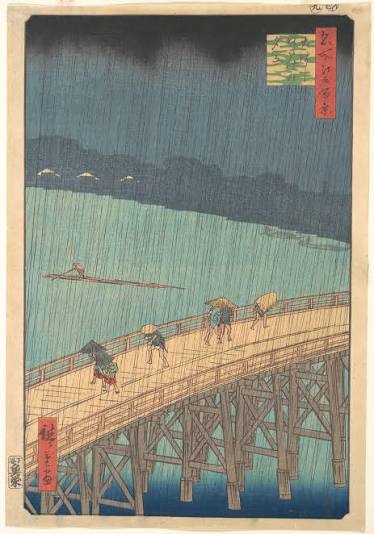
Utagawa Hiroshige
Sudden Shower over Shin-Ohashi Bridge and Atake
1857
Woodcut Print
Japanese Ukiyo-e prints became influential in Europe during the 19th century, contributing to Japonisme (european facination with japanese art and aesthetics)
Modern art did not develop solely in Europe.

Edouard Manet
Dejenuer sur l’herbe
1863
Oil on canvas
Rejected from the Paris Salon, presented at the Salon de Refuses
N**e woman alongside two clothed men, not a goddess or historical figure, challenged the expectations of the French academy, represents the changing definitions and institutions of art during modernity.

Claude Monet
Impression, Sunrise
1872
Oil on canvas
Port of Le Havre - prioritizes the effects of light, colour, and atmosphere.
Founder of Impressionism - Depicts a modern harbour rather than an idealized landscape (not recreating reality exactly)
Inspired by Japonisme

Edgar Degas
Absinthe (At the Cafe)
1876
Oil on Canvas
ordinary experiences in contemporary cities; depicts a moment in a Parisian cafe
Public leisure spaces also involving isolation, addiction and social problems.

Georges Seurat
A Sunday on La Grande Jatte
1884
Oil on Canvas
Contemporary Urban life vs Historical/mythological subjects
Lack of interaction between subjects - artificially modern urban society
Pointillism, represents a shift to neo-impressionism.

Paul Gauguin
Vision After the Sermon/Jacob Wrestling with the Angel
1888
Oil on Canvas
Gauguin represented ideas and emotions (spiritual and imaginative experiences) (used bright colours, simplified shapes, strong outlines, and flat areas of colour)
Depicts Breton women who have just attended a religious sermon, they imagine the story being played out in front of them
Broader tension with modernism: some artists responding to industrialization, some looked to rural cultures and the past.

Paul Cezanne
The Basket of Apples
1893
Deliberately disrupts linear perspective
Believed painting should reorganize and reinterpret nature
challenged conventional ways of depicting 3D reality

Henri Matisse
Woman with a Hat
1905
Exhibited at the Salon in 1905
Unnatural colours, proportions, and visible brush strokes (not normal for the salon)
represents shift to abstraction

Pablo Picasso
Les Demoiselles d’Avignon
1907
Inspired by african masks and ancient Iberian sculpture - France and Colonialism
Distorted bodies, angular and fragmented
precurser to cubism

Georges Braque
Man with a Guitar
1911
The subject is difficult to recognize - fragmented
reinventing what painting can do - the experience of seeing and understanding an object
cubism - analytic cubism - moving away from traditional rep.

Pablo Picasso
Guitar
1912-13
Cardboard, string, wire.
taking cubism beyond 2D
was made out of everyday materials, artwork did not need to be made from expensive materials to be art.
Constructed sculpture (assembled rather than carved)

Giacomo Balla
Dynamism of a Dog on a Leash
1912
Italian Futurist - celebrated modern tech, speed, movement, changing industrial world.
Loved speed of modern society, reflected movement and energy of modern world
trying to represent motion - challenges idea that pictures should represent a frozen moment

Umberto Boccioni
Unique Forms of Continuity in Space
1913
Plaster for the og sculpture, bronze casts used in museums
Futurist - capturing movement
moving forward with big force, shaped by air and resistence
smooth forms represent modern machinery

Ernst Ludwig Kirchner
Street, Berlin
1913
Oil on canvas
Founding member of Die Brucke, expressionist group established in Dresden in 1905
Breaking away from traditional academic art, inspired by metropolis, aiming to expose an emotional truth.
Depicting sex workers in Berlin
German Expressionism

Vasily Kandinsky
Composition VII
1913
Oil on Canvas
Pioneer of abstract painting
German expressionism
art did not need to represent recognizable objects or scenes - colour shape and line could communicate emotions and spiritual experience directly - art shouldn’t have to depict people, landscapes, or historical events.
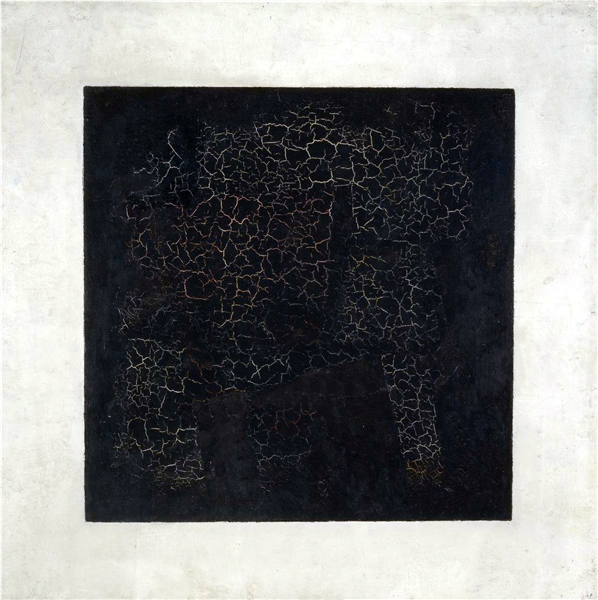
Kazimir Malevich
Black Square
1915
Oil on Linen
Russian avant-garde artist - founded suprematism
Expression of pure artistic feeling and geometric abstraction
Abandoned recognizable subject matter almost entirely
Displayed in the top corner of exhibitions, where religious figures were typically displayed
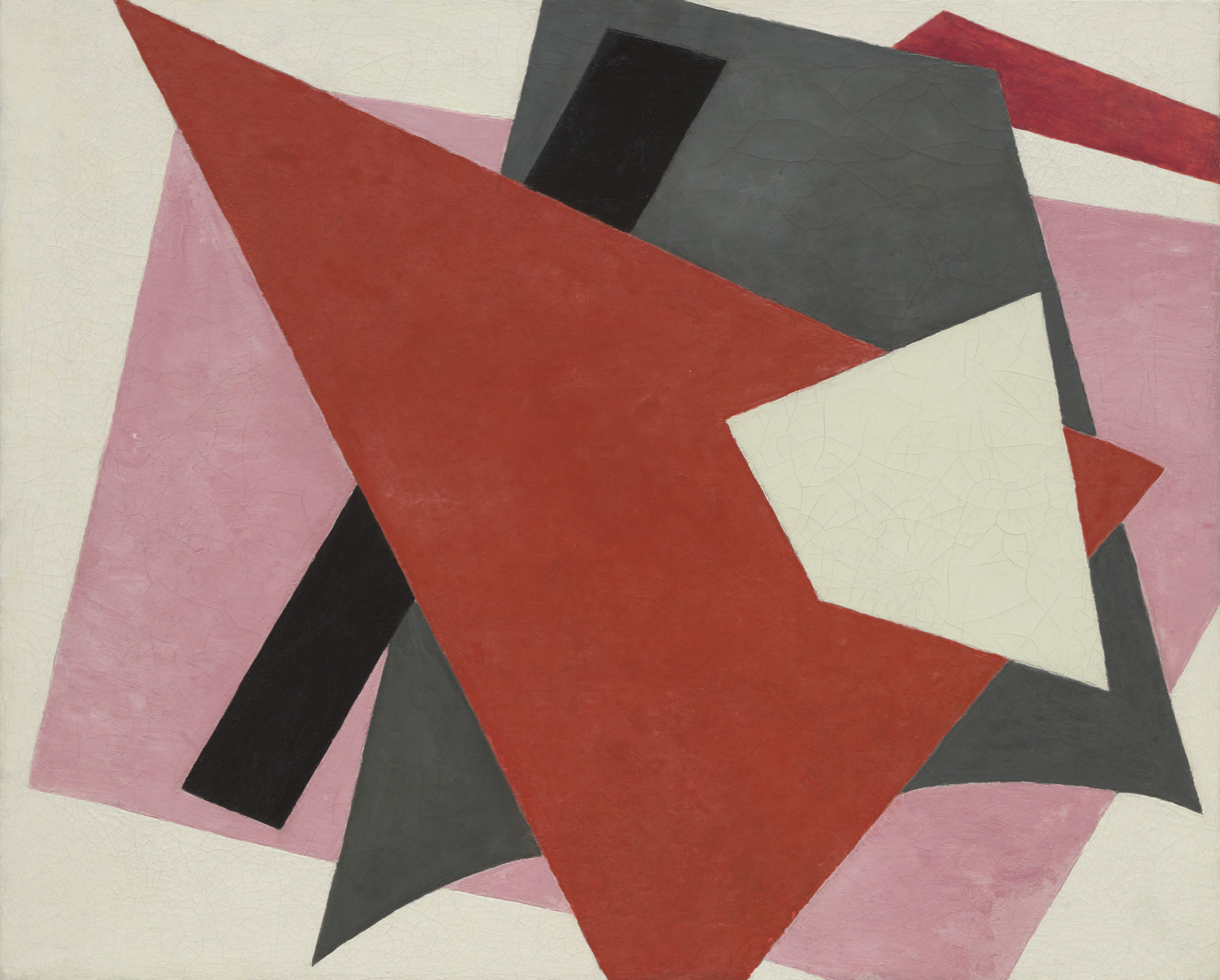
Luibov Popova
Painterly Architectonic
1917
Oil on canvas
important russian avant-garde artist of the 20th century
created during Russian revolution of 1917
treates shapes like physical building materials, they’re interacting with eachother.
combines cubism, suprematism, futurism, while developing her own approach
she eventually moved into textiles (soviet productivism)
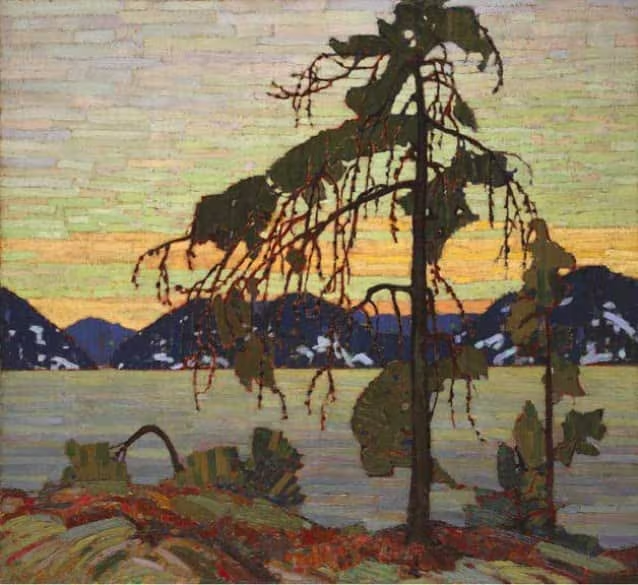
Tom Thomson
The Jack Pine
1916-17
Associated with Go7 but died before officially formed
famous for paintings of Canadian wilderness & Algonquin park
Established a Canadian artistic identity - shaped how Canadians imagined their own country
Nature untouched by humans - connected to settler colonial ideas about land

Piet Mondrian
Composition with Large Red Plane, Yellow, Black, Gray and Blue.
1921
One of the founders of De Stijl (the style): Idealistic aspiration of elevating the world through better design
Focused on geometric shapes, lines, primary colours (harmony)
Neo-Plasticism - Express universal harmony throygh abstract relationships between colour, shape, & line.
Reflects modernism’s interest in moving away from traditional representation - basic visual elements

Man Ray
Untitled
1922
Photograph
Dada Movement: Rejected the idea that art had to be beautiful or meaningful in conventional ways
Placed everyday objects directly onto light-sensitive photographic paper, exposing paper to light, and developing photograph
Challenged the boundaries between painting, photograph, and experimental art.

Tarsila do Amaral, Abaporu, 1928
Brazilian modernist. Anthropophagy

Rene Magritte
The False Mirror
1929
Belgian surrealist placed ordinary objects and familiar subjects into strange, unexpected situations
Inspired by Sigmund Freud’s theories about dreams and the unconscious mind - Andre Breton asks why the waking world gets more credibility then the dreaming
questions if our eyes give us an objective understanding of the world.

Salvador Dali
The Persistence of Memory
1931
Spanish artist - Surrealism
Developed Paranoiac-critical Method: Deliberately cultivated unusual associations and interpretations to generate imagery from his subconscious
Melting watches: time is not fixed/objective
Memory/dreams/psychological states change time.

José Clemente Orozco
The Epic of American Civilization (detail: Gods of the Modern World)
1932-34
part of a 24-panel mural cycle painted at Dartmouth college
Major mexican muralists - mexican muralism developed after the mexican revolution
used large public murals to explore history, politics, social inequality, indigenous cultures, national identity.
Criticism of universities and academic institutions: producing useless knowledge and ignoring serious social problems: disconnected from real world
challenges assumption that modern society represents progress

Frida Kahlo
Self-Portrait on the Borderline Between Mexico and the United States
1932
painted while living in the US with her husband
her body itself is the border
Felt alienated in the US and homesick for Mexico
reflects feelings of living in the two countries + American industrialization and Mexican Cultural identity
Identity is shaped by cultural exchange, America is dominated by factories, questions whether industrial progress means better society

Cândido Portinari
Coffee (Café)
1935
Brazilian modern artist - depicted lives ordinary Brazilians - agricultural and industrial workers
Contrast between foreman and workers (white man is barking orders while afrobrazilian people are the labourers)
Attempted to paint the national themes of Brazil through labour and class as opposed to Amaral

Aaron Douglas
Into Bondage
1936
Harlem Renaissance (1920-30s): African American writers, musicians, and visual artists celebrated black culture, explored African heritage, and challenged racism and discrimination.
Intended to depict journey of African Americans from transatlantic slave trade to modern American society
Addresses forced transportation of millions of Africans into bondage - human consequences of these networks
African American Modernist Style

Rufino Tamayo
Women of Tehuantepec
1939
The Tehuantepec region of Oaxaca is home to indigenous Zapotec communities - became important symbol of Mexican cultural identity
moving away from Muralism - wanted a style that didnt copy european modernism
these women became a symbol of mexican national identity

Wildredo Lam
The Jungle (La jungla)
1942-43
Cuban artist of mixed Chinese, European, Indigeneous, African ancestry
Moved to Cuba in 1941 - interested in culture and history of slavery
art that expressed cultural identity of Afro-Cuban people
sugarcane - reference to Cuba’s plantation economy
Makes African influences central to his modernist artistic language

Jacob Lawrence
This is Harlem
1943
Black artist associated with the Harlem Renaissance
Neighbourhood shaped by the Great Migration - transformed American cities and reshaped African American cultural identity. Harlem in particular.
Uses flattened techniques, simplified forms, bold colours to depict a distinctly African American urban experience

Paul-Émile Borduas
Nature’s Parachutes
1947
Modern abstract art in quebec
Group of artists, Automatistes - influenced by european surrealism, art should be free from rigid academic rules, conscious planning, and traditional social expectations.
Challenging Catholic power in Quebec
Pushing back against the landscape tradition

Jackson Pollock
Autumn Rhythm (Number 30)
1950
Abstract Expressionism
NY became center for International art world, challenging Paris’s traditional dominance.
No recognizable subjects or story - pushes abstraction to an extreme
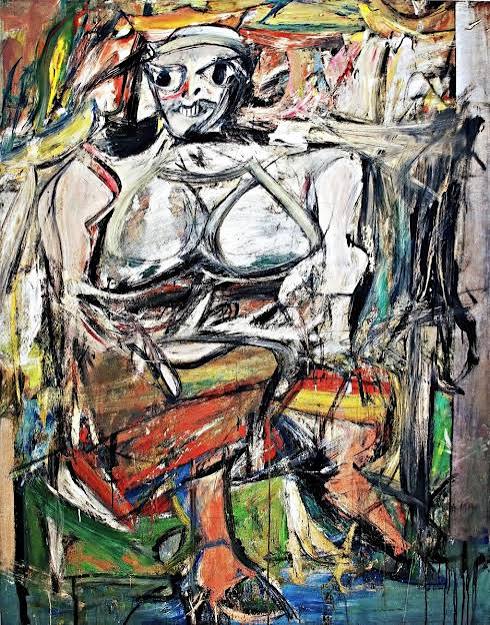
Willem de Kooning
Woman 1
1950-52
figure in NY scene - abstract expressionism
challenged “no subjects” by still painting recognizable subjects
Made his women non-perfect (western art made women idealized, he creates sort of a grotesque representation)

Helen Frankenthaler
Mountains and Sea
1952
Working in NY during rise of Abs Exp. Inspiried by costal landscape
soak stain painting - diluted paint with turpentine, poured onto unprimed canvas, created transparent areas of colour.
took inspo from pollock

Rubem Valentim
Untitled
1956-62
Brazilian Artist born in Salvador Bahia
combined geometric abstraction with symbols and visual traditions from afrobrazilian traditions - Candomble - didn’t identify as afrobrazilian

Demas Nwoko
Nigeria in 1959
1960
Nigeria gained independence from British colonial rule on October 1st 1960 - painting was created at this moment
Nwoko engaging with country’s political and cultural identity - 3 images of colonial officers, poses suggest disorder, fragmentation and breakdown of colonial authority.
Painting directly addresses British Colonial Rule - questions the legitimacy of the colonial system, depicts specifically Nigerian political historical experience

Lygia Clark
Sundial (Bicho)
1960
Anodized Aluminum
Brazilian artist - Neo-concrete movement
art should be more than purely mathematical or intellectual arrangement of shapes, wanted to involve all senses, body, and personal experience
Clark describes Bichos as living organisms because their forms could move and transform.
challenges traditional sculptures by making the artwork movable, interactive, and changeable.

Uche Okeke
Savannah Landscape (Oja suite)
1962
Pen and ink on paper
Nigerian modernist, specifically Nigerian approach to modern art.
Zaria art society - move beyond the dominance of European artistic traditions
Natural synthesis - Combining moderist techniques with indigenous nigerian artistic traditions. Transforming European modernism through Nigerian cultural traditions (after colonial rule)
Lines are inspired/influenced by Uli - trad. lgbo visual art practice used by women to react decorative designs on bodies and walls.

Ibrahim El-Salahi
They Always Appear
1964
Sudanese artist who studied at the Slade school of Fine Art in London before returning to Sudan in 1957.
became leading figure in Khartoum School - sought to develop a distinctive visual language reflecting Sudan’s cultural identity.
Combining African visual traditions with Arabic calligraphy and modernist abstraction. Explores the negative space inside Arabic letters.
“Abstraction produces figuration, figuration dissolves back into script”
Later kept a prison notebook with black and white drawings
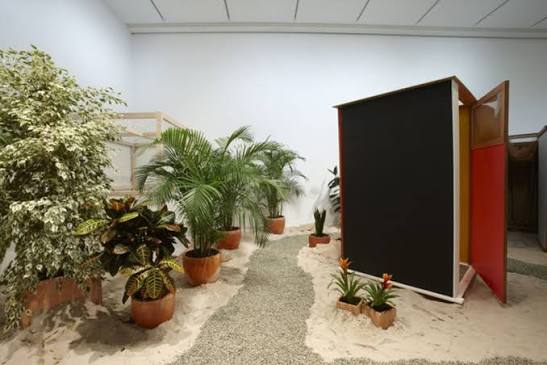
Hélio Oiticica
Tropicalia
1967
Mixed Media Environment
Brazilian, Associated with Neo-Concrete movement
Brazil experiencing political regression under a military dictatorship that began in 1964 - reflects a desire for freedom, experimentation, and resistance to cultural restrictions.
Used experimental art to challenge authoritarianism and conventional ideas about Brazilian identity.
Immersive environment that visitors can explore - favelas, sand and gravel, maze like things, a TV (modern tech)
Challenges stereotypical image of Brazil as exotic paradise - highlights realities of poverty and inequality hidden behind idealized images