Ch. 5 X-ray Tube
 Call Kai
 Learn
 Practice Test
 Spaced Repetition
 Match
 Flashcards
 Knowt Play
1/41

There's no tags or description
Looks like no tags are added yet.
42 Terms
d
which of the following reduces leakage radiation to required standards?
a. x-ray tube
b. collimator
c. added filtration
d. protective housing
c
which component of the x-ray tube is responsible for concentrating the electron cloud?
a. anode
b. filament
c. focusing cup
d. focal track
b
the x-ray tube is a part of the:
a. x-ray circuit primary
b. x-ray circuit secondary
c. filament circuit
d. breaker circuit
c
a technique of 80 kV, 400 mA, 0.8 seconds is to be used on a three-phase, 12 pulse machine. how many heat units are produced with a single exposure?
a. 25,600
b. 34,560
c. 36,096
d. 38,100
d
the intensity of the x-ray beam is less:
a. in the center of the beam
b. at the collimator
c. on the cathode side
d. on the anode side
d
causes of tube failure are most often related to which of the following?
a. electrical characteristics
b. mechanical characteristics
c. physical characteristics
d. thermal characteristics
a
what metal is added to the filament to increase thermionic emission and extend tube life?
a. thorium
b. copper
c. rhenium
d. tungsten
a
a small anode target angle:
a. results in an increase in anode heel effect
b. results in a decrease in anode heel effect
c. results in an equalization of anode heel effect
d. does not influence anode heel effect
b
a dual focus tube refers to a tube with:
a. two focal spots
b. two filaments
c. two focusing cups
d. two targets
d
the purpose of the line focus principle is to create which of the following?
a. small actual and effective focal spot size
b. large actual and effective focal spot size
c. small actual and large effective focal spot size
d. large actual and small effective focal spot size
b
a technique of 50 kV, 100 mA, 0.1 seconds is to be used on a three-phase, 6 pulse machine. how many heat units are produced with a single exposure?
a. 500
b. 675
c. 705
d. 820
c
What is the main purpose of the vacuum inside the x-ray tube envelope?
a. to increase filament size
b. to absorb stray radiation
c. to prevent electrical arcing
d. to cool the anode
b
Which material is commonly used for the target of a rotating anode?
a. iron
b. tungsten
c. copper
d. nickel
tungsten
used for rotating anode face because of its high melting point and high atomic number
F
A stationary anode spreads the heat over a larger area by rotating during exposure.
T/F
b
What does the stator do in the induction motor?
a. Produces thermionic emission
b. Creates changing magnetic fields
c. Controls the tube vacuum
d. absorbs x-ray photons
stator
in the induction motor, what part uses electromagnets to create changing magnetic fields that induce rotor movement?
a b d
Which statements describe the line-focus principle? Select all that apply.
a. the target angle changes the effective focal spot size
b. the effective focal spot helps determine image sharpness
c. the actual focal spot is the projected image seen by the patient
d. the actual focal spot is larger than the effective focal spot
c
Why is the anode side of the x-ray beam less intense?
a. The cathode absorbs most of the photons
b. The rotor blocks the x-ray beamThe rotor does not cause the anode heel effect.
c. Photons are absorbed as they pass through the angled anode targetSome photons are weakened or absorbed while passing through the target heel.
d. The focusing cup reduces the beam intensity
T
The cathode is the negative end of the x-ray tube and serves as the source of electrons.
T/F
b
What is thermionic emission?
a. The absorption of heat by the oil bath
b. The release of electrons from a heated filament
c. The production of a vacuum
d. the rotation of the anode
b
Approximately what percentage of energy from electron interactions at the anode becomes heat?
a. 10%
b. 99%
c. 25%
d. 50%
a
Which component of the protective housing helps draw heat away from the x-ray tube?
a. the oil bathThe tube is immersed in oil, which draws heat away from it.
b. the high-voltage cables
c. the lead lining
d. the target window
b
What is the purpose of adding thorium to the tungsten filament?
a. To prevent the rotor from overheating
b. To increase thermionic emission and filament life
c. To increase the vacuum inside the envelope
d. To reduce the anode target angle
d
Which part of the induction motor is located outside the tube enclosure?
a. rotor
b. focusing cup
c. filament
d. stator
b
What is the approximate rotational speed of the anode in a general-purpose x-ray tube?
a. 1,000 rpm
b. 3,400 rpm
c. 2,000 rpm
d. 10,000 rpm
a
What happens during the first phase of the exposure switch?
a. The rotor reaches speed and the filament is heated
b. The patient receives the x-ray exposure
c. The anode target is replaced
d. The cooling fans shut off
F
The rectifiers allow current to flow in both directions through the x-ray tube.
T/F
a
Which formula is used to calculate heat units (HU)?
a. HU = kVp × mA × seconds × correction factor
b. HU = kVp ÷ mA × seconds
c. HU = mA × seconds ÷ kVp
d. HU = kVp + mA + seconds
d
Which heat-unit correction factor is used for a high-frequency x-ray generator?
a. 1.0
b. 1.35
c. 1.41
d. 1.45
c
Which heat-unit correction factor is used for a three-phase 12 pulse x-ray generator?
a. 1.0
b. 1.35
c. 1.41
d. 1.45
b
Which heat-unit correction factor is used for a three-phase 6 pulse x-ray generator?
a. 1.0
b. 1.35
c. 1.41
d. 1.45
a
Which heat-unit correction factor is used for a single-phase x-ray generator?
a. 1.0
b. 1.35
c. 1.41
d. 1.45
molybdenum
what is the material used as the disc base and core of an anode because it has a low thermal conductivity and is a light but strong alloy?
copper
what is the material used as part of the shaft of the anode b/c of its excellent thermal and electrical conductive properties?
tungsten
what is the material used in the anode face with a very high melting point and atomic number - as well as improving efficiency of x-ray production?
rhenium
what material is added to tungsten to increase the thermal capacity and tensile strength of the anode, allowing for better heat management?
d
When electrons pass from cathode to anode, some of them interact and become x-rays. The remainder become:
a. lost in the x-ray tube
b. positive electrons
c. reserve for the next exposure
d. current in the x-ray circuit
a
what does the drawing represent?
a. anode-heel effect
b. line-focus principle
c. cathode focusing cup
d. electron pathway during exposure
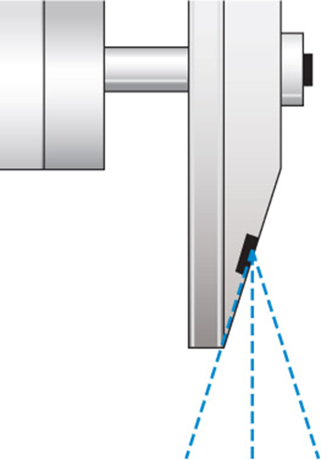
line-focus principle
what principle states that by angling the face of the anode target, a large actual focal spot size can be maintained and a small effective focal spot size can be created?
d
when will thermionic emission occur?
a. when the filament circuit is engaged
b. when the rotor switch is pushed
c. when the cathode wire is heated to white hot
d. all the above