Nervous System Flashcards
 Call Kai
 Learn
 Practice Test
 Spaced Repetition
 Match
 Flashcards
 Knowt Play
1/69

Earn XP
Description and Tags
STUDY NEOWWWWW
70 Terms
List the 4 major components of the nervous system.
Brain
Spinal Cord
Sense organs
Nerves
3 primary functions of the nervous system
Input
Integration
Output
Motor output, or response to a stimulus, is in the form of a movement of a _____ or action of a _____.
Muscle, gland
Stimulus
Anything that causes a response.
The central nervous system is composed of the _____ and _____.
brain and spinal cord
Which of the following statements about the CNS is NOT true?
a) Acts as the integration and command center
b) Includes all sense organs
c) Takes in all conscious and subconscious sensory information
d) Functions in language, creativity, and personality
b) includes all sense organs
All nerves and sense organs outside of the central nervous system are part of the _______ nervous system.
peripheral

List and briefly describe the two subdivisions of the Peripheral Nervous System
Sensory (afferent) division carries information TO the CNS.
Motor (efferent) division carries information AWAY FROM the CNS.
Flowchart of the Peripheral Nervous System. (I’m sorry; there was no picture to attach) ;-;
A. Somatic
B. Autonomic
C. Sensory
Match these characteristics to the correct motor subdivision of the PNS.
a. Somatic
b. Autonomic
Includes reflexes
Controls smooth muscle
Regulates involuntary actions
Allows conscious control of skeletal muscles
Includes reflexes (a)
Controls smooth muscle (b)
Regulates involuntary actions (b)
Allows conscious control of skeletal muscles (a)
Cells that insulate, support and protect neurons are called
neuroglia

Label these parts of a neuron
A. Dendrite
B. Cell body
C. Node of Ranvier

Label the axon and axon terminals
A) Axon
B) Direction of Impulse
C) Axon Terminals
State the function of the myelin sheath
Insulates fibers and increases the speed of transmission
Nodes of Ranvier are gaps between ______ cells that allow the impulse to jump from node to node, which ______ the speed of transmission.
Schwann, increases

Identify the labeled structures in this diagram
A. vesicle
B. neurotransmitter
C. synapse
What event stimulates the release of neurotransmitters?
A nerve impulse reaching the axon terminal
Neurotransmitters are stored in ______ and, when released, cross the synapse by the process of _______ to continue the nerve impulse.
vesicles, diffusion
In the CNS, bundles of nerve fibers are called ______. In the PNS, they are called _______.
tracts, nerves
Compare and contrast white matter and gray matter
-Both are bundles of nerve fibers
-Fibers in white matter are myelinated
-Fibers in gray matter are unmyelinated

Identify the 3 types of neurons shown in this diagram.
sensory (green)
interneuron (yellow)
motor (purple)
What type of sensory receptor is found in muscles and tendons and detects stretch or tension to help maintain balance and posture?
Proprioceptors
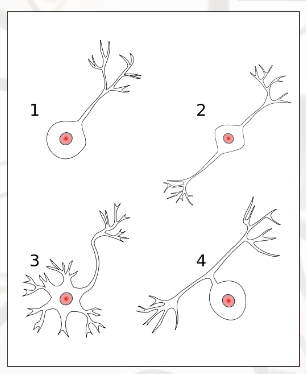
Identify the most common neuron structure by name and number.
3: multipolar
The two major functional properties of neurons are
Irritability and Conductivity.

The plasma membrane at rest is ______.
Identify the intracellular side of the membrane.
________.
Polarized, Side B
List 3 events or types of stimuli that can excite a neuron.
Light
Sound Waves
Pressure
________ is a temporary change in the permeability of neuron membrane, which allows _____ ions to flow into the cell.
Depolarization, sodium

Which part of this diagram shows an action potential?
B
If the stimulus is strong enough and the influx of sodium ions is great enough the depolarization activates a nerve impulse or ______ ______.
action potential
Briefly explain the all-or-none response.
Once an action potential is generated, it continues along the entire neuron membrane; there is no partial impulse.
Put these events, which follow an action potential, in the correct order.
A) K+ ions diffuse out to restore the negative charge on the inside of the membrane; repolarization
B) The sodium-potassium pump restores the original ion balance of resting potential
C) Neuron membrane becomes impermeable to Na+ ions.
2nd (A)
3rd (B)
1st (C)
___________ are chemicals that are released at the end of an axon terminal, diffuse across the synapse, and transfer the nerve impulse to another nerve, muscle or gland.
Neurotransmitters
Briefly explain how nerve impulses are electrochemical.
Action potential along the axon is electrical; transmission across the synapse is chemical
Define reflex.
Rapid, predictable, involuntary responses to stimuli.
The pathways by which a signal travels to the spinal cord and an immediate response is sent called a _______ ___.
reflex arc
Pulling your hand away from a hot object is an example of a _______ reflex.
somatic
_________ reflexes affect smooth muscles, the heart, or glands.
Autonomic

Match the elements of a reflex arc to the appropriate label on the diagram.
Effector
Integration center
Motor neuron
Receptor
Sensory neuron
E
A
D
C
B

Identify the 4 major brain regions.
Cerebrum
Diencephalon
Brainstem
Cerebellum
The largest and most superior part of the brain is the ________.
It is composed of two ______, which are separated by the longitudinal ______.
cerebrum, hemispheres, fissure.
The surface of the cerebrum shows elevated ridges of tissues called ___ and shallow grooves called _____.
gyri, sulci
Complete these 3 facts about the cerebral cortex.
1) Outermost layer of the _______.
2) Composed of ____ matter.
3) Responsible for ________ and processing sensory information.
cerebrum, gray, thinking

Identify the lobes of the cerebral cortex.
1) Pink:
2) Yellow:
3) Purple:
4) Green:
frontal (pink)
yellow (parietal)
purple (occipital)
green (temporal)
Match the cerebral lobes with their primary functions. A. Frontal
B. Parietal
Sensory information such as temperature
Motor function
Memory and language
Processing touch and taste
Problem-solving and judgment
B
A
A
B
A
Match the cerebral lobes with their primary functions.
A. Temporal
B. Occipital
Visual processing
Auditory and olfactory processing
B
A

Name the large fiber tract that connects the two cerebral hemispheres and allows communication between them.
Corpus callosum
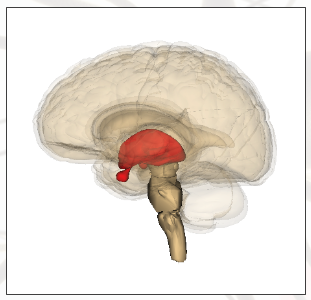
The _______ is superior to the brainstem and includes 3 structures:
Thalamus
_________
Epithalamus
diencephalon, Hypothalamus
Which of the following statements about the hypothalamus is NOT true?
a. Controls the pituitary gland
b. Maintains body temperature
c. Controls emotions and drives such as hunger and thirst
D. Serves as a relay station for sensory impulses
D. Serves as a relay station for sensory impulses

Label the parts of the brainstem.
A:
B:
C:
midbrain (A)
pons (B)
medulla oblongata (C)
Which of the following statements about the cerebellum is NOT true?
a. Located superior to the occipital lobe
b. Controls balance and equilibrium
c. Has two hemispheres covered with parallel grooves
d. Responsible for smooth, coordinated movement
a. Located superior to the occipital lobe
List 3 forms of protection the body provides for the brain and/or spinal cord.
Bones (skull and vertebrae)
Meninges
Cerebrospinal fluid
________ are membranes that protect the brain. The tough, outer, double-layered membrane is called the ____ _____.
Meninges, dura mater

Where is cerebrospinal fluid formed?
What is the function of CSF?
Cavities of the brain called ventricles.
Provides a watery cushion for the brain and spinal cord.
How does the blood-brain barrier protect neurons of the CNS from blood-borne substances?
Composed of the least permeable capillaries in the body (supported by astrocytes), which limit the passage of potentially harmful substances into nervous tissue.
Briefly describe the anatomy of the spinal cord
Continuous with the brainstem
Enclosed within the vertebrae
Extends from the foramen magnum to the lumbar vertebrae
Briefly describe the physiology of the spinal cord.
Provides a 2-way connection between the brain and nerves
Major reflex center

Identify the connective tissue wrappings of the nerve in this diagram.
A:
B:
C:
epineurium (A)
perineurium (B)
endoneurium (C)
There are 31 pairs of _____ nerves and __ pairs of cranial nerves.
spinal, 12
Name the two divisions of the autonomic nervous system that counterbalance each other to keep body systems running properly.
Sympathetic and Parasympathetic
The ________ nervous system is most active during extreme situations. The ________ nervous system is most active when the body is at rest.
sympathetic, parasympathetic

Complete the chart of effects of the sympathetic and parasympathetic nervous systems.
Constricts pupils
Stimulates saliva production
Increases heart rate
Inhibits digestive organs
What is the function of the “fight or flight” response?
To prepare the body to respond (by either fighting or fleeing) rapidly and vigorously to potential threats
Briefly describe traumatic brain injuries and list some common causes
Occurs when an external force injures the brain
Common causes include falls, auto accidents, and violence
A mild form of traumatic brain injury that occurs when a jolt, bump, or blow causes the brain to move rapidly inside the skull is a ________.
concussion
_______ _______ is an autoimmune disease that destroys and hardens the myelin sheath around neurons.
Multiple sclerosis
What are the most common symptoms of Alzheimer’s disease?
Loss of memory and problems with thinking and behavior

Identify the disease indicated by the common effects listed in the chart.
Parkinson’s Disease

What does “meningitis” mean?
What is the most common cause of meningitis?
Inflammation of the meninges.
A bacterial or viral infection.
Paralysis of the lower half of the body including both legs is ________. Paralysis of the arms and legs is called ________.
paraplegia, quadriplegia
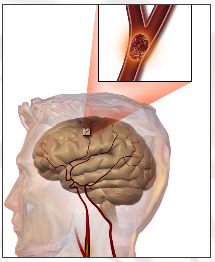
Compare and contrast ischemic and hemorrhagic strokes.
Both involve oxygen deprivation in an area of the brain
Blood clots cause ischemic strokes (pictured)
Leaky or ruptured blood vessels cause hemorrhagic strokes