Chapter 13: Vesicular Transport Part 1
 Call Kai
 Learn
 Practice Test
 Spaced Repetition
 Match
 Flashcards
 Knowt Play
1/33

There's no tags or description
Looks like no tags are added yet.
34 Terms
Transport vesicle
Contains membrane components and soluble lumenal molecules (called cargo)
Transport vesicles bud from one compartment and fuse to another; selective process
3 pathways of vescular transport
secretory pathway
endocytic pathway
retrieval pathway

Secretory Pathway
(red arrows)
leads outward from the ER to the Golgi apparatus and cell surface, with a side route leading to lysosomes

Endocytic Pathway
(green arrows)
leads inward from plasma membrane

Retrieval Pathways
blue arrows
balance flow of membrane between compartments (opposite direction)

Golgi Apparatus
processing center of the cell:
responsible for Transporting, modifying, and packaging proteins and lipids into vesicles for delivery to targeted destinations
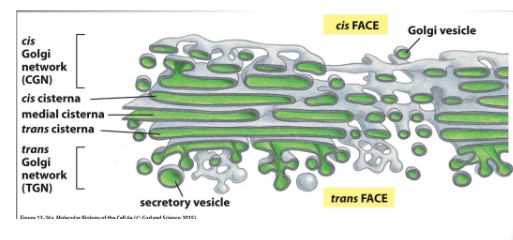
Structure of Golgi apparatus
Consists of a collection of flattened, membrane-enclosed compartments called cisternae (stack of pancakes), each golgi stack typically consists of 4-6 cisternae
tubular connections between corresponding cisternae link stacks. This forms a single complex (near cell nucleus)
Cargo enters through the cis face and leaves through the trans face in secretory vesicles
Two layers of a vesicle coat
Inner coat layer concentrates specific membrane proteins in patch, selects membrane molecules for transport
What plays a role in packaging content
Outer coat resembles a basket-like lattice, deforms the membrane patch and shapes the vesicle
What would happen if vesicles had no outer clathrin coat
Vesicles cannot form properly without a clathrin cage
endocytosis will be inhibited
Clathrin coated (endocytic) vesicles
from PM and between endosomal and Golgi compartments
Clathrin triskelions assemble into basketlike framework (ie hexagons) to form coated pits (buds) on cytosolic surface of membranes
Plasma membrane → endosomes and trans-Golgi network → endosomes

Adaptor proteins
form a discrete inner layer of the coat (bridge between clathrin cage and membrane)
bind outer coat to membrane ans trap cargo receptors (select for specific set of proteins) and package the4m into vesicles

Dynamin
soluble cytoplasmic protein that assemble at the neck of each bud, as a clathrin coated bud grows
Non-clathrin coat
observed on isolated Golgi membranes and vesicles in transport assays
COPI coated (Coat proteins)-from Golgi to ER (or backwards)
Bring back ER resident proteins that have escaped to the golgi
coat is recruited by ARF1
COPII coated (Coat proteins)- bud from ER (secretory) ; er to golgi
Mediate transport ro the ER to the cis golgi network
Proteins leave the ER in COP II vesicles
SAR1 recruits coat
How dos vesicle budding work
1.Recruitment -A small GTPase is activated and recruits coat components to the membrane. Examples: Sar1 for COPII and ARF1 for COPI.
2. Cargo selection - Cargo proteins or cargo receptors are recognized by adaptor or coat proteins.
3 Membrane bending - Coat proteins assemble into a curved structure, concentrating cargo and shaping the membrane into a bud.
4. Scission and uncoating - The bud separates from the membrane. Dynamin drives scission at many plasma-membrane clathrin buds; other vesicles use different mechanisms. The coat is subsequently removed so the vesicle can interact with its target.

Exit signals
Molecular features that allow proteins to be selected for transport out of the ER; help the cell recognize proteins that are ready to move to the cis-golgi
Do resident ER proteins have exit signals
No? Generally no
Instead they can ente the normal export pathway and tnen be retrieved back to the ER
Two mechanisms:
Retrieval - some er resident proteins accidentally leave the ERRetention - other proteins have features that keep them in the er, like membrane anchors or retention signals
Rab
involved in direction
SNARE Proteins
mediate membrane fusion
Rab
GTPases
Associated with one or more membrane-enclosed organelles
Selective distribution across t membranes (ideal marker)
GDP- Rab
(inactive and bound to another protein: Rab-GDP dissociatio inhibitor, GDI, GDI), protein soluble
GTP-Rab
(active and associated with membrane of organelle or transport vesicle)
Snares
Mediate membrane fusion
V and T snares interact to form
Trans SNARE complex
Helices overcome hydration shell
NFS protein (ATPase) separates snares
after fusion
Membrane fusion
For vesicle transport to operate normally, vesicles must incorporate appropriate SNARE and Rab proteins
Ruptture of the new bilayer completes fusion
SNARE must be pried apart before it can function again -> done by NSF: N-ethylmaleimide-sensitive fusion protein (ATPase).
ER to Golgi Transport

Homotypic fusion
When two membranes from the same type of organelle fuse together, combining contents and membrane

Retrieval pathways
As soon as vesicular tubular clusters form, they bud off transport vesicles of their own, which are COPI coated vesicles
They function as a retrieval pathway (bring back resident proteins, SNAREs, cargo receptors)
KDEL
cycles between golgi and er
Affinity for KDEL sequence must differ in each compartment
Where should KDEL e high v low
High affinity in the Golgi: The KDEL receptor binds tightly to ER-resident proteins carrying the KDEL retrieval signal, allowing them to be captured for return to the ER.
Low affinity in the ER: The receptor releases the KDEL-containing protein once it returns to the ER.
Why? The difference in conditions between the Golgi and ER—especially pH—helps the receptor bind cargo in the Golgi and release it in the ER.
Memory trick: Golgi = grab KDEL proteins; ER = eject them.
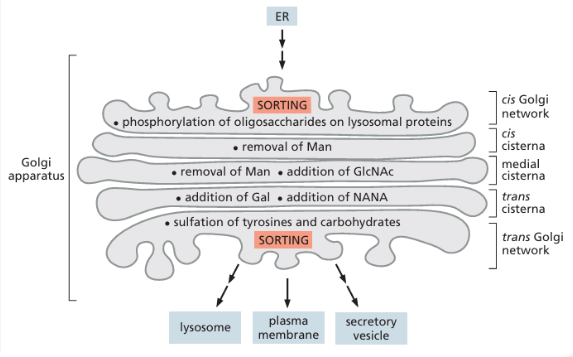
Oligosaccharide Processing in Golgi
Proteins entering from the ER undergo ordered oligosaccharide modification as they pass through the cis, medial, and trans Golgi cisternae. Each cisterna contains characteristic membrane-bound processing enzymes.
Why are proteins glycosylated?
1. To promote protein folding
More resistance to digestion by proteases
Cell adhesion (selectins) in leukocyte rolling
Immune function: presence of sugar can modify antigenic properties
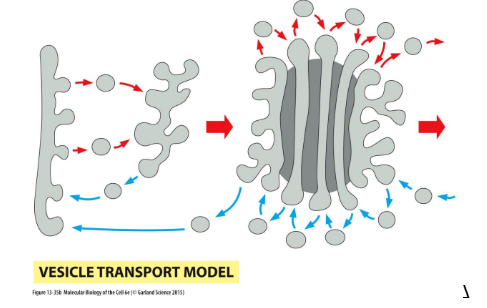
Cisternal Maturation Model of Transport in the Golgi Apparatus
each cisterna matures over time, acquiring new components (as well as red fluorescence) as it matures, and recycling old components (green fluorescence) to the less mature cisternae by retrograde vesicle transpo

Vesicle transport Model
predicts that each cisterna remains stationary and fluoresces either red (or yellow) or green during the entire period