Anat & Phys 2 chptr 17 Blood SG
 Call Kai
 Learn
Learn Practice Test
 Spaced Repetition
 Match
Match Flashcards
 Knowt Play
1/40

There's no tags or description
Looks like no tags are added yet.
Name | Mastery | Learn | Test | Matching | Spaced | Call with Kai | Chat |
|---|
No analytics yet
Send a link to your students to track their progress
41 Terms
Describe the three major functions of blood and provide specific examples of what is transported, regulated, or protected against.
Transport: deliver O2 and Gi nutrients to all body cells, transport hormones from endocrine to target cells, and transport metabolic waste to lungs ( Co2 ) and kidneys for elimination.
Regulatory: maintain body temperature, normal Ph, and fluid volume in circulatory system.
Protective: prevent blood loss and infection by transporting antibodies proteins and white blood cells.
Compare and contrast the components of whole blood.
There are two components: Cellular components ( living blood cells ) like erythrocytes, leukocytes, and thrombocytes.
And liquid component is plasma ( fluid matrix )
If you were to centrifuge blood, identify the components of each layer.
3 layers.
Plasma: least dense
Buffy coat: thin middle layer ( WBCs and Platelets )
Red blood cells ( most dense ) called hematocrit

Identify the physical characteristics of whole blood.
Viscous, opaque fluid, metallic taste, Color varies with O2 ( bright red Oxygen rich, dark red oxide poor ) , ph is 7.35-7.45, and the average volume depends ( male 5-6 L female 4-5 L )
Describe the composition of blood plasma. What is the primary solvent?
Bruh idk
What are the three main types of plasma proteins, where are they produced, and what are their specific functions?
3 proteins:
Albumin 60% plasma protein: produced in liver to regulate plasma osmotic pressure, blood PH and transport molecules into blood.
Globulin 36% PP: Alpha and beta ( produced by liver, transport substances. ) Gamma ( produced by plasma cells, antibodies for immune response )
Fibrinogen 4% PP: produced by liver to regulate blood clotting and form fibrin threads
Describe the structural characteristics of erythrocytes ( RBCs ) and explain how their specific shape (biconcave disc) and lack of organelles (anucleate) directly support their function.
Characteristics: Bioconcave disk, Anucleate, Lack most organelles, Flexible, Packed with hemoglobin ( HB )
Function: transport respritory gasses O2 and CO2

Describe the structure and function of Hemoglobin (Hb).
Structure: consists of Globin protien ( 4 polipeptide chains 2 A and 2 B ) and a Red heme group in the center of each polypeptide.
Function: O2 unloading in lungs ( oxyhemoglobin bright red ), O2 unloading in tissues ( deoxyhemoglobin dark red ), Co2 loading in tissues ( carbaminohemoglobin )
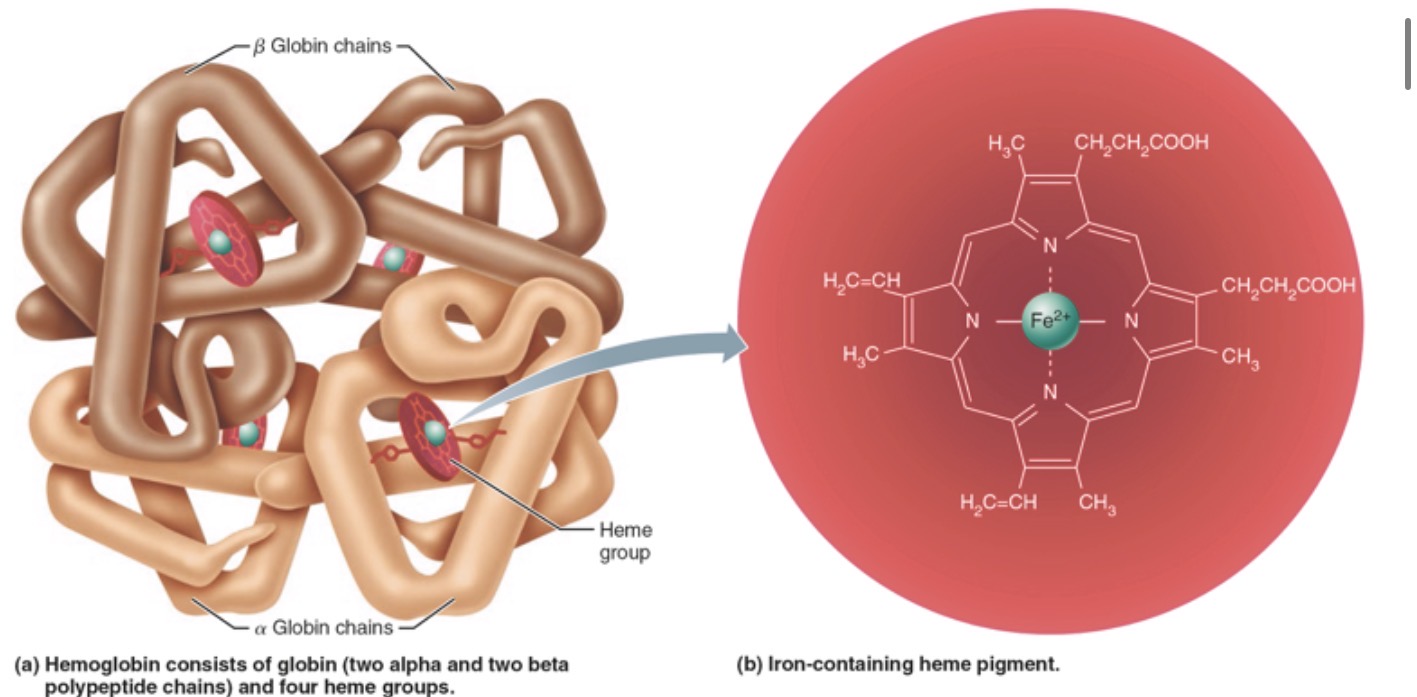
How many oxygen molecules can one hemoglobin molecule carry?
4
Trace the process of Erythropoiesis. Start with the hematopoietic stem cell and end with the mature erythrocyte. Which hormone stimulates this process, and which organ releases it?
Idk

Explain the negative feedback mechanism of Erythropoietin (EPO). What specific stimulus triggers its release? How does the body return to homeostasis?
Idk

Describe the fate and destruction of erythrocytes. Break down the specific recycling pathway for the iron, heme, and globin portions of hemoglobin. What pigments are produced during this process and what ultimately happens to those pigments?
RBCs life span 100-120 days, lose flexibility get fragile, HB deteriorates, and RBCs become trapped.
The Iron is stored for reuse, the Globin is broken down to amino acids, and Heme is degraded to yellow pigment ( bilirubin ) that is released into blood stream.

Compare and contrast Anemia and Polycythemia.
Anemia: not enough RBCs.
Cause- Blood loss, not enough RBCs, or too many RBCs being destroyed. Effects- Blood oxygen carrying s too low, fatigue, pale, shortness of breath, dizziness, chilled.
Polycythemia: too many RBCs
Cause- bone marrow cancer, EPO production. Effects- sluggish blood flow insufficient oxygen delivery, itching, headache, lots more.
Distinguish between Granulocytes and Agranulocytes.
Granulocytes: include Neutrophils, eosinophils, and basophils. Longer and shorter lived.
Agranulocytes: Include Lymphocytes and monocytes. Live for days, months or seven years.

List the leukocytes in order of abundance.
( Never let monkeys eat bananas )
Neutrophils, lymphocytes, monocytes, eosinophils, basophils )
Describe the specific structure and function of: NEUTROPHILS 50- 70% WBCs
Structure: nucleus with 3 to 6 lobes.
Function: Eat bacteria

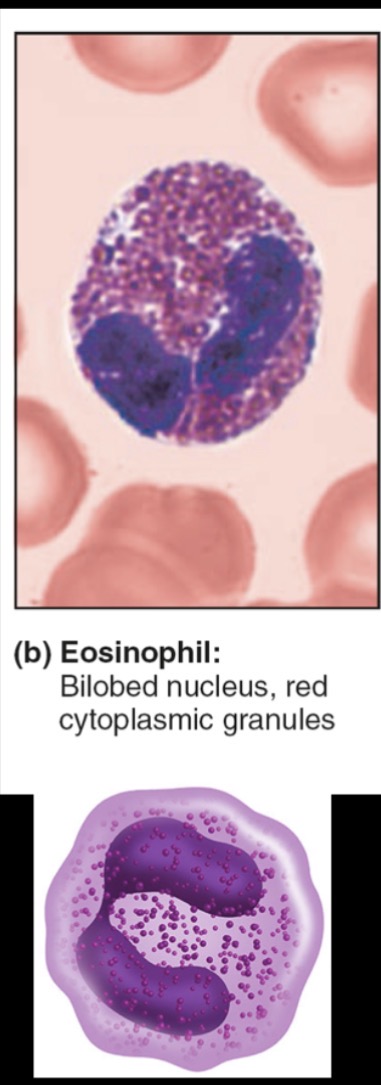
Describe the specific structure and function of: EOSINOPHILS 2-4% WBCs
Structure: nucleus with 2 lobes
Function: destroy parasitic worms
Describe the specific structure and function of: BASOPHILS 0.5-1% WBCs
Structure: nucleus is U or S shaped, large dark granules
Function: attract WBCs to inflamed cites

Describe the specific structure and function of: MONOCYTES 3-8% of all WBCs
Structure: largest, nucleus is U or kidney shaped.
Function: turn into macrophages ( gobble invaders ) or dygrinic cells that warn other cells.

Describe the specific structure and function of: LYMPHOCYTES 25% WBCs
Structure: large dark purple nucleus
Function: circulate blood, found in lymph nodes and turn into B Cells ( antibodies made ) a or T cells ( fighters that attack )

Trace the process of leukopoiesis regarding granulocyte production.
Idk
Contrast the processes of leukopoiesis for agranulocyte production.
Idk
What hormones regulate leukopoiesis?
Idk
Describe the structural characteristics of thrombocytes ( platelets ) and explain how their structure supports their function.
Structure: fragments of megakaryocytes, granules contain chemicals involved in clotting process.
Function: Essential for blood clotting. Circulate freely in blood stream.
What prevents platelets from sticking to uninjured blood vessels?
The intact cells release nitric oxide and prostacyclin which. Prevent sticking.
Trace the process of thrombopoiesis. What is the precursor cell, and how does it release platelets into circulation?
Idk

What hormone controls thrombopoiesis?
Idk
List and describe the three steps of hemostasis.
Vesicular spasm: vessels respond to injury.
Platelet Plug Formation: Platelets stick to exposed fibers in areas of damage.
Coagulation ( blood clotting ): reinforces platelet plug with fibrin.
What triggers the vascular spasm? What role does von Willebrand factor play in the platelet plug formation?
Vascular spasm is triggered by direct injury to vascular smooth muscle, chemicals released by endothelial cells and activated platelets, and pain reflexes.
Willebrand factor plays a big role by stabilizing platelet collagen bridge.
What chemical messengers are released by activated platelets and what are their functions?
ADP is released which causes platelet aggregation to the injured site. ( also causing a positive feedback loop )
Serotonin and thomboxane A2 premote vascular spasm and platelet aggregation.
Compare and contrast the intrinsic and extrinsic pathways of coagulation, Phase. Which pathway is faster? What triggers each pathway? Coagulation (intrinsic or extrinsic) ends with what event?
Idk
Describe what occurs in coagulation, Phase 2.
Prothrombin activator catalyzes transform of prothrombin to active enzyme thrombin.
Describe what occurs in coagulation, Phase 3. What is the final product of this phase?
Idk
Explain clot retraction and fibrinolysis. During this time, what process is the enzyme PDCF stimulating? What enzyme is responsible for digesting the fibrin mesh to remove the clot?
Explain the basis of ABO blood grouping. What specific antigens are present in Type A, Type B, Type AB, and Type O blood?
Type A ————- A antigen
Type B ————- B antigen
Type AB ——— both A and B antigens
Type O ———- Neither A or B antigens
What specific antibodies are present in Type A, Type B, Type AB, and Type O blood?
Type A ———- B antibodies
Type B ———- A antibodies
Type AB —— Neither
Type O ——— both A and B antibodies.
Define the Rh Factor. What determines if a person is Rh positive or Rh negative? Under what specific circumstances do anti-Rh antibodies form?
Describe a transfusion reaction. Physiologically, what happens when mismatched blood is infused (agglutination)? What are the potential consequences for the patient?
Explain the concept of the "universal donor" and "universal recipient." Which blood types fit these roles and why?
Identify which blood types are suitable donors for a particular ABO and D (Rh) type.
Identify the components of a complete blood count.