Routine Venipuncture (MediaLab)
 Call Kai
 Learn
 Practice Test
 Spaced Repetition
 Match
 Flashcards
 Knowt Play
1/91

There's no tags or description
Looks like no tags are added yet.
92 Terms
What is venipuncture?
collection of blood from a vein
Who performs venipuncture?
phlebotomist part of lab staff or any other health care professional trained to preform it
needle gauge
____________: is the size of the needle opening or the inner measurement of the needle
what are the 3 needle lengths typically used for venipuncture?
3/4 inch, 1 inch, 1.5 inch
the larger the diameter of the needle, the _________ the gauge number
smaller
why can you not remove a needle from a pt's vein and reinsert into another vein?
it puts the pt at risk for infection
what is the primary choice blood collection system for routine venipuncture?
evacuated tube system
name 3 blood collection systems
-evacuated tube system
-winged blood collection device
-syringe
what blood collection system is used on small veins (pediatric, geriatric pt, or hands)?
winged blood collection device
what can a winged blood collection device be used with (2)?
-needle holder and evacuated tube system
-syringe
what is the last choice for a blood collection system? why?
syringe & needle
-last option bec requires more manipulation
The diameter of a needle that has a gauge of 23 is __________ the diameter of a needle that has a gauge of 18.
smaller than
what is one reason that tubes should be filled at the correct volume?
could establish the wrong blood to anticoagulant ratio leading to inaccurate test results
what may happen if you use an expired blood tube?
vacuum may not draw the amount of blood needed to fill the tube completely (need correct volume)
why is it important to know the lot number of a tube?
if there is a problem with several collection tubes of the same lot number, manufacturer must be notified
what does a clot activator do? what will the result be?
-accelerates clotting of the blood
-produces serum sample after centrifuged
what does a anticoagulant do? what will the result be?
-prevents the blood from clotting
-produces plasma sample after centrifuged
what is the additive in the light blue tube? what is the additives function? what is the common lab test it is associated with?
-3.2% sodium citrate
-prevents blood from clotting by binding calcium
-coagulation
what is the additive in the red/gold/tiger tube? what is the additives function? what is the common lab test it is associated with?
-serum tube with or without clot activator or gel
-clot activator promotes blood clotting with glass or silica particles, gel separates serum from cells
-chemistry, serology, immunology
what is the additive in the green tube? what is the additives function? what is the common lab test it is associated with?
-sodium or lithium heparin with or without gel
-prevents clotting by inhibiting thrombin and thromboplastin
-stat and routine chemistry
what is the additive in the lavender/pink tube? what is the additives function? what is the common lab test it is associated with?
-potassium EDTA
-prevents clotting by binding calcium
-hematology and blood bank
what is the additive in the gray tube? what is the additives function? what is the common lab test it is associated with?
-sodium fluoride, and sodium or potassium oxalate
-Fluoride inhibits glycolysis, and oxalate prevents clotting by precipitating calcium.
-Glucose (especially when testing will be delayed), blood alcohol, lactic acid
A blood collection tube that has a light-blue top contains which of these anticoagulants?
sodium citrate
what is the function of a tourniquet?
to assess and determine the location of a suitable vein for venipuncture
how many times can you use a tourniquet?
single use, reusable is not acceptable
how does a proper application of a tourniquet help in venipuncture?
tourniquet will partially impede venous blood flow back toward the heart and cause the blood to temporarily pool in the vein so the vein is more prominent and the blood is more easily obtained
where should a tourniquet be placed? how long can it stay there?
-tourniquet is applied three to four inches above the needle insertion point -should remain in place no longer than one minute to prevent hemoconcentration
what product is most often used to cleanse and disinfect the venipuncture site?
70% alcohol in towelette form
what are 2 alternative cleansing agents for venipuncture apposed to the alcohol?
chlorhexadine gluconate (chloraprep) and povidone-iodine
since 2017, what motion does CLSI recommend to clean a venipuncture site?
back and forth
after cleaning venipuncture site, alcohol must air dry for one minute to prevent what 2 things?
-prevent hemolysis of specimen
-avoid discomfort for pt
what should be used when applying pressure after needle is withdrawn?
gauze
adequate pressure after removing the needle prevents formation of what?
hematoma or bruise
why can a cotton ball not be used to apply pressure after venipuncture?
clot may be dislodged by residual cotton fibers as the cotton ball is pulled away from the site
what area should be considered first for vein selection?
antecubital
where is the location (placement/direction) of the median cubital vein? why would you choose this vein?
-mid antecubital fossa
-vertical to diagonal
-musculature assists in stabilizing vein; very often largest; ease of access
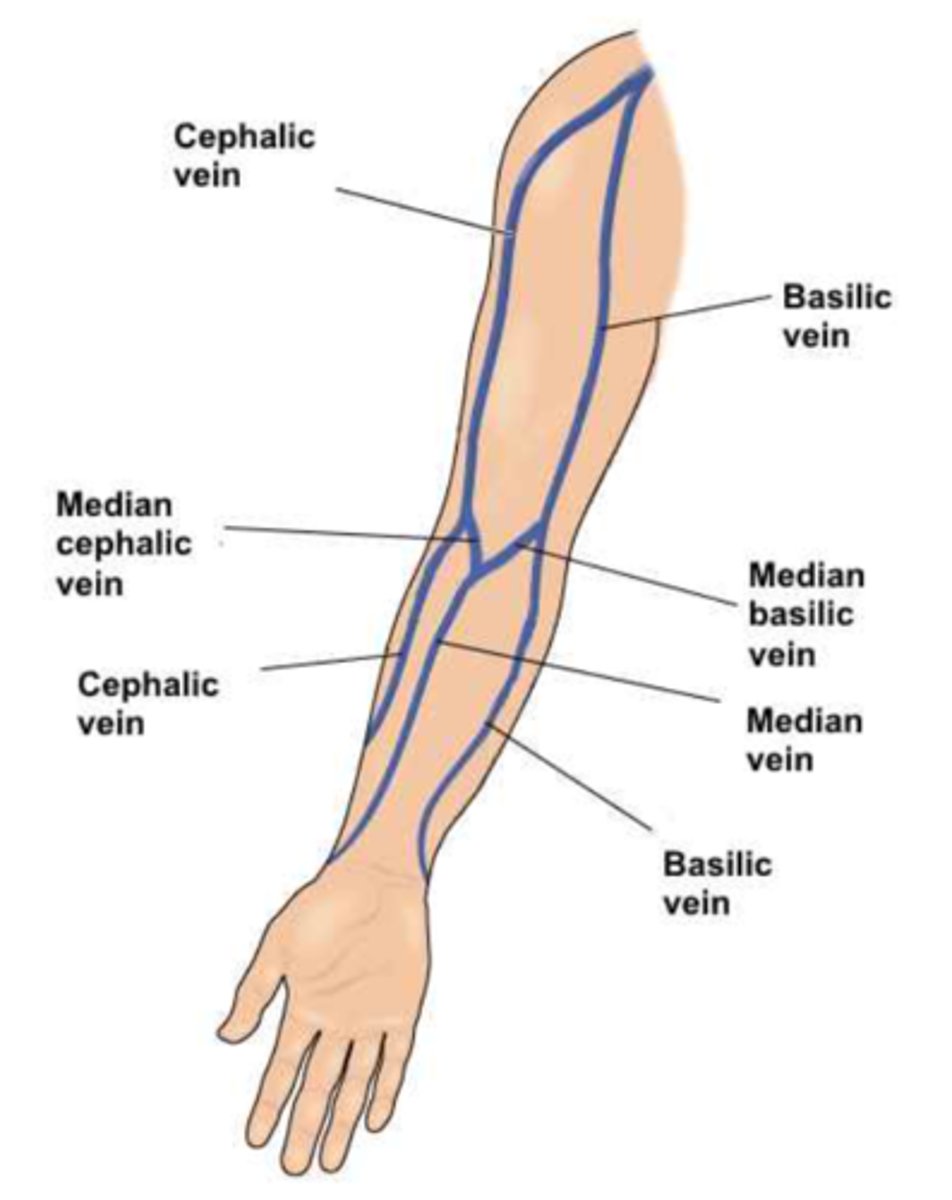
where is the location (placement/direction) of the cephalic vein? why would you choose this vein?
-thumb side of antecubital fossa
-vertical
-ease of access; few nerves and tendons in area
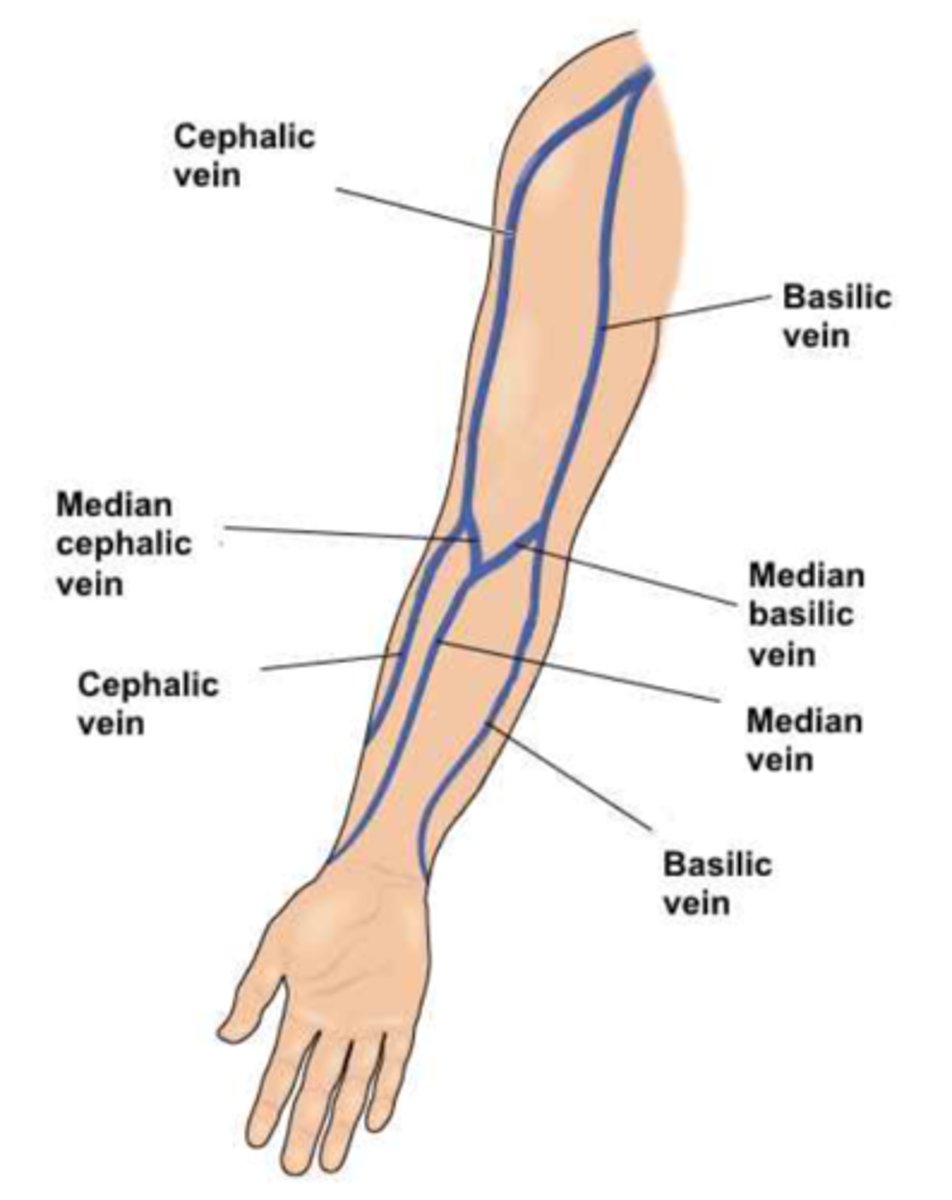
where is the location (placement/direction) of the basilic vein? why would you choose this vein?
-body side of antecubital fossa
-vertical to diagonal
-more difficult to access; proximity of artery, nerves and tendons. Use this vein only as the final alternative.
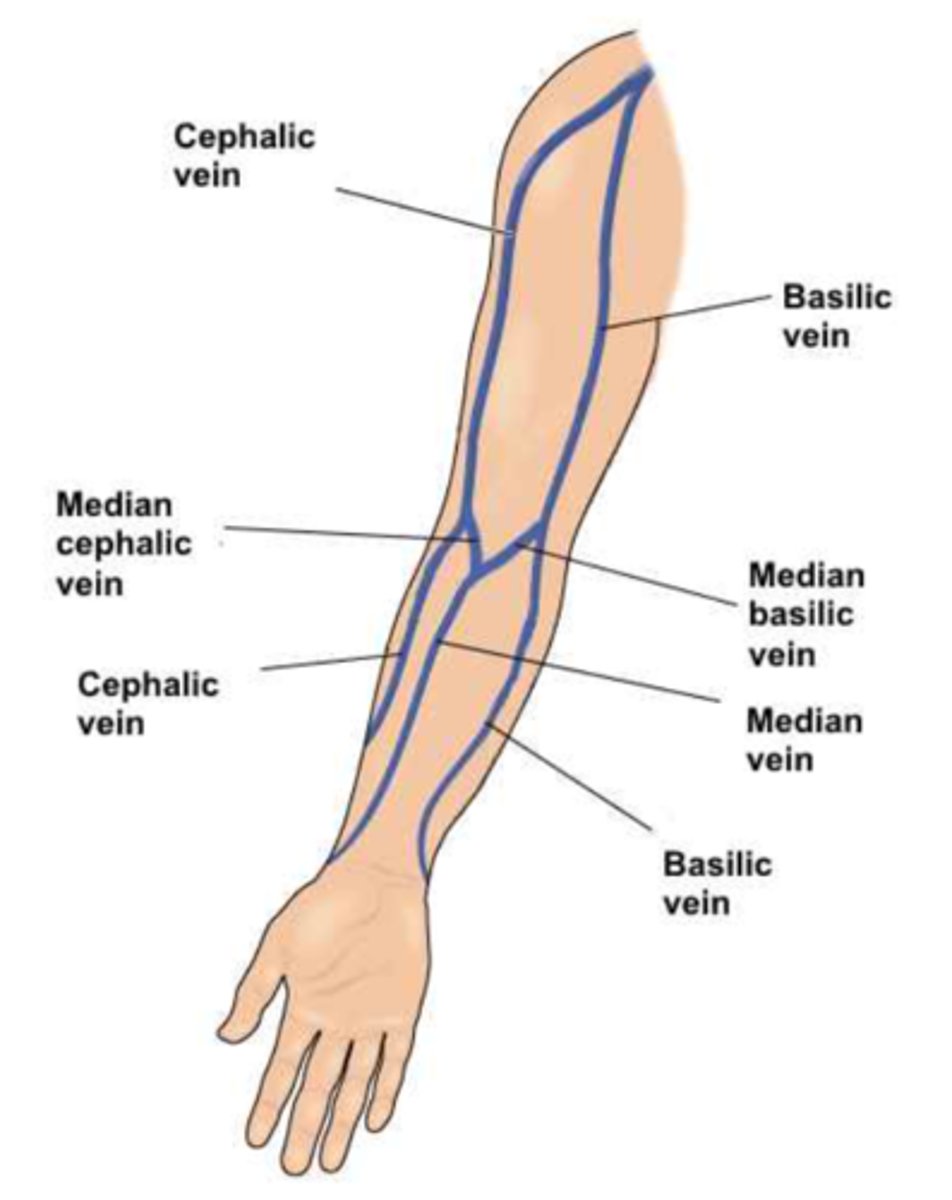
Which of the veins in the antecubital area should be considered only as a final alternative due to its proximity to an artery, nerves, and tendons?
basilic
list 4 reasons that a phlebotomist may decide not to draw in the antecubital area
-Extensive bruising (hematomas) in the antecubital area
-Inability to "feel" a vein suitable for puncture
-Presence of an intravascular line (IV) or vascular access device
-Physical condition of the patient
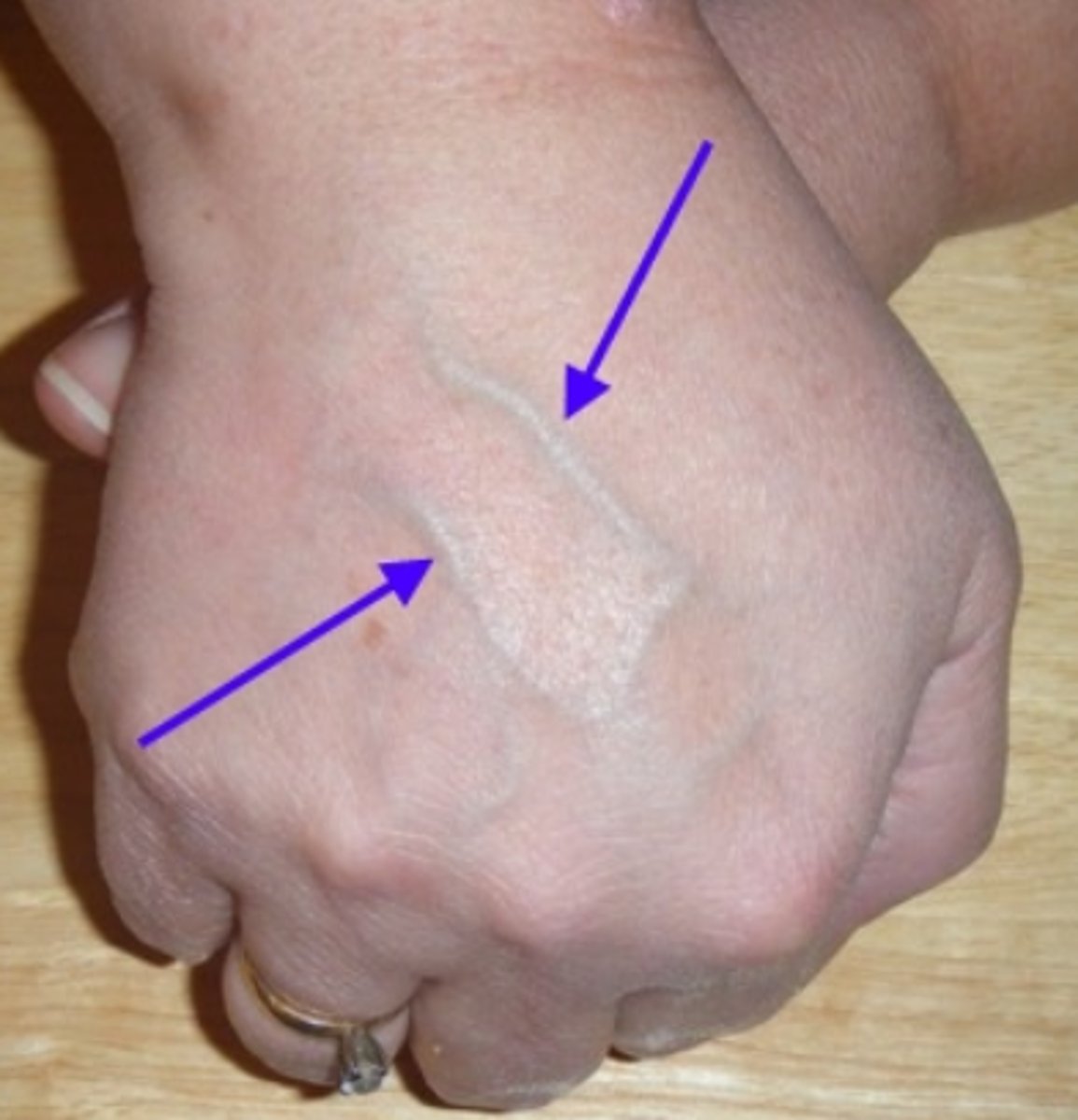
what is the most used device to obtain blood from a hand?
winged device with a small gauged needle of 3/4 inch length, syringe usually attached
why can you not always use a evacuated tube when drawing from a hand?
may collapse a vein by exerting too much pressure on the delicate vein
angle at which the needle is inserted into a hand vein is ________________ compared to the angle of needle insertion into veins of the antecubital area
smaller
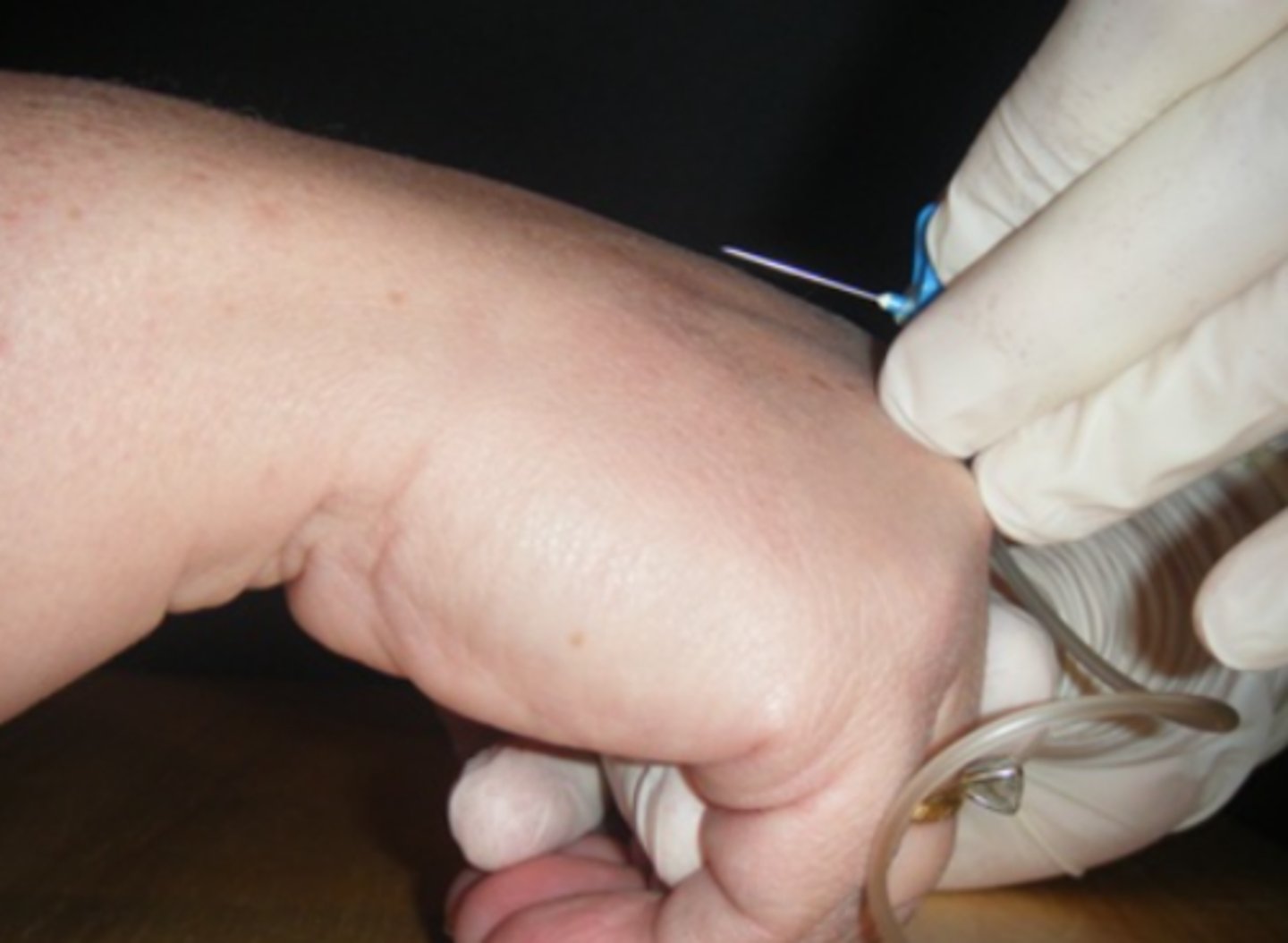
what angle should a needle be inserted when drawing in a hand?
10 to 15 degrees
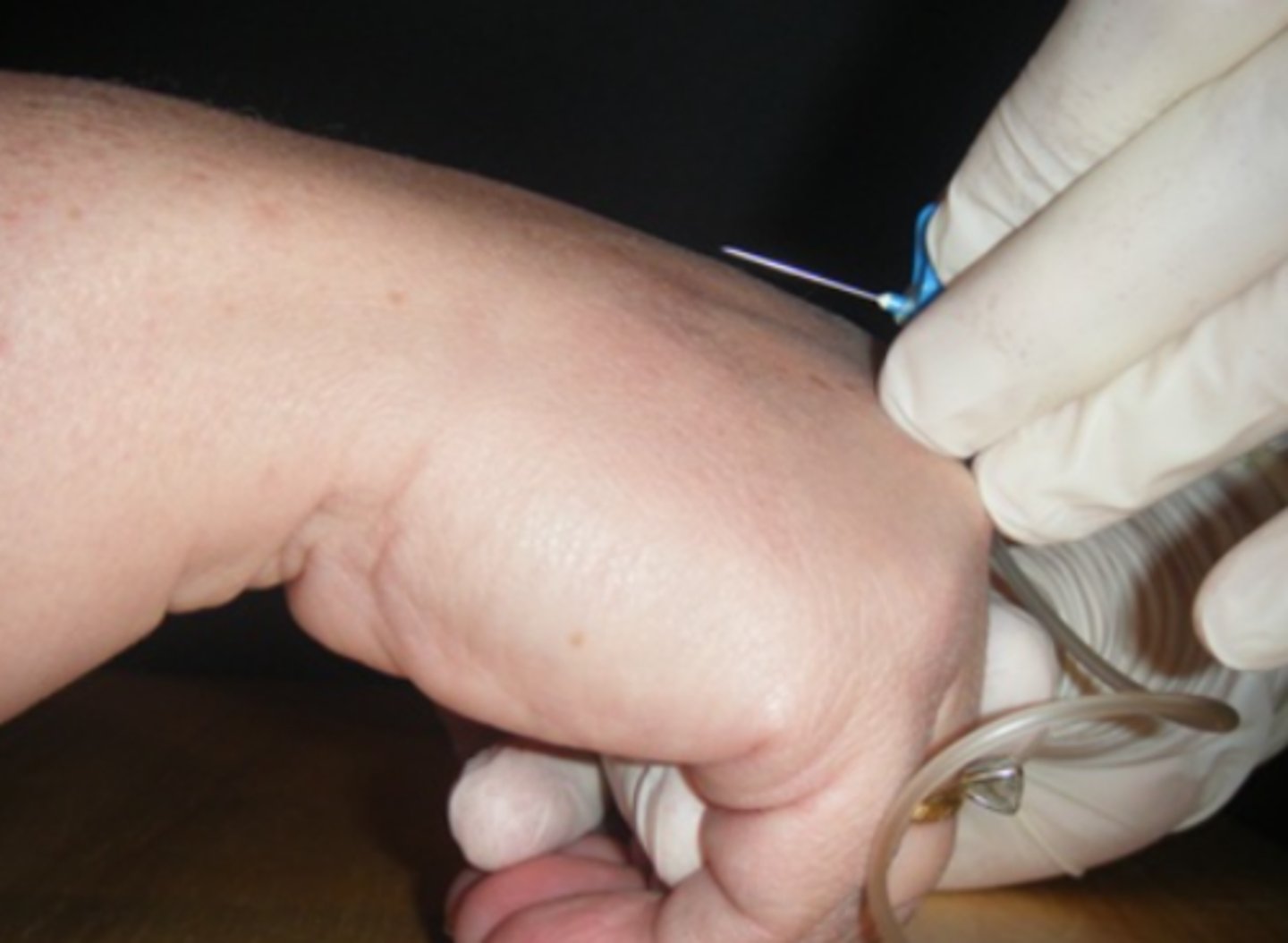
when collecting blood from a hand vein, what position should the patients hand be in?
position the patient's hand slightly downward with the top of the hand facing you, patients fingers should be rolled underneath, forming a loose fist. hand veins will be more prominent if the patient grips a pillow or a rolled up washcloth
Where should the tourniquet be placed when assessing a vein in the hand as a venipuncture site?
1 - 2 inches above the wrist
what areas should you avoid when drawing blood from a hand vein?
avoid the "intersection" or "V" where a vein branches into another vein, this juncture may contain a valve and could be damaged if punctured
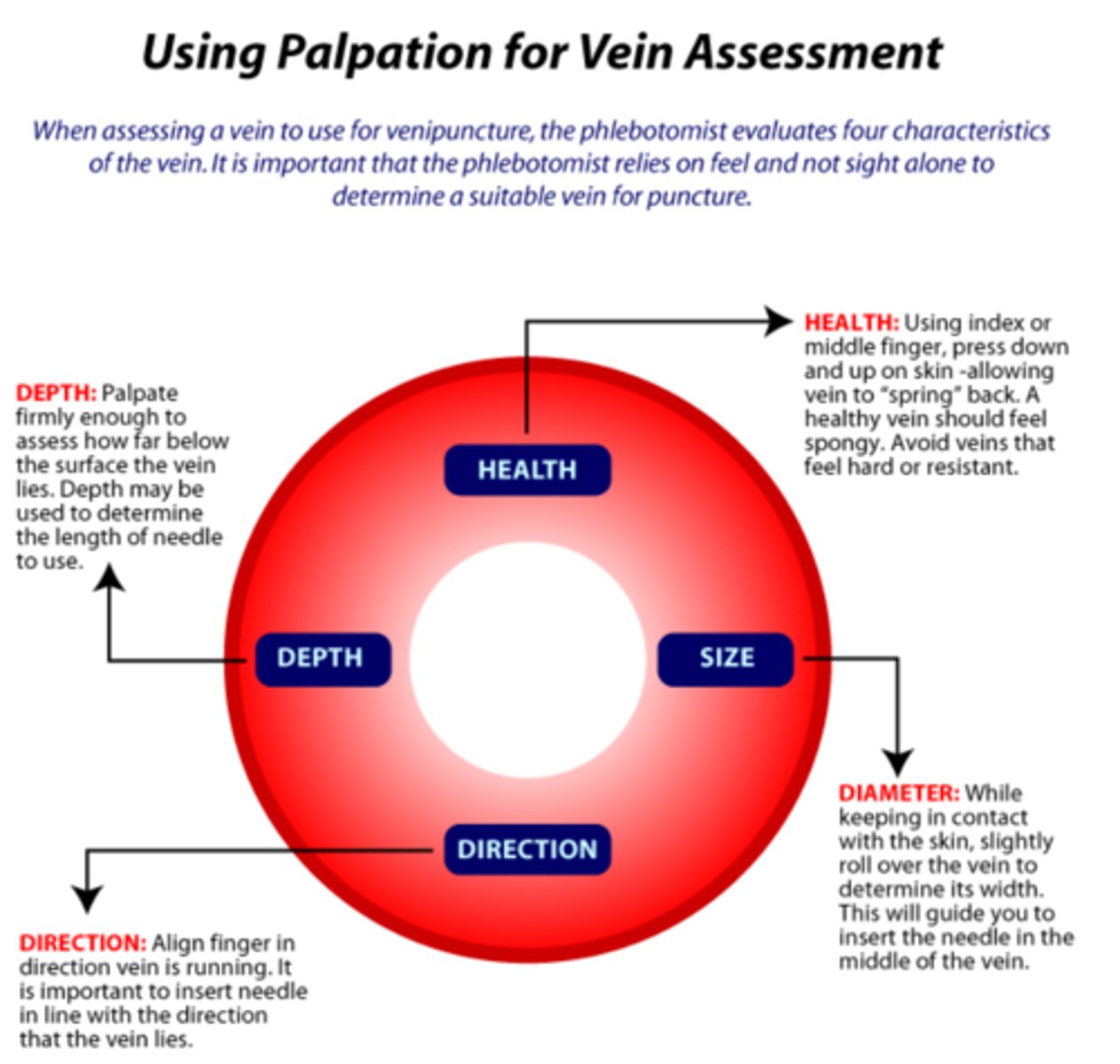
what are the 3 basic steps when palpating a vein using your index or middle finger?
1. Align your finger in the direction of the vein
2. Press on top of the vein with enough pressure to depress the skin
3. Keep your finger in contact with the skin so that you may feel the "bounce back" of a resilient, healthy vein.
what sites should you avoid when selecting a site for venipuncture?
-feet or ankles
-IV transfusion line
-mastectomy
-hematomas or edematous sites or tattoo
-wrist adjacent to hand
-artery
-fistula or shunt
why should you avoid the feet or ankles when selecting a site for venipuncture?
risk of clot forming especially in bedridden patients
why should you avoid the IV transfusion line when selecting a site for venipuncture?
risk of diluting specimen with IV solution which may cause inaccurate results
why should you avoid the area of mastectomy when selecting a site for venipuncture?
risk of infection and lymphedema if arm on side of mastectomy is used
why should you avoid the area of hematomas or edematous sites or tattoos when selecting a site for venipuncture?
risk of contaminating specimen with tissue fluid, lead from tattoo ink
why should you avoid the wrist adjacent to hand when selecting a site for venipuncture?
risk of puncturing nerves, tendons, or arteries
why should you avoid the artery when selecting a site for venipuncture?
risk of prolonged bleeding; venous blood is the preferred specimen for most testing
why should you avoid a fistula or shunt when selecting a site for venipuncture?
risk of damage and infection in the surgically prepared access point for dialysis
what steps should be followed if the only vein is proximal (above/near) the IV?
-Ask the patient's caregiver if the IV can be turned off for a short period of time. The IV should be discontinued for at least two minutes before the venipuncture.
-Apply the tourniquet between the IV site and the area of the venipuncture.
-Perform the venipuncture.
-Document that the venipuncture was performed proximal to an IV site and that the IV was discontinued for two minutes prior to specimen collection.
-Notify the patient's caregiver when the procedure is completed and be certain that she/he restarts the IV.
T/F: If a vein cannot be located in the antecubital area of the arm, the next best alternative for venipuncture is a vein in the ankle.
F
what are the 9 basic steps for a successful venipuncture?
1. sanitize hands
2. positively identify patient using 2 unique identifiers
3. special test requirements
4. prepare patient
5. site determination
6. aseptic technique
7. specimen collection
8. patient care
9. specimen labeling
what are 5 steps in the specimen collection procedure?
-Following the approved order of draw, connect the first blood collection tube onto the needle by pushing the tube into the holder so that the tube stopper is pierced by the exposed end of the needle. Use the flanges of the holder to stabilize the needle while connecting the tube.
-After tube is filled completely, remove the tube, again using the flanges of the holder to stabilize the needle.
-Replace with the next tube and mix the removed tube immediately if it contains an additive.
-Release the tourniquet when blood enters the final tube.
-When the last tube is filled, pull it back off the needle before removing the needle from the vein.
what are preanalytic errors?
errors that occur prior to the testing process
what are examples of preanaytic errors?
Hemolyzed specimens, clotted specimens, incorrect tube type, and inadequate tube fill
what is hemolysis?
Red blood cells (RBCs) break and release contents of cell into plasma.
how does hemolysis happen?
-Needle incorrectly positioned in vein; cells forced to squeeze through opening.
-Needle gauge too small; slow blood return into tube.
-Vigorous mixing or shaking of tube.
-Alcohol on skin that has not had sufficient time to dry.
what is the result of hemolysis?
-Some test results may be falsely elevated. (Potassium is especially affected by hemolysis.)
-Patient may have to be re-drawn.
what is a clotted specimen?
Clumped or clotted cells in specimen that requires anticoagulated or whole blood
how does a clotted specimen happen?
-Insufficient mixing of blood with anticoagulant in tube.
-Delay in mixing tube.
-Slow filling tube.
what is the result of a clotted specimen?
-Inaccurate test results for cell counts and clotting studies.
-Patient may have to be re-drawn.
how does the tube get filled to the incorrect volume?
-Tube removed from needle too quickly.
-Vacuum in tube has been compromised due to use of tube past the expiration date (Results in a short fill).
-Manual fill of tube may lead to over-fill.
what is the result of a tube getting filled to the incorrect volume?
-Test results may be unreliable due to dilution errors.
-Patient may have to be re-drawn.
what are hidden errors?
errors are those that cannot be detected or corrected by the laboratory analyst prior to testing. Most often these errors can be prevented by the phlebotomist following correct venipuncture procedure for every procedure, every time.
what are 3 types of hidden errors?
hemoconcentration, incorrect order of draw, and misidentification of patient or specimens
what is hemoconcentration?
blood pools at site of venipuncture
how does hemoconcentration happen?
Tourniquet is applied for a prolonged period of time
what is the result of hemoconcentration?
Test results may be inaccurate because blood components move between blood and tissues
what is the correct order of draw?
1. Tubes or bottles for blood cultures
2. Light-blue top tubes (sodium citrate)
3. Serum tubes (with or without clot activator)
4. Green top tubes (sodium or lithium heparin)
5. Lavender or pink top tubes (Potassium EDTA)
6. Gray (Sodium fluoride and sodium or potassium oxalate)
what must be labeled on a specimen going to be sent to the lab?
-Patient's first name and last name
-Hospital medical record number, date of birth or alternate unique patient number
-Collector's ID
-Time the specimen was collected
-Date the specimen was collected
Ideally, a tourniquet should remain tightened for no longer than what amount of time before releasing it?
one minute
Julie Smith is a recently certified phlebotomist who has been working at Northwood Hospital for several months. As she approaches room 825, she looks at her collection list to verify this is the correct room for her first collection. Julie enters the room to find a middle-aged man who appears to be sleeping. Julie approaches the patient and says, "Good day Mr. Ready. My name is Julie and I am from the lab. I need to draw blood for some tests ordered by your doctor." The man awakens and Julie again states that she is from the lab and needs to draw blood for some tests ordered by the doctor. The patient tells Julie to go ahead and get it done so he can go back to sleep. Julie then proceeds with the venipuncture.
What procedure did Julie not follow prior to performing the venipuncture?
Properly identify the patient.
Bobby Jones, a phlebotomist at Community Hospital, enters the room of Mrs. Mary Grayson with a physician's order for blood tests. After greeting Mrs. Grayson, identifying himself, and properly identifying the patient, using two methods of identification, Bobby prepares for the venipuncture.
As he approaches the patient's bed, he notices a sign posted above the bed that reads: "Restricted left arm use. Do not use left arm for venipuncture." Bobby prepares to use the patient's right arm and notices an intravenous (IV) line in Mrs. Grayson's right arm positioned in a vein slightly above her wrist on the dorsum (top) of her forearm.
Which site should Bobby choose for the venipuncture?
A vein on the dorsal side of her right hand, below the IV.
A phlebotomist was collecting a STAT prothrombin time (PT) and complete blood count (CBC) on a patient when blood flow unexpectedly stopped. The lavender top tube being drawn at the time was less than one-third full. The light-blue top tube had already been drawn for the prothrombin time.
Before resorting to a second venipuncture, which of the following procedures should be attempted in order to adequately fill the lavender top tube?
-Pull back a little on the needle.
-Try another lavender top tube.
Ray enters a patient room for a routine blood draw. He notices a vein that appears to be a good choice for venipuncture and inserts a needle. There is no blood return and he has to resort to a second venipuncture.
What information would Ray have obtained by palpating the vein before attempting the venipuncture?
-Size of the vein
-Resiliency (health) of the vein
-Direction and depth of the vein.
When should the phlebotomist use gloves for a venipuncture?
With every venipuncture.
T/F: Holding pressure on the puncture site after withdrawing the needle may prevent the formation of a hematoma.
T
T/F: A phlebotomist who is performing venipuncture on a small delicate hand vein should choose a needle with a gauge number of 18.
F
What are key things to remember when collecting a light-blue top tube for coagulation testing?
-The tube must be adequately filled to achieve the correct blood to anticoagulant ratio.
-If a winged device is used for collection of a light-blue top tube for coagulation testing, always draw a waste tube first.
Which of the following can cause hemolysis and perhaps result in recollection of the specimen?
-Incorrectly positioning the needle in the vein so that blood flows slowly into tube.
-Pushing the plunger of a syringe when transferring blood into vacuum tubes.
Which of the following may cause the laboratory to REJECT a blood specimen?
-The wrong color tube is collected.
-A printed label is placed on the tube.
-A hand vein is used for the venipuncture.
-A light-blue top tube is underfilled.
-The wrong color tube is collected.
-A light-blue top tube is underfilled.
Which of these procedures should be followed when collecting a blood specimen into an evacuated tube that contains an anticoagulant?
-Shake the tube vigorously after collecting the specimen.
-Do not invert the tube after collecting the specimen.
-Allow the tube to fill until the vacuum is exhausted.
-Do not fill the tube more than half way.
Allow the tube to fill until the vacuum is exhausted.
To prevent an infection at the puncture site, the skin should be cleansed at the start of a venipuncture. What answer below best describes this procedure?
Using an alcohol wipe, vigorously wipe up and down creating a friction on the puncture site. Allow the site to air dry.
A phlebotomist is collecting several different tubes for a variety of laboratory tests. One of the tubes that is needed is a gray top tube for glucose testing. At her facility, this is a tube that is rarely used, but fortunately she finds some in the back of the phlebotomy supply cabinet.
According to the order of draw, this tube is filled last. She successfully fills the light-blue, green, and lavender top tubes, but the gray top tube barely fills half-way even though the blood was flowing freely throughout the blood collection. She tries another gray top tube and it also begins to fill and then stops. The phlebotomist determines that the vacuum in these tubes is not adequate to fill the tubes.
Which of the following is the most likely explanation for the lack of vacuum in the tubes?
The tubes are past their expiration date.
The veins in the antecubital area of the arm are usually preferred for venous blood collection. Which of the following veins is NOT located in the antecubital area.
-Median cubital vein
-Femoral vein
-Basilic vein
-Cephalic vein
Femoral vein