ch.18 primary dentition
 Call Kai
 Learn
 Practice Test
 Spaced Repetition
 Match
 Flashcards
 Knowt Play
1/70

There's no tags or description
Looks like no tags are added yet.
71 Terms
what are the first set of teeth called
primary dentition
how many teeth are in primary dentition
20
how many teeth per arch
10
what is the numbering system
A-T
what type of teeth are in primary dentition
canine, molars, incisors
when does minerilization happen
13-16 weeks in utero
what neonatal tooth
when a baby is born with a tooth erupted
what year are all roots completed on primarys
3 years
what primary tooth is first to erupt
mandibular central incisor
when do the first teeth erupt
6-10 months
what is more important eruption dates or eruption sequence
the eruption sequence
T/F interproximal space is a good thing
true
T/F Primate spaces occur distal of the canines
true
T/F Molar roots flare more as they approach the apex
true
do primary teeth have a more yellow or white appearence
white
why are the primary teeth so important
esthetics, mastication, speech, and place holders for the succedaneous teeth
when should a child have their first dental exam
before or by 12 months
how many incisors are in each arch
4
each quadrant has a
central and lateral incisor
primary teeth are narrower_____ than perm teeth
MD
what letter are the max central incisors
E and F
when do the centrals erupt
8-12 months
T/F From the facial aspect, the crown appears wider MD than IC, the opposite of the permanent central
true
do the primary max centrals have mamelons
no
T/F Cingulum and marginal ridges are more prominent than on the permanent centrals
true
are the roots long on the max centrals
Roots are about twice the length of the crown
what letter are max laterals
D and G
when do max laterals erupt
9-13 months
T/F max laterals longer IC than MD
true
what letter are the man laterals
N and Q
when do the man lateral erupt
10-16 months
T/F the man lateral root may have a distal
curvature in its apical
third
true
how many canines are in primary dentition
4
what letters are the max canines
C and H
when do the max canines erupt
16-22 months
the root of the max canine is inclined
distally
what letters are the man canines
M and R
primary teeth are erupted by what age
33 months
how many molars are in the primary dentiton
8 (1st and 2nd)
primary molars are replaced by the perm
premolars
T/F none of the primary first molars resemble any
other tooth in either dentition
true
T/F The crown of each primary second molar in both arches resembles the first molars of the
permanent dentition
true
why do the roots of molars have big space between them
for the developing permanent premolar crowns
what are the letters of the max 1st molar
B and I
when do the max 1 molars erupt
13-19 months
how many cusps on max 1st molar
3-4 cusps
what cusp may be absent on max 1 molars
DL
what is the occlusal pattern of the max 1 molar
H
T/F lingual root is the longest and most divergent on max 1 molar
true
what are the letters of the max 2nd molars
A and J
when do max 2 molars erupt
about 2 years of age
is 2nd max molar larger than 1st molar
yes
how many cusps does max 2 molar have
5, possible cusp of carabelli
what letters are man 1st molars
L and S
when do man 1 molars erupt
14-18 months
what is a distinctive characteristic the man 1s molar has
prominent buccal cervical ridge, which is alsovon the mesial half of the buccal surface
how many cusps does man 1st molar have
4 cusps
what cusp on the man 1st molars is larger
mesial
what premolar is developing under right side man 1 molar
#28
what letters are the man 2nd molars
K and T
when do the man 2 molars erupt
23-31 months
T/F the primary man 2nd molar closely resembles the form of the permanent mandibular first molar
true
how many buccal cusps does the man 2nd molar have
3
what perm tooth may not be noticed by an adult when primary teeth are still in mouth
first molar, closely resembles primary 2nd molar

what age is this pt
roughly 9
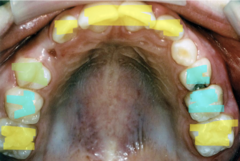
what age is this pt
roughly 10

what age is this pt
roughly 8
The actual dates of eruption are not as important as the
eruption sequence. A radiograph should be taken if teeth erupt asymmetrically
both statements are true
Which primary tooth has a crown that does not resemble any other tooth of either dentitions
mandibular 1st molar
Which one tooth is adjacent and distal to the
primary maxillary second molar in a 7-year-old child
perm max 1st molar
What would you estimate to be the dental age of a
child with the following teeth: all primary maxillary
incisors, canines, and molars; permanent mandibular incisors and permanent first molars
roughly 5-7