Bio Unit 3
 Call Kai
 Learn
 Practice Test
 Spaced Repetition
 Match
 Flashcards
 Knowt Play
1/80

There's no tags or description
Looks like no tags are added yet.
81 Terms
Base pairings
A —> T but for RNA its U (2 hydrogen bonds)
G —> C (3 hydrogen bonds)
Gene
The basic unit of heredity that determines a genetic trait; a specific sequence of DNA that codes for proteins and RNA molecules
Genome
The complete genetic makeup of an organism; an organism’s total DNA sequence
Modern DNA Model: What does it include?
Sugar-Phosphate backbone
Two strands of DNA that are antiparallel
One strand runs from 5’ to 3’ and the other 3’ to 5’
5’ end finishes with phosphate group sticking up
3’ end finishes with hydroxyl group pointing down
DNA of Prokaryotes
Double stranded circular DNA is free in the cytoplasm, packed tightly within a region called the nucleoid, for most prokaryotes
DNA is compacted roughly 1,000 times due to DNA Supercoiling
Plasmids
Not apart of nucleoid but can carry genes, regulatory elements, and other functional sequences
Can be transmitted into cells chromosomal DNA during cell division
Hereditary info is contained on plasmids that can be transferred cell to cell
DNA of Eukaryotic Cells
Genetic material is located in the nucleus
Histones:
Proteins that help compact DNA in the nucleus
Nucleosome:
The condensed structure formed when double stranded DNA wraps around 8 histone proteins
Why does Eukaryotic DNA need to be compacted
They help package up DNA during mitosis and meiosis by the process of supercoiling
They can regulate the transcription process
Chromatin:
non-condensed form of genetic material that predominates for most of the eukaryotic cell cycle; consists of a complex of DNA and proteins.
Chromosomes:
supercoiling of DNA for replication
What is the organization of DNA?
Naked (DNA) —> Active Genes (Nucleosome —> Choanosomes) —> Less Active Genes (Solenoid —> 30 nm fiber) —> Interphase (Chromatin) —> Metaphase (Chromosome)
The conservative models:
results in one new molecule and keeps the old.
The semi-conservative model:
results in two hybrid molecules of old and new strands.
The dispersive model:
results in hybrid molecules with each strand being a mixture of old and new strands.
First Division:
After DNA replication took place, the samples were put in a centrifuge and resulting DNA bands were separated based on their weight
Results showed DNA present at the middle point of the tube (therefore the DNA bands were comprised of half 14N and half 15N).
Conclusion: DNA Replication cannot be the conservative model
Second Division:
The sample was collected and DNA Replication continued a second time. Results showed DNA bands that sat at the top of the tube, and DNA bands that sat at the middle of the tube.
One 14N and the other set of bands was a mix of both 14N and 15N
After many more rounds of replication, those same two sets of bands kept being observed
Therefore, DNA Replication could not be the dispersive model, it had to be the Semi-Conservative Model!
Semi-Conservative Replication 3 Phases?
Initiation
Elongation
Termination
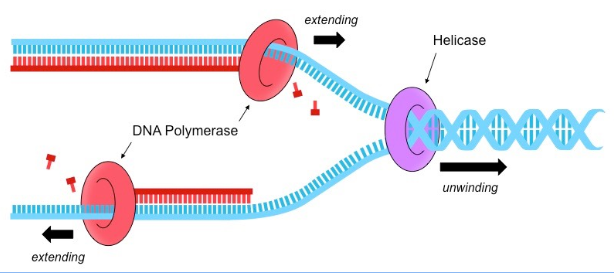
Initiation
Starts at the origin of replication
DNA helicase enzymes: Enzyme that unwinds the double helix by breaking the H bonds between the complementary base pairs holding the two DNA strands together
Single stranded binding proteins (SSBs): Keeps the individual strands apart by blocking the hydrogen bonding between the bases to prevent the double helix from reforming
DNA gyrase (Topoisomerase II): the enzyme that relieves any tension brough about by the unwinding of the DNA strands during bacterial replication
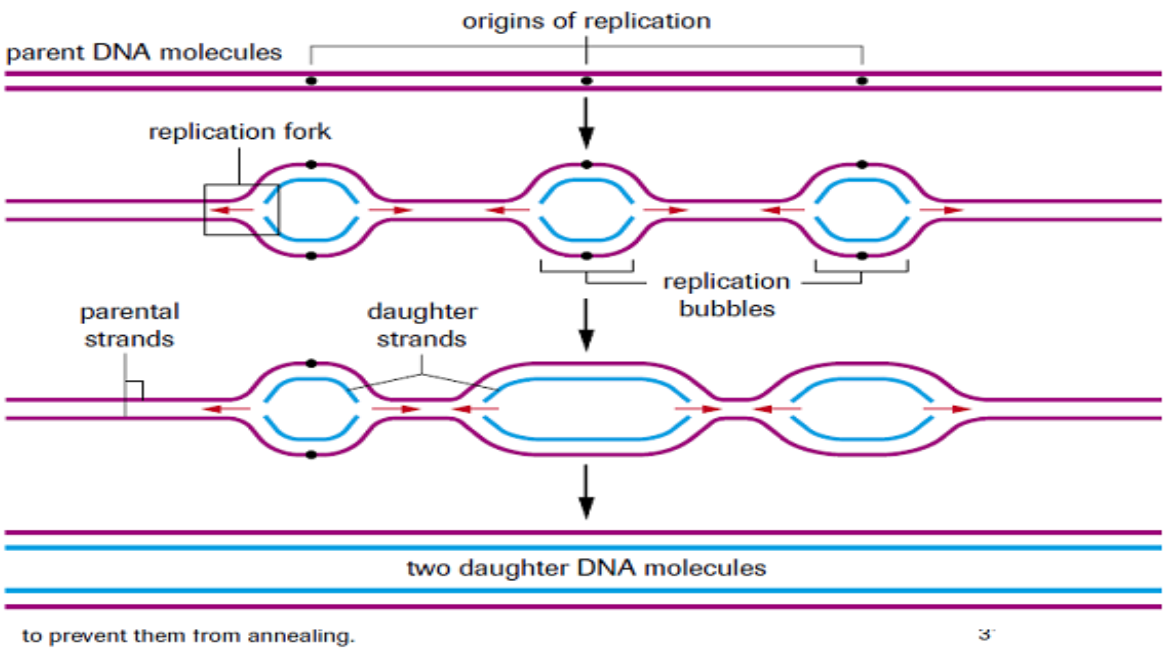
Replication Forks & Bubbles
As the two strands of DNA are disrupted, the junction where they are still joined is called the replication fork
When two replication forks are near each other, a replication bubble forms

Elongation:
DNA polymerase III adds complementary nucleotides in the 5′ to 3′ direction toward the replication fork, using RNA primers as starting points
RNA primer - A short segment of RNA that is complementary to the DNA template strand (starting point for additions of nucleotides), added by RNA primase
DNA helicase enzymes
Enzyme that unwinds the double helix by breaking the H bonds between each base pairing that hold two DNA strands together
Single stranded binding proteins (SSBs)
Protein that keeps the individual strands apart by blocking the hydrogen bonding between the bases
DNA gyrase (Topoisomerase II)
Untwists the helix (not unzips it but makes it from the helix shape into a ladder kind of shape)
DNA polymerase III
adds more nucleotides in the 5’ to 3’ direction towards the replication fork. It uses RNA primers as a starting point
RNA primer
a short strand of RNA that is laid on a single DNA template strand since DNA polymerase cant start a new strand only using bare DNA
(basically the starting point of DNA polymerase)
RNA primase