AH 3175E Exam 2 Notes
 Call Kai
 Learn
 Practice Test
 Spaced Repetition
 Match
 Flashcards
 Knowt Play
1/525

There's no tags or description
Looks like no tags are added yet.
526 Terms
Safely Managed
What type of service level is this?
Drinking water from an improved source that is accessible on premises, available when needed and free from fecal and priority chemical contamination
Basic
What type of service level is this?
Drinking water from an improved source, provided the collection time is not more than 30 minutes for a round trip, including queuing
Limited
What type of service level is this?
Drinking water from an improved source, for which collection time exceeds 30 minutes for a round trip, including queuing
Unimproved
What type of service level is this?
Drinking water from an unprotected dug well or unprotected spring
Surface Water
What type of service level is this?
Drinking water directly from a river, dam, lake, pond, stream, canal, or irrigation canal
Safely Managed
What type of service level is this?
Use of improved facilities that are not shared with other households and where excreta are safely disposed of in situ or removed and treated off-site
Basic
What type of service level is this?
Use of improved facilities that are not shared with
other households
Limited
What type of service level is this?
Use of improved facilities that are shared with
other households
Unimproved
What type of service level is this?
Use of pit latrines without a slab or platform, hanging
latrines or bucket latrines
Open Defecation
What type of service level is this?
Disposal of human feces in fields, forests, bushes, open bodies of water, beaches, or other open places, or with solid waste
1800s
What time period did London have a poor sanitation system?
Cholera
What disease was spread through London?
London
What region believed diseases and epidemics were spread through “bad air”
Miasma theory
The belief that diseases and epidemics were spread through “bad air”
John Snow
A physician who mapped the cases during the cholera outbreak and noticed cases were clustered around a public water pump on broad street.
600
About how many people passed away in 1854 due to cholera?
True
True or False: John Snow had the authorities remove the pump handle, reducing cholera cases greatly
Filtration
What development in 1906 occurred that reduced typhoid cases by 9000?
Chlorination
What development in 1919 occurred that reduced typhoid cases by 1000?
4th
How high in the top 10 does the water supply and distribution rank?
Cuyahoga River
What river in Cleveland, Ohio became a symbol of deteriorating water quality in the United States?
1952
Which Cuyahoga river date was the most damaging fire? Costing ~$1.5 million in damages
1968
What year did Cleveland residents approve a $100 million bond to restore the Cuyahoga?
DDT
What poly-chlorinated biphenyl (PCB) insecticide existed to kill mosquitos?
Concentration
What happens to PCBs as predators ate contaminated predators who ate contaminated prey?
soft eggshells
What was the ultimate notifier that DDT and its PCB’s were affecting people?
General Electric
What company dumped 1.3 million pounds of other PCBs into the Hudson River?
1947-1988
What time period did General Electric dump PCBs into the Hudson River?
200 miles
How far did the PCB contamination reach in the Hudson River?
Clean Water Act
What did the Federal Water Pollution Control Act of 1948 create?
rennovations
What happened to the Federal Water Pollution Control Act in 1972 to become the Clean Water Act??
Restore and maintain the chemical, physical, and biological integrity of the Nation’s waters
What was the stated objective of the Clean Water Act?
Clean Water Act
What act did this?
Established the basic structure for regulating pollutant discharges into the waters of the United States.
Clean Water Act
What act did this?
Gave EPA the authority to implement pollution control programs such as setting wastewater standards for industry.
Clean Water Act
What act did this?
Maintained existing requirements to set water quality standards for all contaminants in surface waters.
Clean Water Act
What act did this?
States are responsible for implementing water quality standards and enforcing regulations under EPA federal guidelines
Clean Water Act
What act did this?
Made it unlawful for any person to discharge any pollutant from a point source into navigable waters, unless a permit was obtained under its provisions.
Clean Water Act
What act did this?
Funded the construction of sewage treatment plants under the construction grants program.
Clean Water Act
What act did this?
Recognized the need for planning to address the critical problems posed by nonpoint source pollution.
The Secondary Treatment Standards
What is the Clean Water Act required to abide by?
Biochemical oxygen demand, Total suspended solids, pH
What are the three secondary treatment standards?
Point sources
What source does the Clean Water Act apply to?
Point Source
is any single identifiable source of pollution from which pollutants are discharged, such as a pipe, ditch, ship, or factory smokestack
True
True or False: The Clean Water Act requires that both publicly owned treatment works (i.e., wastewater treatment plants) and industrial wastewater meet secondary treatment standards.
Safe Drinking Water Act
An act passed by Congress in 1974 to grant the US EPA powers to set national health-based standard to protect against both natural and anthropogenic contaminants in the nations public drinking water supply
False
The Safe Drinking Water Act regulates private wells
Primary Standards
What standard can the Safe Drinking Water Act legally enforce?
True
True or False: The Safe Drinking Water Act has legally enforceable primary standards and treatment techniques that apply to public water systems
True
True or False: Primary standards and treatment techniques protect public health by limiting the levels of contaminants in drinking water
Microorganisms, Disinfectants, Disinfection byproducts, Inorganic chemicals, Organic chemicals, Radionucleotides
What are the 6 categories the Safe Drinking Water Act Regulate?
Microorganism
What contaminant are these?
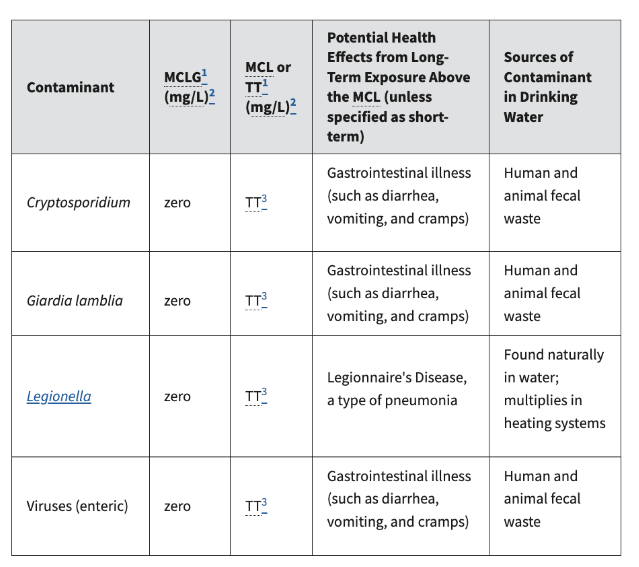
MCLG
Maximum contaminant level goal
MCL
maximum contaminant level
TT
Specified treatment technique
Measurements
What does this table represent?
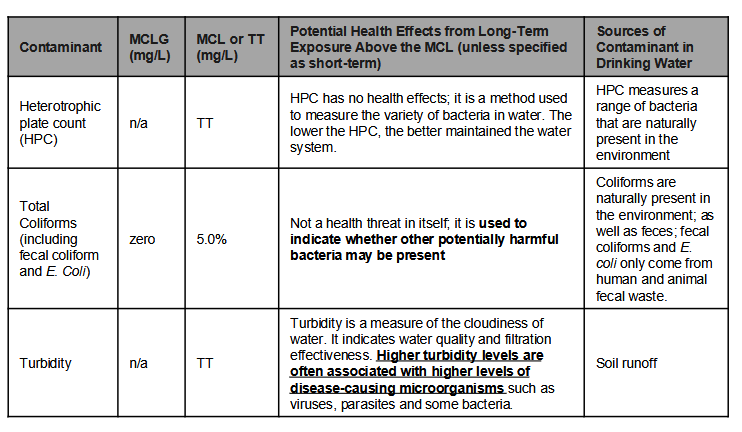
Disinfection byproducts
What does this table represent?

Disinfectants
What does this table represent?

Inorganic chemicals
What does this table represent?

16
How many inorganic chemicals are monitored and enforced by the Safe Drinking Water Act
Organic Chemicals
What does this table represent?

53
How many organic chemicals are monitored and enforced by the Safe Drinking Water Act?
Radionucleotides
What does this table represent?

National Secondary Drinking water Regulation
What else does the Safe Drinking Water Act have?
False
True or False: The National Secondary Drinking Water Regulations are federally enforceable
Cosmetic of individual, aesthetics of water
What do secondary standards influence to the person or the water
Virus, Bacteria, Protozoa
What are the three pathogens of Diarrheal Disease?
Virus
What pathogen are these?
Rotavirus
Adenovirus
Noravirus
Bacteria
What pathogen are these?
Shigella
Vibrio cholerae
Salmonella spp
Campylobacter spp
Enterotoxigenic E. coli
Clostridium difficile
Aeromonas
Enteropathogenic E. coli
Protozoa
What pathogen are these?
Cryptosporidiu spp
Amoebiasis
Crypto and Giardia
What two bacteria are resilient to disinfection and are occasionally responsible for outbreaks when they break through municipalities filtration systems
Legionella
What infection occurs from mismanaged water distribution?
Guinea Worm
What success story for Waterborne Disease occurred in Africa?
True
True or False: The objective of drinking water are to produce water that is:
Portable
Palatable
Meets regulatory criteria
Without interruption
Reasonable Cost
Physical Appearance
color, Taste, Odor, Temperature, turbidity
Chemical Agents
Metals, Inorganic compounds, Organic compounds
Lead, iron, zinc
What are 3 examples of metal chemical agents?
Fluoride, sulfate, chloride
What are 3 examples of inorganic compound chemical agents?
Microbial Agents
Viruses, Bacteria, Protozoa, helminths
Groundwater
Constant composition
High mineral content
Low turbidity
Low color
Low or no dissolved oxygen
CO2, H2S may be present
High hardness
high Fe, Mn
Surface Water
Variable composition
Low mineral content
High turbidity
Colored
Dissolved oxygen present
Low hardness
Taste and odor
Clay, silt, natural organic matter
Coagulation
What is the first step once water leaves a water source?
Flocculation
What is the second step once water leaves a water source?
Sedimentation
What is the third step once water leaves a water source?
Filtration
What is the fourth step once water leaves a water source?
Disinfection
What is the fifth step once water leaves a water source?
94%
What percent of the U.S population is served by Community Water Systems?
False
True or False: The major risk of surface water are chemical exposure (both organic and inorganic chemicals)
False
True or False: The major risks of groundwater is exposure to microbial pathogens and chemical exposure (primarily organic chemicals)
Rapid Sand Filtration Water Treatment Plant
What is this?

Coagulation (Chemical Feed)
Addition of chemicals such as ferric sulfate, aluminum sulfate, and polymers to destabilize colloids (very small suspended particles) in a rapid-mixing device
Aluminum Sulfate
What is the main chemical used in Coagulation we need to know?
Flocculation
Gentle agitation of water that has been coagulated to promote particle contact and formation of larger particles that settle out
Coagulation
Add chemical to make particles “sticky”
Flocculation
Promote collisions among sticky particles so they grow in size and can settle out
Sedimentation
Providing relatively tranquil conditions to allow the solids that can settle out of the water to be removed by the action of gravity
Particles
anything that is suspended in the water (e.g., organic matter, minerals, clay, or microorganisms)
Filtration (Granular Media Filtration)
Polishing of water through a pack of granular media to remove remaining particles.
Disinfection
Inactivation of pathogenic microorganisms through the addition of a disinfectant. This occurs in the Clear Well. In the USA, residual disinfectant is also added.
Residual disinfectant
A small amount of chlorine left in the treated water to prevent microbial growth in the distribution system.