appendicular skeleton (not finished)
 Call Kai
 Learn
 Practice Test
 Spaced Repetition
 Match
 Flashcards
 Knowt Play
1/44

There's no tags or description
Looks like no tags are added yet.
45 Terms
Pectoral girdle
Attach bones of upper limbs to axial skeleton
Paired
Clavicle + scapula
Don’t articulate with vertebral column
Stabilized by group of muscles
The appendicular skeleton
126 bones
Primarily involved in body movements
Appendages to central skeleton
upper and lower limbs + girdles
What is a girdle
Attach upper and lower limbs to axial skeleton
Clavicle
Collar bone —> s shaped
Medial (Sternal end) Articulates with manubrium of sternum
lateral end (acromial) articulates with acromion of scapula
Has Conoid tubercle
—> attaches to conoid ligament
Scapula
Shoulder blade
Flat bone located in superior part of posterior thorax
articulates with the clavicle
—> acromiocivular joint
glenoid cavity (shallow depression) Articulates with humerus
—> glenohumeral (shoulder) joint
Humerus
articulates with scapula
—> rounded head fits into Glenoid cavity
Articulates with radius and unlawful distally
trochlea articulates with ulna
Capitulum with radius
What are the two bones of the forearm? What’s their function?
Ulna
Radius
Allow forearm to rotate
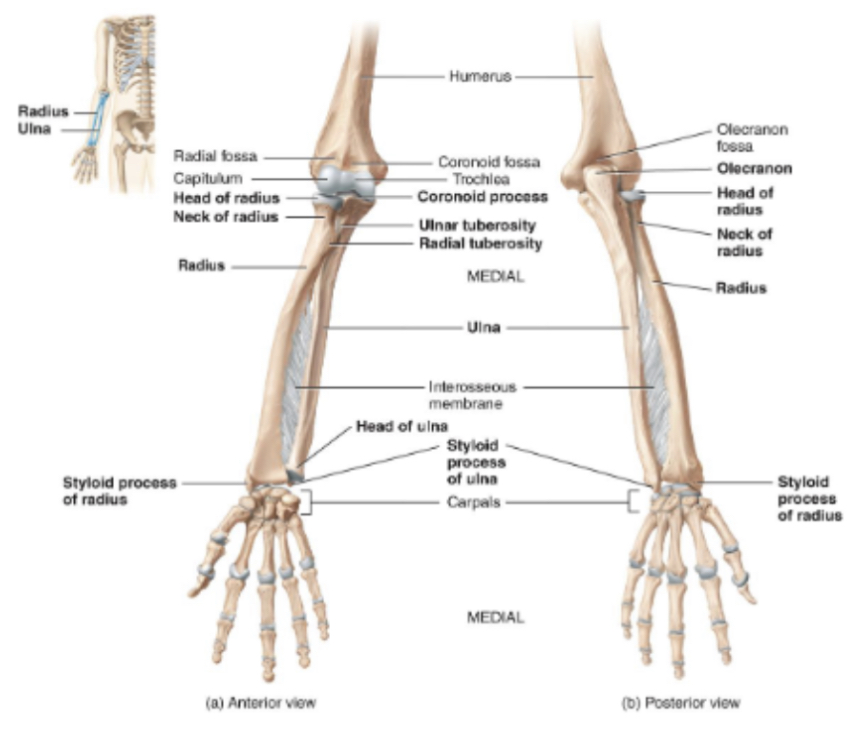
Ulna
Elbow joint: olecranin and coronoid process at proximal end
—> form tochlear notch wrapping around trochlea of humerus
Radius
Located on lateral (thumb) side of forearm
Head articulates with capitulum
Carpal bones
8 small bones
rows of 4 bones
Connected by ligaments
Proximal row of carpal
scaphoid, lunate, triquetrum, pisiform
Articulates with radius and ulna
Distal row
trapezium, trapezoid, capitate, hamate
Articulates with metacarpals
Five metacarpals
make up palm/back of hand
Numbered I-V
Bases articulate with distal carpals
Heads articulate with proximal phalanges
Phalanges
bones of digits/fingers
14 on each hand
thumb: contains 2 (proximal and distal)
Other fingers: contain 3 each (proximal, middle, distal)
What hip bones is the Pelvic girdle made of? Where do they articulate?
made of two hip bones
Os coxa, coxal bones
articulate with sacrum posteriorly
Two bones Articulate anteriorly at pubic bones (pubic symphasis)

What individual bones are the each hip bone made of? (3)
ilium
Ischium
Pubis
What exists between the two hip bones?
disc of fibrocartilage
where does the femur articulate
head of femur articulates with acetabulum of hip bone
like ball and socket joint
Acetablum
of hip bone
Composed of 3 bones making up hip bone
What is the pelvic brim
where abdomen meets pelvic cavity
Divides pelvis into superior and inferior portion

What is the false greater pelvis
area of bony pelvis superior to pelvic brim

What is the true (lesser) pelvis
Area of bony pelvis inferior to pelvic brim

characteristics of male pelvis (6)
male:
bones larger and heavier
false pelvis: Deep pelvis
Pelvic Brim narrow and heart shaped
Acetabulum: large and faces laterally
Obturator foramen: round
Pubic arch: less than 90 degreesq

characteristics of female pelvis
(7)
Female: structured to meet requirements of pregnancy and childbirth
pelvis wide light
False pelvis: Shallow
Pelvic brim: wide and more oval
acetabulum: small and faces anteriorly
Obturator foramen: Oval
Pelvic arch: greater than 90 degree angle


Where is the iliac crest
less curved in females


What is this
Ilium
less vertical in females
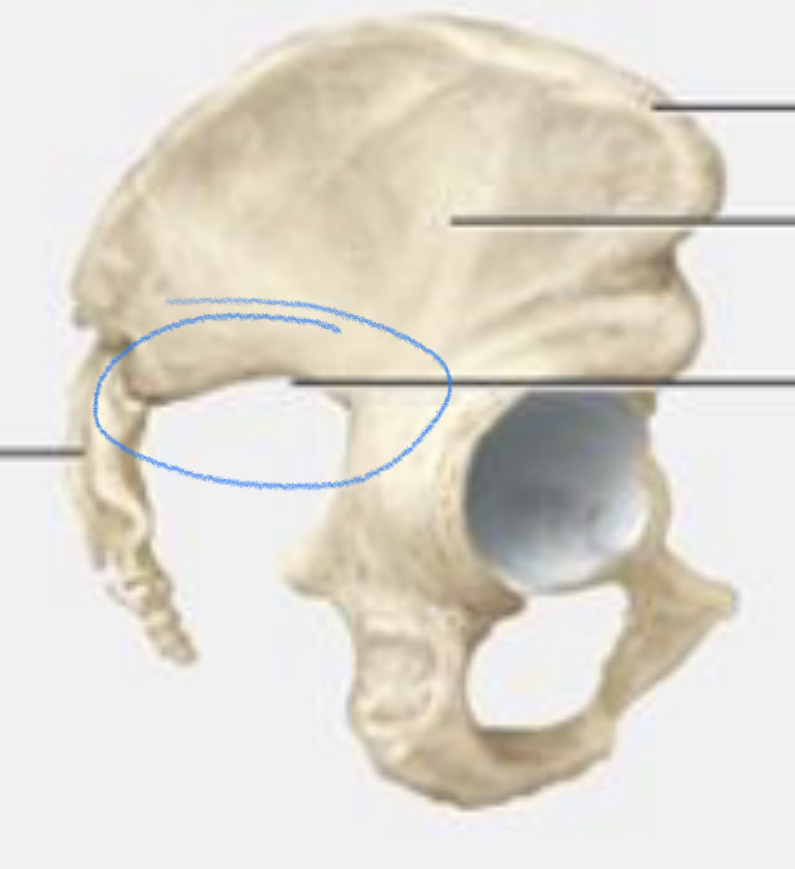
What is this
greater sciatic notch
Wide (almost 90 degrees) in females
Narrow in males (almost 70 degrees)


What is this
Sacrum:
shorter and winder in females

What is this?
pelvic outlet
Wider in females

What is this?
Ischial tuberosity
females: shorter, farther apart and more medically projecting
Males: longer, closer tgt, more laterally projecting
What is the femur
longest, heaviest, and strongest bone
Proximal head inserts into acetabulum of hip
Distal articulates with tibia and patella

What is the patella
triangular bone
Develops into quadriceps tendon
Posterior surface articulates w/ femur
What does the lower leg consist of?
Tibia and fibula

Tibia
Proximal end articulates w/ femur
distal end articulates with talus bone of ankle
Tibial tuberosity
anterior surface of tibia
point of attachment for patellar ligament
Fibula
-please fill
Fibular notch
Medial malleolus
Talus
Tarsus
7 tarsal bones
Talus, calcaneus, navicular, 3 cuneiforms and cuboid
Metatarsus
numbered I-V starting with big toe
Make up sole and dorsal surface of foot
Proximal ends articulate with 3 cuneiform bones and cuboid
Distal ends articulate with proximal phalanges
Phalanges of foot
big toe: proximal and distal phalanx
Other toes: proximal, middle and distal phalanx
What are the two aches of the foot
Supported by ligaments and tendons
longitudinal arch
made of medial and lateral portion
transverse arch

Purpose of two arches
allow foot to support weight of body
Provide leverage while walking
Distribute body’s weight over foot