science & democracy midterm 2 content
 Call Kai
 Learn
 Practice Test
 Spaced Repetition
 Match
 Flashcards
 Knowt Play
1/54

Earn XP
Description and Tags
midterm 2 is cumulative, so this flashcard set is for ONLY content past midterm 1
55 Terms
post-war science-society compact
partnership between fed govt & academia
research funded by govt, carried out by academics
distinguish between basic/applied research
linear model
creation of “free play of free intellect” agenda
funding science like this should promise results leading to health, wealth, security
“free play of free intellect”
agenda for basic research is set by scientists who are guided by their own curiosity
also peer review system for deciding what to find
U.S. science policy attributes
govt pays for both direct AND indirect cost of research
private foundations usually only pay 15% indirect
overall mission of science policy shifts over time
direct vs. indirect cost of research
direct: salaries, equipment, supplies
indirect: facilities, admin expenses
indirects can be >50% of total cost
shift in science policy over time
winning WWII
security during cold war
improve nation’s economic competitiveness / health
reduce threat of terrorism
impact of bush in federal spending on basic research
increasing

basic vs. applied vs. development in FY25 US fed budget pt 1

basic vs. applied vs. development in FY25 US fed budget pt 2

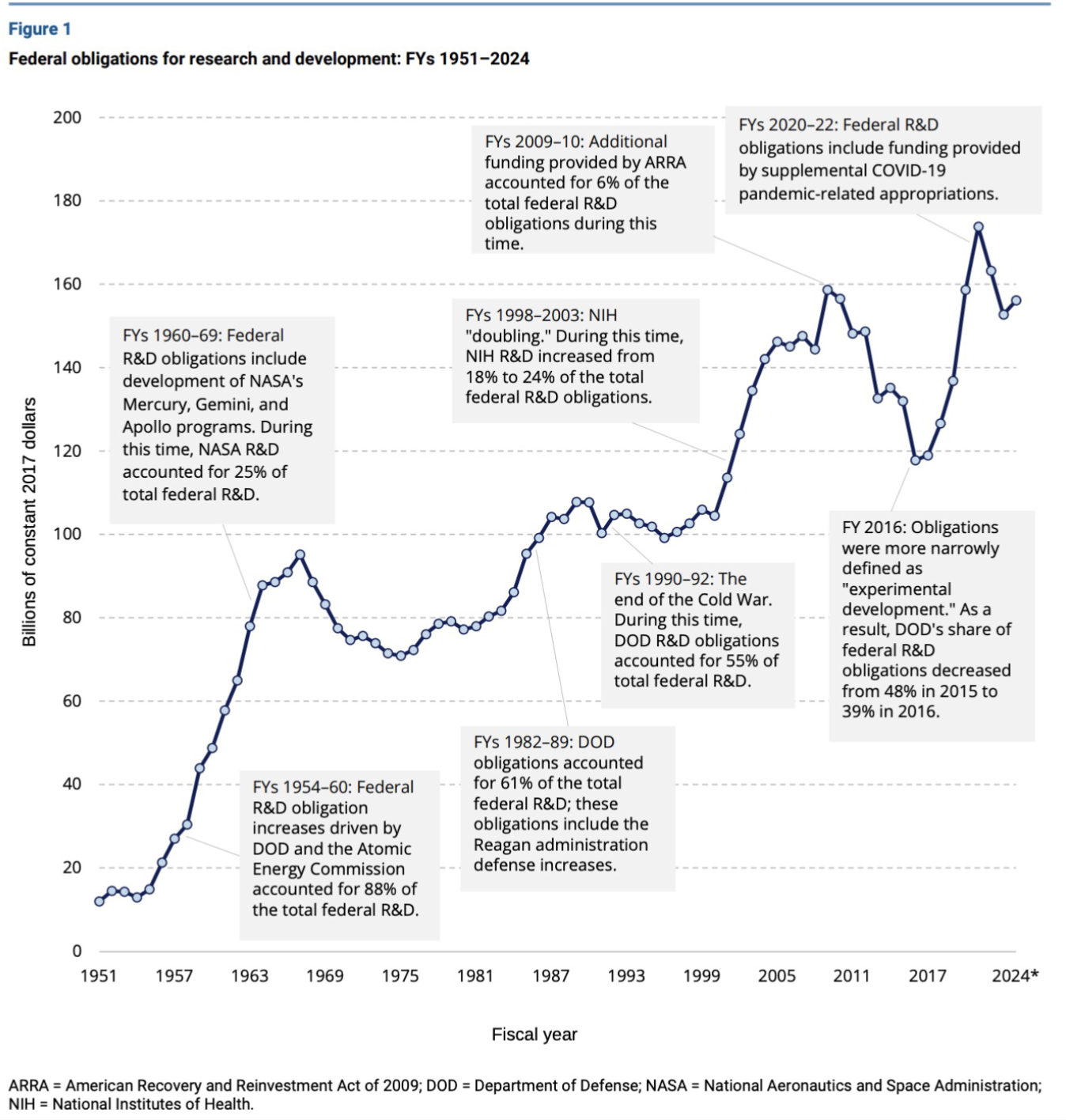
interesting data on federal science funding
increase after atom bomb
spike during space race
increase after reagen defense initiatives
end of cold war plateau
NIH R&D increase after
decrease in 2016
increase in 2020 due to COVID
consequences of federal science policy
NIH budget for biomedical grants towers over other foundation’s investments in grants

executive branch role in federal science policy (PRESIDENT)
constitution does not explicitly assign responsibility for science policy to pres
but importance of science policy for nation means president must take active role
role has changed over time
vannevar BUSH is first science advisor to FDR
not formalized/in legislation until mid 1970s
history of executive branch in federal science policy
1976: legislation created OSTP (in white house), director of OSTP = presidential science advisor
1990: presidential executive order creates PCAST
1993: executive order creates NSTC
OSTP: office of science and technology policy
formulate/develop presidential priority/budget related to sci/tech policy
director + 2 associate directors are presidential appointees w/ senate confirmation
PCAST: presidential council of advisors on science and technology
highest level science advisory group to president not composed of federal government officials
instead composed of academia/industry
NSTC: national science and technology council
coordinates science policy across federal agencies
composed of high-level government officials from all agencies with major sci/tech responsibilities
OMB: office of management and budget
responsibility for preparing presidential budget requests to Congress
i.e. agency requests for research/science programs
two biggest federal science funders
DOD
NIH
DOD funding of science
largest funder
especially for new weapon system development
also basic/applied research (USU)
large extramural funding program with substantial support for engineering research
internet, GPS,
medical research
investments in science education
military research COULD have been part of NSF, but DELAY in post ww2 years led to creation of → office of naval research (ONR) and joint research and development board in mid 1940s
DARPA: defense advanced research projects and agency (1958, sputnik)
mostly extramural research grants to industry/academia
research on emerging tech relevant to military use, led to
weather satellites
GPS
internet
personal computers
NIH funding of science
funds university biomed research AND intramural research program
part of dept of health/human services
27 institutes + centers
85% funding going to extramural
head of NIH = political appointee w/ senate confirmation
no rotator system (like NSF)
NIH history
1887: hygenic library
1930: national institute of health
1937: national cancer institute, first topic-focused institute
1946: national institute of mental health
1948: national heart + dental research institute
1948: national instituteS (plural) of health
other fed agencies in science policy
NASA (1958, sputnik)
space flight, aeronautics research
dept. of energy
dept of commerce
dept of homeland security
science/technology directorate, r&d related to securing country
dept of agriculture
morril acts create land-grant universities
provide funding for agricultural expansion
dept of energy
runs national laboratories (nuclear stockpile)
funds basic research in physical science
via office of science
headed by political appointee w/ senate confirmation
post ww2: creation of ATOMIC energy commission to conduct research on atomic energy
disband and rejoin in 1974
dept of commerce
NIST: national institute of standards and technology
develop standards of measurement for commerce/industry
not regulatory, easier to work with industry
NOAA: national oceanic and atmospheric administration
understand natural world through daily weather forecasts, severe storm warnings, climate change studies
how is budget split between basic, applied, developmental research between these agencies?
dept of defense:
little basic/applied, mostly developmental
health & human services (inc NIH):
½ basic; ½ applied; little development
NSF:
mostly basic; little applied; no development
NASA:
mix of 3, basic largest
dept of energy:
mix of 3
industry & science policy
1945: majority of small/large businesses support govt support for basic research AND new agency to administer it
small > large:
favor govt support for applied research
small & large:
did not support nonexclusive licensing of discoveries from govt supported grants
large firms strongly support BUSH over kilgore
AND organized business (NAM)
industry & science policy history
edison, late 1800s: bridge science + commerce
1920s: university research inadequate for large companies (gen elec, dupont, AT&T)
big industrial labs BRIDGE science/commerce
post-ww2: university basic research growing, cold war demand for advanced lasers, communications, materials, space-related tech
continued support for big industrial labs during cold war
nowadays: some corporate labs
mostly universities + start-ups
bush vs. sarewitz
BUSH:
fed govt should fund large amts of basic research and scientific fellowships at unis
leave scientists themselves to decide what to investigate + who to support
SAREWITZ:
is this correct?
SAREWITZ: evaluating impact of science policy
model of science policy is “beautiful lie”
cold war
breast cancer example
many recent technological breakthroughs come from DOD investment, NOT free play of free intellects
microprocessor, GPS, internet, jet engines
many cases technology sets agenda for basic science
computer development → demand for basic research on how to acquire, store, process digi info
NSF grant to navigate expanding digi info sphere → Google
scientists incentivized to argue they have discovered new, interesting things
does not lead to accumulation of reliable knowledge that actually improves societal wellbeing
many scientific questions are “trans-scientific” questions
sarewitz cold war
post ww2: need to win cold war
DOD mission: ensure american military is strongest (>USSR)
first digital computer: 1940
to calculate trajectory of artillery shells + design hydrogen bomb
DARPA funds compsci research in 1950s as role of computers in military success grows
jet engines: 1940s
need reliable jet engines for jet fighters
civilian spillovers into boeing 707 passenger jet
semiconductors/transistors:
reliable battlefield communication for army
breast cancer example
fran visco approaches director of national cancer institute with money from congress
army’s R&D director approaches director
patient centered breast cancer research program
sarewitz ANTI free play of free intellects arg
“worked because it brought all of the players in the innovation game together, disciplined them by providing strategic, long-term focus for activities, shielded them from market rationality that would’ve doomed almost every crazy, over-expensive idea that today makes the world go round”
trans-scientific questions
object of study cannot be characterized by small number of measurable variables
must be characterized by changes over time
highly sensitive to researcher’s decisions about how to define/study it
science fails to conclusively answer questions or settle debate
economy = total of goods + services?
what about unpaid labor (child rearing)
experts disagree on state of economy
free play of free intellect has NOT
produced solutions for problems
guidance for policy decisions
verifiable truth, sometimes
SAREWITZ: so what should science policy do?
prioritize imperative of technological advance MORE than currently
science must be held ACCOUNTABLE for end users other than ITSELF and should be MANAGED
→ focus scientific inquiry + clear standard for knowing if fundamental understanding is advancing/valid
accountability to those who need solutions to urgent societal problems = provides greatest societal benefit
AGAINST linear model AND researcher autonomy
SAREWITZ: what about trans-scientific problems?
policymakers, business leaders, public still wanna know how well economy is doing
what to do:
be clear/transparent about definitions and values underlying them
what about incentive structure for scientists?
other methods to evaluate impact of science policy