Intro to Psychology sem 1 part 2 '26
 Call Kai
 Learn
Learn Practice Test
 Spaced Repetition
 Match
Match Flashcards
 Knowt Play
1/61

There's no tags or description
Looks like no tags are added yet.
Name | Mastery | Learn | Test | Matching | Spaced | Call with Kai | Chat |
|---|
No analytics yet
Send a link to your students to track their progress
62 Terms
What is are the three types of theories about language development?
1) behaviorist; language is learned through operant conditioning
2) nativist; capacity to acquire language is innate
3) interactionist; nativism + social interactions necessary for learning a language
What is Motherese and how does it support the interactionist theory of language development?
Motherese; creation of languages by deaf children
interplay of nativism (innate capacity to acquire language) and experience (growing up in an isolated deaf culture)
At what life stage is learning a language significantly harder?
after puberty sets in
What is universal grammar, which language development theory is it a part of and who studied it?
universal grammar; a collection of processes that facilitate language learning
nativist theory
Noam Chomsky
What is the difference in aphasia and location between Broca’s area and Wernicke’s area?
Broca’s; problems with speech production (telegraphic speech) (damaged left frontal lobe)
Wernicke’s; problems with speech understanding (damaged superior temporal lobe)

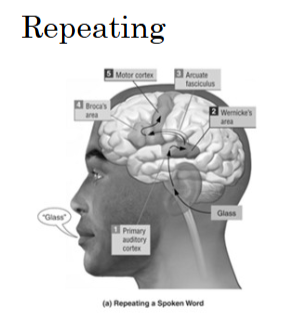
When repeating a word, what brain structures are necessary to accomplish this?
thalamus
primary auditory cortex
Wernicke’s area
arcuate fasciculus (connects B and W area’s)
Broca’s area
motor cortex
Aphasia
difficulty in producing or comprehending language
What are some theories of concepts and categories?
What is the difference between the rational ideal and the irrational reality of decision making?
rational ideal; making a decision based on the probability and value of something happening (logical)
irrational reality; decision making is influenced by heuristics, framing effects and biases (‘‘unlogical’’ (subjective))
What are the causes of decision making errors?
What is the difference between the Means-Ends analysis and the analogical problem-solving approach?
Belief bias
What is the difference between a phoneme and a morpheme?
phoneme; group of phones (physical sounds), has no meaning (c)
morpheme; unit that has meaning (cat, or s in cats)
What are 2 types of morpheme’s
content; has meaning (cat)
functional; used for grammar (for)
What are the three types of language rules?
phonological; how to combine phonemes into words
morphological; how to combine morphemes into words
syntatic; how to combine words into phrases or sentences
Telegraphic speech
2 word sentences, e.g ‘dog barks’, without functional morphemes
What are five key cognitive functions?
What are the milestones of language development?
0-4 months; difference between phonemes
4-6 months; babbling
10-12 months; first words
around 24 months; telegraphic speech
4-5 years; overregularisation errors (e.g. runned ipo run)
What is evidence for and against the linguistic relativity hypothesis?
linguistic relativity hypothesis; language influences how we think about things
evidence for; closed off tribes have different names for colors and see them differently
evidence against; people with aphasia think the same as people without aphasia
What is the difference between the prototype and exemplar theories of concepts?
prototype theory; classifying new stimulus (dog) by comparing it to the best example of stimuli category (german shepherd)
exemplar theory; classifying new stimulus by comparing in to all the members of a category (all dogs)

What is a category-specific deficit and what is the cause of it?
category- specific deficit; not being able to recognize exemplars from a certain category (e.g. living things)
brain damage in area related to that category, because brain is hardwired to classify objects into categories
Which hemisphere sides and brain regions are linked to forming prototypes and recognizing exemplars?
forming prototypes; left hemisphere and visual cortex
recognizing exemplars; right hemisphere and prefrontal cortex
Prospect theory
What factors lead to or inhibit creativity and insight?
What is the difference between truth and validity in reasoning?
Belief biases
Illusions of truth
What is the difference between the illusion of explanatory depth in the lab and in everyday life?
linguistic relativity hypothesis
Whta is the difference between the prototype theory and the exemplar theory?
Rational choice theory
making a decision based on value and probability of something happening
What is the difference between
What is the difference between an conjunction fallacy and a sunk-cost fallacy?
conjuction fallacy; (unlogically) thinking that two events are more likely to occur together than either individual event (e.g. bc of stereotypes)
sunk-cost fallacy; making an (unlogical) decision based on what you have invested into a situation (e.g. going to a $100 concert even if it rains)
Both are errors in judgement making based on irrelevant information
Framing effects
the way something is framed influences someone’s assignment of value to it (e.g. 70% effectiveness of drug vs 30% risk rate of drug)
Optimism bias
thinking that positive experiences are more likely to happen and negative experiences are less like to happen
What is a heuristic and what are two types of it?
heuristic; quick mental shortcut (can be usefull, but also produces biases)
availibility; likelyhood of something is based on what easily comes to mind (e.g. plane vs car crashes)
representativeness; likelyhood of something is based on comparison with prototype of it (e.g. thinking someone is a ravenclaw bc they like reading, even if there are more gryffindoors)
Analogical problem solving
functional fixedness
syllogistic reasoning
How does the prenatal enviroment influence fetal development?
teratogens (e.g. fetal alcohol syndrome)
insufficient nutrition (e.g. IUGR (growth restriction))
auditory information (babies cry with their mother tongue intonation)
What are the 5 types of development and what do they entail?
How does sexuality emerge during adolesence?
What are three concepts that change during adulthood?
What are the three prenatal stages of development?
1) germinal; zygote, till 2 weeks after conception
2) embryonic, embryo, till 8 weeks after conception
3) fetal; fetus, till birth

Why is it beneficial for people to be born with underdeveloped brains?
smaller head fits through the birth canal
brain can develop unique capacities that a specific enviroment requires
Teratogen
substance that passes from mother to unborn child and impairs development (e.g. tobacco or alcohol)
What are the 4 stages of Piaget’s theory of cognitive development and what do they entail?
1) sensorimotor; thinking = doing, no object permanence
2) pre-operational; thinking about things, egocentrism and centration
3) concrete operational; thinking about actions, decentration and conservation
4) formal operational; thinking about thought

What is the difference between egocentrism and theory of mind?
egocentrism; others see the world as I do
What are the four attachment styles?
What is the difference between Piaget’s and Kohlberg’s theories of the development of moral reasoning?
What are the two principles of motor development?
cephalocaudal; the tendency for motor skills to emerge in sequence from the head to the feet
proximodistal; the tendency for motor skills to emerge in sequence from the center to the periphery

Assimilation vs accomodation of a schema
schema; theory about how the world works
assimilation; making a schema bc of an experience
accomodation; adapting a schema bc of new experiences
Centration vs decentration
centration; attention is focused on one observation
decentration; relationship between observations can be made
Object permanence
understanding that an object is still there, even if it is not perceived
Conservation
an amount stays the same no matter what form it is in (e.g. with squished clay or liguid in a taller glas)
Temperament
Internal working model
What are the three Kohlberg’s stages of moral development?