PY2SID3)Attitudes and Attitude Change
 Call Kai
 Learn
 Practice Test
 Spaced Repetition
 Match
 Flashcards
 Knowt Play
1/33

Earn XP
Description and Tags
A set of 30 vocabulary flashcards covering key definitions, theories, models, and empirical concepts from Week 3 lecture notes on attitudes, attitude measurement, persuasion, and cognitive dissonance.
34 Terms
Attitudes
Evaluations of people, objects, and ideas that vary in valence (positive or negative) and strength.
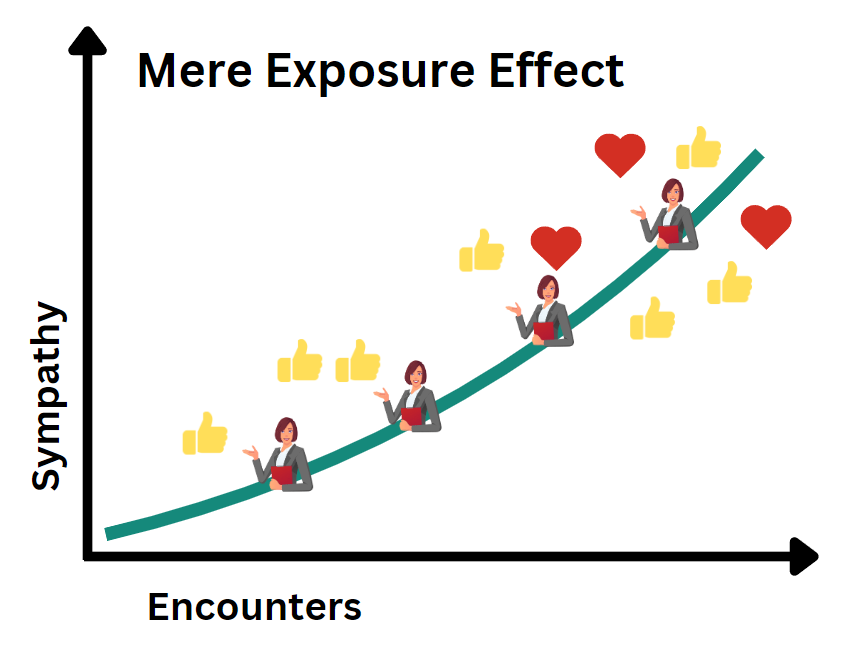
Mere exposure hypothesis (Zajonc, 1968)
The tendency to develop more positive feelings toward objects and individuals the more frequently we are exposed to them.

Classical conditioning (in attitude formation)
A learning process involving the pairing of one stimulus with a second stimulus and its associated feeling, until the first stimulus independently elicits that feeling without direct exposure to the second.
Operant conditioning (in attitude formation)
A learning mechanism in which behavior toward an attitude object is followed by positive reinforcement (e.g., parental approval) or punishment (e.g., parental disapproval), shaping positive or negative attitudes.
Social learning theory (Bandura, 1973)
A framework stating that the behavior of an individual serves as a template for another through observation, imitation, and modeling.
Explicit attitude measures
Direct self-report assessment tools that are quick, cheap, and easy to use, though susceptible to social desirability bias and unperceived personal biases.
Likert Scale
A structured self-report measure where participants evaluate an attitude statement along a numerical scale, such as from 1 ("Strongly disagree") to 5 ("Strongly agree").
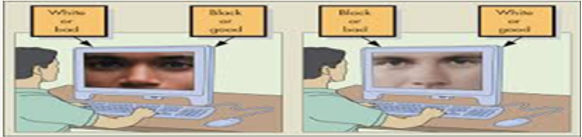
Implicit Association Test (IAT; Greenwald & Banaji, 1995)
An implicit measurement procedure that assesses automatic associations between attitude objects and positive or negative concepts based on reaction speeds to paired categories.

Intergroup bias
A systematic preference for one's own group (ingroup) over an outside comparison group (outgroup).
Cognitive ability confound (in IAT)
A criticism demonstrated by McFarland and Crouch (2002) showing that individuals who are slower at processing information exhibit more biased responses on implicit measures.
Persuasion
The deliberate attempt by an individual or group to influence or alter the attitudes and resulting behaviors of others in a desired direction.
Source credibility
A key source characteristic that increases message persuasiveness, determined jointly by perceived expertise and trustworthiness (Hovland & Weiss, 1952).
Expertise (source factor)
The audience's perception of a communicator's knowledge, experience, and competence (Fogg et al., 2002).
Trustworthiness (source factor)
The audience's perception of a communicator's motivation to deliver a message or share expertise without bias (McGuire, 1969).
Source likeability
A communicator attribute that facilitates persuasion, influenced significantly by physical appearance and perceived similarity to the audience (Eagly & Chaiken, 1975).
Fear-arousing messages
Emotional appeals designed to alter pro-health attitudes or curb risk-taking behaviors by evoking fear regarding potential negative consequences.

Inverted-U hypothesis (McGuire, 1969)
The proposition that fear appeals achieve optimal attitude change when they elicit a moderate level of fear, becoming less effective at very low or very high levels.


Primacy effect
Individuals are most influcneced by what they hear or see first. Lays foundation.

Recency effect
Individuals are most influenced by what they hear or see last.

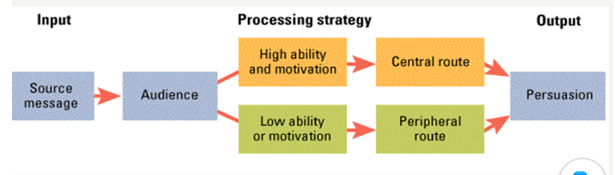
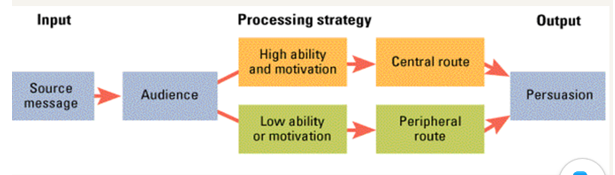
Elaboration-Likelihood Model
A dual-route persuasion theory stating that recipients process messages either via the central route or peripheral route depending on their ability and motivation.

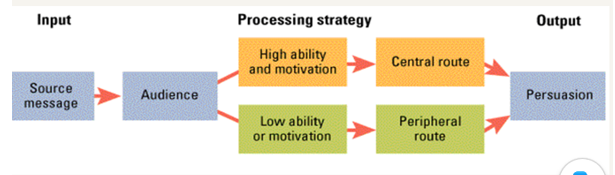
Central route to persuasion
A processing route where an audience scrutinizes message content through deep thinking, with persuasion driven by strong evidence and arguments to create enduring attitude change.

Peripheral route to persuasion
A processing route where an audience does not analyze message arguments in depth, relying instead on superficial cues such as source likeability or argument quantity.
Message relevance
The perceived personal significance of an issue to an audience member, functioning as a primary determinant of their motivation to elaborate via the central or peripheral route.
Cognitive dissonance
A state of negative psychological arousal experienced when an individual recognizes an inconsistency between two cognitions, such as their attitude and their behavior.
Insufficient reward effect
The phenomenon demonstrated by Festinger and Carlsmith (1959) where a small incentive (1) provides inadequate external justification for counter-attitudinal behavior, prompting attitude change to resolve dissonance.
Sufficient reward effect
The finding in cognitive dissonance research where a large external incentive (20) adequately justifies a counter-attitudinal action, leaving attitudes unchanged because no dissonance is aroused.
New look theory of cognitive dissonance
An explanation proposing that dissonance-induced attitude change stems from aversive emotions (such as guilt, shame, regret, and sadness) caused by the belief that one's deceptive behavior caused harm.
Threat to the self-concept (Aronson & Thibodeau, 1992)
The perspective that cognitive dissonance is triggered when counter-attitudinal actions, such as lying to others, conflict with an individual's view of themselves as a decent, moral person.
Murray (2012)
The researchers investigated 164 US undergraduate students to see whether individual differences in psychopathic personality traits influence the experience of cognitive dissonance. They completed a repetitive abacus task. Participants were divided into two conditions
High-choice condition: Participants were politely asked to tell the other students that the task was enjoyable, but they were not directly instructed to do so.
Low-choice condition: Participants were directly instructed to tell the other students that the task was enjoyable.
- Participants completed questionnaires measuring psychopathic traits and Machiavellianism (a tendency towards manipulation and strategic self-interest). Afterwards, participants rated how enjoyable they had found the task.
Machiavellianism
A personality trait characterized by a predisposition toward interpersonal manipulation, deceit, and strategic self-interest.

Attitude change
Refers to the attempt of an individual or group to influence/ alter the attitude (and often behaviours as a result) of others in the way that they desire. For example, in regard to making healthy eating choices, politicians are trying to sway our votes.


Haugtvedt and Wegner (1994)
50 UG students presented with two opposing arguments regarding the inclusion of exams as a prerequisite for graduation. The relevance of argument when considering the order of presentation.


Sex differences in attitudes:Sistrunk and McDavid (1971)
-Male and Female UG participants completed 65-item conformity measure-make judgements on various stimuli:
Male-orientated (tools)
Female-orientated (sewing machines)
Neutral (e.g., pop stars)
Provided with ostensible majority
Group answers/opinions (normative influence)

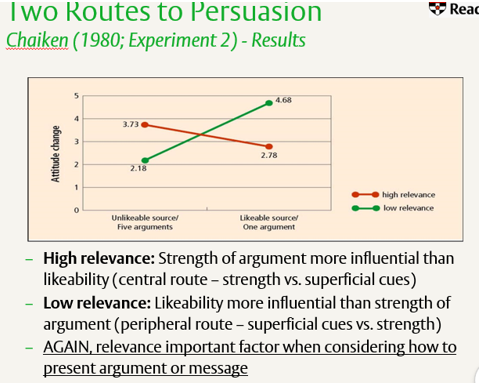
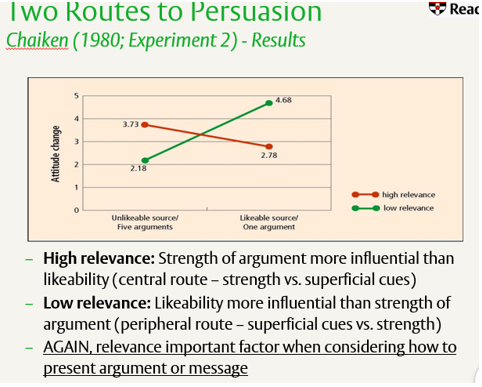
Chaiken (1980)
UG students at University of Toronto (UoT)
- Brochure used to attempt attitude change towards a new school term structure
-IV 1: Relevance of topic (high vs low) (Relevance represents the motivation of the perceiver.)
· High: Changing UoT term structure next year
· Low: Changing UoT term structure in 5 years
-IV 2:Likeability of source (high vs low)
· Author ‘UoT administrator previously worked at University of British Columbia (UBC)' – asked which university preferred
· High: author prefers UoT and students there.
· Low: author prefers UBC, and students are here
-IV 3: Strength of argument (no. of arguments – 1 vs 5)
-DV: Attitude change