Glycolysis & Pyruvate Dehydrogenase
 Call Kai
 Learn
Learn Practice Test
 Spaced Repetition
 Match
Match Flashcards
 Knowt Play
1/130

There's no tags or description
Looks like no tags are added yet.
Name | Mastery | Learn | Test | Matching | Spaced | Call with Kai | Chat |
|---|
No analytics yet
Send a link to your students to track their progress
131 Terms
Glucose
- The form of sugar that circulates in the blood and provides the major source of energy for body tissues. When its level is low, we feel hunger.
Carbohydrates
- The starches and sugars present in foods, broken down into glucose to provide energy
Common Formula for Carbohydrates
- Cn(H2O)n
- "Watered carbon"
Glucose: Formula
C6H12O6
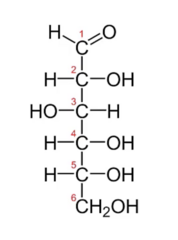
Monosaccharides
- The simplest carbohydrates
Key Monosaccharides
- Glucose, Fructose, Galactose
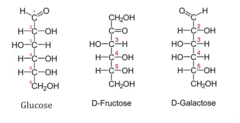
Glucose, Fructose, Galactose: How are they similar? How are the different?
- Similar: All have the same chemical formula C6H12O6
- Different: They are isomers with different spacial orientations
Disaccharides
- Carbohydrates that are made up of two monosaccharides
What happens to disaccharides in the GI tract?
- Broken down into monosaccharides → then absorbed
Lactose
- Galactose + glucose
What breaks down Lactose? What happens when someone is lacking in this enzyme?
- Lactase
- Lactose intolerance
Sucrose
- Glucose + fructose, found in table sugar
What breaks down Sucrose?
- Sucrase
Polysaccarides
- Polymers of monosaccharides
Common Polysaccharides
- Starch
- Glycogen
- Cellulose
Starch
- A storage polysaccharide in plants consisting entirely of glucose.
Glycogen
- An extensively branched glucose storage polysaccharide found in the liver and muscle of animals; the animal equivalent of starch.
Cellulose
- A substance (made of sugars) that is common in the cell walls of many organisms, cannot be broken down by animals
- "Fiber" in diet → improved bowel function
How can glucose be used in the body?
ATP production, amino acid synthesis, glycogen synthesis, triglyceride synthesis
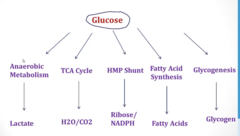
Which organ has the most varied use of glucose?
Liver
- TCA for ATP
- Glycogen synthesis
How does the brain use glucose?
- Constant use of glucose for TCA cycle (ATP)
- Little glycogen storage
How do muscles/heart use glucose?
- Transport of glucose into cells is heavily influenced by insulin; more insulin → more glucose uptake
- TCA (ATP) and can store glucose as glycogen
How do RBCs use glucose?
- Only use glucose for anaerobic metabolism (generates ATP) because they lack mitochondria → generates lactate
How does Adipose Tissue use glucose?
- Converts glucose into fatty acids
- Uptake is influenced by insulin
How does glucose enter cells?
- Na+ independent entry
- Na+ dependent entry
Na+ Independent Entry
- GLUT-1 to GLUT-14 (uses [c] gradient)
- Varies by tissue (RBCs use GLUT-1)
Na+ Dependent Entry
- Glucose is absorbed from low [c] → high [c]
- Intestinal epithelium and renal tubules
How is Glucose Absorbed By Intestinal Epithelial Cells?
1. In GI lumen (left), you have low [glucose] compared to inside the cell
2. In order to absorb glucose, the cell will couple that absorption with sodium to move against [c] gradient (SGLT1, Na+ dependent)
3. [glucose] inside cell is higher than in interstitium/blood, so glucose can move down [c] gradient via GLUT2 (Na+ independent) into interstitium
4. Sodium previously uptaken by SGLT into cell (coupled to glucose) is pumped back out into GI Lumen to create high [Na+] outside of cell; this sodium can then be reused as a cotransporter for more glucose
![<p>1. In GI lumen (left), you have low [glucose] compared to inside the cell</p><p>2. In order to absorb glucose, the cell will couple that absorption with sodium to move against [c] gradient (SGLT1, Na+ dependent)</p><p>3. [glucose] inside cell is higher than in interstitium/blood, so glucose can move down [c] gradient via GLUT2 (Na+ independent) into interstitium</p><p>4. Sodium previously uptaken by SGLT into cell (coupled to glucose) is pumped back out into GI Lumen to create high [Na+] outside of cell; this sodium can then be reused as a cotransporter for more glucose</p>](https://assets.knowt.com/user-attachments/9d32ff24-1e04-4d70-8227-aaef813f60ca.png)
GLUT-1: Insulin dependent or independent? Its result? Where is it utilized?
- Insulin Independent → uptake of glucose when [c] is high, less uptake when [c] is low (no influence from insulin)
- Location: Brain and RBCs
GLUT-4: Insulin dependent or independent? Its result? Where is it utilized?
- Insulin Dependent
- Fat tissue, skeletal muscle
How does insulin interact with GLUT4?
1. Insulin binds to receptors on cell surface
2. GLUT4 containing vesicles fuse w/ plasma membrane → ↑ glucose uptake from extracellular fluid
3. After insulin is removed, GLUT4 returns to its intracellular location via endocytosis
GLUT-2: Insulin dependent or independent? Its result? Where is it utilized?
- Insulin independent
- Liver (hepatocytes), Kidneys, Intestines, Pancreas (β-cells)
What is the directionality of GLUT-2?
- Bidirectional: Can transport glucose OUT of cells after gluconeogenesis
Which organs synthesize glucose for the body via gluconeogenesis?
- Liver and Kidney → they have GLUT-2 (bidirectional) so they can take up glucose but also put it back into bloodstream
What role does GLUT-2 have in Intestinal Cells?
- Transports glucose OUT of epithelial cells (from lumen) → portal vein

GLUT1: General Function
- Allows basal uptake of glucose, providing a constant supply (especially to brain)
GLUT2: General Function
- Controls intake/release of glucose by the liver, serves as a glucose sensor in the pancreas for insulin release
GLUT4: General Function
- Responsible for glucose uptake in muscle/adipose tissue
GLUT1/2/4: Km and affinities for glucose
- GLUT1: Low Km → High affinity
- GLUT2: High Km → Low affinity
- GLUT4: Low Km → High affinity
RBCs use which method of carbohydrate metabolism?
- ONLY glycolysis, as they lack mitochondria for TCA/ETC/Gluconeogenesis
Which tissues can utilize gluconeogenesis?
- ONLY the liver
Which tissues can utilize glycogen metabolism? (Breakdown/Storage)
- Skeletal muscle/Adipose tissue for THEMSELVES
- Liver for WHOLE BODY (GLUT2 → Bidirectional)
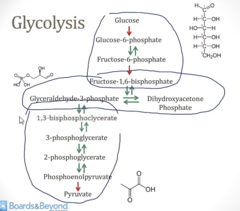
Glycolysis
- The breakdown of glucose by enzymes, releasing energy and pyruvic acid.

Glycolysis: Investment and Yield
- Investment: 2 ATP
- Yields: 4x ATP, 2x NADH, 2x Pyruvate
Nets 2x ATP because 2 are initially invested to make glucose more favorable for rest of rxns
Which cells use glycolysis? Where does it occur within cells?
- ALL cells of the body
- Sequence of rxns occur in cytoplasm
What conversion happens in glycolysis? What does it generate?
- Converts: Glucose (6 carbons) → pyruvate (3 carbons)
- Generates: ATP and NADH
NADH
- The reduced form of NAD+; an electron-carrying molecule that functions in cellular respiration
- Generated during glycolysis
Cellular Respiration
- Process that releases energy by breaking down glucose and other food molecules in the presence of oxygen
NAD+ vs NADH
- NAD+: Accepts electrons
- NADH: (Made during glycolysis) Dontaes electrons to ETC → generates ATP
Are the reactions of glycolysis mostly reversible or irreversible? What does this allow?
- Majority of rxns are reversible
Allows for:
- When the level of one substrate gets high, ex. 3-phosphoglycerate, more 2-phosphoglycerate is generated
- On the other hand if [2-phosphoglycerate] is high, more 3-phosphoglycerate would be generated
MEANS RXNS CAN BE USED IN BOTH GLYCOLYSIS AND GLUCONEOGENESIS
![<p>- Majority of rxns are reversible</p><p>Allows for:</p><p>- When the level of one substrate gets high, ex. 3-phosphoglycerate, more 2-phosphoglycerate is generated</p><p>- On the other hand if [2-phosphoglycerate] is high, more 3-phosphoglycerate would be generated</p><p>MEANS RXNS CAN BE USED IN BOTH GLYCOLYSIS AND GLUCONEOGENESIS</p>](https://assets.knowt.com/user-attachments/f8b230e8-6b71-4c77-8f04-28e277e61738.png)
Which Reactions of Glycolysis are Irreversible?
1. Glucose → Glucose-6-Phosphate
2. Fructose-6-Phosphate → Fructose-1,6-Bisphoshate
3. Phosphoenolpyruvate (PEP) → Pyruvate
What are the stages of Glycolysis?
1. Priming/Investment stage: Where the cell invests energy (spends ATP) to convert glucose to a more favorable structure to go through remaining rxns
2. Splitting Stage: The 6-carbon structure is divided into 2x 3-carbon structures
3. Energy Stage: Where ATP is generated
Glucose → Glucose-6-Phosphate: What enzyme catalyzes this rxn?
- Hexokinase
- Glucokinase
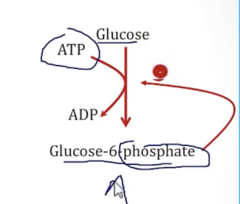
Hexokinase: Which rxn does it catalyze? Where is it found? Insulin dependent/independent?
- Rxn: Glucose → Glucose-6-Phosphate (Uses ATP)
- Location: Most Tissues
- Insulin Independent
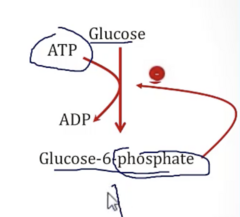
What is Hexokinase Inhibited by? Its result?
- Inhibited by G-6-P → Prevents cells from hoarding glucose
High [G-6-P] means cells have satisfied their metabolic requirements, meaning it doesn't need more glucose → prevents further rxns from Hexokinase
![<p>- Inhibited by G-6-P → Prevents cells from hoarding glucose </p><p>High [G-6-P] means cells have satisfied their metabolic requirements, meaning it doesn't need more glucose → prevents further rxns from Hexokinase</p>](https://assets.knowt.com/user-attachments/bfe74acd-7b2d-477d-b34b-a51acf28b852.png)
Hexokinase: Kinetics (Km/Vm)
- Low Km: High affinity for glucose. It binds glucose very readily, even when glucose concentration is low.
- Low Vm: Even if you give it tons of glucose, it has a relatively low maximum rate at which it can process it.

Hexokinase's low Km allows what?
- Allows tissues to efficiently use glucose even at low [c]
Glucokinase: Which rxn does it catalyze? Where is it found? Insulin dependent/independent?
- Rxn: Glucose → Glucose-6-Phosphate (Uses ATP)
- Location: Liver/Pancreas
- Induced by Insulin
What is Glucokinase Inhibited by? Inhibition is overcome by what?
- Fructose-6-Phosphate
- Inhibition overcome by ↑↑ [Glucose]
![<p>- Fructose-6-Phosphate</p><p>- Inhibition overcome by ↑↑ [Glucose]</p>](https://assets.knowt.com/user-attachments/20248cf2-9771-4812-8fd5-9d47a769c837.png)
When is Glucokinase inactive?
- In a fasting state → ↓ [Glucose] and ↑ [F6P]
- F6P is high because pyruvate is undergoing gluconeogenesis → you want to shut down glucokinase to prevent further processing of glucose
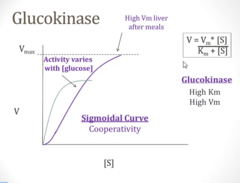
Glucokinase: Kinetics (Km/Vm)
High Km:
- Glucokinase doesn't bind glucose very well when glucose levels are low.
- It becomes much more active when there's lots of glucose around, like after a meal
High Vm:
- Once glucose is abundant, glucokinase can process large amounts of glucose quickly.
How does F6P Inactivate Glucokinase? How does Glucose overcome this inactivation?
1. F-6-P encourages Glucokinase Regulatory Protein to bind to glucokinase → translocated to the nucleus → inactivation of enzyme → no more glycolysis
2. When [Glucose] ↑↑ → Competes with GKRP for GK binding → GK goes back to cytosol where it can participate in glycolysis to generate ATP/NADH
![<p>1. F-6-P encourages Glucokinase Regulatory Protein to bind to glucokinase → translocated to the nucleus → inactivation of enzyme → no more glycolysis</p><p>2. When [Glucose] ↑↑ → Competes with GKRP for GK binding → GK goes back to cytosol where it can participate in glycolysis to generate ATP/NADH</p>](https://assets.knowt.com/user-attachments/3ad3972b-da48-4728-bc17-85d18549f548.png)
Hexokinase vs Glucokinase: What is their activity in the setting of Low blood sugar? Its result?
- Hexokinase: Active (No inhibition by G6P)
- Glucokinase: Inactive (not working when ↓ [Glucose])
GLUCOSE GOES TO TISSUES FOR USE, NOT LIVER
Hexokinase vs Glucokinase: What is their activity in the setting of High blood sugar? Its result?
- Hexokinase: Inactive (inhibited by G6P)
- Glucokinase: Active (↑ [glucose] → glucokinase freed from nucleus)
GLUCOSE GOES TO LIVER TO BE STORED AS GLYCOGEN
Glucokinase Deficiency
- If deficient → less uptake of glucose by liver/pancreas → mild hyperglycemia
Glucokinase Deficiency is exacerbated by what?
- Pregnancy
Is Glucokinase active in the fed or fasting state?
- Fed state → ↑ blood glucose → frees glucokinase from nucleus → activated
What does Glucokinase's high Vm allow?
- It's high Vm allows liver to effectively remove a FLOOD of glucose after eating → prevents large [glucose] into systemic circulation → minimizes hypoglycemia
What is the rate limiting step in glycolysis?
PFK-1
Fructose-6-Phosphate → Fructose-1,6-Bisphosphate: What enzyme catalyzes this rxn?
- Phosphofructokinase-1 (uses ATP)
- Commits glucose to glycolysis
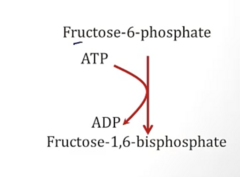
Phosphofructokinase-1: Key Inhibitors and Inducers
Inhibitors (↓ Glycolysis):
- Citrate (from TCA cycle), ATP (MEANS THE CELL ALREADY HAS HIGH ENERGY)
Inducers (↑ Glycolysis):
- AMP, Fructose-2,6-Bisphosphate (MEANS THE CELL NEEDS MORE ENERGY)
What are the roles of PFK1 and Fructose-1,6-Bisphosphatase 1?
- PFK: F6P → F16BP (Glycolysis)
- Fructose-1,6-Bisphosphatase 1: F16BP → F6P (Gluconeogenesis)
The relative activity of the two enzymes will determine if the cell utilizes glycolysis or gluconeogenesis

How do Insulin/Glucagon control the rate of glycolysis/gluconeogenesis?
- Via Fructose-2,6-Bisphoshate
Fructose-2,6-Bisphoshate
- Activates PFK-1 → drives cell towards glycolysis
- Inhibits Fructose-1,6-BP1
Fructose-2,6-Bisphoshate: What does it do when its [c] is high or low?
- High → Glycolysis ON
- Low → Glycolysis OFF
Fructose-2,6-Bisphoshate: How is it synthesized?
- Fructose-6-Phosphate, one of the molecules its supposed to regulate
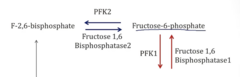
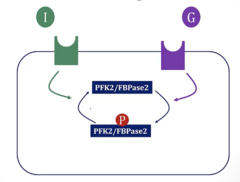
What is the role of PFK2/FBPase2?
- They control the conversion of F6P ↔ F26BP
What is the role of PFK-2 during the well fed state?
- ↑ Insulin and ↓ Glucagon → dephosphorylation of PFK-2 → ↑ fructose-2-6-BP → activates PFK1 → ↑ Glycolysis
What is the role of PFK-2 during the fasting state?
- ↑ Glucagon and ↓ Insulin → phosphorylates PFK2 → ↓ fructose-2-6-BP → inactivates PFK1 → ↑ Gluconeogenesis
How do Insulin and Glucagon affect Fructose-2,6-Bisphoshate? Its Result?
- Insulin: Dephosphorylates PFK2/F16BP → ↑ Fructose 2,6 BP → Activates Glycolysis
- Glucagon: Phosphorylates PFK2/F16BP → ↓ Fructose 2,6 BP → Activates Gluconeogenesis
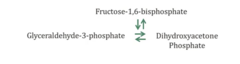
Glycolysis: Splitting Stage
- 1x (6 carbon) molecule of Fructose-1,6-BP → 2x (3 carbon) molecules of Glyceraldehyde-3-Phosphate
Glycolysis: Energy Stage
- Starts with 2x Glyceraldehyde-3-Phosphate → ends in pyruvate
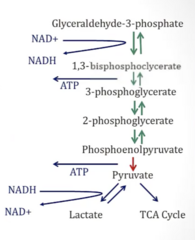
What Is Generated During the Energy Stage of Glycolysis?
- 4 ATP, 2 NADH (2x ATP and 1x NADH per GAP, and there are 2x GAP)
- 2 net ATP generated because 2x are used during investment stage
Phosphoenolpyruvate → Pyruvate: What enzyme catalyzes this rxn?
- Pyruvate Kinase: transfers phosphate from PEP to ADP → ATP
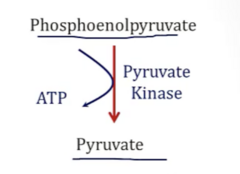
Pyruvate Kinase: Key Inhibitors/Inducers
- Inhibitors: ATP and Alanine
- Inducers: Fructose-1,6-BP (Feedforward activation)
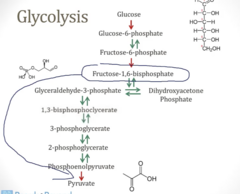
What effect do Glucagon/Epinephrine have on Pyruvate Kinase? Its result?
- They phosphorylate it → inactivates PK
- Slows glycolysis and favors gluconeogenesis
Alanine: Where is it made/why? What do its levels in the body indicate?
- Where/Why: Skeletal muscles degrade proteins for energy → produces alanine → sent to blood/liver
- Indicates: A lack of glucose throughout the body
Why is Alanine an Inhibitor of Pyruvate Kinase?
- Indicates low [glucose] in body bc muscles are degrading proteins for energy
- When alanine goes to liver, it inhibits PK → slows down glycolysis; liver then converts alanine back into glucose via gluconeogenesis → sent back to muscles as glucose for energy
![<p>- Indicates low [glucose] in body bc muscles are degrading proteins for energy</p><p>- When alanine goes to liver, it inhibits PK → slows down glycolysis; liver then converts alanine back into glucose via gluconeogenesis → sent back to muscles as glucose for energy</p>](https://assets.knowt.com/user-attachments/60ed9c74-bd7e-460e-a404-5a144b4ea92f.png)
What is the end product of glycolysis? What can it generate?
- Product: Pyruvate
- Generates: Lactate or Acetyl-CoA (for TCA)
What happens when the TCA cycle is unavailable? (Ex. ↓ O2)
- Pyruvate is shunted to lactate
Lactate Dehydrogenase
- Converts pyruvate to lactate, uses NADH (regenerates NAD+)

When are levels of Lactate Dehydrogenase common?
- Hemolysis
- Myocardial Infraction
- Tumors
Level of NAD+ in cells
- They have a limited supply NAD+, needs to be regenerated in order to continue conducting glycolysis
How is NAD+ regenerated: O2 present vs O2 Absent?
- Present: NADH made in glycolysis can go to mitochondria → NAD+ regenerated in oxidative phosphorylation (that makes ATP)
- Absent: TCA/Oxidative phosphorylation are not available; pyruvate → lactate is important for regenerating NAD+
Under anaerobic conditions, pyruvate is converted to what?
- No O2 → No TCA → Shunted towards lactate via lactate dehydrogenase
Why do cells prefer aerobic conditions?
- So they can use TCA to generate more ATP
Lactic Acidosis: MOA
1. ↓ O2 → ↓ Pyruvate entry into TCA → Shunted to Lactic acid production to regenerate NAD+
2. ↑ Lactic acid → ↓ pH and HCO3

When is Lactic Acidosis seen clinically?
- Sepsis, bowel ischemia, seizures
Too much exercise can result in what?
1. Excessive exercise → NAD+ overcomsumed (TCA can't keep up)
2. Cells favor pyruvate → lactate
3. ↑ Lactate → ↓ pH in muscles → cramps
Pyruvate Kinase Deficiency: Inheritance; What age does it present at?
- Autosomal Recessive
- Usually presents in newborns