Memory
 Call Kai
 Learn
 Practice Test
 Spaced Repetition
 Match
 Flashcards
 Knowt Play
1/84

There's no tags or description
Looks like no tags are added yet.
85 Terms
What is memory not like?
A video
Get too much information + only some of this is relevant
Memory system is built for getting a lot out of a little
Store a few bits
Infer what you need from them
What are the 7 sins (failures) of memory?
Transience → fade over time
Retrieval failures
Disuse
Absent-mindedness
Shallow encoding
Blocking → tip-of-the-tongue
Interference
Misattribution → regarding sources
Encoding of meaning not details
Suggestibility → e.g. misleading questions
Encoding of meaning
Reconstructive nature of memory based on available cues
Bias
Retrieval based on cues -> current self-knowledge is a powerful cue
Persistence → forget some things + not others
Rehearsal
Suggestive of how memory works
What is the modal model of memory?
Different memory stores
Control processes → dictate movement of info between stores
Sensory store
Holds info from senses long enough to allow processing for basic characteristics
Large capacity
Short duration
Shortest retention time
No manipulation of incoming info occurs → transferred (amount of info is reduced because capacity of WM is not large enough to cope with sensory input) to WM

What process occurs at the sensory store?
Attention → shadowing task → filter theory
Filtering of info is based on specific physical properties of stimuli
For every frequency there exists a distinct nerve pathway → attention control selects which pathway is active + can thereby control which info is passed to the WM
Also happens semantically
What is attenuation theory?
We attenuate information which is less relevant, but don’t filter it out completely → also semantic info of ignored frequencies can be analysed but not as efficiently as those of the relevant frequencies
Explains empirical results of revised shadowing task more accurately
What is late selection theory?
All info is analysed first and afterwards the decision of the importance of info is made
What are the subtypes of sensory information?
Iconic = visual info
Lasts ms, up to 1s
Echoic = auditory info
Lasts up to fives
Haptic + olfactory
How did Sperling research iconic information?
Present PPTs with matrix of letters for 1/20th of a second + record as many of these as possible
PPTs only report half
Not enough time to view whole matrix
Enough time but representation doesn't last long enough to answer question
Used tone sounds in another variation → PPTs report only letters indicated by tone
If manipulation doesn’t affect performance, the issue is limitation in perception
If PPTs can remember any row then the issue is NOT perceiving, but that the perception does not last
Result: PPTs can recall any row given the tone
Conclusion: People can see and recall all letters, but memory only lasts a few ms

How can X and Y be binded together?

What is the STM?
Sensory memory forms automatically
Attention is needed to transfer info beyond the sensory story
System that keeps recently perceived or recalled info active + available (processing of info) → what you're currently thinking about
Keeping track of things in the world
Processing stuff for dealing with the world
Isn't passive → process info
System for holding + processing → NOT JUST STORAGE SPACE
more than a second but less than a minute
Processed further but discarded unless effort is used to keep memory alive
How did Wickens (1972) contribute to the understanding of STM?
PPTs given a list of words from category-A (e.g. animals)
PPTs are asked to recall words
PPTs given a second, third, and fourth list from category-A
On each subsequent recall phase, performance suffers
Gave some PPTs a list from category-B → performance returns to peak level
STM is actively processed → processing 2 sets of similar info leads to interference
We are actively processing, interpreting, encoding + using info about the category or the semantics of the info while the info is in STM
What are the features of STM?
Limited capacity
Peterson + Peterson
80% after a 3-second delay to less than 20% after a 20-second delay (memory for consonant strings)
Info held for 15-20s
Limited duration
Keeps info available + integral
Integration requires a bunch of independent info together + binding
Rehearsal keeps info available → re-entering the item into the STM (gives it another 15-20s shelf life)
Elements must be active + distinguished → fire at different times or lose what-goes-with-what
Don't want them to overlap or go off completely
Let signal decay (is lost) → only have a finite amount of time before you lose a binding (time based binding)
Limited amount of time like this → only so much you can keep distinct + action → go longer + lose what was at the beginning
What helps us overcome the limitations of STM?
Processing
E.g. chunking = combining multiple pieces of info together in a single unit/code → takes up less space (make more use of our limited WM); collection of elements that are strongly associated with one another but are weakly associated with other chunks (Goldstein, 2005)
Enhances performance only in specific memory tasks (Chase + Simon, 1973)
Result of active processing of info in STM
What is working memory?
Cognitive system that provides temporary storage for manipulation of info
Active maintenance + manipulation of info in ST storage
What is Baddeley’s WMM?
WM = 3 processing units/systems (stores + CE)
Echoic vs iconic info in the stores

What is the phonological loop?
Responsible for auditory + verbal info
Briefly encodes mental reps of sounds
Short-term store
Articulatory rehearsal system
Active = rehearsal → deepens memory
Passive = storage of information (fades after two seconds if the information is not rehearsed explicitly)
Supported by:
Phonological similarity effect = words that sound similar are confused
Word-length effect = more difficult to memorize a list of long words and better results can be achieved if a list of short words is memorized
Articulatory suppression
What is the visuospatial sketchpad?
Info about the position + properties of objects can be stored
Brandimote
What is the central executive?
Coordinates activity
Links WM + LTM → controls the storage in LTM + the retrieval from it
Process of storage is influenced by the duration of holding information in Working Memory and the amount of manipulation of the information
The latter is stored for a longer time if it is semantically interpreted and viewed with relation to other information already stored in Long Term Memory (deep processing)
Shadow processing = pure syntactical processing
Initiating movement
Control of conscious attention
BUT cases have been reported where patients could form Long Term Memories even though their STM-abilities were severely reduced SO all info may not pass to WM to be stored in LTM
What is the episodic buffer?
Temporary storage space where info from long-term memory can be integrated into working memory
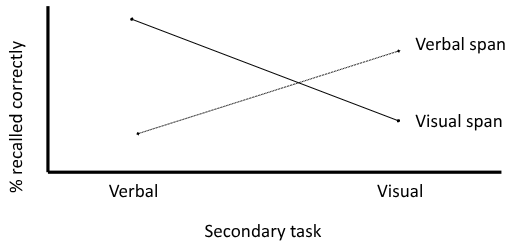
How does Logie, Zucco and Baddeley (1990) support Baddeley’s WMM?
Dual-task paradigm → not a single unit
Enables us to perform several cognitive operations at a time with different parts of the Working Memory
If 1 task interferes with another, they use (at least some of) the same resources
Verbal/visual memory + verbal/visual span tasks
Memory task → remember a string of letters or a sequence of coloured squared
Spane task → identify capital letters from a sequence of letters or add numbers from a sequence of numbers
Canonical interaction
What evidence supports the division between LTM and STM stores?
Profile of memory loss from amnesiac patients
CW
Can retrieve memories from years ago BUT not minutes
HM
Parts of temporal lobes removed (hippocampus)
Couldn’t remember things that happened to him after the operation (e.g. forget that he had just eaten a meal or fail to recognise the hospital staff who helped him on a daily basis)
What is LTM?
Built for retaining relevant knowledge + filling in/augmenting incomplete info
Based on input from WM
Encoding is affected by level of processing
Encoding is active
The initial processing of a stimulus that leads to a rep of that stimulus in memory
Done via:
Rehearsal (practice)
The deeper/more actively you process something, the better you are at remembering it
BECAUSE you understand how info fits together, not just isolated facts
Memory is a function to encode meaning rather than just facts → extract important details, like meaning, + store these
What are the 2 types of LTM?
Declarative (conscious)
Implicit (unconscious)
What is declarative memory?
Episodic
Semantic
What is episodic memory?
Events
Temporally structured
Reconstructive → rebuilt from available cues (can be from environment or memories themselves) → malleable
Bransford + Johnson (1972)
Give PPTs ambiguous passages to read
Viewing a peace protest vs. taking a trip to another planet
Recalled details = function of interpretation
“atmosphere did not require special clothing” and such details about clothing were recalled more frequently for those interpreting story as about space travel
Recall some bits + infer the rest → more cues = easier to recall
Tulving + Pearlstone (1966)
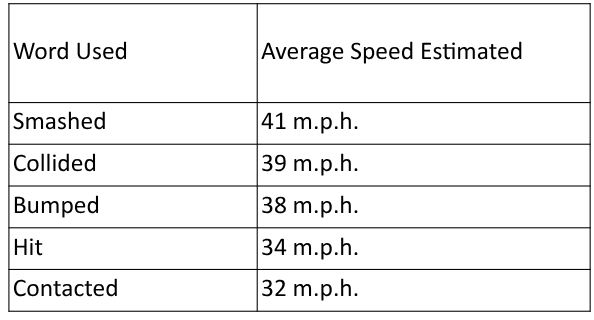
What was Loftus’ (1978) research into episodic memory?
PPTs see a series of 30 slides telling the story of an event
Car drives down street
Car stops at stop sign
Car turns right
Car appears to knock down pedestrian in crosswalk
PPTs answer series of 20 qs about accident
Consistent q: “Did another car pass the first car when it was stopped at the stop sign?”
Inconsistent: “Did another car pass the first car when it was stopped at the yield sign?”
Later asked about which slides they had seen
When slide had a yield sign, PPTs who received “yield” q 34% more likely to say had seen slide before
1974 → words + car study
What was Garry’s (1996) research into episodic memory?
PPTs fill out surveys containing events and check which ones have happened to them in life
PPTs engage in imagination exercise (image themselves doing several new things)
Come back a week later and fill out surveys again
Results: many PPTs now check off events they imaged as having happened to them
What is semantic memory?
Scripts = blueprints of what happens in a certain situation
Closely related → memory of facts might be enhanced by interaction with memory about personal events and vice versa
Facts + categories (meaningful classes + links)
Organised by content → similar concepts cue one another
Permits powerful inferences → not tied to source
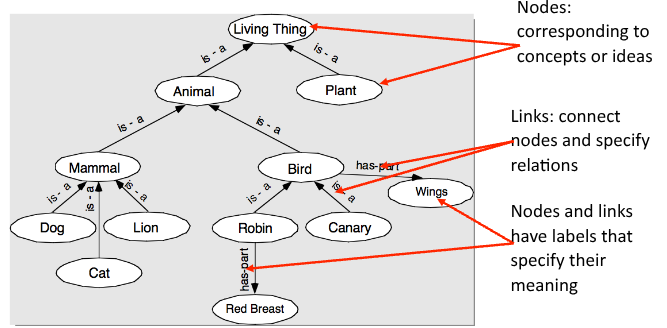
Hierarchal model of Collins + Quillian (1972)
Allows efficient storage → inference + deriving info (no need to directly represent info)
Spreading activation effect
As other concepts are getting activated, activation is spreading around the network of related concepts -> false memories
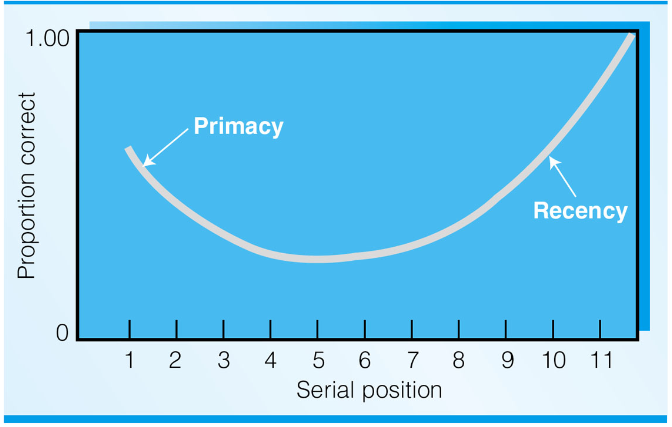
Serial position curve
Primacy effect
Due to rehearsal + less content
Recency effect
Didn't have time to fade
Tendency to recall items at the start or end of a list better than items in the middle of the list → interference is best explanation
Recall what's most active
What is implicit memory?
Procedural
Responsible for highly skilled activities that can be performed without much conscious effort
Motor
Perceptual
Cognitive
Priming effects
Perceptual
Semantic
Perfect + Askew (1994)
Conditioning
Non-associative
Habitutation
Sensitisation
What did Craik and Lockheart (1972) argue about the LTM?
Active processing affects the amount that you recall → level of processing phenomenon
A memory is a function of how that item is processed
Memory is affected by the material being learned AND how material is processed
Craik + Tulving (1975)
Present PPTs with words → answers one of three types of qs about word
What case (upper/lower) is the word typed in?
Requires processing only font
Does the word rhyme with _______?
Requires processing a word’s sound
Does the word fit in this sentence: x y ______ z?
Requires processing a word’s meaning
Results: Case → 17 % recalled; Rhyme → 37 % recalled; Meaning → 65 % recalled
What is LTP?
Existing synaptic proteins are altered + new proteins are synthesized at the modified synapse
Most easily generated in regions of the brain which are involved in learning and memory
Neurons firing together build excitatory connections
Neurons firing at different times build inhibitory connections
Transforms new memories from a fragile to a more permanent/stable state
Synaptic consolidation → occurs at synapses over a matter of mins
Fast learning of info in hippocampus is available for a number of weeks
Systems consolidation = gradual reorganisation of entire circuits in cortex (lasts weeks or more)
Slow learning of general behavioural responses (LT storage in cortex → available for much longer + harder to get rid of)
How is the amygdala involved in memory?
Modulation of memory consolidation → info regarding the event is slowly assimilated into LT storage over time
Mediates the effects of emotional arousal on the strength of the memory for the event
James McGaugh
BUT learning can occur without this (even if it is impaired)
Amygdala activity at the time of encoding information correlates with retention for that information BUT this correlation depends on the relative "emotionality" of the info
More emotionally-arousing info increases amygdalar activity → activity correlates with retention
How is the hippocampus involved in memory?
Plays an essential role in the formation of new memories about experienced events (Episodic or Autobiographical Memory)
Part of a larger medial temporal lobe memory system responsible for general declarative memory
Ceases to play a crucial role in the retention of the memory after a period of consolidation
Damage → difficulty forming new memories (anterograde amnesia) + normally also affects access to memories prior to the damage (retrograde amnesia)
Retrograde effect (anterograde amnesia) + normally also affects access to memories prior to the damage (retrograde amnesia)
BUT researchers have difficulties in testing the sparing of older memories + (in some cases of retrograde amnesia), the sparing appears to affect memories formed decades before the damage to the hippocampus occurred → its role in maintaining these older memories remains controversial
Recall diagrams

What is collective memory?
Shared in a group
What is autobiographical memory?
Remembering specific events that have happened over the course of one's entire life (e.g. experiences in year 6)
How can forgetting a misremembering (false recall or recognition) be explained?
Stages are not as discrete as we think → depend on one another
E.g. how we encode info determines how it will be stored + what cues will be effective when we try to retrieve it → the act of retrieval itself also changes the way info is subsequently remembered (usually aiding later recall of the retrieved info)
What is encoding?
Selective → attend to some events in our environment + ignore others
Prolific → always encoding events of our lives (attending to the world + trying to understand it)
Pay specific attention to stimulus outside of daily routine
istinctiveness = having an event stand out as different from the background of similar events) → key to remembering
Emotional content also improve memory -> flashbulb memory (vivid memory of finding out an important piece of new, distinct + emotional)
What we remember, at best is what we encoded (selective)
Always involves recoding = taking the info from the from it is delivered to us + converting it in a way that we can make sense of it (can happen unconsciously)
What are the weaknesses of encoding (especially recoding)?
Can introduce errors → accidentally adding info + remember this new material instead (making false memories from our inferences)
Stadler, Roediger, & McDermott (1999)
Deese-Roediger-McDermott effect
Brewer (1977) → pragmatic inferences/conclusions
What recoding strategies improve retention?
Making associations
Imagining events also makes them more memorable; creating vivid images out of information (even verbal information) can greatly improve later recall (Bower & Reitman, 1972)
Form distinctive memories
What is storage?
Experiences leave memory traces/engrams (physical change in the NS that reps our experience)
Memories have to be stored somewhere in the brain → the brain biochemically alters itself + its neural tissue
Events create engrams through consolidation (the neural changes that occur after learning to create the memory trace of an experience)
Remembering involves a reconstruction with the aid of our memory traces + our current belief of what happened (reconstructive vs reproductive)
Retention interval = time between learning + testing
What occurs in the retention interval?
Consolidate memories during this time
Retroactive (new affects old, one of main causes of forgetting) + proactive (old affects new) interference
Misinformation effect = type of retroactive inference occurring during retention interval
Loftus + Palmer
Although interference may arise between the occurrence of an event and the attempt to recall it, the effect itself is always expressed when we retrieve memories
What does consolidation allow?
Transference + stabilisation of memory
Shortly after encoding, memories exist in a fragile state that can be disrupted easily → more resistant to disruption after consolidation
What does consolidation involve?
Transfer of info from the hippocampus to more permanent storage sites in the cortex
Act of recalling a memory, thinking + talking about it with others probably contributes to consolidation + boosted by sleep
Why does reconsolidation occur?
Memories can become vulnerable to disruption when they are recalled → need to be consolidated again
May be possible to modify traumatic memories by disrupting reconsolidation
What was Kredlow and Otto’s (2015) research into reconsolidation?
2013 Boston marathon bombing → recalled event + then read a positive, neutral or negative story
Then recalled memories
Students who read a negative story shortly after memory reactivation recalled significantly fewer details about the bombing than they had initially
Those who read positive or neutral stories showed smaller, non-significant reductions in recalled details
Reading the negative story appeared to interfere with reconsolidation of students’ negative memories of the bombing
What is retrieval?
Available info = stored in memory BUT how much + what types are stored isn't known
Accessible info = what info we can retrieve
Thought to represent only a tiny slice of the information available in our brains
Encoding specificity principle
For a retrieval cue to be effective, a match must exist between the cue + the desired target memory + to produce the best retrieval, the cue-target relationship should be distinctive
Production tests = involving recall
Recognition tests = involving the selection of correct from incorrect info
The act of retrieval makes the retrieved memory much more likely to be retrieved again → testing effect or the retrieval practice effect (Pyc & Rawson, 2009; Roediger & Karpicke, 2006)
Retrieving some info can actually cause us to forget other info related to it, a phenomenon called retrieval-induced forgetting (Anderson, Bjork, & Bjork, 1994)
To max retrieval, we should construct meaningful cues that remind us of the og experience + those cues should be distinctive + not associated with other memories
What is the encoding specificity principle?
To the extent a retrieval cue matches or overlaps the memory trace of an experience, it will be effective in evoking the memory
Godden + Baddeley (1975)
BUT for the cue to work, it can’t match too many other experiences (Nairne, 2002; Watkins, 1975)
Cue overload principle = to be effective, a retrieval cue cannot be overloaded with too many memories
Relates to distinctiveness
What are the weaknesses of recognition tests?
Imperfect → you can fail to recognise a target staring you right in the face, yet be able to recall it later with a different set of cues (Watkins + Tulving, 1975)
Recall can sometimes lead to better performance than recognition → explained by the encoding specificity principle
Recognition failure of recallable words = highlights the point that a cue will be most effective depending on how the information has been encoded (Tulving + Thomson, 1973)
Best cues → recreate the event or name to be remembered (whereas sometimes even the target itself is not the best cue) → which cue will be most effective depends on how the information has been encoded
What technique can be used to improve memory?
Mnemonic
Peg word technique (used to remember discrete items) → form a vivid image of what you want to remember + imagine it interacting with your peg words
Items to be remembered need to be presented relatively slowly at first, until you have practice associating each with its cue word
What is the function/role of forgetting?
Mind would become cluttered with out of date/irrelevant info
Evidence that some forgetting is a prerequisite for more learning
Benefits of distributing practice opportunities may arise in part because of the greater forgetting that takes places between those spaced learning events → some encoding activities that are difficult + lead to the appearance of slow learning actually lead to superior learning in the long run (Bjork, 2011)
What do memory failures occur from?
Capacities/processes being overstretched in each store
What are the types of forgetting?
Trace decay
Need to follow a certain trace to recall a memory
If this hasn't be used → the activity of the info decreases → difficulty/inability to recall the memory
Interference
Forgetting curve (Ebbinghaus)
Repression = not easily remembered
Recovery → usually occurs due to retrieval cues
Intentional forgetting (Bjork)
Increase likelihood to be forgotten info is recalled
Attempting to forget → rehearsal → improved memory
OR
→ making connections → more connections = improved memory
Transcience
Blocking
What is transcience?
Forgetting what occurs with the passage of time
Occurs during storage phase of memory after an experience has been encoded + before retrieval
Don't fade at a constant rate as time passing → most forgetting happens soon after an event occurs (increasingly less forgetting as time passes)
Decay + interference contribute to this
Quality of memory changes → relatively detailed record to reliance on general memories + reconstruction (+ guesswork)
Involves gradual switch from specific to general memories
Caused by new experiences + memories created overtime -> interferences → serial position effect (enhanced memory for events presented at the beginning + end of a learning episode)
Recency effect
Primacy effect
Memories are actively processed + incorporated with existing memories + subsequent experiences
What is blocking?
Failure to retrieve info that is available in memory even though you are trying to produce it
E.g. tip-of-the-tongue experience
Frequently recall similar works, know the first letter but not the final/middle letters
Occur especially often for names of people + places → links to related concepts + knowledge are weaker than for common names
Blocked less often on descriptive names than arbitrary names
Name blocking usually results from damage to parts of the left temporal lobe on the surface of the cortex, most often as a result of a stroke
Studies that show strong activation of regions within the temporal lobe when people recall proper names support this idea (Damasio, 1996; Tempini, 1998)
Retrieval failure
Occurs more often with age (60-70s)
Some people with brain damage live in this perpetual state
What is absentmindedness?
Lapse in attention that results in memory failure
Caused by failures in attention, shallow encoding + influence of automatic behaviours
Often associated with forgetting to do things in the future
What is divided attention?
Individuals simultaneously monitor more than one source of info
Greater activity in the lower left frontal region during encoding is associated with better memory → PPTs show less activity in the lower left frontal lobe when their attention is divided (Shallice, 1994)
Dividing attention prevents the lower left frontal lobe from playing its usual role in elaborative encoding → absentminded forgetting
Lower left frontal lobe linked to automatic behaviour → cause of absentminded errors (associated with low levels of prefrontal activity → shallow, not elaborative, encoding)
What is an upside to forgetting?
Savings in relearning
Burtt (1941)
Reading Greek passages to 15 month olds
Tested at 8.5, 14, 18
At each age child is faster + better at learning old ones
What are some biases in memory?
Egocentric = seen in best possible light
Consistency = attitudes remain persistent over time
Positive change = one perceives things to be generally improving
Misleading post event info
Loftus + Palmer (1974)
Misinformation effect + memory impairment hypothesis = suggestible + more detailed info that one receives after having made the actual memory can replace the old memory
Confabulation = constructive absurd + incomplete memories that can be contradictory (done by people with lesions in the brain) → firmly convinced despite acknowledgement of absurdity
What is Korsakoff’s syndrome/amnesia?
LT alcoholism usually elicits this Korsakoff’s amnesia due to a prolonged deficiency of vitamin B1
Associated with the pathology of the midline diencephalon including the dorsomedial thalamus
What is Alzheimer’s disease?
Neurodegenerative disease
Most affected region = entorhinal cortex
Forms the main input + output of the hippocampus → damages here are mostly severe
What is amnesia?
Anterograde amnesia = the inability to transfer new information from the short-term store into the long-term store
Retrograde amnesia = the inability to retrieve information that was acquired before a particular date, usually the date of an injury or operation
Different aspects of a single memory are stored in different places in the cortex (e.g. concert)
Hippocampus gathers these together to have a single, integrated memory → index which links these together
When people repeatedly recall experiences, the bits + pieces start to become integrated → no longer need the hippocampal index to tie them together
Explains why people like patient HM cannot make new memories but can remember old ones
What is temporary amnesia?
Result of head injury or extreme psychological state
Concussion = mild traumatic brain injury affecting brain function → often associated with memory loss
Retrograde amnesia for events just prior to the injury, which suggests that memory of the events is only held in a temporary store and does not become encoded into long-term memory
Fugue state = amnesia of one's previous life + identity
Response to or means of coping with distressing life crises (bereavement, divorce, criminal prosecution)
What is retrospective memory?
Info learned in the past
Concerned with what should be remembered
What is prospective memory?
Remembering to do things in the future
Concerned with when something should be remembered
Remembering what to do in the future + remembering to do it → self-monitor (requires conscious awareness + attention → supported by frontal lobes)
People with damage to frontal lobes may have problems with prospective memory but not retrospective
What are the 2 types of prospective memory?
Event based
Requires an action when an event occurs
More likely to be triggered by external cue
Time based
Requires an action when a certain time/interval is reached
Harder to remember -> usually require monitoring the passage of time
What age do memories usually date from?
3-5 years
Sheingold + Tenney (1982)
PPTs who were at least 3 years old at the time of the birth of their sibling remembered it in considerable detail, whereas participants who were younger than 3 years old at the time of the birth remembered little or nothing
What are the explanations for childhood amnesia?
May be due to brain regions necessary for episodic memory not being fully mature
Early memories are procedural → autobiographical memories depend on maturation of hippocampus + neocortical regions of the brain (takes place around 2yo)
Other possible explanations address the role of language and knowledge to form schemas that make sense of experiences and help to encode memories (Simcock + Hayne, 2002)
Why type of memory increases as children learn about the world?
Semantic memory → become more skilled at organising, storing, retrieving info + using strategies to remember
Facilitated by parent–child reminiscing → adults talk to their children about the day’s events
The typical 2-3yo barrier for childhood amnesia can be made younger if parents provide a narrative framework of interpretation → help children make sense of their experiences + form better memories (Nelson + Fivush, 2004)
This may also explain cultural differences in childhood amnesia
Why does memory decline again in later adulthood and older age?
Mostly as a result of a change in processing efficiency + inhibition
What is metamemory?
Subjective awareness of one's own memory → how we know that our memories are correct (difference between remembering + knowing)
Remember → vivid recollection of encoding info + can access that info in consciousness
Associated with episodic memory
Knowing → don't necessarily remember how + where you learned the info
Associated with semantic memory
Can know something without remembering it BUT still certain that we would recognise it if we came across it
What is the ‘feeling of knowing’?
Subjective awareness of info that can't be retrieved from memory
Reveal that individuals are aware of the contents of their memory even though the info isn't explicit
Strong FOK judgements are related to increasing amounts of partial info
Partial info predicts whether the individual experiences a sense of remembering or simply knowing
Experts almost always recall more info accurately than novices, BUT no difference in recognition tests → bg knowledge helps to elaborate the memory trace they were forming while reading the stories by providing more points of reference + context
What is source monitoring? What are the 3 types?
The process of determining when, where + how info was acquired
Internal
Externak
Reality
What is internal source monitoring?
Involves distinguishing between events that an individual thought about doing versus events they actually did
Perceptual details are critical for establishing the validity of the memory
What is external source monitoring?
Involves distinguishing between two external sources
Contextual info helps decide the likely source of the memory
What is reality source monitoring?
Involves distinguishing between an actual event + an imagined one
Reality can usually be checked against corroborating evidence, (e.g the presence of other witnesses + the existence or otherwise of such a video)
Although there is still considerable scope for groups of individuals to falsely remember an event
Which people are especially prone to source monitoring errors and why?
People with damage to frontal lobes → play a significant role in effortful retrieval processes, which are required to dredge up the correct source of a memory
What are memory misattributions?
Assigning a recollection or idea to the wrong source → false memories
Can explain déjà vu = feel that you've been in a situation before though you can't recall any details
A present situation that is similar to a past experience may trigger a general sense of familiarity that is mistakenly attributed to having been in the exact situation previously (Reed, 1988)
déjà vécu = a confabulated memory where the individual is certain that the new experience is old
When the experience is particularly intense + the person can’t tell that a situation is new → may believe that they’re really reliving a familiar experience
When are memory misattributions likely to occur?
When people experience a strong sense of familiarity about a person, object or event BUT lack specific recollections
What is false recognition?
Feeling of familiarity about something that hasn’t been encountered before
Words included in the list may be related/associated with words falsely recognised → become more activated (similarity leads to confusion in memory)
Many of the same brain regions are active during false recognition + true recognition (e.g. hippocampus)
PET experiment → part of the auditory cortex (on the surface of the temporal lobe) showed greater activity for words that had actually been heard earlier in the experiment than for associated words such as needle or sweet, which had not been heard previously (Schacter, 1996b)
Later fMRI study → true recognition of previously studied visual shapes produced more activity in parts of the visual cortex than false recognition of new shapes that looked similar to those previously studied (Slotnick + Schacter, 2004)
According to Goff and Roediger (1998), what plays an important role in constructing false memories?
Visual imagert
How can false memories be reduced?
Presenting distinctive info + encouraging PPTs to require specific recollections of seeing the picture before they say yes on a recognition test
What are the 3 types of bias?
Consistency bias = altering past to fix the present
Change bias = exaggerating differences between past + presence
Egocentric bias = distorting past to make us look better
What is suggestibility?
Tendency to incorporate misleading information from external sources into personal recollections
Closely related to memory misattributions → converting suggestions into inaccurate memories must involve misattribution
Unlike suggestibility, however, memory misattribution often occurs in the absence of specific suggestions
People develop false memories in response to suggestions for some of the same reasons that memory misattribution occurs
We do not store all the details of our experiences in memory, making us vulnerable to accepting suggestions about what might have happened or should have happened
What is persistence?
Intrusive recollection of events that we wish we could forget
High emotion → high remembrance → undesirable consequences
Associated with traumatic events
Amygdala influences memory storage by turning on the hormones that allow us to respond to and vividly remember emotionally arousing events