4.1 & 4.2- Stereoisomerism and Aromaticity
 Call Kai
 Learn
Learn Practice Test
 Spaced Repetition
 Match
Match Flashcards
 Knowt Play
1/56

There's no tags or description
Looks like no tags are added yet.
Name | Mastery | Learn | Test | Matching | Spaced | Call with Kai | Chat |
|---|
No analytics yet
Send a link to your students to track their progress
57 Terms
Define structural isomerism
Compounds that have the same molecular formula but differ in their arrangement of atoms
What are the three different types of structural isomerism?
Chain
Position
Functional group
What is chain isomerism?
When isomers have different branches or are straight chain
Position isomerism?
Same molecular formula functional group in different position.
Functional group isomerism?
same molecular formula but different functional group
Define stereoisomerism
Compounds that have the same shortened structural formula but have a different arrangement of atoms in space
What are the two types of stereoisomerism?
E/Z and optical
What does E/Z isomerism occur in?
Compounds that have a C to C double bond as there is restricted rotation around the double bond
Both carbon atoms each have two different groups attached to them
When it is E and when is it Z?
E when the groups with the highest atomic number on each carbon are on opposite sides
Z when the groups with the highest atomic number on each carbon are on the same side
How do molecules have optical isomers?
When their mirror images are non-superimposable
What is a chiral centre?
A carbon atom with four different groups attached to it
What can a chiral centre not have?
A double bond attached to it
Know how to draw non-superimposable images
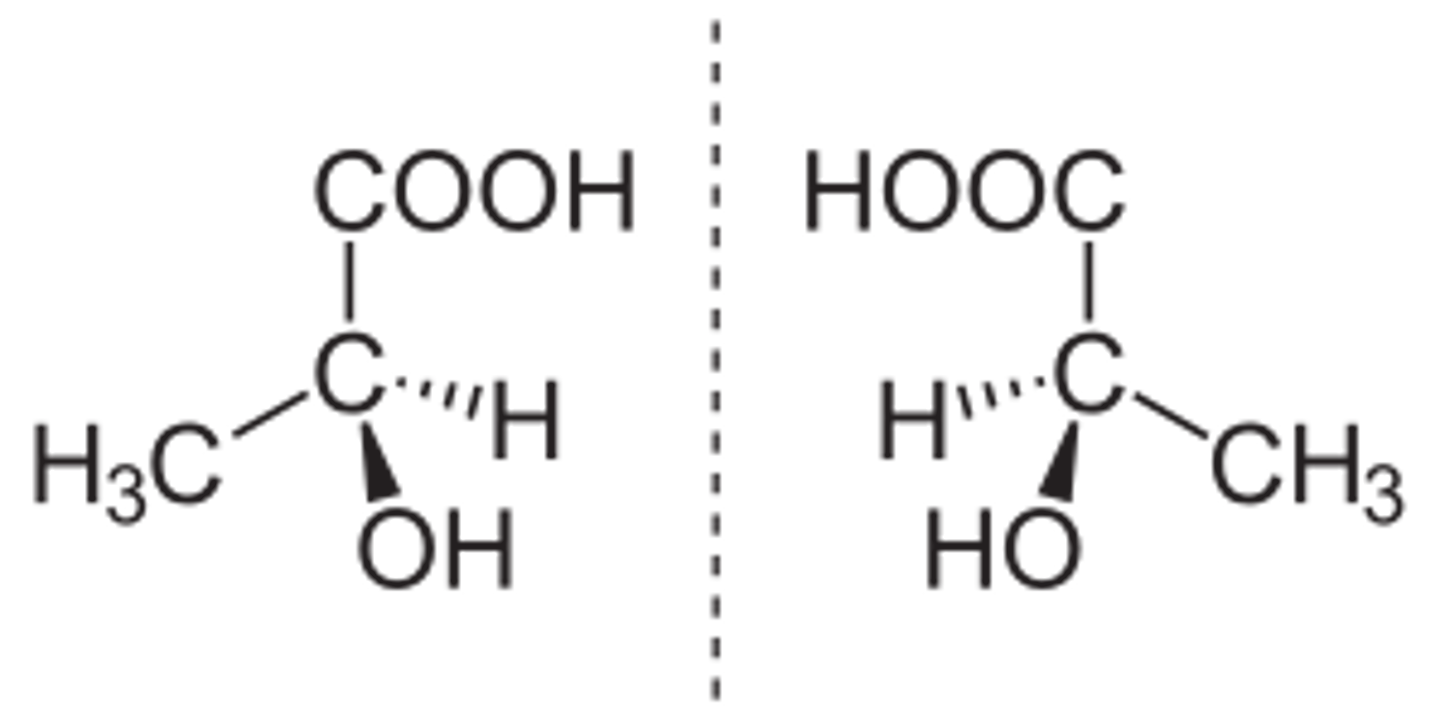
What are the properties of optical isomers?
1. Their physical properties are identical except for the direction of rotation of plane-polarised light, as an enantiomer may rotate the plane-polarised light to the right or left
2. They react at different rates with optically active reagents
Are their chemical properties the same?
Yes
What are enantiomers?
A pair of optical isomers
What is an equimolar mixture/ racemic mixture?
Optically inactive as there is no overall rotation of plane polarised light
What do arenes have?
One or more rings of carbon atoms in which the bonding electrons are delocalised
What is one example?
Benzene C6H6
What is its structural formula?
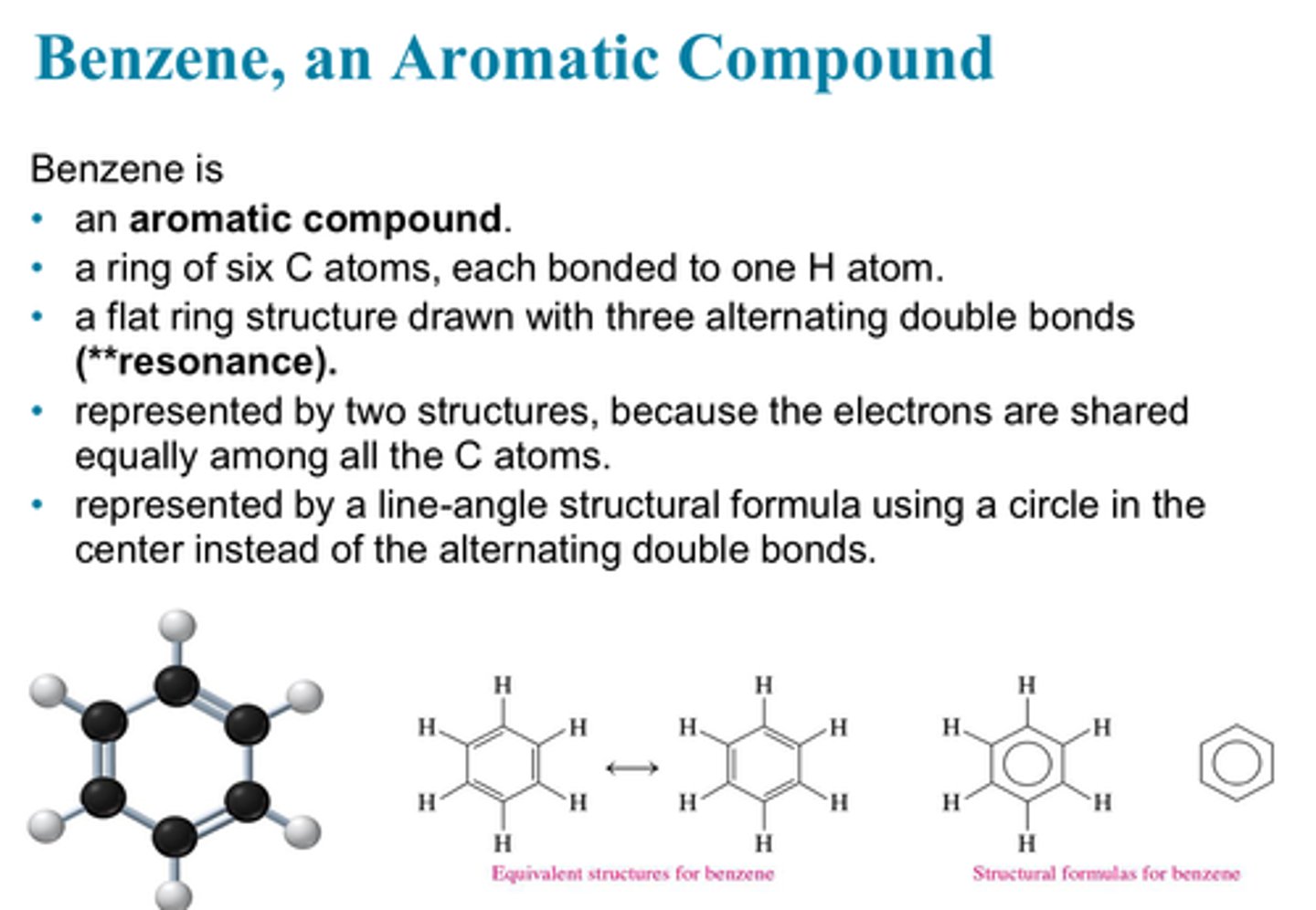
What is the Kekule structure?
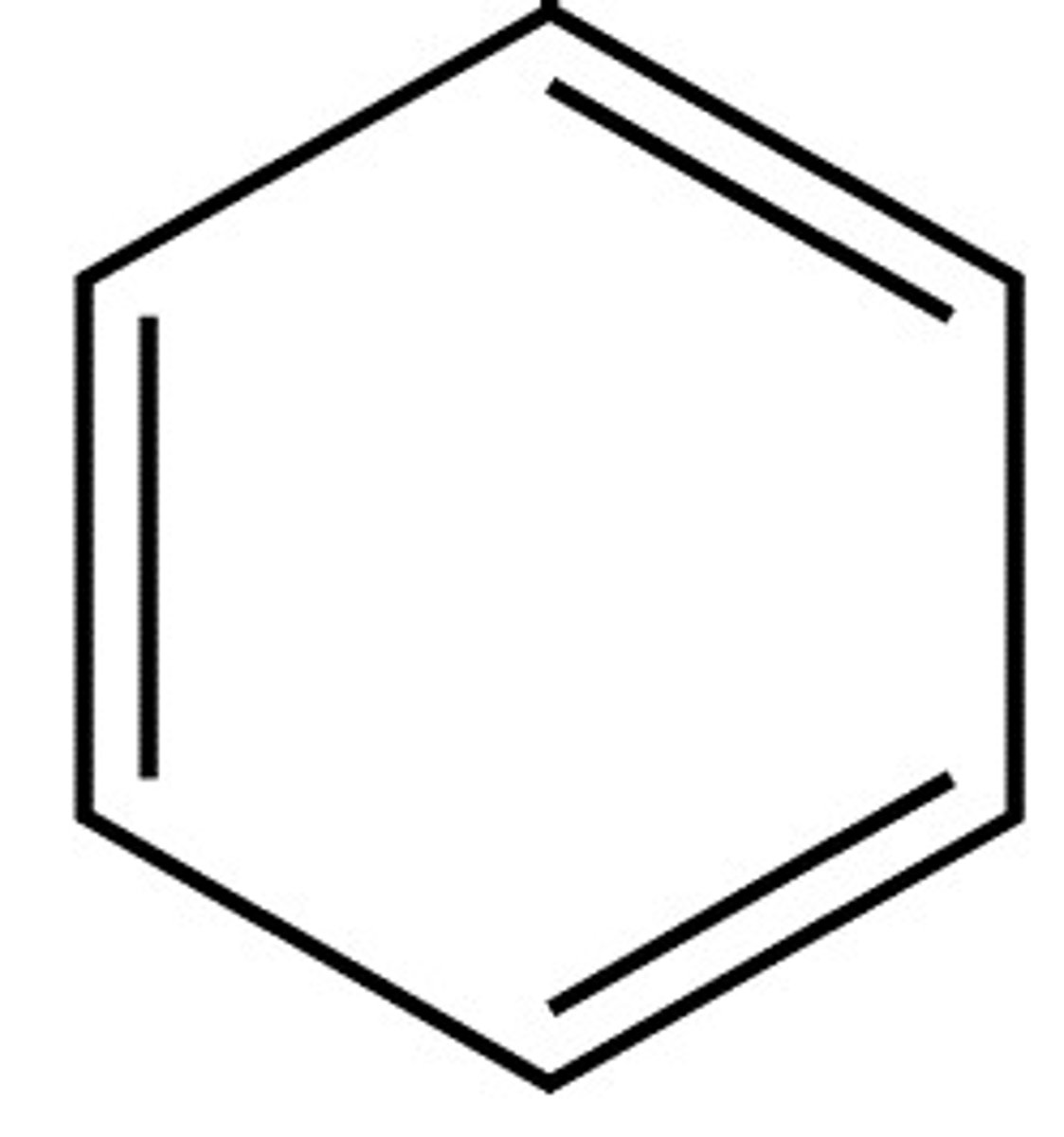
Why is the delocalised structure more accurate?
1. Bond length
2. Resistance to reaction
3. Enthalpy change of hydrogenation
Explain bond length
Single and double bonds do not have the same length. If kekule, the double bonds would be shorter than the single, but all of the bonds in benzene have a length intermediate between single and double
Resistance to reaction
If Kekule is correct, benzene should readily decolourise bromine. Does not readily decolourise bromine and does not readily undergo addition reactions
Enthalpy change of hydrogenation
Less exothermic than expected, as delocalisation leads to a more stable structure
What is the difference between the expected enthalpy change of hydrogenation and the actual change called?
The delocalisation energy
So what is the structure of benzene?
-6 electrons
-6 singularly occupied p orbitals
-Delocalised pi system is above and below the plane of the ring
-3 sigma bonds around each carbon atom
-P orbitals overlap side by side
-Bond angle 120 degrees and planar molecule
-C6H6
How are the delocalised bonds formed?
Two adjacent p orbitals overlap to form a pi bond. In benzene, 6 p orbitals overlap to form a delocalised system of pi bonds that extends over all 6 carbon atoms
Each carbon atom forms how many sigma bonds?
3- 2 to neighbouring carbon atoms and one to a H atom
What does benzene burn with oxygen with?
A smoky flame due to its high carbon content
What type of reaction does benzene take place in?
Electrophilic substitution
Why?
The delocalised electrons are an electron dense area, so are susceptible to attacks by electrophiles
What are the 3 examples?
1. Nitration of benzene
2. Halogenation of benzene
3. Friedel-Crafts alkylation
What are the conditions and reagents required for nitration?
50:50 mixture of concentrated nitric acid and concentrated sulphuric acid
Under reflux at 50 degrees C
Why can the temperature not exceed this?
Because otherwise further substitution may occur
What is formed?
Nitrobenzene
What is the catalyst?
The concentrated sulphuric acid
How is the electrophile formed?
HNO3 + 2H2SO4 -> H3O+ + +NO2 + HSO4-
What is the mechanism of the substitution?
The HSO4 transfers its electrons for on top of the O to the H in the second step to form H2SO4
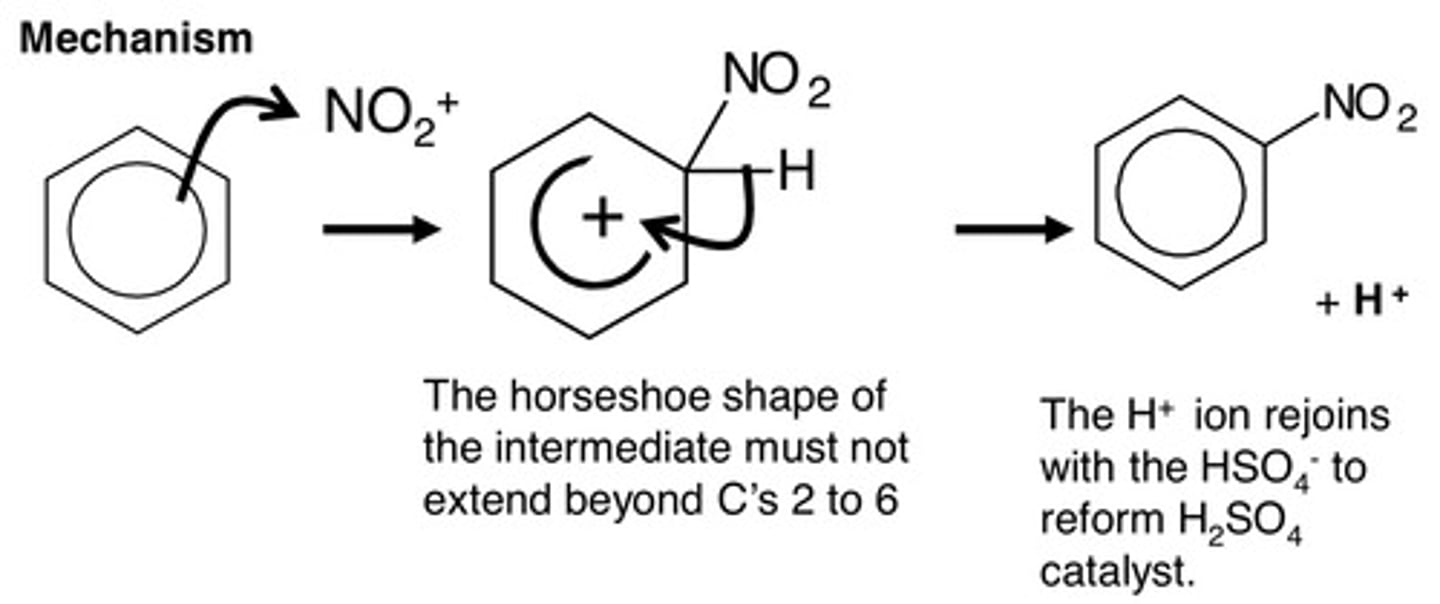
What do you need to remember to do?
Put the plus sign next to the N in +NO2
Move the horseshoe around depending on the Carbon atom that the electrophile is attaching to
What does the +NO2 act as and why?
The electrophile because it accepts a pair of electrons
Define electrophile
An electron pair acceptor
What happens in the second step?
The carbocation intermediate has 4 pi electrons, delocalised over 5 carbons. H+ is eliminated to complete the reaction.
What are the conditions for halogenation?
Reflux with halogen in the presence of a catalyst
Eg, for chlorination- AlCl3, FeCl3
For bromination- AlBr3, FeBr3
Mechanism for chlorination of benzene
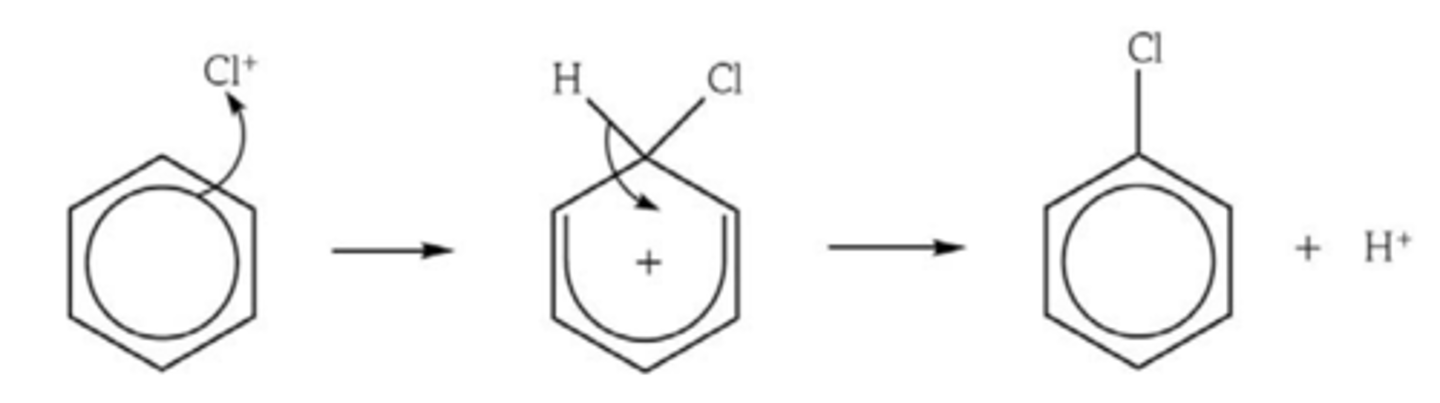
The compound IBr reacts with benzene. Would iodobenzene or chlorobenzene be the main product of the reaction?
What is the equation for friedel-crafts reactions?
C6H6 + CH3Cl -> C6H5CH3 + HCl
What is the hydrogen atom replaced by?
An alkyl group
Why is this important?
Because it increases the carbon atoms in a compound by forming C-C bonds
How is the electrophile formed?
AlCl3 + CH3Cl -> AlCl4- + +CH3
What is the mechanism for the substitution?
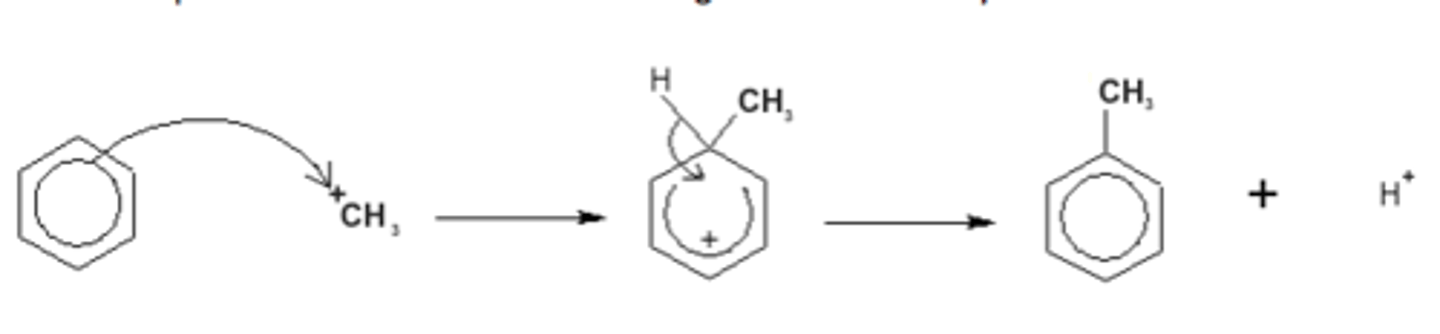
How is the catalyst reformed?
AlCl4- + H+ -> AlCl3 + HCl
Compare the reactivity of alkenes with arenes
Alkenes are more reactive as the double (pi) bond is a region of high localised electron density, which can induce a dipole in a neighbouring molecule, causing electrophilic addition to occur
The electron density of the pi bonds in benzene is delocalised, so does not have a region of high electron density so cannot induce a dipole
What does the shorter and stronger bond between carbon and chlorine in chlorobenzene result from?
The pair of electrons in a p orbital on chlorine overlapping with the ring pi system of electrons.
What does the resulting bond need?
More energy to break
What does this mean?
Extreme conditions are needed to produce phenol from chlorobenzene
What test could be used to distinguish between chlorobenzene and chlorobutane?
Reflux with NaOH
Cool and acidify with nitric acid
Add silver nitrate
A white precipitate will be formed with the halogenoalkane only
The C-Cl bond in the halogenoalkane is weaker and will react with OH- (nucleophilic sub)
C-Cl bond in chlorobenzene is stronger so will not react
Electrons in p orbital as Cl overlaps with delocalised pi system
Making C-Cl bond shorter and stronger