GRC EXAM 3
 Call Kai
 Learn
 Practice Test
 Spaced Repetition
 Match
 Flashcards
 Knowt Play
1/76

There's no tags or description
Looks like no tags are added yet.
77 Terms
Goal of Airway Clearance Therapy
Mobilize retained secretions from peripheral lung segments to central airways for clearance via cough, huffing, or suctioning.
Secretion Retention Diseases (Chronic)
Cystic Fibrosis and Bronchiectasis.
Secretion Retention Diseases (Acute)
Post-operative atelectasis and neuromuscular diseases that impair cough efficiency.
Routine CPT Indications Limitation
CPT is NOT recommended for routine/uncomplicated pneumonia, stable COPD without excessive sputum, or routine post-op prophylaxis.
Conventional Chest Physiotherapy (CPT) Components
Turning, Postural Drainage (PD), Percussion, Vibration, and Cough/Huffing.
Postural Drainage (PD) Definition
Placing the target lung segment superior (above) to the carina to allow gravity-assisted drainage.
Postural Drainage Position Duration
Positions are held for 5 to 10 minutes per segment (longer in special situations).
Turning Definition
Rotation of the body around its longitudinal axis to promote unilateral/bilateral lung expansion and assist secretion clearance.
Chest Percussion Common Names
Cupping or Clapping.
Chest Percussion Hand Position
Cupped hand position with fingers closed, trapping air between hand and chest wall.
Manual vs Mechanical Percussion Evidence
No convincing evidence supports the superiority of manual percussion over mechanical percussion.
Active Cycle of Breathing Technique (ACBT) Steps
1) Breathing control, 2) Chest expansion exercises, and 3) Forced expiratory technique (huffing).
Absolute/Severe Thoracic Manipulation & PD Contraindications
Untreated tension pneumothorax, skin grafts/flaps on thorax, severe burns, open chest wounds, chest skin infections, lung contusion, osteomyelitis of ribs, suspected TB, and active hemoptysis.
CPT Hypoxemia Intervention
Administer 100% FiO2, stop therapy IMMEDIATELY, return patient to original resting position, and consult physician.
CPT Complication Interventions (Hemorrhage, Bronchospasm, Dysrhythmias, Hypotension)
Stop therapy immediately, return patient to resting position, administer/increase oxygen, clear/maintain airway, and call physician/help.
Discontinuing PDT Sputum Threshold
PDT can be discontinued if sputum production is less than 25 mL per day (normal/acceptable ranges vary from 15 to 30 mL/day up to 70-100 mL/day).
IPPB Definition
Intermittent Positive Pressure Breathing; short-term, machine-assisted positive-pressure breaths used primarily for lung expansion.
Primary Purpose of IPPB
Augment lung expansion when simpler therapies (incentive spirometry, PEP, CPT) have failed.
Absolute Contraindication for IPPB
Untreated tension pneumothorax.
IPPB Relative Contraindications
ICP > 15 mmHg, hemodynamic instability, recent facial/oral/skull/esophageal surgery, head trauma, tracheoesophageal fistula, active hemoptysis, nausea/vomiting, and air swallowing.
IPPB Pressure Control Function
Controls delivered volume; increasing pressure increases delivered tidal volume.
IPPB Flow Control Function
Controls inspiratory time; increasing flow decreases inspiratory time (shorter breath).
IPPB Sensitivity Control Function
Controls patient effort required to trigger/cycle the machine on.
IPPB Target Lung Expansion Volume
Tidal volume (VT) of 10 to 15 mL/kg based on ideal body weight (IBW) or at least 25% larger than baseline VT.
IPPB Critical Care Order Re-evaluation Frequency
Orders should be reevaluated at least every 24 hours based on treatment assessments.
Hyperventilation Complication during IPPB
Respiratory alkalosis caused by low PCO2; causes dizziness and tingling in fingers.

Puritan Bennett PR-2 IPPB Unit
Pneumatic unit originally designed as a ventilator; features pressure, rate, sensitivity, air dilution, terminal flow, and aerosol controls.

Bird Mark-7 IPPB Unit
Designed by Dr. Forrest Bird in the late 1950s; pneumatically powered unit with adjustable effort, flow, pressure, and air-mix controls.
IPV Definition
Intermittent Percussive Ventilation; combines positive pressure, high-frequency percussive pulses (300-400 pulses/min), and aerosol delivery.
Inventor of IPV and Year
Dr. Forrest Bird in 1979 (the Phasitron was the first IPV device).
IPV Physiologic Effect (PEEP)
High-frequency ventilation induces auto-PEEP, maintaining expiratory pressure to keep alveoli recruited.
Percussionator IPV-1C Operating Requirements
Pneumatically powered, requires a 50 psi gas source, and delivers aerosol with percussive breaths.
Vortran PercussiveNeb Parameters
Single-patient disposable IPV device; operates at 15-16 L/min from 50 psi source; frequency 11-30 Hz (660-1800 cycles/min); NOT for ventilator use.
MetaNeb / Volara System Combined Modalities
Combines Continuous Positive Expiratory Pressure (CPEP), Continuous High-Frequency Oscillation (CHFO), and continuous aerosol delivery.
MetaNeb 10-Minute Alternating Treatment Cycle
2.5 min CPEP (expansion) -> 2.5 min CHFO (clearance) -> 2.5 min CPEP -> 2.5 min CHFO.
CPEP Mode Function in MetaNeb
Expands and holds open airways while delivering continuous aerosol.
CHFO Mode Function in MetaNeb
Pneumatic chest physiotherapy that oscillates secretions while delivering continuous aerosol.
Cough Assist (Mechanical Insufflation-Exsufflation) Mechanism
Delivers positive pressure during inspiration to inflate lungs, then rapidly switches to negative pressure during expiration to simulate a cough.
Cough Assist Initial vs Target Pressure Settings
Initial acclimation: +10 to +15 / -10 to -15 cmH2O. Target therapeutic: +25 to +35 cmH2O (inspiration) and -30 to -40 cmH2O (expiration) up to +60/-60 cmH2O max.
Cough Assist Contraindications
Untreated pneumothorax, active hemoptysis, severe head trauma/skull surgery, hemodynamic instability, and tympanic membrane rupture / middle ear pathology.
Bedside Pulmonary Mechanics Reviewed
Tidal volume (VT), Vital Capacity (VC), Respiratory Rate (f), Minute Ventilation (VE), NIF/MEP, RSBI, and Peak Flow.
Vital Capacity (VC) Definition
Maximum volume inhaled after maximal expiration OR maximum volume exhaled after maximal inspiration.
Aerosol Therapy Definition
Delivery of pharmacologic agents directly to the respiratory tract/airways to treat symptoms or assist in bronchopulmonary hygiene.
Three Main Aerosol Medication Categories
Bronchodilators, Antibiotics, and Mucolytics.
Advantages of Aerosol Therapy
Smaller doses required, rapid drug onset, local pulmonary effect, fewer/less severe systemic side effects, painless, and convenient.
Disadvantages of Aerosol Therapy
Variable dose delivery/deposition, difficult dose estimation, dependence on patient technique/coordination, device complexity, and potential clinician exposure to hazardous aerosols.
SVN Jet Flow Rate Standard
6 to 8 L/min compressed gas.
SVN Medication Fill Volume Standard
3 to 5 mL total fill volume (4 to 5 mL recommended for standard jet nebulizers).
SVN End-of-Treatment Indicator
A sputtering sound indicates liquid depletion and signals treatment end.
SVN Reservoir Bag Purpose
Captures aerosol generated during exhalation, keeping particles available for the next inspiration and reducing drug loss to room air.
SVN Mouthpiece Advantage
Preferred interface for maximum lung deposition compared to a face mask.
SVN Ventilator Circuit Protocol
Place SVN in inspiratory limb, remove the HME, and set flow to 6-8 L/min. (Watch for increased delivered volume and peak pressures).

Respirgard Nebulizer Purpose
SVN with one-way valves and an expiratory baffle/filter used specifically for hazardous drugs like Pentamidine to protect room air and staff.

HEART Nebulizers Flow & Use
High-output continuous nebulizers. Purple Top: 10-15 L/min (up to 8 hrs, 240 mL); MiniHEART Lo-Flo: 1-2 L/min (for ventilator circuits); IV HEART: 10-15 L/min; UniHEART: 2-4 L/min.

AeroEclipse BAN Modes
Breath-Actuated mode (aerosol generated only during inspiration using mouthpiece) and Continuous mode (used with face mask or trach adapter).

Altera Nebulizer Specific Medication
Used specifically for Cayston (aztreonam inhalation solution) for Pseudomonas aeruginosa in Cystic Fibrosis patients (3x/day for 2-3 min).

Vibrating Mesh Nebulizer Features
Electrically powered piezo-element micro-mesh, generates 3-6 micron particles, extremely low residual volume, and operates without adding gas flow to circuits.
pMDI Definition
Pressurized Metered Dose Inhaler; compact, portable canister delivering fixed, consistent metered aerosol doses.
pMDI Breathing Technique
Exhale fully, place mouthpiece in mouth, begin slow deep inspiration, actuate canister once at start of inspiration, continue inhaling, and hold breath for 10 seconds.
pMDI Spacer / Holding Chamber Benefits
Reduces target hand-breath coordination demands, reduces oropharyngeal impaction/loss, and minimizes systemic side effects/thrush from inhaled steroids.
Whistling Sound on Spacer/Holding Chamber
Indicates that the patient's inspiratory flow rate is TOO FAST.
Inhaled Corticosteroid (ICS) Post-Administration Step
Rinse mouth with water and spit it out to prevent oral candidiasis (thrush).
Determining pMDI Content Level
Use integrated mechanical dose counter; water-floating test is invalid and unsafe.
Soft Mist Inhaler (SMI / Respimat) Mechanism
Spring-powered mechanism forces liquid through micro-nozzles (Uniblock) to create a slow-moving aerosol mist.

Respimat SMI Common Medications
Combivent Respimat, Spiriva Respimat, and Striverdi Respimat.
DPI Primary Requirement
Patient must be capable of generating high inspiratory flow rates to disperse the dry powder (>60 L/min).
DPI Inhalation Technique
Inhale FAST, FORCEFULLY, and DEEPLY through the device.

DPI Diskus Medications
Advair Diskus, Flovent Diskus, and Serevent Diskus.

DPI Flexhaler Medication
Pulmicort Flexhaler (budesonide).

DPI Aerolizer Medication & Mechanism
Foradil Aerolizer; uses a clear capsule placed into the chamber and punctured prior to inhalation.

DPI HandiHaler Medication & Mechanism
Spiriva HandiHaler; uses a capsule loaded into the chamber and punctured via side button prior to inhalation.

DPI Twisthaler Medication
Asmanex Twisthaler (mometasone furoate).

DPI Pressair Medication & Control Window
Tudorza Pressair; control window changes from RED to GREEN when ready to inhale, and back to RED after dose is successfully delivered.
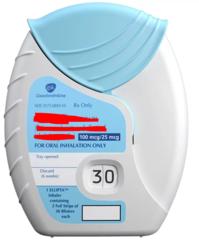
DPI Ellipta Medications
Breo Ellipta, Anoro Ellipta, Arnuity Ellipta, and Incruse Ellipta.
In-Check DIAL Function
Measures a patient's inspiratory flow rate across simulated device resistances to verify if they can generate sufficient flow for a specific DPI.
Age Reference Rule of Thumb for Aerosol Devices
SVN/Mask: Neonates+; Chamber/Mask: Neonates to Toddlers; Chamber/Mouthpiece: >4 years; pMDI / Breath-Actuated: >5 years; DPI: >6 years.
Required Documentation Elements for Aerosol Tx
Date, time, procedure/device, medication and dose, pre- and post-vital signs, breath sounds, peak flow/FEV1, cough/sputum description, patient education, and adverse effects.