ceutics 2 emulsions
 Call Kai
 Learn
Learn Practice Test
 Spaced Repetition
 Match
Match Flashcards
 Knowt Play
1/56

There's no tags or description
Looks like no tags are added yet.
Name | Mastery | Learn | Test | Matching | Spaced | Call with Kai | Chat |
|---|
No analytics yet
Send a link to your students to track their progress
57 Terms
what makes up an emulsion
2 immiscible liquids
-internal/dispersed phase: droplets
-external/continuous phase: outer portion
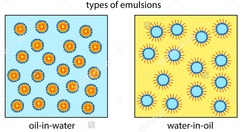
types of emulsions
water-in-oil (w/o) & oil-in-water (o/w)

internal phase
dispersed phase
inner droplets

external phase
continuous phase
outer portion

droplets in emulsions are usually greater than _____ in size, giving a _________ appearance
0.1 micrometers; milky appearance
(microemulsion: 10-200nm)
o/w
oil in water emulsion

w/o
water in oil emulsion

w/o/w
water-in-oil-in-water
multiple emulsion

purpose of doing multiple emulsion (ex: w/o/w)
1. separates incompatible substances
2. adjusts drug release rates
advantages of emulsions
-more palatable (taste)
- greater chemical stability
- smaller oil globules = more digestible and increased absorption
- enhanced skin absorption
- less irritating to skin in internal phase
why are smaller oil globules in emulsions advantageous
1. more digestible
2. increases absorption
why are emulsions beneficials for topical drugs
1. enhanced skin absorption
2. drugs that irritate the skin are less irritating in the internal phase
castor oil
emulsion laxative
simethicone
emulsion defoaming agent
surface active agents are also known as
surfactants, amphiphiles, emulsifying agents, SAAa

amphiphilic
molecules possessing both hydrophobic (nonpolar) and a hydrophilic (polar) parts
all SAAs are amphiphilic
adsorbed
held on the surface
what allows SAAs to be adsorbed on interfaces
amphiphilic nature allows polar heads to face water and nonpolar tails to face water

where do heads and tails of surfactants face
head= polar= water
tail= nonpolar= oil
_______ must be nontoxic, stable, and compatible with water, oil, and drug
SAAs
SAAs provide droplets with ____________________ to make mutual repulsions
adequate electric potential
SAAa must be effective in __________ concentrations
low
Critical Micelle Concentration (CMC)
The surfactant concentration at which micelles form

HLB
hydrophillic/lipophilic balance (0-20), low HLB is more oil, high HLB is more water

HLB increases as
polarity/ hydrophilicity increases
HLB>9
vs
HLB
greater than 9: o/w (think hit hard, up= ow)
less than 9: w/o

mineral oil HLB in o/w vs w/o
4 in w/o
10.5 in o/w
how do you determine what HLB an emulsifier should have
should be similar to oils
overall HLB value=
sum of (each fraction * HLB)
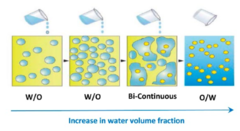
increasing the concentration of the internal phase to >75% can cause
inversion
why does inversion lead to instability
if SAA favors o/w and it is inverted to w/o, then it is no longer stable
4 classifications of SAA based on ionic contents
1. anionic= negative charge on head
ex: sodium layryl sulfate in toothpaste, tri ethanolamine dodecyl sulfate, sodium dodecyl benzene sulfonate
(SLS, TEDS, SDBS)
2. cationic= positive charge on head
= bacteriostatic, reacts w cell wall
ex: quaternary ammonium, cetyl trimethyl ammounium Br
3. ampholytic= both + and - zwitterionic head, depends on pH
4. non-ionic= water soluble head that does NOT have charge
Spans (w/o) and Tweens (o/w)
which SAAs are bacteriostatic
cationic
Spans vs Tweens
both nonionic SAAs
Spans (Sorbitan fatty acid esters)= oil soluble, promote w/o
Tweens (PEG-sorbitan fatty acid ester)= water soluble, promote o/w
(think tweens= mean= ow)
3 theories of emulsification (summary)
1. surface tension theory
= liquids assume shape with least amount of area exposed
=SAA lowers interfacial tension= break globules into smaller parts= reduce coalescence
2. oriented-wedge theory
= formation of MONOmolecular layer around drops = prevent coalescence via 1) electrical repulsion 2) physical separation via layer
3. interfacial-film theory
= MULTImolecular film at interface prevents coalescence
1) increases viscosity 2) charge repulsion
interfacial tension
Interphase between two liquids
SAA vs interfacial tension and coalescence
SAAs LOWER interfacial tension and REDUCE coalescence
high pressure homogenizer
uses high pressure to make homogenized product
continental/ dry gum method
1. add gum/SAA to oil
2. add water all at once and triturate= crackle and white
3. add other ingredients
fixed(4o:2w:1g)
mineral (3o:2w:1g)
volatile (2o:2w:1g)
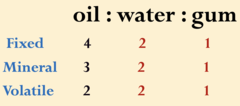
English/wet gum method
(think england= wet)
1. add gum/SAA to water
2. add oil slowly and triturate
3. add other ingredients

Bottle Method
*used for volatile oils or low viscosities
1. gum and oil shaken in bottle
2. add water and then oil in proportions
micro/nano emulsions
clear
transparent
thermodynamically stable systems of two immiscible fluids
size of micro/nano emulsions
10-200nm
why arent nanoemulsions not true solutions
they are dispersions of oil, so even though they are transparent, they arent completely soluble like a solution
example of SAA used in micro/nano emulsions
polysorbate 60 and 80
micro/nano emulsion advantages
- rapid oral absorption
-increased diffusion into skin
-targets cytotoxic drugs to cancer cells
how can you dilute emulsions
o/w: dilute with water (external phase)
w/o: dilute with oil
what emulsions can conduct an electric current
o/w (water is conductor)
which emulsions can be colored by water soluble dyes
o/w
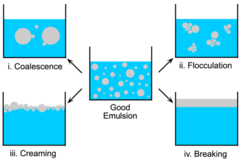
Creaming of emulsions
internal phase droplets separate slightly (oil to top, water to bottom)
= reversible
= may lead to improper dosing
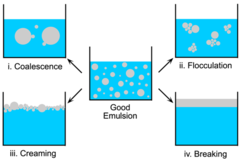
Cracking/breaking of emulsions
internal phase globules seperate into a PERMANENT LAYER that CANNOT be fixed
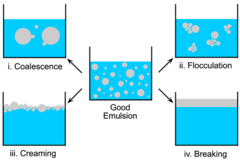
how can you stabilize emulsions/ reduce coalescence
1. reduce particle size
2. minimal density difference between internal and external phase
3. high viscosity of external phase
4. proper SAA selected
coalescence
The process by which parts of a whole join together, or fuse, to make one
emulsion inversion
changing of an emulsion from o/w to w/o
what environmental conditions can affect the stability of an emulsion
temp, light, air
what can be added to reduce oxidative decomposition
antioxidants
what can be added to reduce contamination from microbes
methylparaben, propylparaben, alcohol