Upper Limbs 1: Muscles Compartments of the Upper Limb
 Call Kai
 Learn
 Practice Test
 Spaced Repetition
 Match
 Flashcards
 Knowt Play
1/31

There's no tags or description
Looks like no tags are added yet.
32 Terms
movement of the upper limb
- flexion
- extension
- abduction
- adduction
- rotation
- composite movements = circumduction

Important
some muscles span more than one joint.
Their main action may only be at one of those joints, but....
.... if a muscle spans a joint, it can act as a mover of that joint.
Compartments in Limb Anatomy
•The limb muscles are divided into compartments
•Compartments tend to have a distinct function
•Compartments tend to have the same nerve supply
•Compartments tend to have the same blood supply
•Compartments tend to be separated by connective tissue septae (walls)
Muscles acting on the shoulder
•The pectoral girdle muscles (anterior and posterior axio-appendicular muscles)
•The intrinsic shoulder muscles (scapulohumeral muscles)
What are the pectoral (shoulder) girdle muscles?
- trapezius
- serratus anterior
- pectoralis major
- latissimus dorsi
- levator scapulae
- supraspinatus
- infraspinatus
(Pectoral girdle = clavicle and scapula)The muscles act on the scapula + shoulder joint to move arm — move scapula and humerus as one unit

Pectoral/Shoulder Girdle
Muscles acting on the scapula and shoulder joint have attachments in the neck, anterior chest, back and arm.
- muscles act:
= directly on scapula. eg trapezius and serratus anterior muscles
OR
= across the shoulder joint to move the arm.
- indirectly act on scapula by moving the whole humerus and scapula unit
- muscles that directly act on arm are pectoralis major and latissimus dorsi
-latissimus dorsi has an attachment at the lumber region of back and the posterior pelvic region

Which muscles are responsible for protracting the shoulder (e.g. throwing it out like a punch)?
- serratus anterior
- pectoralis minor
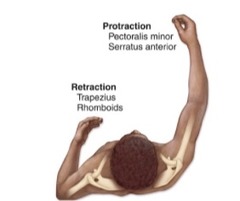
What muscles are responsible for retracting the shoulder (bringing it back like you're about to throw a punch)?
- trapezius
- rhomboids
Intrinsic Shoulder Muscles
•Deltoid
•Teres Major
•The Rotator Cuff Muscles: (SITS)
- supraspinatus
- infraspinatus
- teres minor
- subscapularis (on the deep surface of the scapula so not visible)
Act to move the humerus at the shoulder joint
Very important in stabilising the shoulder joint by holding the head of the humerus in the glenoid fossa

What is the name of the fossa on the posterior of the elbow joint?
— olecranon fossa
— accommodates OLECRANON PROCESS OF THE ULNA in full extension of the forearm

What is the role of the intrinsic shoulder muscles?
— attached to scapula
— stabilise shoulder joint by holding head of humerus to glenoid fossa
— move the humerus at the shoulder joint

The Rotator Cuff Muscles
SITS:
- supraspinatus
- infraspinatus
- teres minor
- subscapularis

Deltoid muscle attachments
has lateral and posterior attachments to scapula, significant anterior attachment to clavicle
Name the 3 muscles of the anterior flexor compartment of arm
1. Biceps brachii (acts across both elbow/shoulder joints)
2. Coracobrachialis (acts only across shoulder joint)
3. Brachialis (acts only across elbow joint)
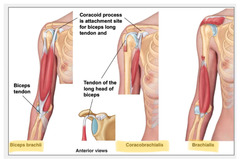
Movement of Anterior flexor compartment of the arm
- flexion of shoulder joint
- flexion of elbow
Where is the biceps tendon?
Attaches to biceps brachii proximallyAttaches distally to the tuberosity of the radius (slight protrusion on medial side)
— acts as a strong supinator of forearm (turns to face it up)
Biceps brachii
- contribute to the stability of shoulder joint
- bicep tendons attaches distally to the tuberosity of radius
Extensor (Posterior) Compartment of the Arm
- Triceps
- Anconeus
- both supplied by the radial nerve
- both extensors of the forearm at elbow joint

Where are the forearm muscles attached to?
— attachment to the distal humerus
— attachments from radius/ulna/interosseous membrane to hand/wrist
Name the 3 heads of the triceps brachii and their attachments
Lateral head (attached to posterior shaft of humerus)
Medial head (attached to posterior shaft of humerus as well)
Long head (spans the shoulder joint, attaches to infraglenoid tubercle [lump of bone] of scapula)
Converge distally to form triceps tendon
What do the 3 heads of the triceps brachii converge to form?
All 3 converge distally to form the triceps tendon
What does the triceps tendon attach to?
Attaches to the olecranon process of the ulna (at elbow)
Anconeus
- stabilises the elbow

The Forearm Muscles
•The hand and wrist are operated by 'remote control' by these muscles
•The forearm muscles have attachment on the distal humerus as well as from the radius and ulna and the interosseous membrane
- muscle bellies found in proximal region of elbow region
- for greater length and strength, muscle attch across the elbow joint on the distal humerus

Muscles of the Forearm
Superficial Flexor Compartment
•Pronator teres (PT)
•Flexor carpi radialis (FCR)
•Palmaris longus (PL)
•Flexor digitorum superficialis (FDS)
•Flexor carpi ulnaris (FCU)
Deep Flexor Compartment
•Flexor digitorum profundus (FDP)
•Flexor pollicis longus (FPL)
•Pronator quadratus (PQ)
Extensor Compartment
•Extensor carpi radialis longus (ECRL)
•Extensor carpi radialis brevis (ECRB)
•Extensor carpi ulnaris (ECU)
•Extensor digitorum (ED)
•Extensor indicis (EI)
•Extensor digiti minimi (EDM)
Abductor pollicis longus (APL)
•Extensor pollicis brevis (EPB)
•Extensor pollicis longus (EPL)
•Brachioradialis
Supinator
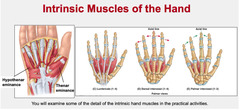
The intrinsic muscles of the hand
1.Thumb
2.Index finger
3.Middle finger
4.Ring finger
5.Little finger

Name the two muscle bulges in the palm
- thenar eminence
- hypothenar eminence
What is the role of intrinsic muscles of the hand?
— produce fine movements that allow intricate, precise movements
— contibute to activates requiring strength
— includes hypothenar/thenar eminence
How many phalanges are in digits 2-5 (not thumb)?
3 phalanges bones ; have metacarpophalangeal and 2 interphalangeal joints within each digit
Thumb only has 2 phalanges

Thenar eminence
prominence between the base of the thumb and the wrist containing small muscles acting on the thumb.

Hypothenar eminence
prominence between the base of the little finger and the wrist containing small muscles acting on the little finger.

*Intrinsic Muscles of the Hand
•Thenar muscles
•abductor pollicis brevis
•flexor pollicis brevis
•opponens pollicis
•Adductor muscle
•adductor pollicis
•Hypothenar muscles
•abductor digiti minimi
•flexor digiti minimi
•opponens digiti minimi
•Interossei and lumbricals
•four lumbricals - flex the MCP's, extend the IPJs
•three palmar interossei - adduct the digits ("PAD")
•four dorsal interossei - abduct the digits ("DAB")