Endocrine Staging
 Call Kai
 Learn
 Practice Test
 Spaced Repetition
 Match
 Flashcards
 Knowt Play
1/80

There's no tags or description
Looks like no tags are added yet.
81 Terms
Which surgical specimens are used for thyroid carcinoma staging?
Resection types
Thyroidectomy
Lobectomy
Partial excision
Which thyroid malignancies are included in TNM classification?
Follicular cell-derived thyroid neoplasms
Papillary, follicular, poorly differentiated
C-cell-derived thyroid carcinomas
Medullary
Salivary gland-type thyroid carcinomas
Thymic tumors within the thyroid
Embryonal thyroid neoplasm
Thyroid tumors of uncertain cytogenesis
Which thyroid tumors are excluded from this staging protocol?
Thyroid lymphoma
Thyroid sarcoma
Thyroid carcinomas arising in struma ovarii
What is struma ovarii?
An ovarian teratoma composed predominantly of thyroid tissue
What is the most common distant metastatic site for differentiated thyroid carcinomas?
Lung
What is the most common distant metastatic site for medullary thyroid carcinoma?
Liver
Are distant metastases common in thyroid carcinoma?
They are relatively uncommon
How are LN levels categorized for thyroid?
Left I-V
Right I-V
Level VI
Level VII
What is this?
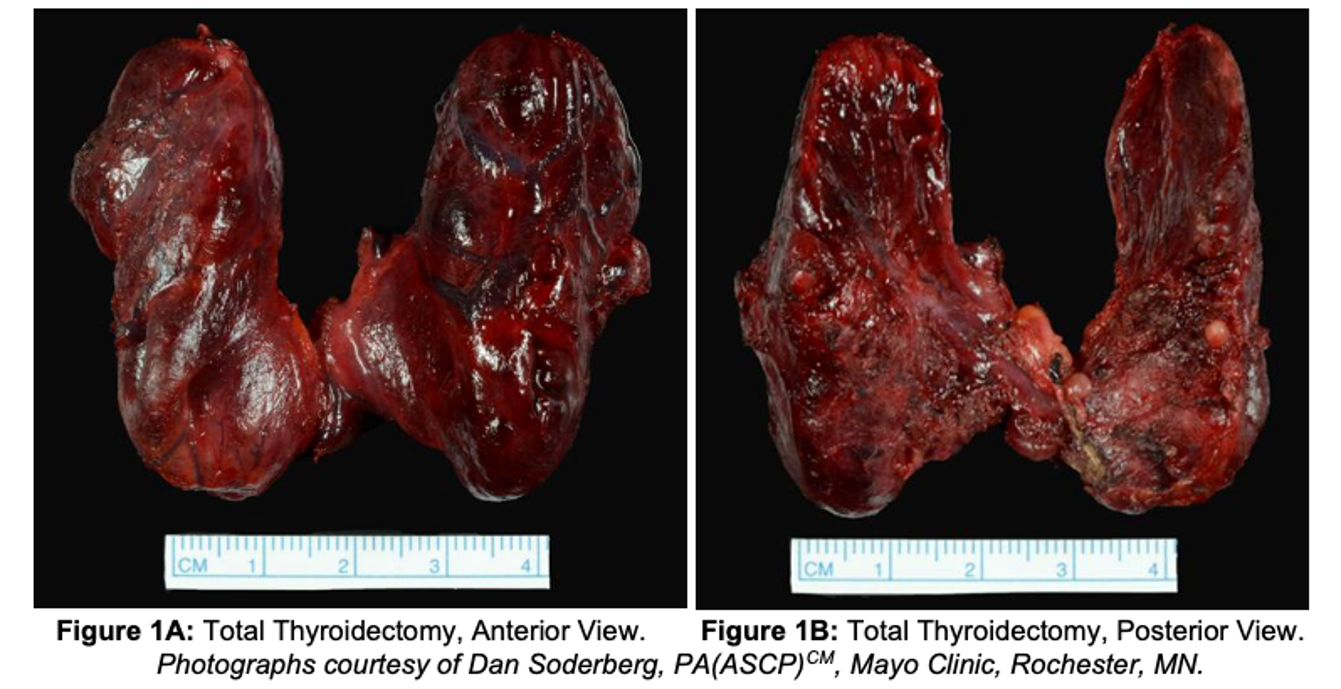
Gross thyroid
What is this showing?

Carcinoma of thyroid
Hashimotos’s thyroiditis
What is this?

Papillary carcinoma
What is this?

Follicular carcinoma
What is this?
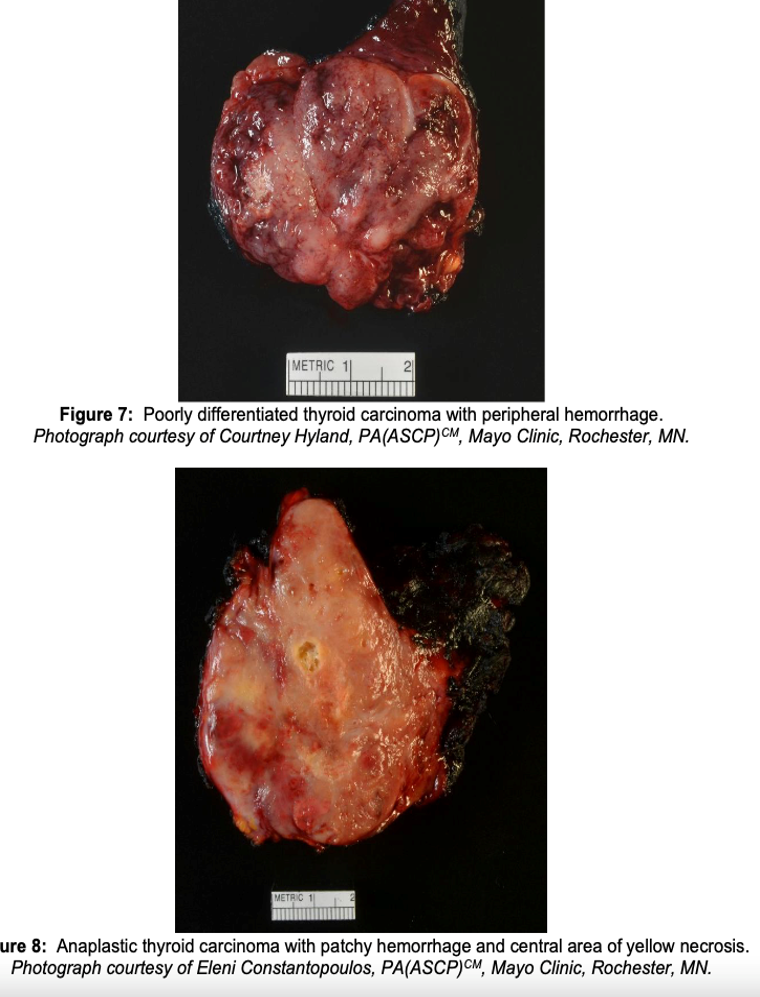
Thyroid carcinoma — Poorly differentiated
What is pT1 for non-medullary thyroid carcinoma?
2 cm or less in greatest dimension
Limited to the thyroid
What is pT1a for non-medullary thyroid carcinoma?
1 cm or less, limited to the thyroid
What is pT1b for non-medullary thyroid carcinoma?
1 cm < x ≤ 2 cm, limited to the thyroid
What defines pT2 non-medullary thyroid carcinoma?
2 cm < x ≤ 4 cm, limited to the thyroid
What defines the pT3 categories for non-medullary thyroid carcinoma?
pT3a — >4 cm, limited to thyroid
pT3b — Invades ONLY strap muscles, ANY size
Sternohyoid, sternothyroid, thyrohyoid, and omohyoid
What is pT4a for non-medullary thyroid carcinoma?
Gross extrathyroidal extension invading:
Subcutaneous soft tissues
Larynx
Trachea
Esophagus, or
Recurrent laryngeal nerve
What is pT4b for non-medullary thyroid carcinoma?
Gross extrathyroidal extension invading:
Prevertebral fascia
Encasing the carotid artery
Mediastinal vessels
How is pT1-pT3 categories defined for medullary thyroid carcinoma?
Similar to non-medullary thyroid carcinoma
What is the most important difference between non-medullary and medullary thyroid T4 staging?
Medullary has the same general progression/involvement as described in non-medullary, with the addition of:
T4a — Moderately advanced disease
T4b — Very advanced disease
What T staging distinction is important or non/medullary thyroid carcinoma?
Size matters
Extension matters
Which lymph nodes are considered regional for thyroid carcinoma?
Central compartment nodes (level VI and VII)
Lateral neck nodes (levels I–V)
Retropharyngeal node
What is pN1a for thyroid carcinoma?
Mets to level VI or VII nodes, including:
Pretracheal
Paratracheal
Prelaryngeal/Delphian, OR
Upper mediastinal
May be unilateral or bilateral
What is pN1b for thyroid carcinoma?
Mets to:
Unilateral
Bilateral, or
Contralateral
lateral neck nodes (levels I–V) or retropharyngeal nodes
What defines pM1 thyroid carcinoma?
Distant mets
Which tumors are included in the adrenal staging protocol?
Adrenal cortical carcinomas
Which tumors are excluded from the adrenal cortical carcinoma staging protocol?
Pheochromocytoma
Sarcoma
Lymphoma
What is pT1 for adrenal cortical carcinoma?
≤ 5 cm, without extra-adrenal invasion
What is pT2 for adrenal cortical carcinoma?
>5 cm, without extra-adrenal invasion
What is pT3 for adrenal cortical carcinoma?
Any size with local invasion
WITHOUT invasion of adjacent organs
What is pT4 for adrenal cortical carcinoma?
Any size WITH invasion of
Adjacent organs
Kidney, diaphragm, pancreas, spleen, or liver
Large blood vessels
Renal vein or vena cava
What is this?

Adrenal cortical carcinoma
What is pN1 for adrenal cortical carcinoma?
Mets to regional LNs
What is pM1 for adrenal cortical carcinoma?
Distant mets
Why is the distinction between pediatric and adult adrenal cortical tumors important?
Criteria for malignancy differ between pediatric and adult tumors
What is a pheochromocytoma?
A neuroendocrine tumor arising from the adrenal medulla
Usually submitted as a adrenalectomy specimen
Also known as a paraganglioma

What is a paraganglioma?
A related neuroendocrine tumor arising from paraganglionic tissue OUTSIDE the adrenal gland
True or False: ALL pheochromocytomas hormonally functional
FALSE — May be functioning or nonfunctioning
What are the classic "10% rules" for pheochromocytoma listed in the lecture?
10% of pheochromocytomas are:
Malignant
Bilateral
Extra-adrenal (paraganglioma)
Pediatric
Occur without hypertension
What is pT1 for pheochromocytoma?
< 5 cm, without extra-adrenal invasion
What is pT2 for pheochromocytoma?
≥5 cm, OR
A paraganglioma of any size
NO extra-adrenal invasion
What is pT3 for pheochromocytoma?
Any size with invasion into surrounding organs or tissues, such as:
Liver
Pancreas
Spleen, or
Kidneys
What is pN1 for pheochromocytoma?
Mets to regional LN
What is pM1 for pheochromocytoma?
pM1a — ONLY bone
pM1b — ONLY distant LNs, liver, or lung
pM1c — Bone + multiple other sites
Which pancreatic tumors are included in this staging protocol?
Well-differentiated pancreatic neuroendocrine tumors (NETs)
Which pancreatic tumors are excluded?
Exocrine pancreatic carcinoma
Mixed ductal-neuroendocrine carcinoma
Mixed acinar-neuroendocrine tumors
Poorly differentiated neuroendocrine carcinoma
What determines the pT category for a well-differentiated pancreatic NET?
Size matters
Extension matters
Does extension into peripancreatic adipose tissue alone establish a higher T category?
No — Extension into peripancreatic adipose tissue is NOT a basis for staging
What is pT1 for pancreatic NET?
≤2 cm, limited to pancreas
What is pT2 for pancreatic NET?
2 cm < x ≤ 4 cm, limited to pancreas
What is pT3 for pancreatic NET?
>4 cm, limited to pancreas OR
Invade the duodenum, ampulla of Vater, or common bile duct
What is pT4 for pancreatic NET?
Invade either:
Adjacent organs, OR
Ex. stomach, spleen, colon, adrenal gland
Wall of large vessels
Ex. Celiac axis, superior mesenteric artery or vein, splenic artery or vein, gastroduodenal artery or vein, and portal vein
What is pN1 for pancreatic NET?
Regional LNs involvement
What is the pM1 for pancreatic NET?
pM1a — Confined to liver
pM1b — At least one extrahepatic site
pM1c — BOTH hepatic + extrahepatic site
Which sites are considered reliable sources for definitive metastatic disease in pancreatic NET?
LNs
Bone
What is an appendiceal carcinoid?
A well-differentiated neuroendocrine tumor of the appendix
Helpful surgical specimens — Appendectomy and right hemicolectomy

What is this microscopically showing?

Carcinoid
Next of blue cells
What are the major considerations when examining an appendix containing a NET?
Tumor location (proximal, distal, or diffusely involved)
Tumor size
Tumor extent
Regional lymph nodes
Distant metastasis
What is the only relevant circumferential margin for appendiceal NET?
Mesenteric resection margin
Why is the mesenteric resection margin important?
It is the relevant circumferential margin for evaluating the extent of resection and possible residual tumor
What is pT1 for appendiceal NET?
≤2cm
What is pT2 for appendiceal NET?
2 cm < x ≤ 4 cm
What is pT3 for appendiceal NET?
>4 cm, OR
Tumor with subserosal invasion, OR
Involvement of the mesoappendix
What is pT4 for appendiceal NET?
Perforates the peritoneum, OR
Directly invades other adjacent organs or structures
Ex. Abdominal wall or skeletal muscle
Which lymph nodes are regional for appendiceal NET?
Ileocolic lymph nodes
How many lymph nodes should a regional lymphadenectomy include?
12 LNs
What is pN1 for appendiceal NET?
Regional LNs involvement
What is pM1 for appendiceal NET?
pM1a — Confined to liver
pM1b — At least one extrahepatic site
pM1c — BOTH hepatic + extrahepatic site
Which gastrointestinal sites are covered in the lecture's GI NET staging section?
Stomach
Small bowel
Colon
What determines the T category for gastrointestinal NETs?
Tumor size
Depth of invasion into the bowel wall
What is the size cutoff for T1 in the GI NET staging section?
1 cm
What characterizes T2 in GI NETs?
Greater tumor size (>1 cm)
Invasion into the muscularis propria
What characterizes T3 in GI NETs?
Invasion into the subserosa
What characterizes T4 in GI NETs?
Invasion through the visceral peritoneum (serosa)
What is the special T3 consideration for duodenal NETs?
Invasion into peripancreatic adipose tissue OR the pancreas
What determines the N category for all GI NET sites?
Regional LNs involvement
What determines the M category for GI NETs?
Liver involvement or extrahepatic sites
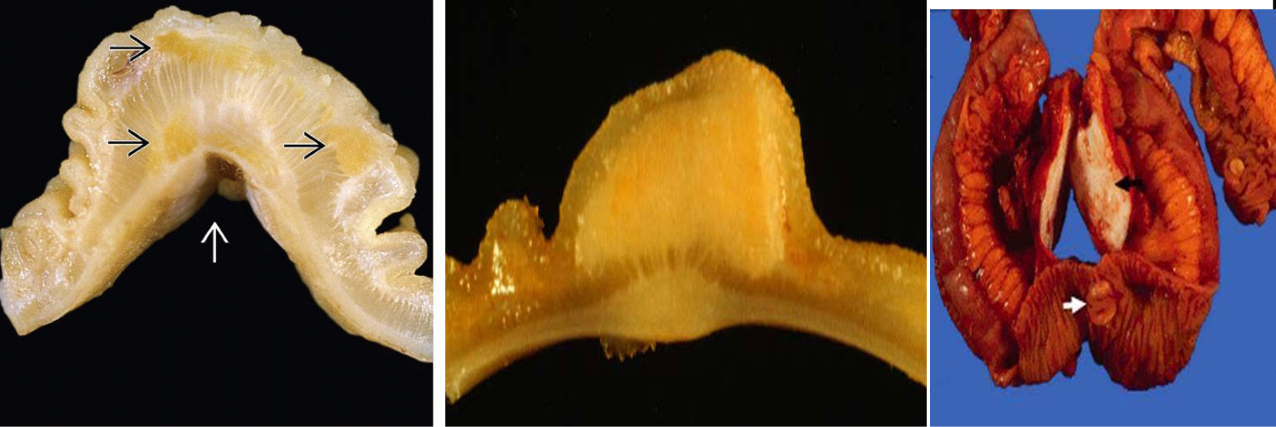
What are these all examples of?
Bowel NET (Carcinoid)
What is this microscopically showing?

Carcinoid
Of the GI tract