NSG 217: Intracranial Regulation & Infection
 Call Kai
 Learn
 Practice Test
 Spaced Repetition
 Match
 Flashcards
 Knowt Play
1/42

There's no tags or description
Looks like no tags are added yet.
43 Terms
Intracranial Regulation General Aspects
Children < 2 require special evaluation
Unable to respond to directions
Infants
Information for neuro obtained thru observation of spontaneous & elicited reflex responses
As the infant matures—reflexes are replaced by purposeful movement
Reappearance of reflexes indicate a pathologic condition
If the child had their reflexes at birth and then the reflexes went away as they should through the life span, and then all of a sudden they reappear, that could indicate that there's something going on intracranially and they're gonna probably need further testing.
through indirect measurement, check those reflexes, and see are they there if they are, should they still be there? If they shouldn't still be there, then that could suggest that there is a neurological issue going on.
Delay or deviation from expected milestones helps Identify high-risk infants/children
Assessment
Family history
Whenever they come in and you're suspecting that there might be issues with the intracranial regulation, you want to make sure you get a family history.
So is there any neurological history in the family? And if so, what is it? When did it appear? How has it been treated? Did it go away on its own? Those sorts of things.
Health history
Maternal health history (pregnancy & delivery)
babies don’t have much of a health history so we’re going to look at the moms
Was there any complications during pregnancy? Were there any issues during the birthing process?
Physical evaluation of infant/child
Most information about the status of the brain is obtained by indirect measurement
There's so much about the brain that we don't know. So most of what we're gonna find out about intracranial regulation is going to be through indirect observation.
So watching the child, talking to the parents, finding out from the parents that they have deviated from their baseline or from their norm
Importance of milestones
Babies may not be able to follow directions, so how will we know their A&O status?
we measure their milestones
Have they met them? Are they where they need to be? Were they late reaching them?
Will not be oriented x3?? What is normal--milestones
if you have too much pressure because you have too many fluids or things like that, you can have issues like strokes and other things, and if for whatever reason, your cerebral spinal fluid is low and you have low intracranial pressures, you can have things like seizures and episodes of fainting and things of that nature.
Neurological Assessment
Anatomy and Physiology differences
Infants
Head size
Cranial bones
Fontanels
Suture lines
Head is large in proportion to the rest of the body and neck muscles are poorly developed – Increases risk for SBS
In addition, they have those weak neck muscles, so they can't do a great job of holding their head up, secondary to that. They are at risk for shaken baby syndrome.
we can also see intracranial regulation issues with shaken baby syndrome
you're definitely going to want to check some scans of the brain to see what, if any damage has been done.
The skull expands until 2 years of age. Infants have excessive spinal mobility.
Cranial bones not completely ossified placing the infant at greater risk for injury resulting from trauma.
that does put them at a greater risk for injury, resulting from trauma.
Fontanels are spaces of connective tissue covering the brain at the junction of skull bones.
So they have an anterior and posterior fontanel. And basically that's just an open area. There's nothing protecting the brain in those areas. So we need to be very careful about protecting those areas.
Suture lines are completely ossified by 12 years of age.
Neurological Assessment Continued
Baseline neurologic information
through parents and your own assessment
Observation
most of what we're going to end yet is going to be through indirect measurement, it’s going to be from watching them.
Health History
Developmental Milestones
how we would know a child’s A&O status
Physical Assessment
Fontanels for infant
you want to make sure that you're assessing the fontanels specifically the anterior fontanel, because they can tell you, like, if it's bulging, that means that there's excessive fluid in the cranial cavity and If it's, dipped in, that means that there's not enough food, which could mean that they’re dehydrated
Family History
LOC is the earliest indicator of IICP
Deterioration or improvement
Important to establish an accurate baseline of neurologic information. – this is why it is important to complete your assessment early in your shift
Most information about infant and young children is gained by observation.
Detailed health history to identify causes of alteration in neurologic status
Infant physical assessment
Size and shape of the head
Reflexes
Symmetry of movements
might be at risk for stroke if pressures too high
Cry
there is a neurological cry. It is dubbed the cry of the cat
It's very high pitched
Level of development
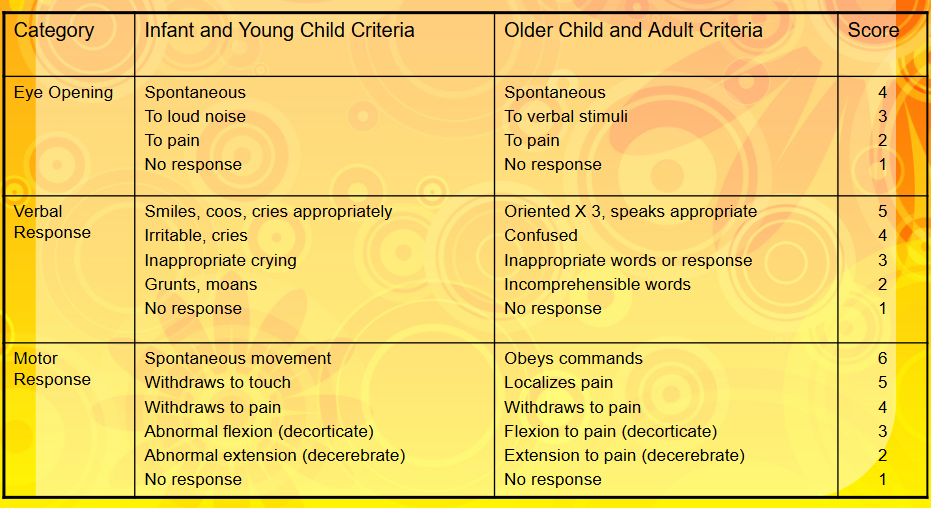
Glasgow coma scale (chart to follow)
Pupil response Normal response is to constrict to light bilaterally.
bilateral fixed and dilated or very sluggish 0 poor sign-brain herniation from increased ICP
problematic. This probably means that there's a herniations somewhere in the brain that was secondary to that increased intracranial pressure.
Vital signs should be monitored for any changes-can indicate increased ICP (will talk about on next slide)
Nursing Assessment
Vital Signs
Cushing’s Triad – Widened pulse pressure, Bradycardia, Irregular RR, Bradypnea
Skin—examined for signs of trauma
Eyes—pupil check “fixed and dilated”
Motor Function
Posturing
Reflexes
Specifically Moro and Tonic Neck
What is widened pulse pressure? Increasing gap between systolic and diastolic
Posturing Flexion & extension posturing (decebrate and decorticate)
Infant reflexes: key: Moro, tonic neck and withdrawal reflexes
Moro: The startle reflex observed in normal infants from birth through the first few months, consisting of abduction and extension of all extremities, followed by flexion and abduction of the extremities.
Tonic neck: fencing reflex – head turns to arm/leg that is extended and other side is flexed.
Positive babinski is significant in >18mo – toes fan out
Nursing Assessment: Glasgow Coma Scale
Many different variations
Glasgow coma scale total score is 15. Lowest score is 3. total neurologic unresponsiveness.
Age appropriate responses/keep in mind stranger
Alert responsive to parents, coos, cuddles, smiles
Verbal responsive to verbal stimuli
Pain responsive to painful stimuli ONLY
Unresponsive to painful stimuli
Altered Levels of Consciousness
Level of consciousness is the MOST IMPORTANT indicator of neurologic dysfunction
WHY?
LOC is earliest indicator of neurologic issues
Full Consciousness - Alertness-ability to react to stimuli.
Unconsciousness - Inability of the brain to respond to stimuli. Depressed cerebral function
Lethargy- limited spontaneous movement, sluggish speech
Obtunded limited response to the environment, arousable with stimulation
Stupor response to vigorous stimuli only
Coma severely diminished response. No motor or verbal response to painful stimuli
Persistent vegetative state – permanent loss of cerebral cortex function
This is very subjective!! Paint clearest picture possible
Altered Levels of Consciousness Causes
Causes
Trauma
Infection
Poisoning
VP shunt malfunction
Seizures
Tumors
Hypoxia
Congenital structural defect of the brain
Altered Level of Consciousness Clinical Manifestations
Clinical Manifestations
Restlessness
Fussy
Pupil changes
Irritability
Posturing
Increased ICP
Posturing
Decorticate-characterized by rigid flexion associated with lesions above the brainstem in the corticospinal tracts.
Decerebrate characterized by rigid extension associated with lesions of the brainstem.
Posturing may not be evident when the child is quiet----elicited by stimuli (usually painful stim)

Increased ICP
Normal pressure: 5-15 mmHg
The brain is well protected within the skull---but vulnerable to changes in pressure
Early signs-VS and LOC can be slight, need to be aware of any changes. Pulse ox change can be your first sign.
In infants-bulging fontanels and high-pitched cry
Increased ICP ~ Early (Infants)
Infants:
Tense, bulging fontanel
Separated cranial sutures
Irritability and restlessness
Drowsiness
Increased sleeping
High-pitched cry
Increased fronto-occipital circumference
Distended scalp veins
Poor feeding
Crying when disturbed
Setting-sun sign
Increased ICP ~ Early (Children)
Children:
Headache
Nausea
Forceful vomiting
Diplopia, blurred vision
Seizures
Indifference, drowsiness
Decline in school performance
Diminished physical activity and motor performance
Increased sleeping
Inability to follow simple commands
Lethargy
Late Signs Of IICP Infants & Children
• Bradycardia
• Decreased motor response to command
• Decreased sensory response to painful stimuli
• Alterations in pupil size and reactivity
• Extension or flexion posturing
• Cheyne-Stokes respirations
• Papilledema
Papilledema – swelling of optic disc
• Decreased consciousness
• Coma
If you see any of these symptoms in children consider that the child is in severe distress

Special Diagnostic Tests
Laboratory
Blood sugar
Lytes, BUN, Cr
Toxicology
Ammonia level
CBC
Blood cultures
EEG
EEG- identifies damaged or nonfunctioning areas of the brain
LP
LP not In presence of IICP----herniation
CT
MRI
CT Scan, PET scan, MRI to detect lesions, structural abnormalities, vascular malfunction or edema.
Intracranial pressure monitoring.
Skull x-rays detect fractures or bone malformations.
Lumbar Puncture
Lumbar puncture collects cerebrospinal fluid for testing and measures CSF---definitive diagnosis
Contraindicated in patients with increased ICP or infected skin over puncture site.
LP the holder is the most important person, stabilizes the spine for person performing LP---sedation!!
Other Diagnostics include: Glasgow coma scale. Lab tests CBC electrolytes Blood culture, Toxicology

Nursing Considerations
Maintain airway
Perform routine care
Provide adequate nutrition
Provide skin care
Perform ROM activities
Provide sensory stimulation
Provide family support and education
Routine Care- bed bath, oral care, artificial tears
Frequent Nero checks, ICP monitoring. Pupil checks, Vital signs
Emergency measures are directed toward ensuring airway, treatment of shock & reduction of ICP
Intracranial Pressure Monitoring

Nursing Diagnoses
Ineffective breathing pattern
Risk for aspiration
Risk for impaired skin integrity
Impaired Verbal Communication
Interrupted family process
Structural Defects: Hydrocephelus
Imbalance of CSF in the ventricular system.
Congenital
Developmental malformation
Acquired
Infection
Trauma
An imbalance in the production and absorption of CSF in the ventricular system.
CSF accumulates causing an increase of pressure within the ventricle which leads to dilatation of the ventricles.
Hydrocephalus is the body’s response to an imbalance between the production and absorption of CSF leading to an increase in the volume of CSF.
Communicating Hydrocephalus
Communicating (Non-obstructive)
Impaired absorption
Caused by:
Neural Tube Defects
Neonatal Meningitis
Trauma
Tumor
Chiara Malformation
Communicating (non-obstructive) – Flow of CSF is blocked after it exits the ventricles. CSF can still flow between ventricles.
Noncommunicating Hydrocephalus
Noncommunicating (obstructive)
Obstructive
Subarachnoid hemmorhage
Noncommunicating (obstructive) – CSF is blocked in the ventricular system. Most common type in children
Hydrocephalus: Clinical Manifestations in Infants
Infants
Early Signs
Infants-increased head circumference
Bulging fontanels
Irritability
Dilated scalp veins
Late Signs
Frontal bossing
Sluggish pupils
Setting-sun sign
General
Difficulty swallowing or feeding
Cardiopulmonary depression
Shrill, high-pitched cry
Hydrocephalus: Clinical Manifestations in Children
Children
Headache
Irritability, lethargy.
Altered level of consciousness
Personality changes
Alterations in motor development
Signs of ICP
Hydrocephalus Nursing Interventions
Measure and mark head circumference – also done with brain tumor
Scalp veins may appear dilated and prominent.
Sunsetting eyes are when the sclera is visible above the iris.
Increased tone or hyperreflexia
Decreased LOC
Distortion of the brainstem may result in vital sign changes like bradycardia, hypertension and altered respiratory rate.
IICP signs and symptoms – Teach these to parents/care givers
Hydrocephalus-Diagnostics
Neurological Assessment
Including HC that is increasing in growth chart
Mark the location of tape measure for serial measurements
Neuro-Imaging studies:
CT Scan
MRI
Infant-measure head circumference
Childhood-increased ICP
Left—hydroceph right –normal scan

Therapeutic Management
Surgery
Ventriculoperitoneal (VP) shunt
Ventriculoartial (VA) shunt
Goal:
Relief of the hydrocephalus
Treatment of complications
Management of problems related to the effect of the disorder on psychomotor development
Shunt- catheter is placed into one of the lateral ventricles, usually the right and the distal end is placed in the peritoneal cavity (VP) or right atrium (AV).
The catheter has a flush pump and a one-directional flow valve . When the pressure exceeds a certain value the valve opens. When pressures decreases the valve closes (preventing backflow).
Shunt Complications
Shunt Complications
Infection
Most serious complication
Need for external ventricular device (EVD)
Mechanical failure
Blockage
Kinking
Valve breakdown
When patient has an infection of the shunt, the infected shunt is removed and an EVD is placed to drain the CSF outside of the body.
EVD’s positioned at the level of the external auditory meatus for optimal drainage of CSF fluid.
A new shunt is placed when the infection is cleared up.
Mechanical failure can sometimes be repaired without removal, but if removal is required, a new one can be placed immediately because no infection is present.
Nursing Care Management
Neurologic Assessment
ICP concerns
Teach parents for home care s & sx
Postoperative care
Provide skin care
Nutritional needs
Do Not Place on Operate side
HOB will be FLAT
Observe for abdominal distention
Monitor Intake and Output
Provide family support
Why are we observing for abdominal distention? CSF may cause peritionitis or a postop ileus as a complication of catheter placement.
Hydrocephalus Nursing Diagnoses
Risk for infection
Impaired physical mobility
Risk for caregiver role strain
Anxiety
Risk for delayed development
Febrile Seizure
Febrile Seizure
One of the most common neurologic issues of childhood
Seen between 1 months and 5 years
Peak incidence before18 months
Sudden rise in temperature >38 C
Runs in families
Generalized tonic-clonic movements
Can occur with both viral and bacterial infections.
Cause is uncertain – believe it is because the temp rises so quickly
Children who have multiple 4 or > febrile seizures are at greater risk for developing a seizure disorder like epilepsy
Lower seizure threshold may explain why infants have them most frequently
Febrile Seizures Diagnostics
Diagnostics
Lumbar puncture
Lab work
Neuro imaging if other s/s
Does not need EEG
Febrile Seizures Management & Nursing Considerations
Management
Antipyretics
Nursing Considerations
Family teaching
Seizure precautions
Children with febrile seizures do not need to be put on anti-seizures medications.
They need antipyretics such as Acetaminophen or Ibuprofen and family teaching---may be given rectal valium.
What are seizure precautions? KEEP THEM SAFE
Otitis Media
Infection
Pathophysiology & Etiology
Peak incidence-6-20 months of age
Occurs more frequently in:
Males
American Indians & Alaska Native children
Children in day care
Children exposed to second hand smoke
Children who use a pacifier several hours/day
Children with cleft defects
Children with Down Syndrome
Inflammation of the middle ear - one of the most common childhood illnesses
Eustachian tubes – shorter, straighter, and more open in infants – thus more easily obstructed
Why second hand smoke - passive smoking increases by prolonging inflammatory response
Highest in winter months—usually proceeded by a viral URI (RSV and influenza)
Function of the eustachian tube:
protection of middle ear from secretions of the nasopharynx
drainage of secretions from middle ear to nasopharynx
equalization of pressure via ventilation of the middle ear

Otitis Media Clinical Manifestations
Ear pain-pulling at the ear
May have diarrhea, vomiting
May have fever
Irritability & acting out (signs of hearing loss)
Night awakenings with crying due to increase pressure when prone or supine
Drainage
Otitis Media Diagnosis & Therapeutic Management
Diagnosis
Direct & careful visualization of Tympanic Membrane
Therapeutic Management:
Pharmacologic
High dose oral Amoxicillin drug of choice
Length of Abx therapy
10-14 days for severe AOM
5-7 days for mild/moderate infection in children > 6 years
Ibuprofen or acetaminophen for pain relief
Surgical
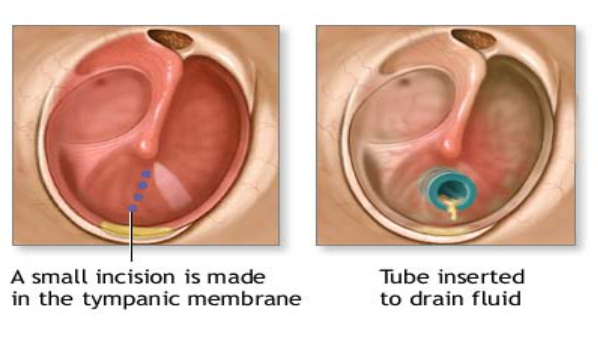
Myringotomy—surgical incision of the eardrum – allows drainage of fluid and relief of pressure
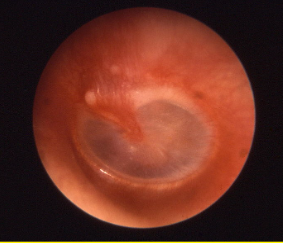
Myringotomy with Tube Insertion
Not done as frequently as they used to be
Nursing Care Management Otitis Media
Relieve pain
Prevent Complications or Recurrence
Proper use of antibiotics
Hold upright for feeds
No second hand smoke
Education
Emotional Support
Child & Family
Non-pharmacological pain relief – positioning, warm compress
Pharmacological treatment – acetaminophen in all ages, ibuprofen 6 months and older – discuss with physician
Meningitis
Pathophysiology
Inflammation of the meninges:
Bacterial
Viral (aseptic)
Occurs secondary to other infections:
otitis media
Sinusitis
Pharyngitis
Cellulitis
Pneumonia
TB
septic arthritis
brain trauma
neurosurgical procedures
Infectious agent spreads to CSF and enters the subarachnoid space
Infants <2 month—group B strep passed from the mom to the infant during the birth process.
Meningococcal in adolescents.
What has helped change the epidemiology of bacterial meningitis??? Hib vaccine (haemophilus influenza b – not associated with virus that causes the flu) today almost eradicated in countries where vaccine is given
Viral meningitis
Increased number of blood cells and protein in CSF
Enterovirus-80% of all viral meningitis
Child does not appear as ill as child with bacterial meningitis
Bacterial Meningitis Clinical Manifestations & Diagnostics
Bacterial Meningitis
Clinical Manifestations
Increased irritability and lethargy
Headache
Nuchal rigidity
Fever
+ Kernig and Brudzinski signs
Diagnostics
Lumbar puncture
Blood cultures
Older children may be sick for several days with URI or GI illness.
May have photophobia.
Nuchal rigidity-resistance to neck flexion.
Symptoms may progress to seizures, altered LOC, hydrocephalus
**Priority is to get LP and blood cultures ASAP Before Abx therapy is started.
Viral Meningitis Clinical Manifestations & Diagnostics
Viral Meningitis
Clinical Manifestations
Usually febrile
Irritable and lethargic
Headache
Maculopapular rash
+ Kernig and Brudzinski signs
Diagnostics
Lumbar puncture
Blood cultures
Older children may be sick for several days with URI or GI illness.
May have photophobia.
Symptoms may progress to seizures, altered LOC, hydrocephalus
**Priority is to get LP and blood cultures ASAP Before Abx therapy is started.
Therapeutic Management
Medical Emergency
PICU
Isolation precautions
Respiratory for 24 hours after appropriate treatment has been started
Antibiotic therapy
Corticosteroids-reduce neurological sequalae
eg. hearing loss
Maintain hydration
prevent cerebral edema
Respiratory isolation is needed secondary to the mode of transmission of meningitis – mask, gown, gloves
Therapeutic Management Continued
Maintain quiet environment
Minimize environmental stimuli
Reduce the ICP
Management of systemic shock
Monitor I & O
Control seizures
Control temperatures
Management of pain
Treatment of complications
blindness, deafness, paralysis, learning problems/cognitive challenges
Care is determined by severity of sx
Meningitis Nursing Considerations
Nursing Considerations
Neurologic Assessment
Quiet Environment
Positioning
Monitor response to antibiotic therapy
Prevention
Provide family support and education
**Watch for changes in behavior – this is an early sign of increased ICP in children
Management for Meningitis is antibiotic therapy until CSF and blood cultures are received.
If viral meningitis antibiotics are discontinued.
Bacterial continues antibiotic therapy. Bacterial meningitis patients are treated in the PICU.
Treat any complications.
Administer antipyretics as needed.
Keep the room dark and quiet. Strict I and O. Seizure Precautions.
What Nursing Diagnoses are most appropriate for a child with meningitis?