Skin Disease and Immune System pt.1; Skin Immune Defense and General Patterns of Skin Disease
 Call Kai
 Learn
 Practice Test
 Spaced Repetition
 Match
 Flashcards
 Knowt Play
1/32

Earn XP
Description and Tags
M.8R, W.4, L.1
33 Terms
What is the largest organ in the body?
Skin
List the 4 portals of entry into the skin
Epidermis
Adnexa
Dermis and panniculus/subcutis
Extension from underlying tissues

List the portals of entry into the epidermis (5)
Absorption
Direct contact
Colonization (ex: ringworm)
Penetration
Impaired barrier
How can pathogens enter the Adnexa?
via follicle ostium
via rupture of follicle or adnexa glands (ex: furunculosis)

Define furunculosis
deep infection of the hair follicle
pus filled
causes inflammation
How do pathogens enter the dermis and panniculus?
blood vessels
nerves (rare)
What nerve is commonly impacted by feline herpesvirus? What happens to it?
Trigeminal nerve
lays latent in ganglia
How can underlying tissues cause issues with the skin?
Fracture trauma
Extension from adjacent tissues
ex: tumor
List the physical barriers that act as passive defense of the skin and what they prevent
Stratum corneum + tight junctions
Prevention of water loss
Skin + Hair + Subcutis
Prevent physical and chemical injury
Hair + Skin pigmentation
Prevent DNA damage and structural Proteins
What process regenerates the physical and permeability of the skin barrier?
keratinization
What does filaggrin form from?
Profilaggrin
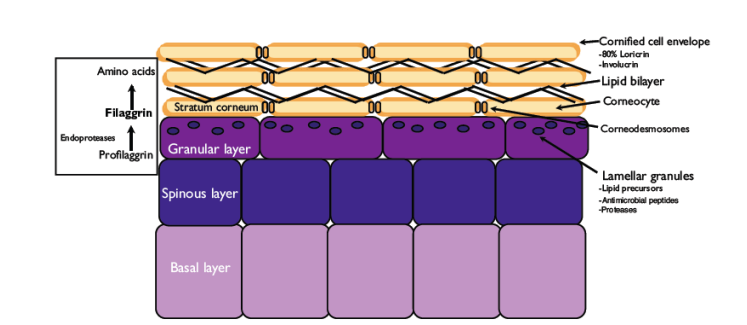
What does filaggrin break down into and list its function
Amino Acids
natural moisturizing factor
What lipids is the stratum corneum made up of? (3)
Sphingolipids (ceramide)
Cholesterol
Free Fatty Acids
What are sphingolipids and fatty acids important for?
physical barrier
permeability barrier
immunologic barrier
What kind of cells are keratinocytes?
What do they express?
What do these respond to? and what do these induce?
Sentinel cells
express Pattern Recognition Receptors (PRRs)
PRRs respond to Damage Associated Molecular Pattern (DAMPs) and Pathogen Associated Molecular Pattern (PAMPs)
induced innate immune system
Since keratinocytes are pro-inflammatory, what do they produce?
Complex mixture of:
AMPs (Antimicrobial Peptides)
Pro-inflammatory cytokines and chemokines
What kind of molecules do keratinocytes express? and what does these molecules interact with?
Major Histocompatibility Complex (MHC) Class II molecules
interact with antigen-experienced T cells