Organic Chem Topics 10-18
 Call Kai
 Learn
 Practice Test
 Spaced Repetition
 Match
 Flashcards
 Knowt Play
1/58

There's no tags or description
Looks like no tags are added yet.
59 Terms
Alkane
a molecule consisting entirely of carbon and hydrogen atoms connected by single bonds
straight-chain alkane with one C
methane
straight-chain alkane with two C’s
ethane
straight-chain alkane with three C’s
propane
straight-chain alkane with four C’s
butane
straight-chain alkane with five C’s
pentane
straight-chain alkane with six C’s
hexane
straight-chain alkane with seven C’s
heptane
straight-chain alkane with eight C’s
octane
straight-chain alkane with nine C’s
nonane
straight-chain alkane with ten C’s
decane
Parent chain
longest continuous chain of carbon atoms found in a branched molecule
where does the parent chain name go in an overall name
at the end
-CH3
methyl
-CH2CH3
ethyl
-CH2CH2CH3
propyl or n-propyl
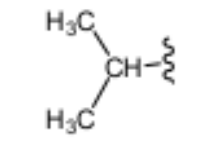
what is the name of this molecule?
isopropyl
-CH2CH2CH2CH3
butyl or n-butyl

what is the name of this molecule?
isobutyl

what is the name of this molecule?
sec-butyl

what is the name of this molecule?
tert-butyl or t-butyl (looks like a T)
-CH2CH2CH2CH2CH3
pentyl
how are branches named?
branches end in yl

What information do the numbers in the names above convey?
the numbers indicate which carbon a branch is on
how do you order branch names in the title of a molecule?
alphabetically (not including prefixes di, tri, sec, or tert)
what role does a ring play in the title of a molecule?
If a ring is present the ring is almost always considered the parent chain
What prefix is used to indicate that a parent chain when it is a ring?
cyclo
how do you make a conformation of a molecule?
move atoms by rotating a single bond

what is the conformation called when all the atoms are aligned?
eclipsed, it is the least fav (highest P.E.) conformation of butane
To determine if a double bond is neither E or Z…
put a box around each carbon shown in the double bond and determine if there are two identical groups on either boxed C, if yes then the double bond is neither E or Z
To determine if a double bond is E or Z…
draw line along the double bond and find the highest priority group connected to each C, if the groups are on opposite sides of the line then the double bond is E, if they are on the same side then the double bond is Z
how to describe the circled groups in E double bonds
trans to each other
how to describe the priority groups in Z double bonds
cis to each other
when do you use trans/cis instead of E/Z?
if the molecule has one (non-H) group on each carbon of the double bond
when do you use E/Z instead of trans/cis?
when there are three or more non-H groups around the double bond
what does the “ene” suffix on a molecule name mean?
indicates the presence of a carbon–carbon double bond (C=C) classifying the molecule as an alkene
how to assign E/Z priorities for isotopes
the heavier atoms wins for isotopes (so 2H beats 1H, 13C beats 12C)
how to assign E/Z priorities for multiple bonds
double bonds count double, so C=O is the same as a C single bonded to two O atoms
configurational stereoisomers
have the same atoms connected in the same order, but different 3D arrangement that cannot be changed into one another by rotating single bonds
constitutional isomers
have the same molecular formula and same types and numbers of atoms, but the atoms are connected in a different order
what does the E/Z in otherwise identical names of a molecule tell you?
the molecules are configurational stereoisomers
how to indicate where a double bond is in a molecule in the name?
use a number before "ene" for example but-1-ene
how is a double bond in a ring named?
it is assumed to be Z so you can name it “cyclohexene” not Z-cyclohexene
how to name molecules with more than one double bond that can be Z or E
place multiple prefixes and numbers at the start to designate which bonds are Z and which are E
how to name molecules with two, three, or four double bonds?
they have the base names diene, triene, and tetraene
Newman projection of a molecule
focuses on one bond
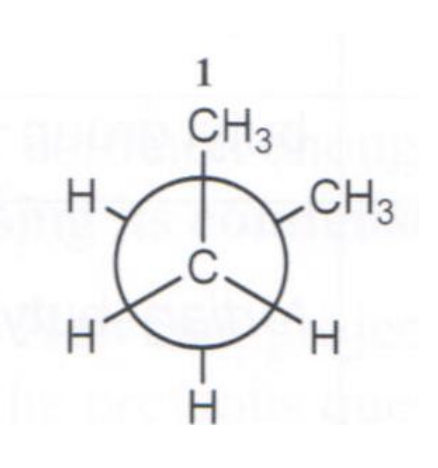
what kind of conformation is this?
staggered gauche because two methyl groups are neighbors (60° apart), not the most favorable or the least favorable conformation
what happens when an alkyl group bonds to a carbocation
they stabilize it by donating some of their electron density to help complete its octet
tertiary (3°) carbocation
three R groups attached to C, no H atoms, most stable
secondary (2°) carbocation
two R groups (one H)
primary (1°) carbocation
one R group (two H’s)
methyl (0°) carbocation
zero R groups, three H atoms, least stable, does not form
Appropriate proximity to π bond(s) leads to two special categories of resonance-stabilized carbocations:
benzylic carbocation + charge next to benzene ring (and in resonance with benzene π bonds)
allylic carbocation + charge next to (and in resonance with) π bond(s) (not benzene ring)

allylic position
the carbon atom (or position) that is directly next to a carbon-carbon double bond

Benzylic position
the carbon atom that is directly attached to a benzene ring
how does a pi bond act as a weak base towards a strong acid?
To draw a Newman projection in the lowest P.E. conformation, the following rule of thumb usually applies:
Place the largest group on the front carbon anti to the largest group on the back carbon.
Hydration reaction
the addition of H2O to an alkene in the presence of an acid catalyst to make an alcohol
markovnikov’s rule
In the addition of HX to a π bond, the X ends up on the carbon atom with more alkyl (R) groups and fewer hydrogens