neuro exam 2 (memory)
 Call Kai
 Learn
 Practice Test
 Spaced Repetition
 Match
 Flashcards
 Knowt Play
1/24

There's no tags or description
Looks like no tags are added yet.
25 Terms
Phases of memory
Perceptual memory (1-2 sec), WM (45 sec), LTM (min to years).
Working memory
Keeps track of, updates, and manipulates information at the moment. 4 chunks of info. Dorsolateral PFC. N-back, DNMTS/DMTS.
Declarative memory
1972 Endel Tulving. Episodic memories (autobiographical, specific events, etc.), occur in medial temporal lobe, more specifically the hippocampus. Semantic memories, facts knowledge. CONSCIOUS.
Non-declarative memory
Conditioning, motor skill learning, UNCONSCOUS, LTM.
Baddley’s 2000 model
WM.

Goldman and Rakic, 1992
dlPFC→WM, single cell recording monkey. Holded target in mind, dlPFC activity occurred during WM retrieval response.
Encoding: Creation
Transform sensory data to mental representations. Occurs in hippocampus which stores cortical patterns from events. Cortical regions are then connected together in a process called CELL ASSEMBLY.
CELL ASSEMBLY
Memories become permantatly stored in assigned regions in brain. This happens through Hebbian learning (cells that wire together, fire together). Hebbian learning is done by long-term potentiation where repeated stimulation of hippocampus resulted in potentiated (increased) response of previously stimulated neuron. Starts with Ca2+ flows into post-synaptic cell and changes the shape of dendrites.
Pre-syn: NT Ca2+ gated, glutamate doesn’t open Mg2+ receptor.
Post-syn: depolarization Glutamate opens receptor Mg2+, Ca2+ starts protein synthesis in post-synaptic neuron.
Consolidation
STM —> LTM. ONLY HAPPENS WITH SEMANTIC MEMORIES. Occurs in the hippocampus, where recent memories.
Recent memory: retrieval cue accesses hippocampus index to access disrupted cortical memory traces.
Distant memory: direct associations between cortical traces. It is independent of hippocampus.
Episodic memory is dependent on hippocampus for as long as the memory has spatial details and episodic content.
Retrieval
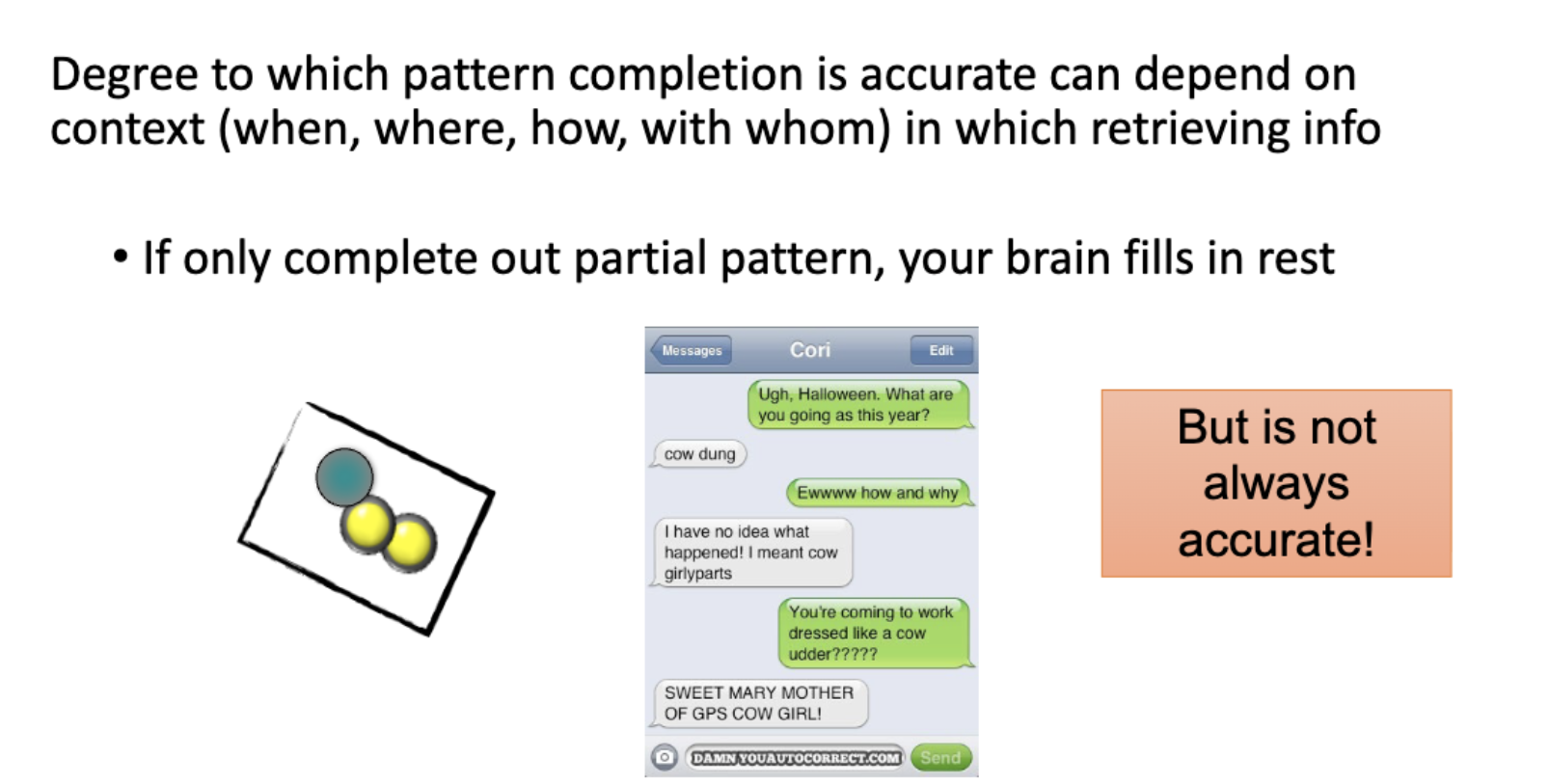
Mechanism of synaptic plasticity, Pattern completion that occurs in hipp. Cortical reimbursement happens in pattern completion, here, partial cue acitvates partial hipp → partial hip can reactivate the rest of the trace → hipp trace can reactivate cortical patterns.
Sensory specific area

Memory is actually constructive
Ribot’s Law
Retrograde amnesia is more prominent for recent memories.
Causes of Amnesia.
Damage to:
Medial temporal lobe.
Mammillary body in hypothalamus.
Dorsomedial nucleus in thalamus.
Psychological trauma, fugue state.
Global Amnesia.
Profound forgetfulness regardless of type of information and its presentation.
Patient H.M.
Fell off bike when he was 10 which caused him to get epilepsy. Surgeon removed his medial temporal lobes (except for the posterior portion). He couldn’t remember things like his last meal, where he lives, his age, etc. Found hippocampus was important for:
• laying down long-term memories
• allocentric spatial information
• timing information, relative timing between
events in an experience
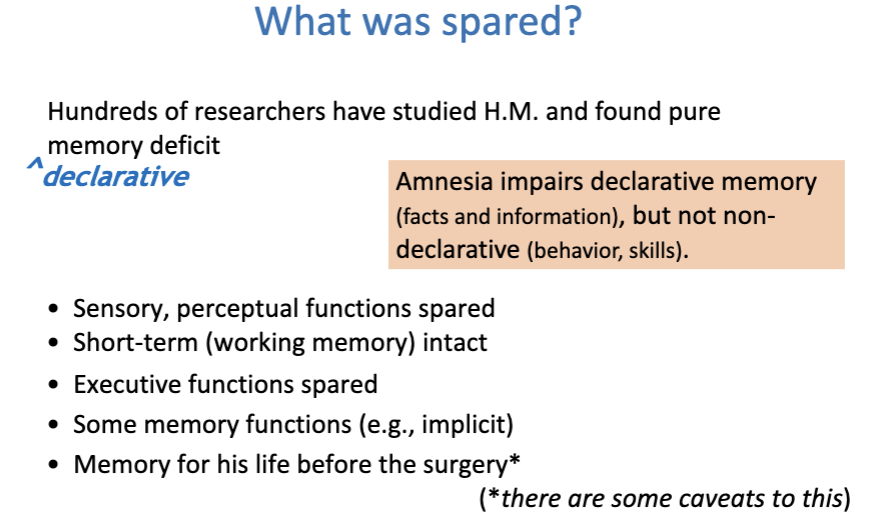
LOST DECLARATIVE MEMORY
Amnesia impact declarative memories, but not non-declarative memories. Also his STM was fine but his long-term memory (to an extent) was much worse.
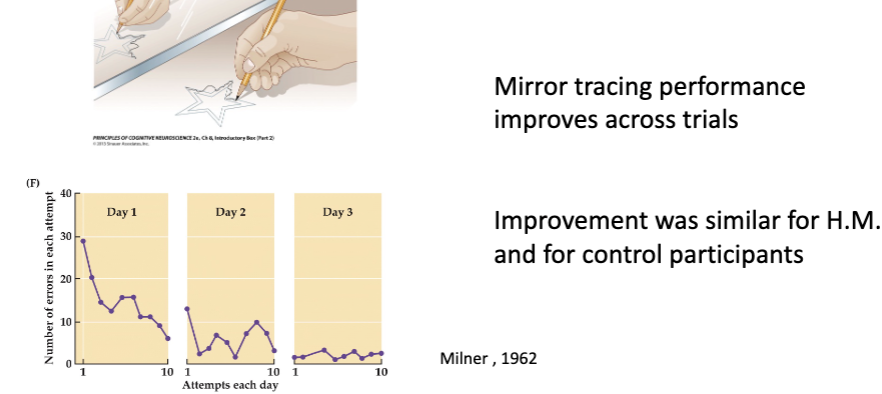
H.M. Skill Learning Performance
Had anteregorade amnesia so his procedural memory and skills before injury were still in tact. Could only remember 2 episodic memories in his life (cig and plane).

Multiple Trace Theory of Memory Consolidation
MTL is always needed for episodic memories, only semantic memories can become hippocampal over time. MTL (inlcuding the hippocampus) bind together cortical patterns to form a coherent memory.
Single dissociation
Term used in neuropsychology. When brain lesions disrupts one thing but not the other. ex. H.M could not make any new episodic memories (anterograde amnesia) but he could tell you about his childhood and he could acquire new skills, however, he would not be able to remember that eh had performed the tsk before.
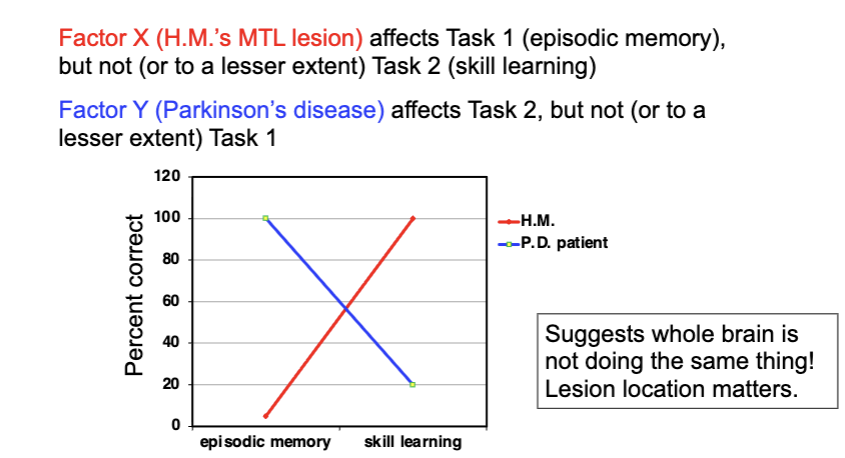
Double Dissociation.
H.M had issues with declarative memory but his non-declarative memory was in tact.
PD patient had normal declarative memory but struggled with their non-declarative memory.
Patient K.F.
Sustained head injury from motorcycle accident. Damage to perisylvian region (Sylvian fissure aka lateral sulcus, separates temporal lobe from frontal and parietal lobe). Impaired STM (unlike H.M), spared LTM.
Recollection.
Retrieval process where you remember specific contextual details associated with an object. Better for recall examinations.
Familiarity
The process of recognizing an item based on perceived memory strength as opposed to specific details about a study episode. Better for recognition examination.
MTL supports two different memory types
Recollection recovery of contexual/detail-rich mem. Content representation.
Hippocampus
Posterior parahippocampal cortex
Familiarity an acontexual/detail-free sense of prior encounter. Item representation.
Perirhinal cortex
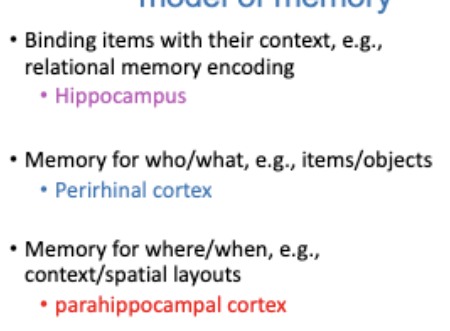
Binding of Items and Contexts (BIC) model of mem
Perihinal → items/objects (similar to a camera). Ventral stream.
Parahippocampal cortex → context/spatial layout (similar to GPS), enviromental. Dorsal stream.
Hippocampus binds memories together.
Caudal hippocampus processes exteroceptive signals/sensory cues for scene learning.
Rostral hippocampus processes interoceptive signals/internal sensory cues for emotional and motivational modulation.
Amygdala & limbic system send affective information.