Contact dz (fourth)
 Call Kai
 Learn
 Practice Test
 Spaced Repetition
 Match
 Flashcards
 Knowt Play
1/72

There's no tags or description
Looks like no tags are added yet.
73 Terms
What are the 3 types of contact transmission?
Direct, indirect, droplet
Direct vs. indirect contact transmission?
Direct = person-to-person
Indirect = person-to-fomite
What is a fomite?
A contaminated, non-living object (e.g., a doorknob)
What are the 2 types of person-to-person (direct contact) diseases?
1. Sexual = STDs (STIs)
2. Non-sexual = Non-STDs
Which contact diseases are non-STDs?
Trachoma (bacterial), Hepatitis C (viral)
Which STDs are bacterial?
Gonorrhea, Genital Chlamydia, Syphilis
Which STD is caused by a protist?
Trichomoniasis (K. Protista)
Which STDs are viral?
Genital Herpes, Hepatitis B, HIV/AIDS
Why is Hepatitis C not an STD?
It’s spread by contaminated blood
What is the most common STD in the U.S.?
Genital Chlamydia
HPV (Human Papilloma Virus), which is viral

What is the 2nd most common STD in the U.S.?
Genital Herpes (HSV-2), which is viral
What is the most common non-viral STD in the U.S.?
Trichomoniasis (protozoal).
It’s more common than Chlamydia, yet it’s the STD women are least familiar with (22%).
Rank the bacterial STDs from most to least common.
Chlamydia > Gonorrhea > Syphilis
What happened in 1981?
A cluster of Pneumocystis (atypical) pneumonia (fungus), Kaposi’s sarcoma (cancer) and loss of immune function in young homosexual men → AIDS epidemic begins
What happened in 1982?
The term Acquired Immunodeficiency Syndrome (AIDS) was first used. Acquired means caught through HIV infection, and syndrome means a group of signs and symptoms common to most cases.
What happened in 1983, and who made the discovery?
A virus causing loss of immune function was discovered → named Human Immunodeficiency Virus (HIV). Discovered by Dr. Luc Montagnier (France) and Dr. Robert Gallo (USA).
What can cause acquired immunodeficiency?
1. HIV infection (→ AIDS)
2. Transplant drugs
3. Chemotherapy
Where did HIV come from?
It spread from “old world” monkeys (Africa) to humans. SIV (Simian Immunodeficiency Virus) → HIV strains. Simian = monkey/ape.
What are the key facts about HIV-1?
-Related to SIV in gorillas and chimps
More pathogenic than HIV-2
99% of cases worldwide = most common human strain
What are the key facts about HIV-2?
- Endemic to West Africa
Lower mortality than HIV-1
What are the 2 key HIV enzymes?
1. Reverse transcriptase
2. Integrase
How does HIV (an RNA virus) get into host DNA?
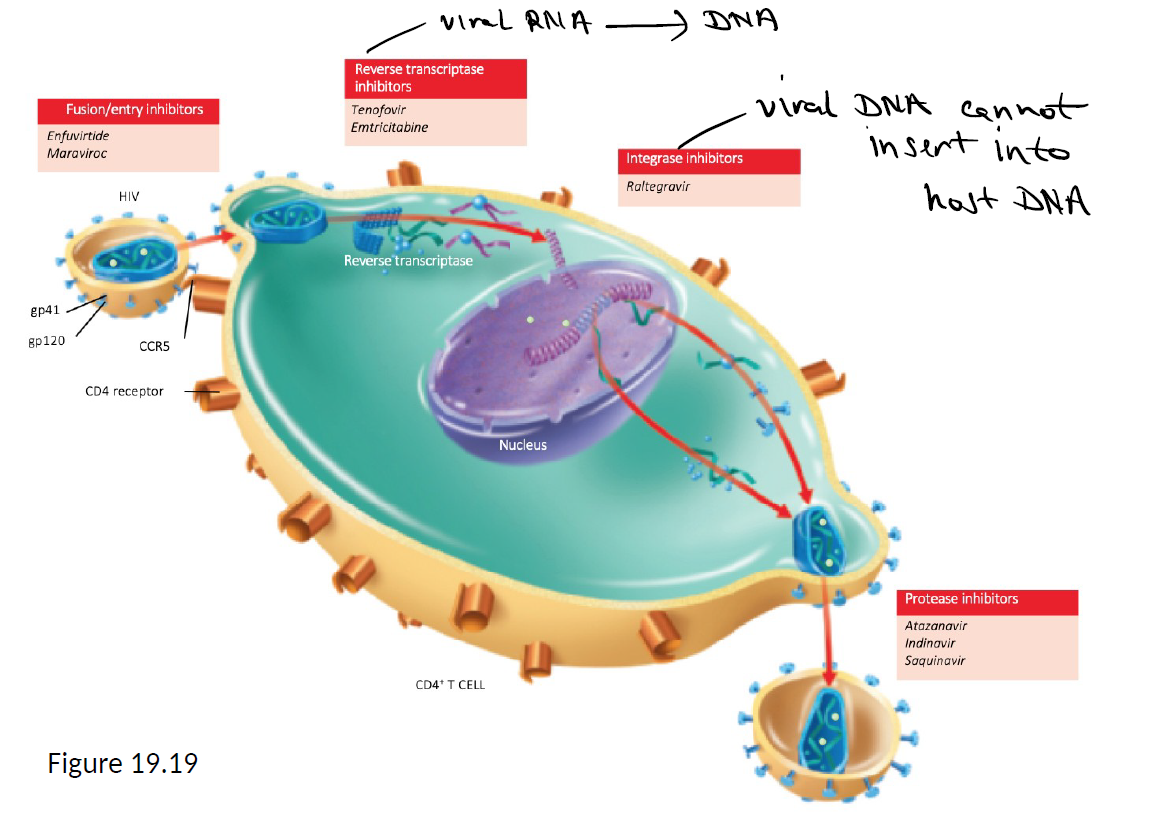
Viral RNA → reverse transcription (reverse transcriptase) → viral DNA → integrase inserts it into host DNA
What is a provirus?
Viral DNA integrated into host DNA = hybrid DNA
What happens after the provirus forms?
Hybrid DNA → transcription → RNA → translation → viral proteins (parts) → assembled into new viruses
What is HIV’s target cell, and how does HIV reach it?
Viremia → HIV travels to lymphoid organs → attacks CD4⁺ T cells
What is HIV’s key virulence factor, and what does it bind?
gp120 (glycoprotein spike) attaches to the CD4⁺ T cell receptor and coreceptors
Where are CD4 molecules found?
On the surface of T_H cells
How does HIV enter the CD4⁺ T cell?
The virus fuses with the cell and enters
What are the 3 steps of HIV entering a CD4⁺ T cell?
1. Attachment
2. Entry-fusion
3. Uncoating
What happens during uncoating?
The viral envelope remains behind and HIV uncoats, releasing the RNA core to direct synthesis of new viruses
After integration, which 2 cycles can HIV enter for viral multiplication?
Lytic or lysogenic
Active vs. latent HIV infection?
Active = new viruses (virions) bud from the host cell (lytic cycle)
Latent = viral DNA is hidden in the host chromosome (CD4⁺ T_H cell) as a provirus (lysogenic cycle)
What is the order of the HIV cycle (lytic → lysogenic → lytic)?
A-E-U (Attachment, Entry, Uncoating) = active infection, lytic
→ Lysogenic cycle = latent infection (provirus forms)
→ B-M-R (Biosynthesis, Maturation, Release) = active infection, lytic
How do new HIV get their envelope, and what are they called?
The provirus activates → viral parts assemble at the cell membrane → the virus buds from the T cell, taking the envelope proteins (gp120, gp41) with it → progeny HIV = virions
In an untreated person, how do CD4⁺ T cell and HIV levels change over time?
CD4⁺ T cells (red line) decline steadily over the years
HIV (blue line) peaks about 2 months after infection, drops and stabilizes, then rises again as the immune system breaks down
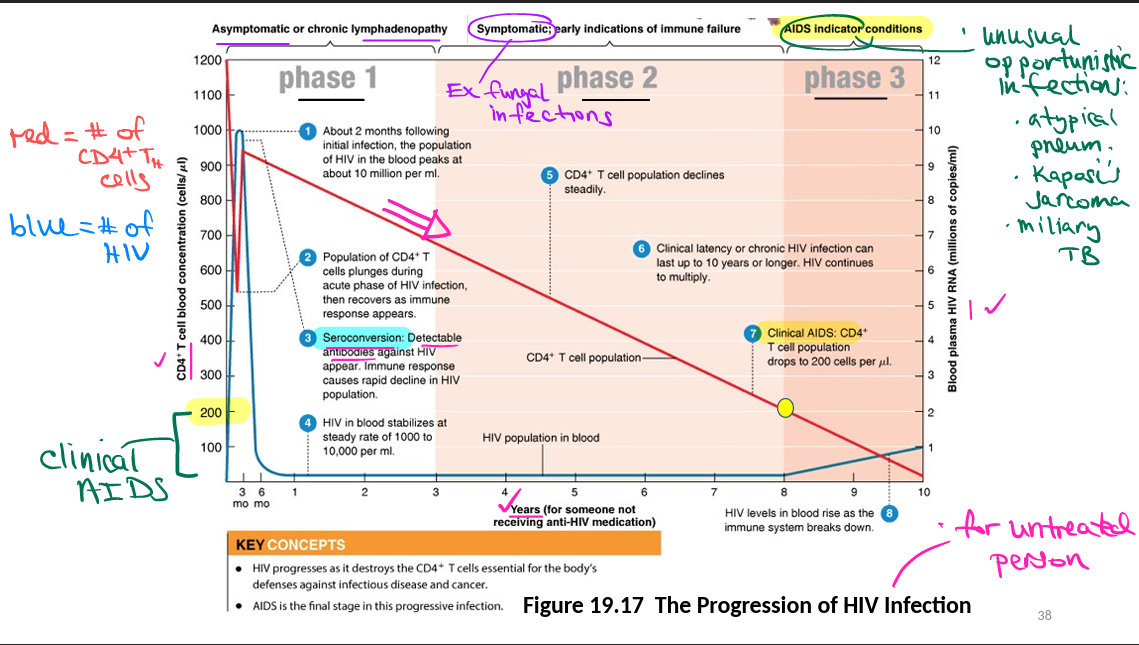
What causes the rapid drop in HIV early on?
Seroconversion: detectable antibodies against HIV appear, and the immune response lowers HIV levels
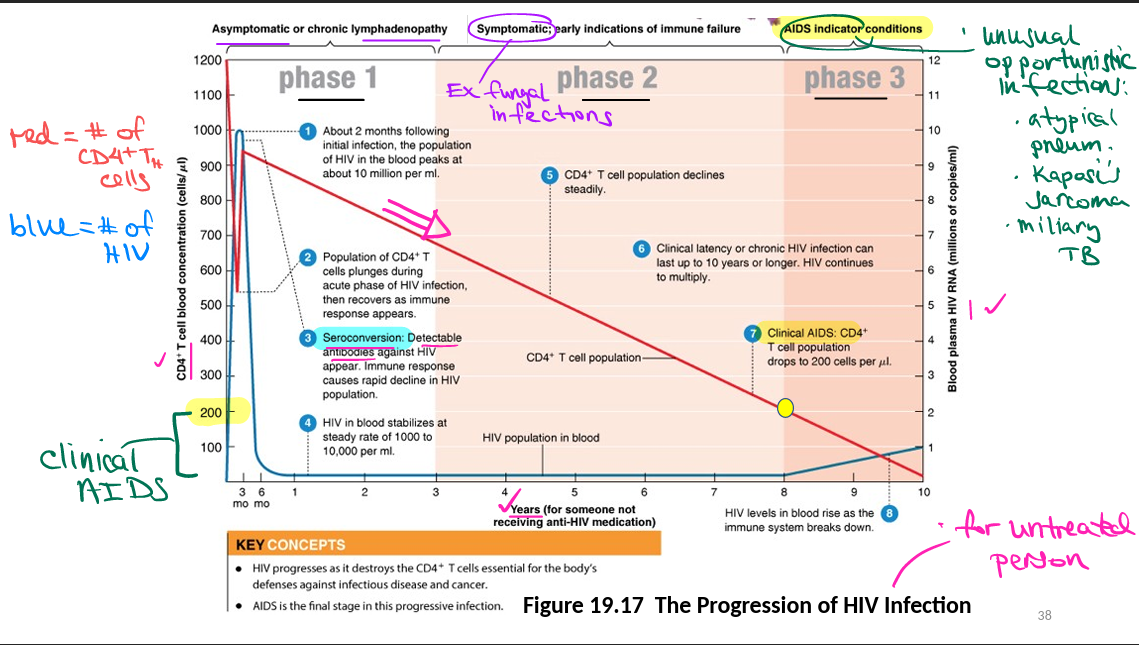
How long can clinical latency (chronic HIV) last?
Up to 10 years or longer. HIV keeps multiplying the whole time.
At what CD4⁺ count is it clinical AIDS, and what are the AIDS indicator conditions?
Below 200 cells/µl. The indicators are unusual opportunistic infections: atypical pneumonia, Kaposi’s sarcoma, miliary TB.

What happens in HIV Phase 1?
Asymptomatic or lymphadenopathy (swollen lymph nodes). Seroconversion occurs, meaning antibodies become detectable; it lasts about 3 months.
What happens in HIV Phase 2?
CD4⁺ T cells decline steadily, and only a few infected cells release HIV. There are a few serious symptoms: persistent Candida albicans (fungal) infections, persistent diarrhea, fever.
What causes Kaposi’s sarcoma, and how does that virus compare with HHV-2 and HHV-3?
Kaposi’s sarcoma is an HIV-related skin cancer caused by HHV-8
HHV-2 = genital herpes
HHV-3 = chickenpox
What type of pathogen causes the atypical pneumonia in AIDS?
Fungal (Pneumocystis)
Which latent viruses commonly come back in AIDS, and what do they cause?
HSV-2 → vesicles on skin and mucous membranes (e.g., genital herpes)
Varicella-zoster virus → shingles
Which fungus causes the life-threatening atypical pneumonia in AIDS?
Pneumocystis jirovecii
Where does Candida albicans overgrow in phase 2 vs. phase 3 of HIV?
Phase 2 = oral and vaginal mucous membranes
Phase 3 = esophagus and lungs
Which bacterial infection is common in AIDS?
Mycobacterium tuberculosis (TB)
What does Kaposi’s sarcoma affect?
It’s a cancer of skin and blood vessels, caused by a virus (HHV-8)
What are the 2 immune responses to HIV, and what does each involve?
1. Humoral = B cells and antibodies (HIV-specific antibodies made during seroconversion)
2. Cell-mediated = T cells (CD8⁺ T_H cells suppress viral replication)
Define seroconversion.
The period between infection and detectable HIV antibodies. It takes up to 3 months (part of Phase 1).
Before seroconversion = only HIV present
After = HIV and antibodies present
Can HIV be transmitted before seroconversion?
Yes. A person can still transmit HIV before antibodies are detectable.
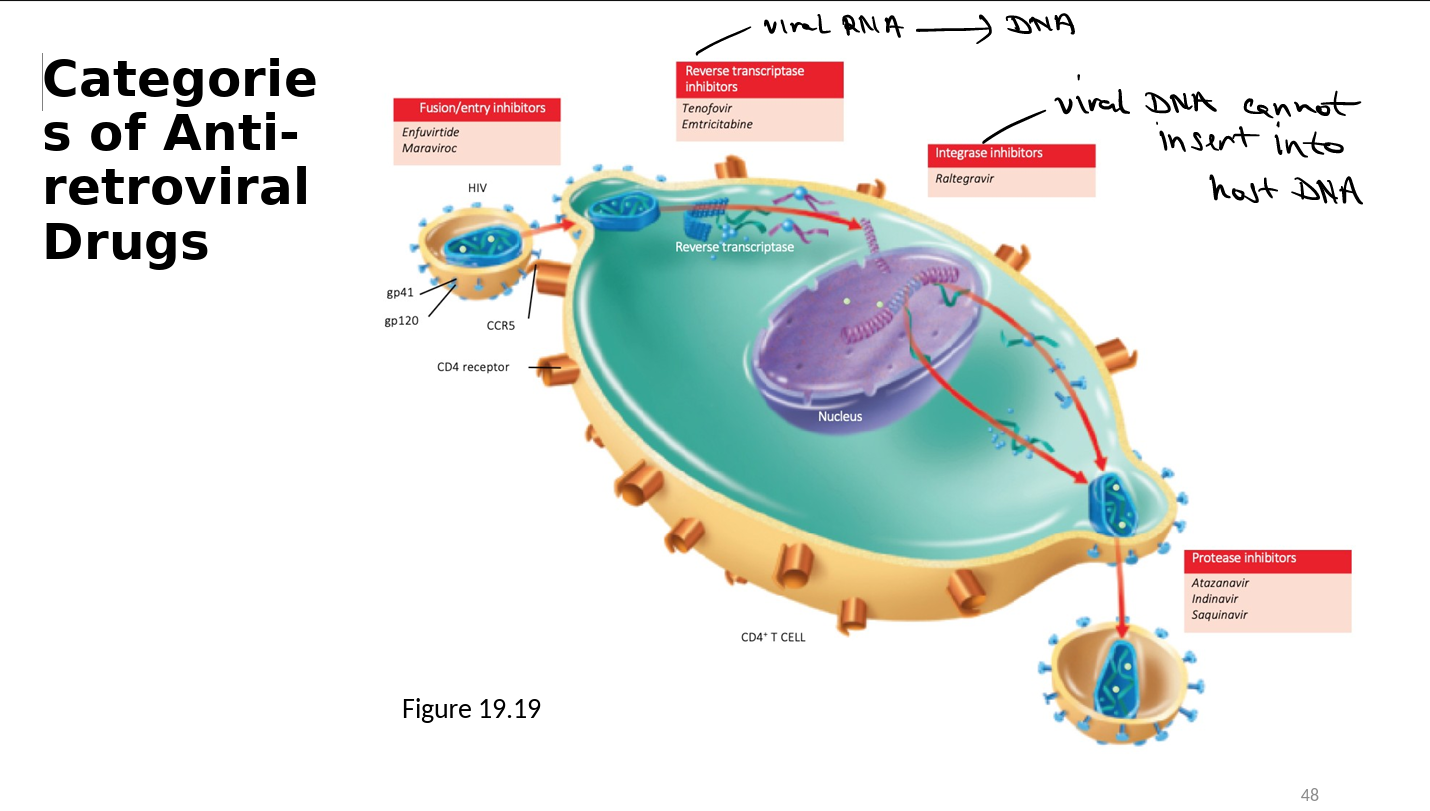
What is the goal of anti-retroviral drugs?
To lower the amount of HIV. They’re management only, not a cure.
What is HAART?
Highly Active Antiretroviral Therapy, a “cocktail” that uses combinations of multiple drugs to combat resistant HIV strains
What do fusion/cell entry inhibitors do?
Prevent fusion of HIV with the host cell (CD4⁺ T cell)
What do reverse transcriptase inhibitors do?
Prevent conversion of viral RNA into viral DNA
What do integrase inhibitors do?
Prevent the integration of viral DNA into the host (CD4⁺ T cell) DNA
What do protease inhibitors do?
They block protease, so immature viral proteins can’t become mature viral proteins. Those mature proteins are needed, for example, to make viral spikes.
What are the 5 categories of anti-retroviral drugs?
1. HAART
2. Fusion/cell entry inhibitors
3. Reverse transcriptase inhibitors
4. Integrase inhibitors
5. Protease inhibitors
In order, where does each anti-retroviral drug act in the HIV cycle?
1. Fusion/entry inhibitors → at entry into the CD4⁺ T cell
2. Reverse transcriptase inhibitors → viral RNA ↛ DNA
3. Integrase inhibitors → viral DNA can’t insert into host DNA
4. Protease inhibitors → at assembly/budding (no mature viral proteins)
Remaining cards are good HIV review
Early infection (first ~3 months): what happens to HIV and CD4⁺ T cells?
HIV peaks at about 2 months (~10 million/ml)
CD4⁺ T cells plunge during the acute phase, then recover as the immune response appears
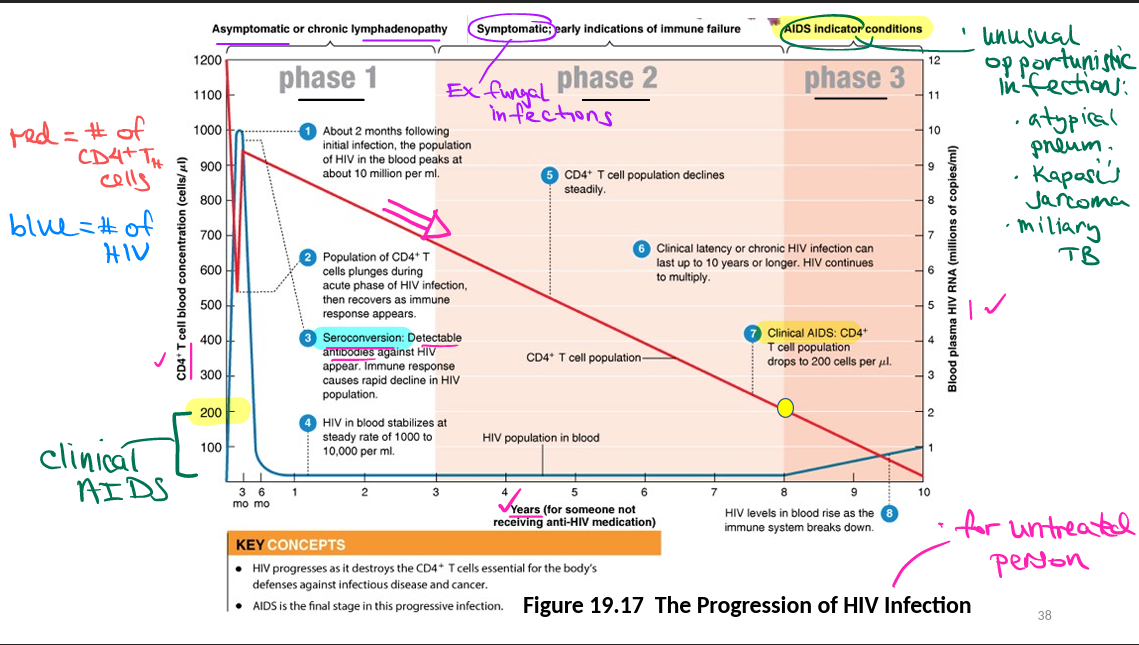
What does seroconversion do to the graph?
Antibodies against HIV appear → rapid decline in HIV. HIV then stabilizes at 1,000–10,000/ml.
Phase 1: CD4⁺ T cells vs. HIV?
CD4⁺: high; dips, then recovers (~1,000 cells/µl)
HIV: spikes, then drops after seroconversion
Symptoms: asymptomatic or swollen lymph nodes

Phase 2: CD4⁺ T cells vs. HIV?
CD4⁺: decline steadily
HIV: stays low and stable, but keeps multiplying
Clinical latency can last up to 10+ years

Phase 3: CD4⁺ T cells vs. HIV?
CD4⁺: drops below 200 cells/µl = clinical AIDS
HIV: rises as the immune system breaks down
Result: opportunistic infections

Why does HIV stay low during Phase 2?
The immune system holds it back:
Cell-mediated: CD8⁺ T cells suppress viral replication
Humoral: antibodies (made at seroconversion) keep fighting HIV
So only a few infected cells release HIV
If the body fights HIV in Phase 2, why does it still progress to AIDS?
HIV keeps destroying CD4⁺ T_H cells, so they decline steadily.
Eventually cell-mediated immunity (CMI) fails and HIV rises.

What is HAART, and why use it?
Highly Active Antiretroviral Therapy, a “cocktail” that combines multiple drugs to fight resistant HIV strains
Fusion/entry inhibitors: which step do they block?
Fusion and entry. HIV (gp120) can’t fuse with and enter the CD4⁺ T cell.
Reverse transcriptase inhibitors: which step do they block?
Reverse transcription: viral RNA → DNA can’t happen
Integrase inhibitors: which step do they block?
Integration: viral DNA can’t insert into host DNA (no provirus)
Protease inhibitors: which step do they block?
Protein maturation: immature viral proteins can’t become mature proteins (e.g., spikes), so no new infectious virions
Put the drugs in order of the HIV cycle step they block.
Fusion/entry inhibitors (enter cell) → RT inhibitors (RNA → DNA) → Integrase inhibitors (DNA → host DNA) → Protease inhibitors (assembly/maturation)
HAART = a combination of these
What is the overall goal of ART?
To lower plasma viral load to “undetectable”. It’s management, not a cure: the person is still HIV-positive.