Exam 4 (#21) - Respiration
 Call Kai
 Learn
 Practice Test
 Spaced Repetition
 Match
 Flashcards
 Knowt Play
1/21

There's no tags or description
Looks like no tags are added yet.
22 Terms
What are the 4 processes of respiration?
Pulmonary ventilation
External respiration
Transport of respiratory gases
Internal respiration
Explain the 4 processes of respiration:
Pulmonary ventilation - air in and out of lungs
External respiration - breathing out
Transport of respiratory gases - CO2 and O2 through the blood
Internal respiration - breathing in
What is pulmonary ventilation?
Air in and out of lungs (bulk air flow)
What is transport of respiratory gases?
CO2 and O2 through the blood
What makes up the upper respiratory system?
Nose - Filters, humidifies
Pharynx - Connects nose/mouth to larynx

What makes up the lower respiratory system?
Larynx - Contains epiglottis and vocal cords
Trachea - Contain cilia → Move in one direction
Bronchi/bronchioles
Lungs
Diaphragm
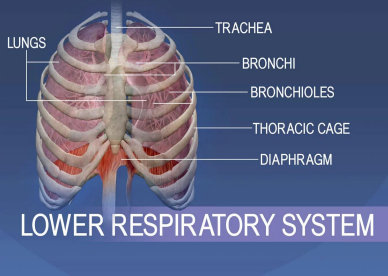
How many lungs are there? How many lobes does each lung have?
Two lungs: left lung and right lung
Left: 2 lobes
Right: 3 lobes
What is the anatomy of the bronchioles?
First order bronchioles
Second order bronchioles
Third order bronchioles (10 on each side)
Terminal bronchioles (21-23rd order)
(The first-third is the conducting zone)

Can bronchioles change diameter? Why or why not?
Yes. This is so they can regulate airflow to different parts of the lungs
What do you expect to find in bronchioles?
Smooth muscles
What is the pathway of air into the lungs?
Conducting zone (bulk air flow, contain smooth muscle, dilate or constrict):
Trachea → first order bronchioles → second order bronchioles → third order bronchioles
Respiratory zone (external respiration):
Terminal bronchioles (contain alveoli) → alveoli
Explain the conducting zone and the respiratory zone:
Conducting zone:
Bulk air flow
Contain smooth muscle
Dilate or constrict
Respiratory zone:
External respiration
Explain the anatomy of the lungs:
Tip/top: Apex
Bottom: Base
Can see the indent of ribs (reflects the function)

What surrounds the lungs?
(CT) Pleurae
Explain pleurae surrounding the lungs:
Parietal pleura lines the lungs + visceral pleura is the layer under the parietal pleura.
The space in between ^ is called the pleural cavity (which contains serous fluid)
Do the lungs share the same pleura? Why or why not?
No. They each have one so if the pleura is compromised on only one lung it will not spread to the other lung
How does air enter the lungs?
Pressure gradients - air will move from a high-pressure area to a low-pressure area
Why is air flow - bulk flow?
Because air moves as a single connected unit, not random molecules moving randomly based on individual gradients
What is happening during air flow?
Inspiration and expiration due to muscle movements (diaphragm mainly)
Creates pressure differentials
Air moves → lung volume changes
Flow = ∆P / Resistance
What is the formula for air flow?
Flow = ∆P / Resistance
What are the different pressures involved in air entering the lungs?
Atmospheric pressure - pressure of air outside of your body)
Intrapulmonary pressure - pressure of air inside your lungs (this changes with muscle contraction + relaxation)
Respiratory pressure - can be 1) exhale: air going out of lungs. 2) inhale: air going into lungs
Respiratory pressure = intrapulmonary pressure - atmospheric pressure
What is the formula for respiratory pressure>
intrapulmonary pressure - atmospheric pressure = respiratory pressure