Anatomy and Physiology - Unit 0
 Call Kai
 Learn
Learn Practice Test
 Spaced Repetition
 Match
Match Flashcards
 Knowt Play
1/152

There's no tags or description
Looks like no tags are added yet.
Name | Mastery | Learn | Test | Matching | Spaced | Call with Kai | Chat |
|---|
No analytics yet
Send a link to your students to track their progress
153 Terms
Epithelial Tissue: LOCATION (7)
Skin, thyroid, liver, intestines, glands, lines internal organs, mainly everywhere
What are the differentiating characteristics of epithelial tissue? (3)
Lack of blood vessels, cells can quickly divide, cells are tightly packed together
Connective Tissue: FUNCTION (5)
Bind & Support, fill space, stores fat, transports nutrients and gases through blood
Connective Tissue: LOCATION (5)
Body fat
Bones
Blood
Tendons
Cartilage
What are the differentiating characteristics of connective tissue?
Good blood supply
Cells are spread out with extra cellular matrix
Muscle Tissue: FUNCTION
Generate force for movement
What are the three types of muscle tissue?
Skeletal, Smooth, Cardiac
Muscle Tissue: Skeletal LOCATION
Attaches to bone
Skeletal is an example of? (What movement)
Voluntary
Smooth and cardiac are examples of? (What movement)
Involuntary
Muscle Tissue: Cardiac & Smooth LOCATION
Heart, internal organs
What are the differentiating characteristics of muscle tissue?
Able to contract in response to stimuli
Nervous Tissue: FUNCTION
Conduct electrical and chemical signals to send signals to function
Nervous Tissue: LOCATION
Brain and Spinal Nerves
What are the differentiating characteristics of nervous tissue?
Neuron’s shape, cells communicate with each other and to the rest of the body
Tissues
Groups of similar cells with a common function
Apical surface
Faces body cavity or external environment
Basal Membrane
Connects epithelial cells to connective tissues
How many layers of epithelial tissue are there?
8
Simple Squamous
Single layer of flattened cells with nuclei in the middle
Single Squamous: Function
Diffusion & Filtration through exchange of gas, water, nutrients
Simple Squamous: LOCATION
Lungs, capillaries
Simple Cuboidal
Single layer cube-shaped cells
Simple Cuboidal: FUNCTION
Secretion and absorption
TRUE OR FALSE: Simple Cuboidal doesn’t always form in rings and can be circled in a straight line
TRUE
Simple Cuboidal: LOCATION (3)
Kidney tubules, ducts of glands, ovaries
Cilia
Hair like organelle on the surface in cells, helps love substances
Goblet cells
Produce mucus
Simple Columnar: FUNCTION
Secretion and absorption
Microvilli
Projection of cell membrane and cytoplasm, increase cell surface
Simple Columnar: LOCATION (2)
Digestive tract, stomach
Pseudostratified Epithelium: FUNCTION
Protects against infection
Pseudostratified Epithelium: LOCATION
Lines respiratory passageways
Stratified Squamous: LOCATION (3)
Skin, mouth, esophagus
TRUE OR FALSE: Stratified Squamous layers are from outer layer cells youngest to inner layer cells oldest
FALSE, outer layer cells are older than inner layer cells
Stratified Cuboidal: LOCATION
Lines ducts of glands
Stratified Columnar: FUNCTION
Secretion and protection
Stratified Columnar: LOCATION
Male Urethra
Transitional Epithelium: LOCATION
Inner lining of bladder, urethra

What tissue is this?
Simple Squamous

What tissue is this?
Simple Cubodial

What tissue is this?
Stratified Cubodial

What tissue is this?
Stratified Columnar

What tissue is this?
Transitional Epithelium
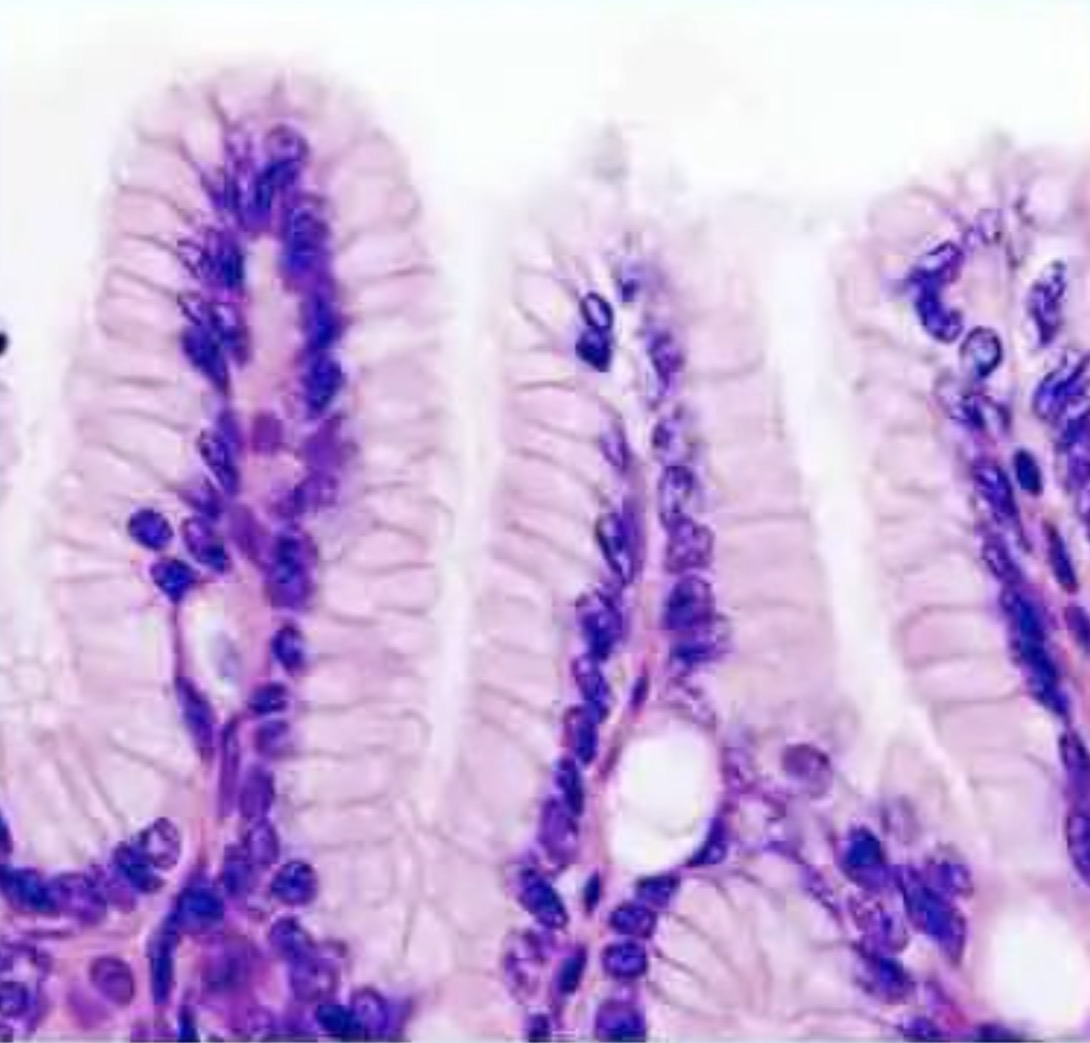
What tissue is this?
Simple columnar

What tissue is this?
Pseudostratified Columnar

What tissue is this?
Stratified Squamous


What tissue is this?
Stratified Squamous

What tissue is this?
Simple cuboidal
What tissue is this?
Simple squamous

What tissue is this?
Pseudostratified columnar

What tissue is this?
Simple Columnar

What tissue is this?
Stratified Cubodial

What tissue is this?
Simple columnar

What tissue is this?
Pseudostratified columnar

What tissue is this?
Transitional
List all types of connective tissue (3)
Blood, bone, cartilage
Collagen fibers: DESCRIBE
Extremely tough and provides strength to the connective tissue
Elastic fibers: DESCRIBE
Stretchy and bounce back like rubber bands
Reticular Fiber: DESCRIBE
Made of shorter, thinner, branched collagen fibers. They form nets to support organs
What type of fiber is thick and strong?
Collagen
TRUE OR FALSE: Connective tissue is the most abundant tissue type in the human body
TRUE
What are the 3 types of loose connective tissue?
Areolar, Adipose, Reticular

Areolar Tissue: FUNCTION
Nourishes and supports nearby epithelial cells, fills/connects space

Areolar Tissue: LOCATION (2)
Beneath most epithelial cells (skin & organs), between muscles
Adipose Tissue: FUNCTION
Stores FAT, cushions and insulates
Adipose Tissue: LOCATION
Beneath skin, around kidney and heart
Reticular Tissue: FUNCTION
Provides framework for liver, spleen, and lymph nodes

Reticular Tissue: LOCATION
Walls of liver, spleen, and lymph nodes
What are the the 2 types of dense connective tissue?
Dense regular tissue and dense irregular tissue
Dense Regular Tissue: FUNCTION
Binds together bone and muscle
Dense Regular Tissue: LOCATION (2)
Tendons, ligaments
Dense Irregular tissue: FUNCTION
Sustain tissue tension
Dense Irregular tissue: LOCATION (4)
Covers organs, bones, cartilage, makes up skin
Hyaline Cartilage: FUNCTION
Prevents damage from compression
Hyaline Cartilage: LOCATION
Ends of bones, in joins, nose
Fibrocartilage: FUNCTION
Absorbs shock and cushions
Fibrocartilage: LOCATION (2)
In between vertebrae, knees
Elastic Cartilage: FUNCTION
Provides flexible framework
Elastic Cartilage: LOCATION
Ear and larynx
Blood: FUNCTION (4)
Transports gases, substances, nutrients, white blood cells
Blood: LOCATION
Blood vessels

What tissue is this?
Fibrocartilage

What tissue is this?
Dense regular tissue

What tissue is this?
Blood

What tissue is this?
Bone

What tissue is this?
Areolar Tissue

What tissue is this?
Reticular Tissue

What is this tissue?
Hyaline Cartilage
This type of connective tissue forms strong rope like structures such as tendons and ligaments, where collagen fibers all go in the same direction. This allows them to stretch in that direction ONLY, which is important to prevent dislocations.
Dense regular tissue
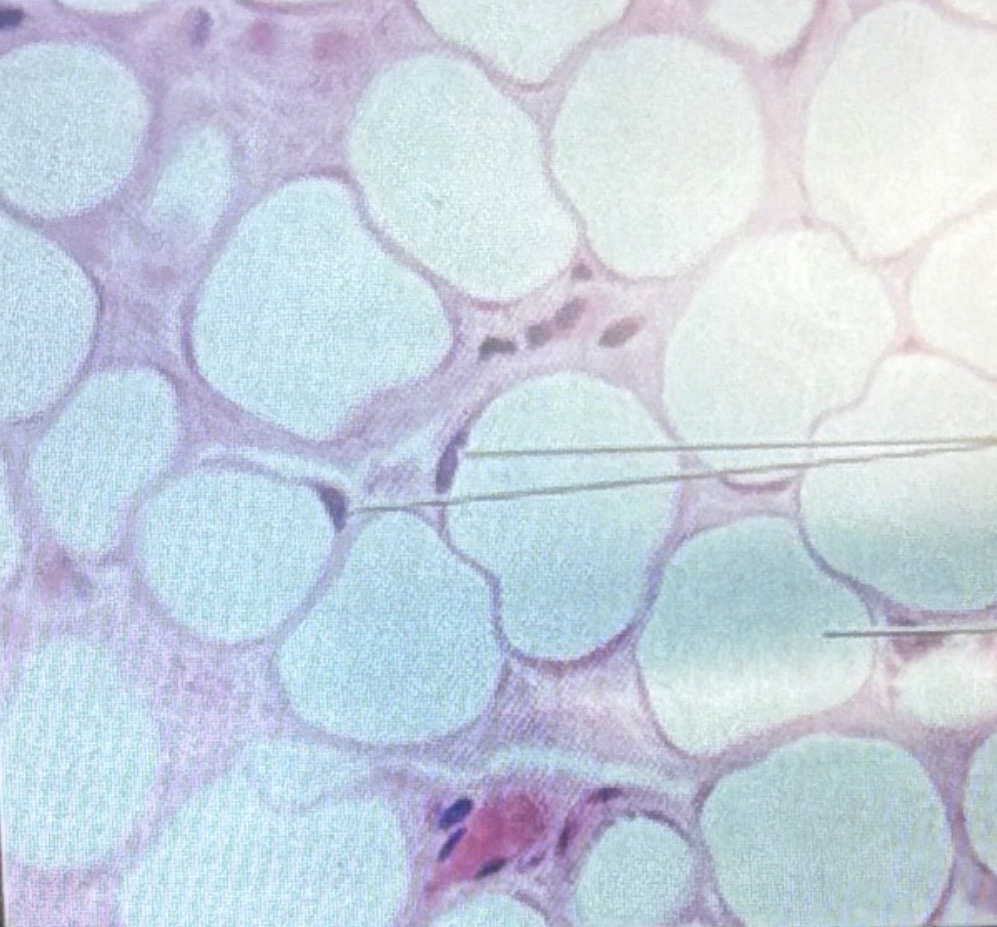
What tissue is this?
Adipose
This tissue carries nutrients, waste, respiratory gases, and many other substances throughout the body.
Blood
Which connective tissue contains a gel-like matrix and is found in the nose, ear, and at the ends of the bones
Cartilage
What type of fiber is long and thin and allows for stretch and recoil?
Elastin
Which type of tissue is the most widely distributed, supports and binds other tissues, the universal packing material?
Areolar
This type of fibers is extremely tough and provides strength to the connective tissues.
Collagen
This fiber is stretchy and bounce back like rubber bands.
Elastic
This fiber is made of shorter, thinner, branched collagen fibers. They form nets to support your organs.
Reticular
Which type of fiber is thick and very strong?
Collagen
Serves as a packing material that wraps and cushions organs
Areolar