Unit 3 biochemistry b4 quiz
 Call Kai
 Learn
 Practice Test
 Spaced Repetition
 Match
 Flashcards
 Knowt Play
1/73

There's no tags or description
Looks like no tags are added yet.
74 Terms
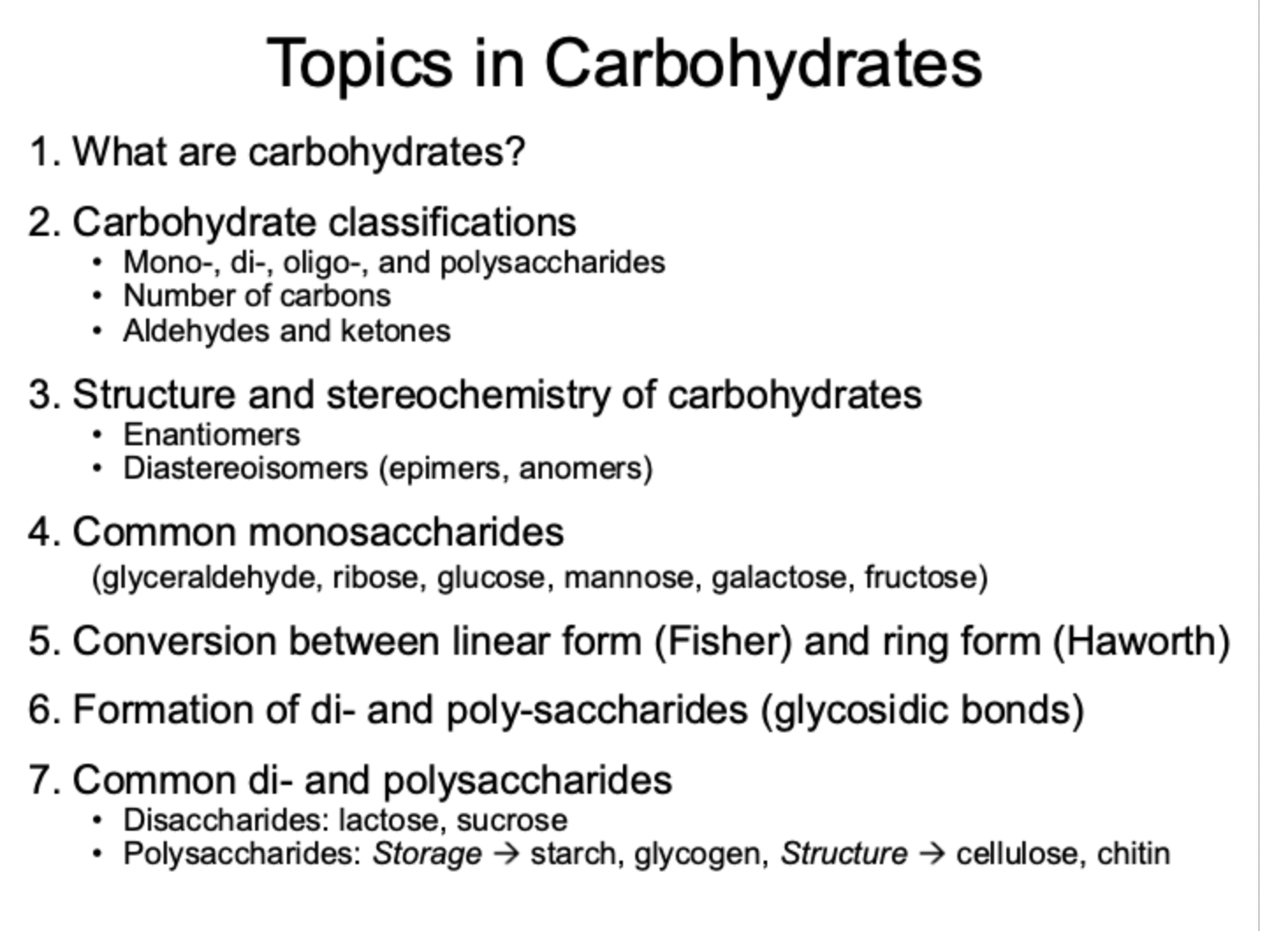
what are carbohydrates
carbohydrates- aka sugars- have a variety of functions
important source of energy- plant starches consist of chains of linked glucose molecules which are broken down into glucose for generation fo ATp and other precursors
found in cell membranes/walls and in protective coatings
carbs are maker molecules that allow one type of cell to recognize and interact with other types of cells
they serve as precursors for a number of biological molecules, including amino acids, lipids, and nucleic acids
hydrates of carbon
Cn(H2O)n
more than half of all organic carbon is found in carbohydrates
they are classified as mono, di, oblige, and polysaccharides according ot the number of simple sugars they contain
saccharide is latin for
sweet taste!
one of the characteristics of sugars is that they taste sweet
sweetness is a SUBJECTIBE INTERACTION between molecules and taste receptors in your mouth
the sweetness receptor is encoded by two genes called
TAS1R2 and SAS1R3
these encode for GPCR
monosaccharides (simple sugars)
aldose and ketose
one has an aldehyde one has a keytone
colorless, crystalline
moneclature is based on number of carbons (trios, tetrose, pentose)
D,L system
aldoses with ____ or more carbons and ketoses with _____ or more carbons are chiral
3;4
enantiomers and diasteriomeers
D and L are enantiomers- non superimposable mirror images
diasteriomers- stereoisomers that are not mirror images-D altros and D glucose
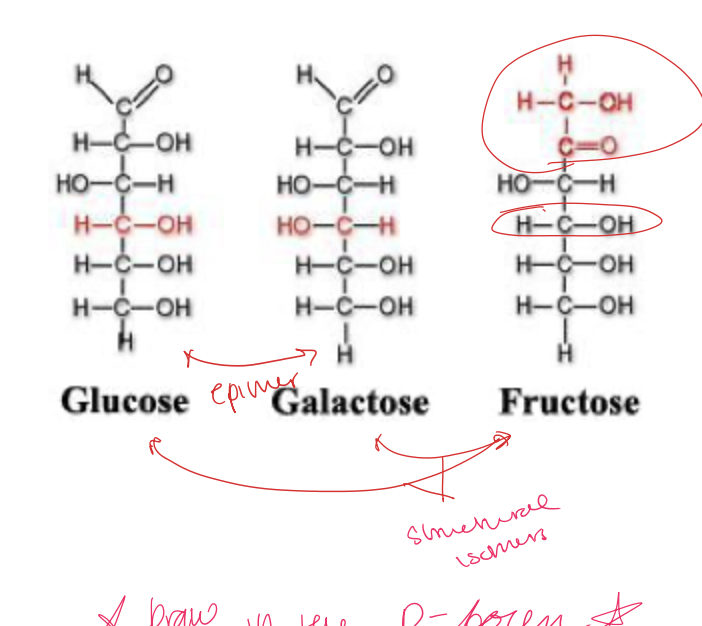
include epimers- different at one of several asymmetric carbon atoms
anomers- differ at a NEW asymmetric carbon atom formed upon ring closer
D or L configuration for natural sugars
only D configuration
carbs can bind to D-sugars but not to their L isomers
diasteriomers
have different physical properties ie solubilities
epimers
two sugars that differ only in the configuration around one carbon atom
both d-mannose and D-galactose are epimers of D-glucose but they are not epimers of each other

glucose
six carbon aldehyde containing sugar- aldose
primary fuel for living cells
exclusive energy source for brain cells, erythrocytes, and cells of the eye
dietary sources include plant starch and the disaccharides lactose, maltose, and sucrose
fructose- fruit sugar
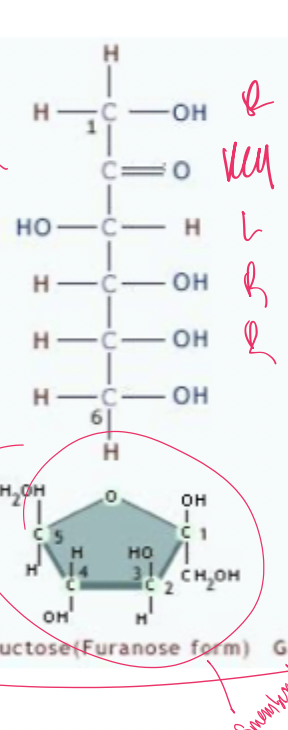
ketose sugar- hetohexose
twice as sweet as sucrose and is often used in food products in smallr amounts, produces the same sweetening effect with fewer calories
galactose
necessary to synthesize a variety of biomolecules
lactose- mammary glands
lglyco and phospholipids (carbs and lipids)
proteoglycans/glycoporteins (carbs and proteins)
galactosemia
genetic disorder which an enzyme required to metabolize galactose is missing. accumulation causes liver damage, cataracts and severe mental retardation
fisher and Haworth projections
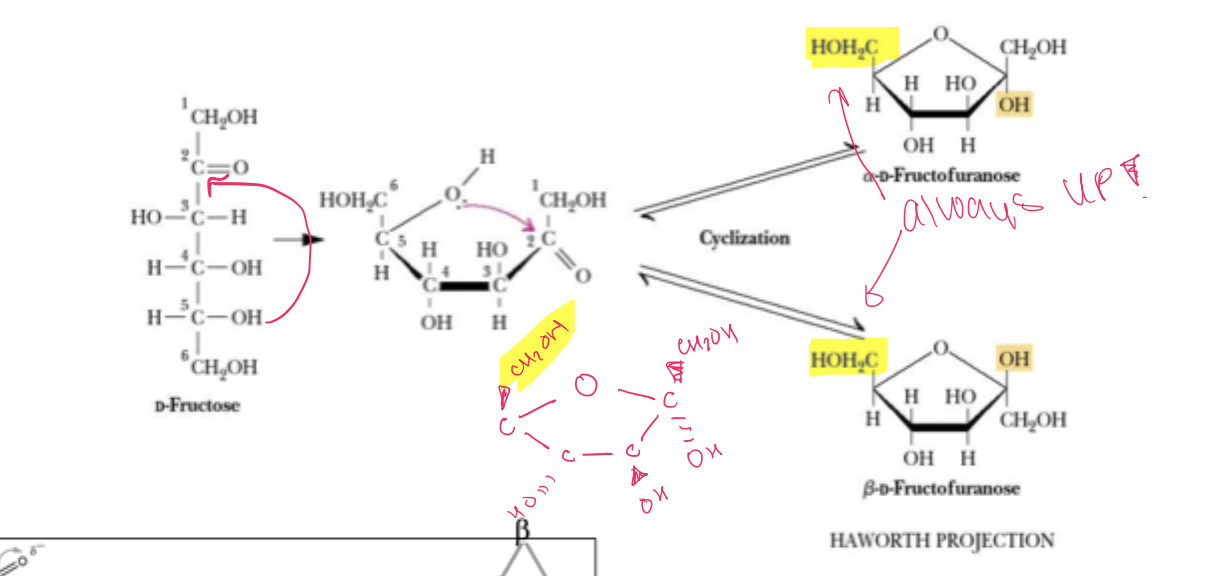
sugars normally exist as cyclic molecules rather than as the open chains forms due to higher stablity
cyclization takes place as a result of an interaction between the functional groups on distant carbons→ interaction between hydroxyl and carbonyl, highest numbered chiral carbon
between carbon 1 and 5 in aldohexoses to for a hemiacetal
c2 and c5 in ketohexoses to form a hemiketal
cyclization
carbonyl carbo become new chiral center called the anomeric carbon
therefore cyclic forms possess anomeric carbons and the cyclic alpha and beta forms are anomer’s of each other

alpha and beta
alpha down beta up unless aldose is on the same plane then beta
mutarotation
sugars can interconvert between alpha and beta forms in vivo
for l sugars where is the ch2oh
down
cyclization of ketoses
pyranoses and furanoses
six membered oxygen ring are pyranoss
five membered oxygen ring are furanoses
If something is a fisher projection what stereochemistry can it have
NOT alpha and beta and pyre/furan
CAN- glucose/fructose/galactose and D/L
fructose
glucose

galactose

blood glucose testing
the ring forms exist in equilibrium with the open-chains forms
aldehyde can reduct carbon 2+ to +
aldehyde can reduct Ag+ to 0
allows detection of reducing sugars, such as glucose
modern detection techniques use colorimetric and electrochemical tests with glucose oxidase
the glycosidic bond
two sugar molecules can be joined via a glycosidic bond between an anomeric and hydroxyl carbon
reducing hemiacetal end still has free anomeric carbon
nonreducing end- no amoebic carbond
a glycoside- contains a glycosiding bond
important hexose derivatives

joining monosaccardies
glycosidic bonds btw monosaccharide units are the basis for the formation of oligosaccharides and polysaccharides
disaccharides are the most common form of oligosaccharides
disaccharides
glycosides composed of two monosaccharide untis
significant source of calories in many human diets- lactose and sucrose
digestion of disaccharides is medicated by enzymes synthesized by cells lining the small intestine
surcose
common table sugar- anemia sgare
glucose and fructose
produced in the leaves and stems of plants
no free anomeric carbon
dietary considerations for carbs
gram to gram, sugars contain an equivalent number of carrels as proteins
40-60% of caloric intake by a typical American should be carbs
90% for soem individyals
average college age male consumes 400g carbs per day, mostly starch and sucrose
biggest diet risk to excess of sugar is tooth decay
lactose
milk sugar- glucose and galactose
lactose intolerance is a common enzyme deficiency the disaccharide passes into the large intestine, where bacteria digest the lactose and produce co2 h2 and irritating organic acids, thereby causing diarrhea, bloating and cramps.
roughly 70% of the world’s population begins losing the ability ot synthesize lactase- the glycosides that catalyzes the digestion of the lactose in milk immediately after weaning off breast milk
structure and chemistry of polysaccharides- GLYCANS
function:
storage- of sugar + storing energy- starch and glycogen
structure- we dont use carbs for structure- bugs do- exosekelton- chitin and cellulose
recognition- viruses recognize our cells cuz of our sugars- cell surface polysaccharides are almost entirely glucose
homo vs heteropolysaccharide
storage nd structure are homo and cell surface is hetero
polysaccharides two different structures
large moleucle containing hundeds to thousands of sugar units
linear or branched
the molecular weights have no fixed values- reflection of the metabolic state of the cell producing them- can get buffer or smaller
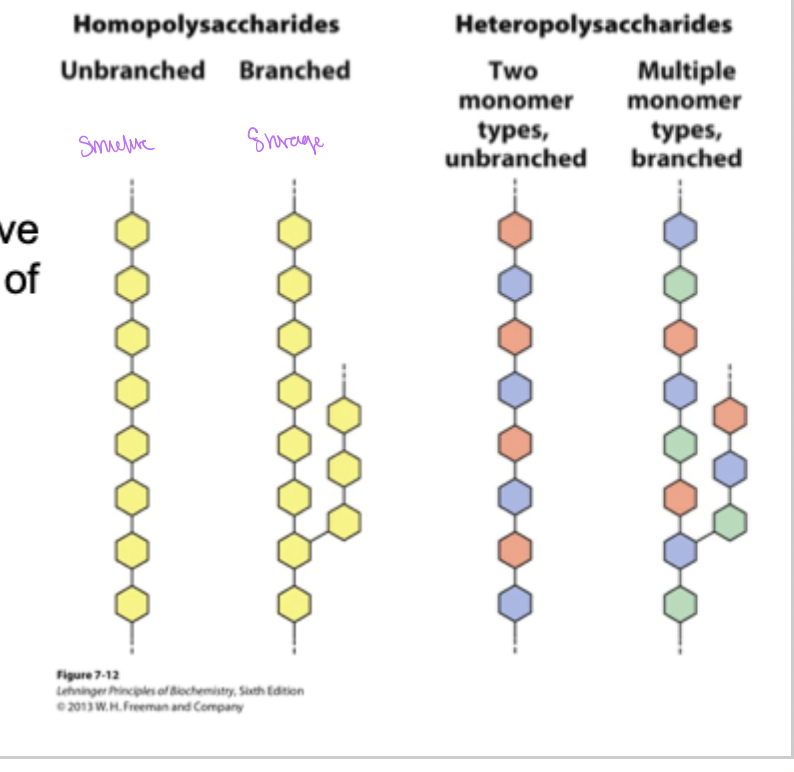
starch and cellulose
starch- glycsoe storage molecule in plants
mostly alpha 1→4 linked glucose with a few alpha 1→6
→ helps to form a branched structure
cellulose- primary structural component of plant cells b1_>4 linked glucose
tight and strong and rigid linkages
forms of starch
homopolysaccharide of glycose
-almylose- linear
-amylopectin- branched
most starch is 10-30% amylase and 70-90% amylopectin
molecular weight of amylopectin- up to 200 million daltons
compact helical shape
glycose polymers- storage
amylose- linear alpha 1→4
amylopectin- highly branched, branches occur every 12-30 residues alpha 1→4 linear alpha 1→6 branch points
glycogen
main storage polysaccharide in animals
greatest abundance in liver and muscle cells
similar in structure to amylopectin, except that it has more branch points
more compact, an important consideration in mobile animal bodies
stored glucose is rapidly mobilized when the animal demands energy’
reducing end- anomeric carbon
cellulose- structural polysaccharide
structural polysaccharides- composition similar to storage polysaccharides, but small structural differences greatly influence properties (b1→4) linkages make al the difference!
more compact- no water molecule sin here
accounts for ove half of the total carbon in plants
tough, water-soluble- provides support and protection
beta 1-4 links allow molecule to stretch out and hydrogen bond with neighboring, parallel polysaccharide strands to form tough fibrils
insoluble fiber
most animals cannot use cellulose as a fuel source because they lack the enzyme to hydrolyze beta 1-4 inakges

cell surface polysaccharides
a host of important funtions
animal cel surfaces contain an incredible diversity of glycosylated proteins- glycoproteins
polysaccharide structures regulate recognitions (cell-cell interactions, adhesion, stability ect)
the uniqueness of the information in these structures is determined by the enzymes that synthesize these polysaccharides
glycoprotein
a protein with small oligosaccharides attached
carb is attached via anomeric carbon to amino acids on protein
commonly at threonine, serine, and asparagine from OH and NH
about half of mammalian proteins are glycoprotiens
carbs play role in protein-protien recognition
viral proteins are heavily glycosylated, this helps evade the immune system
defined as proteins that are covalently linked to carbs through N or O linkages

flu targets
hemagglutinin and neuraminidase

glycolipids
lipids w covalently bound oligosaccardie
they are parts of plant and animal cell membranes
in vertebrates, carb composition determines blood groups
lipids
class of biomolecules defined by low solubility in water and high solubility in non polar solvents
largely hydrocarbon in nature
heath association with low fat diet
fats are an essential part of the human diet, less than 15% of the diet is dangerous
promotes stiety
carriers of fat-soluble vitamins
major source of essential fatty acids- those that cannott be synthesized by the human body
two essential fatty acids for humans alpha-lionlenic acid (omega 3 fatty acid) and linoleum acid (omega 6 fatty acid)
these are important precursors for the EICOSANOIDS
cells use approximately ____ % of their genes to synthesize all of these lipids
5
lipid classification
TAGs, waxes, phospholipids, sphingolipids, glycolipids, eicosanoids, steroids, lipoproteins, fat-soluble, vitamins, glycerophospholibipds, sphingomyelins, cerebrosides, gangliosides, prostaglandins, throboxanes, leukotrienes
divide the various types by function:
storage lipids
membrane lipids
specific biological activities- signals, cofactors, pigments, antioxidants
fatty acids
the simplest lipids are the fatty acids, which are also constituents of many more complex lipds
their basic structure exeplifies the amphipathic lipid model
a long hydrocarbon chain (tail) and a terminal carboxyl group (head)
carboxylic acids with hydrocarbon (highly reduced) chains containing between 4-36 carbons
almost all natural fatty acids have an even user of carbons
most natural fatty acids are unbranched
saturated vs mono and poly unsaturated
saturated means there are no double bonds
monounsaturated- one double bond
polyunsaturaed0 more than one double bond
fatty acid nomenclature
omega is the carbon at the end so you can count backwards to the first double bond to get omega 3/6
second carbon is alpha carbon (adjacent to carboxylic carbon)
#carbons:#db(delta^where db located)
confirmation of fatty acids
melting points are lower for unsaturated fats
a saturated chain tends ot adopt extended conformations
unsaturated fatty acids are slightly more abundant in nature
the double bonds in natural unsaturated fatty acids are commonly in cis configuration, which kinks the chian
this prevents close packing and increases flexibility

do free fatty acids exist by themselves
no they are completed with something else always
fatty acid composition of food fats
olive oil, butter, and beef fat consist of mixtures of TAGS, differing in their fatty acid compostion
the melting points of these fats and hence their physical sate at room temperature are a direct function of their fatty acid composition
for exmaple, olive oil has a high proportion of long-chain unsaturated fatty acids which accounts for its liquid state at room temrpature
partial hydrogenation of cooking oils produces trans fatty acids
to improve the shelf life of veggie oils commercial veggie oils are prepped by partial hydrogenation
partial hydrogenation converts unsaturated fat oils to firmer fats which can be used as butter subs
this process converts many of the cis DB to single bonds and increases melting temp of oils
fatty acts occur in large amounts in cells but rarely in a free uncompleted state. what the heck do they complex w ?
in vertebrate animals, free fatty acids circulate in the blood bound to bovine serum albumin
however, fatty acids are present mostly as carboxylic acid derivatives. they are typically esterifed to glycerol or other backbone structures
triacylglycerols (TAGs)
aka triglycerides
fatty acid esters of glycerol
three fatty acids each in ester linkage to 1 glycerol
a major energy source for many organisms
a typical human stores sufficient calories in fat ot survive for several weeks
why can fat provide so much energy compared to other energy forms?
most reduced form of carbon in nature
efficient packing w no salvation needed
other uses for triacylglycerols
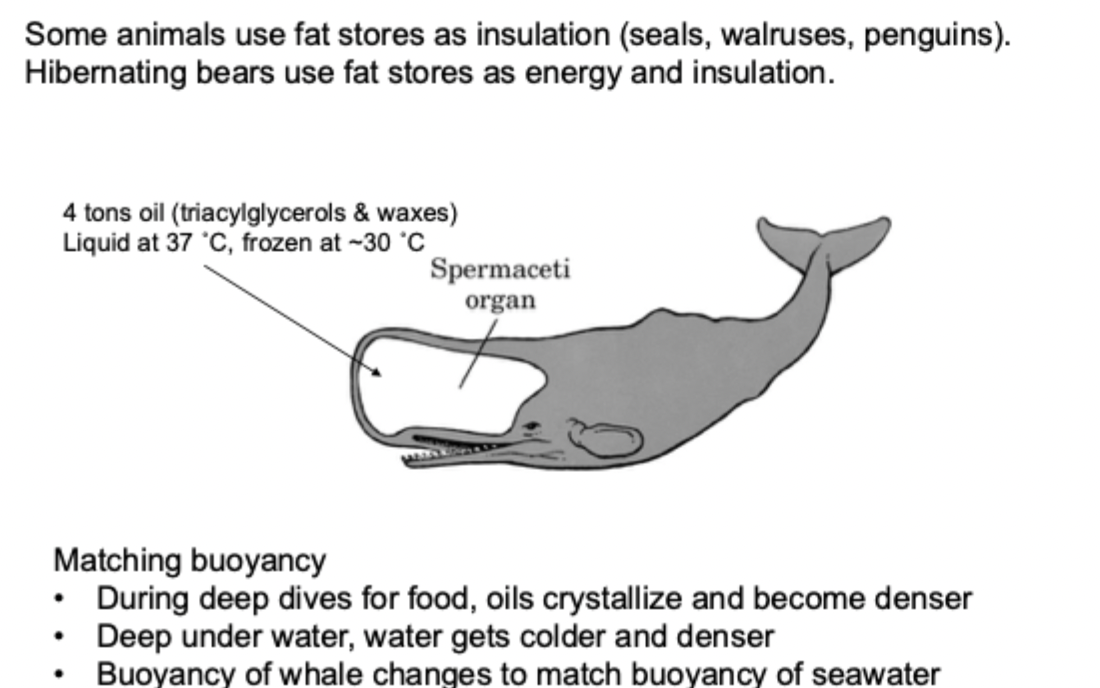
waxes
also used as storage and water repellent
esters of long chain saturated and unsaturated fatty acids with long chain al

structural lipids in membranes
contain polar head groups and non polar tains
diversification can from form:
modifying a different backbone
changing fatty acids
modifying head grup
head groups- determine surface properties of membrane
Varys both by organism and cell

membrane bilayer
membranes lipids are amphipathic
in cells, lipids do not pack well into micelles but rather tend to form lipid bilayers
consists of two leaflets of lipid monolayers
one leaflet faces the cytoplasm
another leaflet faces the extracellular space or the inside of membrane- enclosed organelle
a lipid bilayer is typically 5 to 6 nm thick

structural lipids in membrane
phospholipds- hydrophobic region attached to polar group byphosphate
glycolipids- hydrophobic region attached to polar group (sugar)
sterols- rigid system of four fused hydrocarbon rings

phospholipids
backbone
glycerol backbone→ glycerophospholipid
sphingosine backbone→phosphosphingolipid
fatty acids
glycerol backbone→2 fatty acids at c1 and c2 (usually one saturated and one unsaturated)
sphingosine backbone→ one fatty acid at c2
C-3 carbon has a highly polar or charged group attached through phosphodiester bond
glycerophospholiipids
consist of glycerol-3-phospate with fatty acids esterified at the 1 and 2 positions
parent compound- phosphatidic acid
acerbity of polar groups are esterified to the phosphoric acid moeity of the molecule