Macroeconomics Topic 4
 Call Kai
 Learn
 Practice Test
 Spaced Repetition
 Match
 Flashcards
 Knowt Play
1/22

There's no tags or description
Looks like no tags are added yet.
23 Terms
What is openness in goods markets?
The ability of consumers and firms to choose between domestic and foreign goods.
This choice is not free of restrictions, there are; tariffs, quotas and administrative barriers.
What is openness in financial markets?
The ability of financial investors to choose between domestic assets and foreign assets.
Countries may have capital controls (restrictions on the foreign assets that domestic residents can hold).
What is openness in factor markets?
The ability of firms to choose where to locate production and of workers to choose where to work.
Why do countries differ in openness?
Geography
Size
The distance from other markets influences exports. Large countries like the US can rely on themselves for most of their products meaning they import very little. Small countries like the Netherlands have high export ratios because they rely heavily on imports and only export their specialties.
What are the two main decisions people face in an open economy?
Save or buy.
Buy foreign or domestic.
What is the real exchange rate?
The price of domestic goods in relation to foreign goods.
It considers both the relative price of currencies and the relative price level.
What is the nominal exchange rate? What is it denoted by?
We define it as the price of the domestic currency in terms of foreign currency.
It is denoted by E.
How would you define appreciation and depreciation in relation to the domestic currency?
Appreciation - An increase in the price of domestic currency in terms of a foreign currency.
Depreciation - A decrease in the price of the domestic currency in terms of a foreign currency.
When countries operate under fixed exchange rates, what are movements in exchange rates called?
Revaluations and devaluations.
What does being in an open financial market allow countries to do? Explain fully.
It allows the country to run in trade surpluses and trade deficits.
Trade deficits are where the country is buying more from the rest of the world (RoW).
Trade surpluses are where the country is selling more to the rest of the world. (RoW).
What does a positive mean in the balance of the current and capital accounts?
Net Lending Capacity: It earned more than it spent in relation to the RoW.
What does a negative mean in the balance of the current and capital accounts?
Net Borrowing Position: It spent more than it earned in relation to RoW.
What is the difference between GDP and GNP?
GDP measures value added domestically. GNP is gross national product and it measures the value added by domestic factors of production.
What is the equation for GNP in an open economy?
NDP=GNP+NI
What formula determines the return on investing 1 euro in foreign (UK) bonds in terms of domestic currency next year?
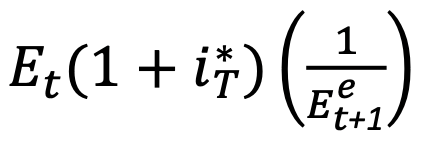
What is the exact Uncovered Interest Parity (UIP) equation comparing domestic and foreign gross returns?

Define the variables it, it*, Et, Eet+1 in the Interest Parity equation.
it = Domestic interest rate.
it* = Foreign interest rate
Et = Current exchange rate
Eet+1 = Expected exchange rate next year
What is the linear approximation equation for interest parity?

What does the Uncovered Interest Parity condition state?
It states that the expected rate of return on domestic and foreign bonds must be equal when investors only care about the expected rate of return.
What two reasons make the assumption that investors always choose bonds with the highest expected return unrealistic?
Transaction costs: Buying and selling foreign bonds involves additional costs.
Exchange-rate risk: Future exchange rates are uncertain, so investors may earn less than expected.
If investors expect the exchange rate to remain unchanged (Eet+1 = Et), what happens to the domestic and foreign interest rates?
The interest parity condition simplifies to it = it*, meaning domestic and foreign interest rates must be equal.
Suppose German bonds pay i=2% and UK bonds pay i=5%. If you expect the pound to depreciate relative to the euro by more than 3%, which bond is more attractive?
German bonds (investing in UK bonds is less attractive).
Suppose German bonds pay i=2% and UK bonds pay i=5%. If you expect the pound to depreciate by less than 3% (or appreciate), which bond is more attractive?
UK bonds (investing in UK bonds is more attractive).