BISC205 Topic 5 (in-person)
 Call Kai
 Learn
 Practice Test
 Spaced Repetition
 Match
 Flashcards
 Knowt Play
1/37

There's no tags or description
Looks like no tags are added yet.
38 Terms
what is respiration? what is its purpose?
respiration: the entire sequence of events that results in the exchange of O2 and Co2 between external environment of an animal and the mitochondria within its cells
purpose: gas exchange. this involves receiving O2 from the environment and removing CO2 from the blood
what is partial pressure?
pressure that a single gas in the mixture would exert if it occupied the entire volume of the mixture by itself
ficks’ law of diffusion

how to increase rate of diffusion (based on ficks law)
increase diffusion constant of gas
increase SA of membrane
increase difference in partial pressure of gas
decrease diffusion distance across membrane
how to decrease rate of diffusion (based on Ficks law)
decrease diffusion constant of gas
decrease SA of membrane
decrease difference in partial pressure of gas
increase diffusion distance across membrane
equation of graham’s law
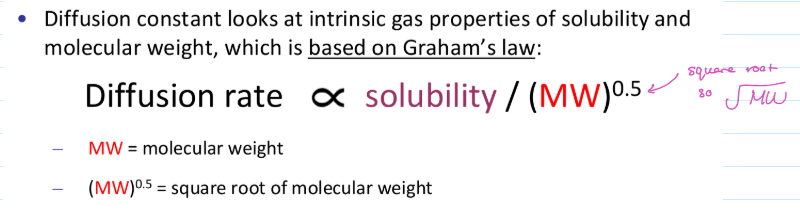
how to increase rate of diffusion based on graham’s law
increase solubility of a gas in medium
decrease the molecular weight of a gas
**liquid: solubility is more important than MW
**air: MW is more important than solubility
what is ventilation?
the active movement of respiratory medium (air or water) across respiratory surface
three types of ventilation with descriptions
1.) non-directional:
medium flow past the respiratory surface in an unpredictable pattern
found in animals that use cutaneous respiration or wave their external gills into the environmental medium
2.) unidirectional
medium moves through respiratory system in one direction, passing over gas exchange surface before exiting through a separate pathway
countercurrent vs crosscurrent
3.) tidal
medium moves in and out of respiratory chamber in a back-and-forth movement
examples of animals that use each type of ventilation
1.) non-directional
cutaneous respiration: earthworms, frogs, lungless salamanders,
external gills: axolotl
2.) unidirectional
seen in fish with internal gills (teleosts and elasmobranchs)
avian lungs
3.) tidal
lungs of mammals, insects, most reptilians (non-avian, except crocodiles), air breathing amphibians, and air-breathing fish
why is the non-directional graph shaped the way it is
medium moves across an organ’s respiratory surface in an unpredictable pattern, creating a well-blended pool of oxygenated or deoxygenated medium at the exchange surface
more mixing = more oxygenated medium rather than only stagnant unoxygenated medium, allowing for blood to pick up more oxygen
why is the tidal ventilation graph shaped the way it is
as the animal breathes in, incoming oxygenated medium mixes with stale deoxygenated medium left behind from the previous breath in the respiratory cavity. This means PO2 in the respiratory cavity is lower than that in the environment
two types of unidirectional ventilation
1.) countercurrent flow: blood flows in the opposite direction compared to medium along exchange surface
2.) crosscurrent flow: blood flows at a perpendicular direction compared to medium along exchange surface
why is the countercurrent exchange graph shaped the way it is
medium starts with high PO2 and decreases steadily as it gives up oxygen along the exchange surface. blood starts with low PO2 but increases as it picks up oxygen at exchange surface
why is crosscurrent exchange graph shaped the way it is
blood starts with low PO2 and steadily increases as it picks up oxygen from different parts of the medium. this causes the PO2 in blood to be higher than the PO2 in medium
examples of animals that use crosscurrent vs countercurrent exchange
still have to find
determine which is: unidirectional, tidal, crosscurrent, countercurrent
edit later
how does boyle’s law work
important to understand the mechanics of breathing. as volume decreases, pressure increases
4 steps in which elasmobranchs use buccal pump as a dual pumping mechanism for gill ventilation
1.) mouth opens and buccal cavity expands in volume, which decreases pressure inside the cavity
2.) suction phase: water rushes into buccal cavity through mouth and spiracles
3.) force phase: mouth and spiracles close, and muscles surrounding buccal cavity contract. this decreases volume of cavity and increases pressure inside, which forces water past gills and out through external gill slits
3 important structures of gills in bony (teleost) fish
1.) operculum
flap-like structure that protects gills located in opercular cavity
four gill arches in each opercular cavity
2.) gill arches
provide structural support for two rows of gill filaments that project from each gill arch in a V-shape
3.) gill filaments or primary lamellae
4.) secondary lamellae
main respiratory surface (thin walled and highly vascularized)
rows of folds on each gill filament that are perpendicular to the filament
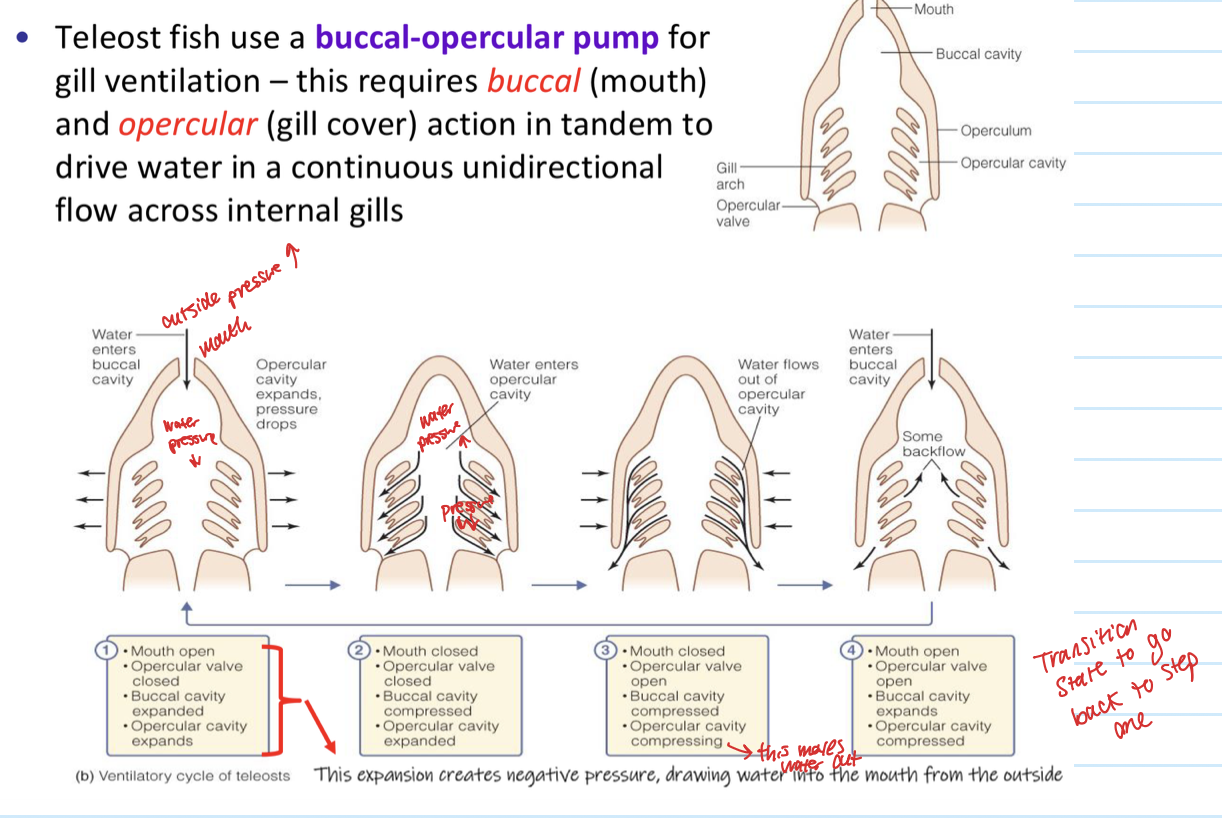
4 steps in which teleost fish use a buccal-opercular pump for ventilation
1.) draw water in
mouth open
opercular valve closed
buccal cavity expands
opercular cavity expands
2.) water moves from buccal cavity to gills
mouth closed
opercular valve closed
buccal cavity compressed
opercular cavity expanded
3.) water is forced over gills and out
mouth closed
opercular valve open
buccal cavity compressed
opercular cavity compressing
4.) return to step one, with some backflow of water
mouth open
opercular valve open
buccal cavity expands
opercular cavity compressed
how is gas exchange very effective at fish gills based on Fick’s Law
1.) lamellae have a very thin membrane (small diffusion distance)
2.) lamellae provide very large surface area for gills
3.) large partial pressure gradient of gas between water column and capillaries inside lamellae

how are fish gills an example of countercurrent exchange?
fish gills are an example of countercurrent exchange because blood flows through capillaries in the secondary lamellae in the opposite direction to water passing through gills
why is concurrent exchange not efficient with fish gills
if water passed through gills in the same direction as blood flow, the oxygen from the oxygen-rich water would quickly diffuse into the oxygen poor blood and reach an early equilibrium. Without the gradient, there is no more diffusion occurring and the fish will have insufficient oxygen.
what is ram ventilation?
when teleosts and elasmobranchs swim forward at higher rate of speed with mouth open to allow water to flow across gills without active pumping of the muscles surrounding buccal and opercular cavities
advantages of ram ventilation
1.) allows fish to dedicate more energy towards powerful swimming muscles instead of buccal/opercular muscles. this enhances speed
2.) increases flow rate of water over gills as fish swims faster. this increased oxygen uptake is needed to meet the higher metabolic needs of the fish
disadvantages of ram ventilation
1.) some fish (obligate ram ventilators) must swim continuously to breathe for survival
2.) opening mouth results in increased drag on fish and thus affects locomotion. this drag is minimized if they have a streamlined body shape
how do mudskippers perform air breathing? (focus on organs)
1.) absorb oxygen through their skin (cutaneous respiration)
2.) absorbs oxygen through the lining of their mouth and throat (both of which contain a high density of blood capillaries)
3.) they have modified gill chambers that help in trapping pockets of air and water while on land (this prevents gills from collapsing and allow for gas exchange)
how do electric eels perform air breathing?
they use extensive folds in mouth which are highly vascularized for substantial aerial gas exchange
how do armoured cat fish perform air breathing
they have a highly vascularized stomach that they use for gas exchange after gulping air. they can survive out of water for up to 30 hours if enough oxygen is stored in their bellies
how do bichirs perform air breathing
use paired lungs that are highly vascularized for gas exchange. they are facultative air breathers, accessing surface air to breathe when the water they inhabit is poorly oxygenated.
both of their lungs are unchambered sacs. the larger right lung reaches the whole length of the body cavity while the smaller left lung extends to the stomach
how do lungfish perform air breathing (most developed air breathing organs)
they have highly vascularized lungs that are complex and covered in folds and pockets that increase their surface area. most extant lungfish species have two symmetrical lungs (exception is Australian lungfish that has one lung)
how do insects use the tracheal system in respiration
1.) spiracles
large trachea connect to spiracles (openings on surface along abdomen) where O2 enters and CO2 exits
spiracles close using valves to reduce water loss, which lets the insect live in dry areas
spiracles open with a rise in CO2 in the tracheal system
2.) air sacs
reservoirs of air. they push air through the tracheal system when contracted
3.) tracheal tubes and tracheoles
tubes that carry air throughout body directly to cells and tissues (like muscles)
how do amphibians and non-avian do respiration
it respires through its most skin (cutaneous respiration) and by using their lungs
why are frog lungs not as efficient as fish gills for respiration
1.) new air that is inhaled mixes with old air already in the lungs (since tidal ventilation is not as efficient as unidirectional)
2,) lungs have relatively smaller surface area
**this is okay because O2 levels are higher in air than in water
why can’t non-avian reptiles use cutaneous respiration like frogs/amphibians
they cannot perform cutaneous respiration because their dry scaly skin is watertight to avoid water loss
why do non-avian reptiles have more efficient lungs than amphibians/ frogs
the lungs of reptiles have a larger surface area than the lungs of amphibians