Lower Urinary Tract and Male Genital System
 Call Kai
 Learn
Learn Practice Test
 Spaced Repetition
 Match
Match Flashcards
 Knowt Play
1/246

There's no tags or description
Looks like no tags are added yet.
Name | Mastery | Learn | Test | Matching | Spaced | Call with Kai | Chat |
|---|
No analytics yet
Send a link to your students to track their progress
247 Terms
What structures make up the lower urinary tract (LUT)?
Renal pelvis
Ureters
Bladder
Urethra
What specialized epithelium lines the lower urinary tract?
Urothelium — A specialized form of transitional epithelium
What are the three major layers of the urinary tract wall?
Urothelium
Lamina propria
Muscularis propria
What structures are found within the lamina propria of the urinary tract?
Rich vascular and lymphatic networks
Elastic fibers
Smooth muscle fibers (muscularis mucosae)
Sensory nerves
Other cells
What is the muscularis propria of the bladder called?
Detrusor muscle
What type of muscle forms the external urethral sphincter?
Skeletal muscle

What structure is this showing?
Ureter
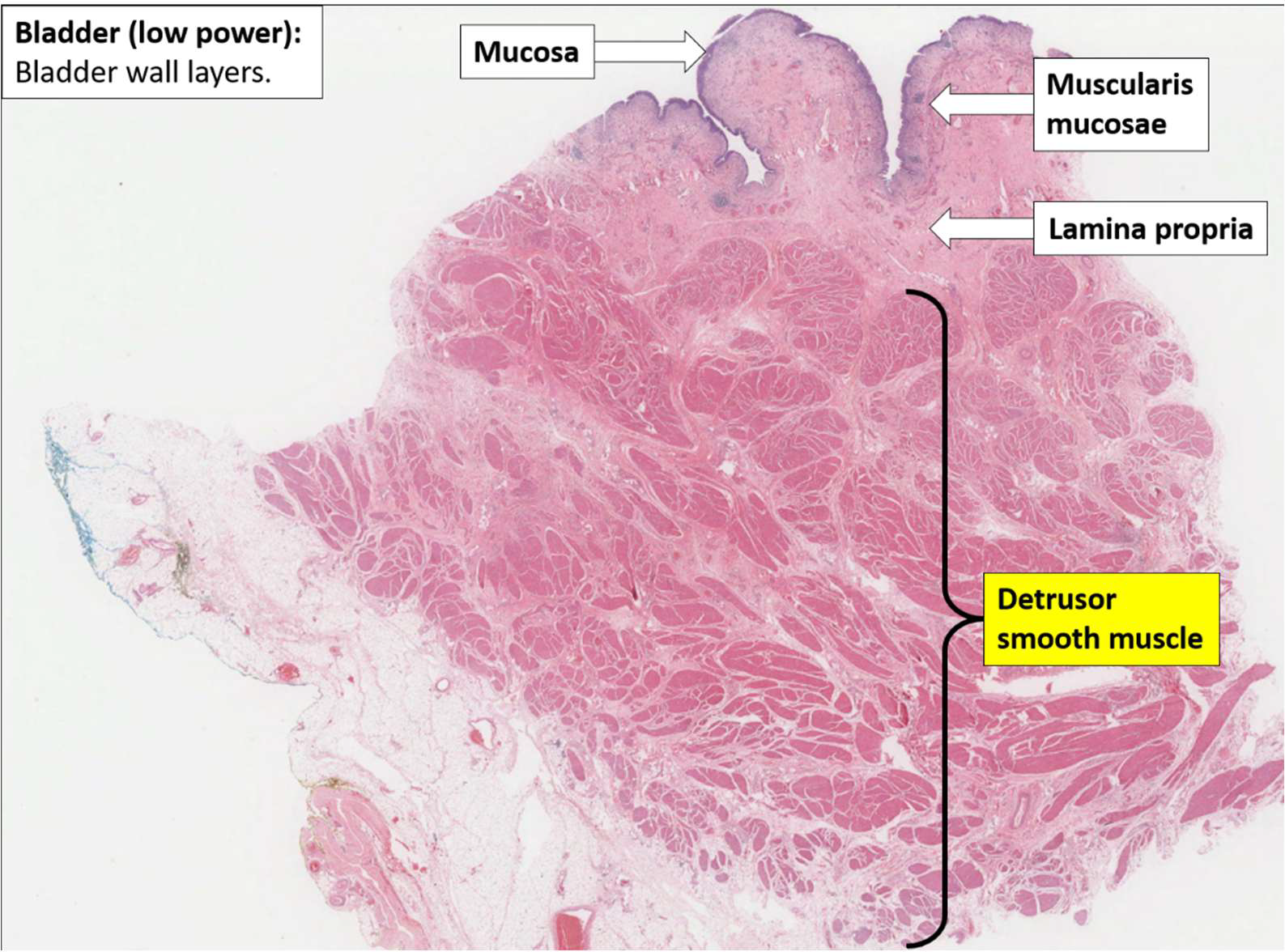
What structure is this showing?
Bladder
What are the three major cell groups of urothelium?
Umbrella cells — superficial
Intermediate cells
Basal cells
(Cells are DISTINCT morphologically and genetically)

What are the two major functions of urothelium?
Allows the urinary tract to distend
Provides a highly effective barrier against urine and pathogens
What is unique about the permeability of urothelium?
Forms the MOST impermeable barrier in the body
How many cell layers are typically present in urothelium?
Approx. 2-7 layers
Depends on the degree of distention
What are umbrella cells?
Large, flattened, with abundant cytoplasm
Terminally differentiated superficial urothelial cells that directly face the urinary lumen

What structures are primarily responsible for the barrier function of umbrella cells?
Tight junctions
Adherens junction
What is the primary function of intermediate urothelial cells?
Highly proliferative
Responsible for rapid regeneration following injury or infection
How are intermediate cells connected to one another?
Primarily through desmosomes

How do intermediate cells look histologically?
Approx. 5 layers in human
Larger in diameter than basal cells
What are basal urothelial cells?
The smallest urothelial cells
Approximately 5–10 μm
Sit directly on the basement membrane
What junctions attach basal cells to the basement membrane?
Hemidesmosomes
What junctions attach basal cells to intermediate cells?
Desmosomes
Which urothelial cell population may contain stem cells responsible for lifelong regeneration?
Basal cells

What is this?
Basement membrane
Lamina propria
What is a ureteropelvic junction (UPJ) obstruction?
A blockage where the renal pelvis connects to the ureter
Impair urine flow and causing urine to back up into the kidney

What is the major consequence of UPJ obstruction?
Hydronephrosis due to impaired urine drainage
What is the most common cause of hydronephrosis in infants and children?
Ureteropelvic junction (UPJ) obstruction
What is the approximate incidence and sex distribution of UPJ obstruction?
Approx. 1 in 1,500 births
Boys > Girls
How does UPJ obstruction differ epidemiologically in adults?
More common in women
Usually unilateral
What is the treatment for UPJ obstruction?
Pyeloplasty (surgical correction)
A surgical operation used to fix a blocked or narrowed tube where your kidney meets your ureter
What is retroperitoneal fibrosis (RPF)?
A fibroinflammatory process that produces fibrous tissue around retroperitoneal structures
Can encase and obstruct the ureters
(Uncommon cause of ureteral narrowing or obstruction)
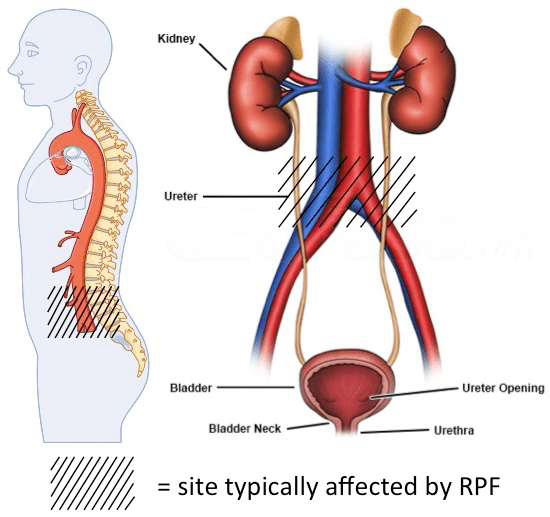
What urinary complication can result from retroperitoneal fibrosis?
Fibrotic inflammation → encases retroperitoneal structures → hydronephrosis
The swelling of one or both kidneys caused by a backup of urine
What demographic is most commonly affected by RPF?
Adults approximately 40–60 years old
A male predominance (2:1 or 3:1)
What is the most common cause/category of retroperitoneal fibrosis?
Idiopathic disease (>70%), also called Ormond disease
What is an important immune-mediated form of retroperitoneal fibrosis?
IgG4-related disease
Characterized by fibroinflammatory lesions rich in IgG4-secreting plasma cells
What other conditions can be associated with retroperitoneal fibrosis?
Malignancies
Vasculitis
Crohn disease
Radiation
Infections
Prior surgery
Certain drugs such as β-adrenergic blockers
How is retroperitoneal fibrosis treated?
Corticosteroids/immunosuppression
Ureteral stents
Surgery
What is a bladder diverticulum?
A pouch-like evagination of the bladder wall
Most are small and asymptomatic
What can cause congenital bladder diverticula?
Abnormal development of bladder musculature or LUT obstruction during fetal development
What is the most common association with acquired bladder diverticula?
Urinary outflow obstruction due to BPH
Increases intravesical pressure
What complications can occur in bladder diverticula?
Urinary stasis → Recurrent UTIs and bladder stones
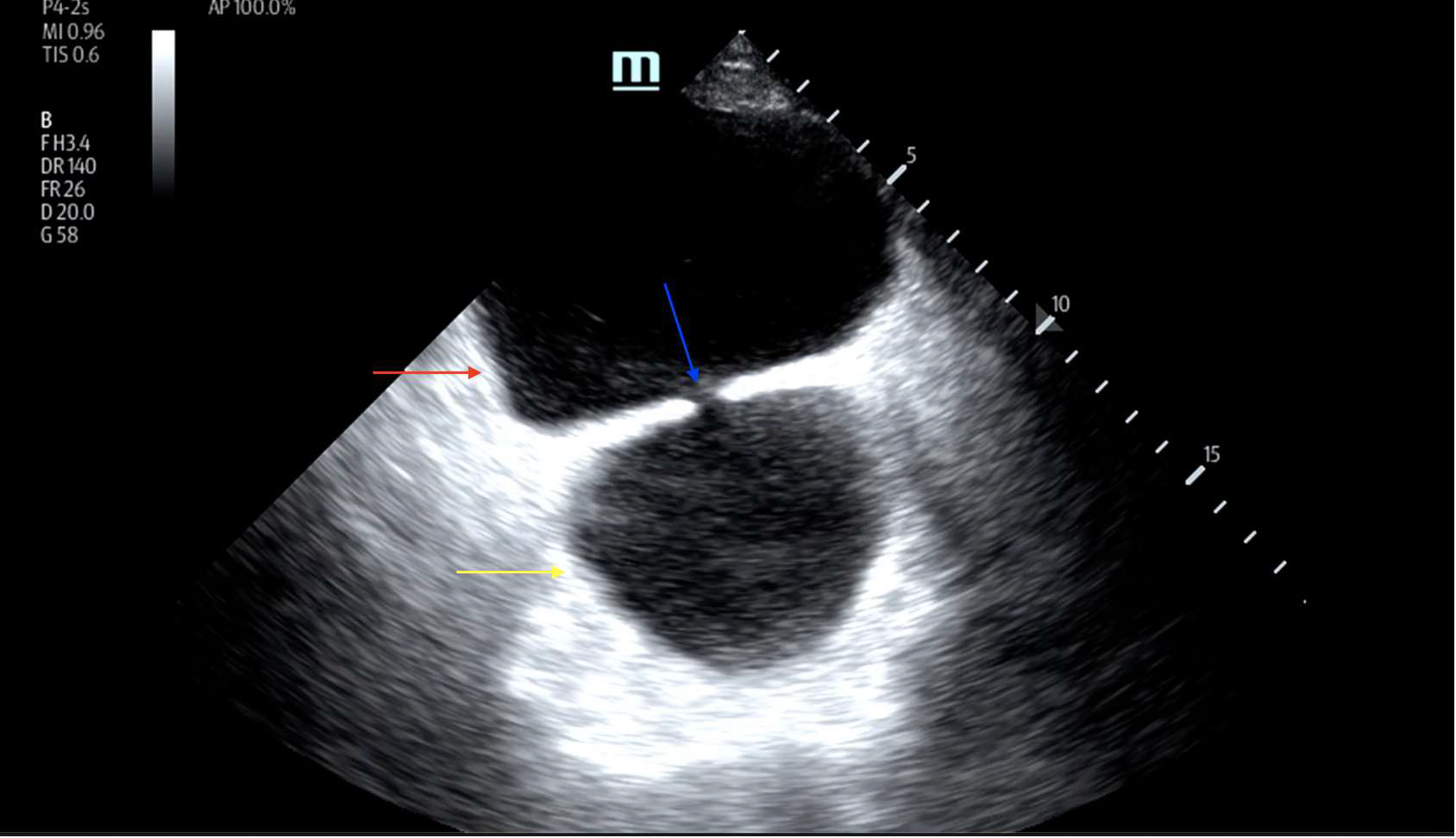
What is this X-ray showing?
Bladder diverticulum
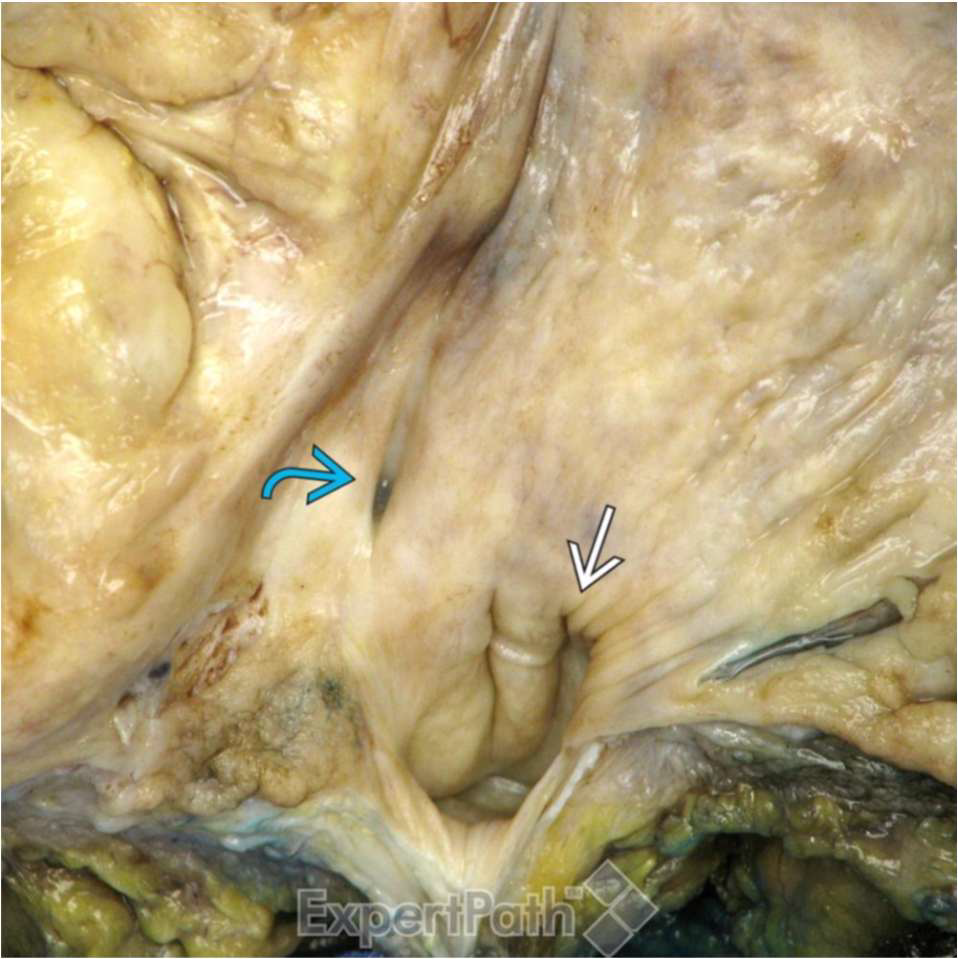
What is this?
Bladder diverticulum

What is this showing histologically?
Bladder diverticulum
What is cystitis?
Inflammation of the urinary bladder
What are the classic symptoms of cystitis?
Urinary frequency
Lower abdominal pain
Dysuria
What is the most common cause of bacterial cystitis?
E. coli
More COMMON in women due to shorter urethra
What complication can result from untreated bacterial cystitis?
Pyelonephritis due to ascending infection
A serious type of urinary tract infection (UTI) that travels to one or both of your kidneys
What causes hemorrhagic cystitis?
Cytotoxic drugs — Cyclophosphamide and
Certain viral infections
Particularly adenovirus
What is interstitial cystitis?
A chronic pelvic pain syndrome of unknown etiology
Most frequently occurring in women
What are characteristic cystoscopic findings in interstitial cystitis?
Mucosal fissures
Punctate hemorrhages
What is the major role of pathology in interstitial cystitis?
Histologic findings are nonspecific
Biopsy is primarily useful to rule out carcinoma in situ (CIS)
What is malakoplakia?
A rare form of chronic cystitis
Associated with defective macrophage phagocytic function
What are Michaelis-Gutmann bodies?
Calcium-containing deposits
Formed from incompletely digested bacterial products within macrophages

What is the pathogenesis of malakoplakia?
Defective macrophage phagocytosis → Accumulation of undigested bacterial products in phagosomes → Calcium salt deposition → Michaelis-Gutmann bodies


What is this?
Hemorrhagic cystitis
What is the most common type of bladder cancer in the United States?
Urothelial carcinoma
Approximately 90% of bladder cancers
What is the approximate male-to-female ratio for bladder cancer?
Approximately 3:1
Men affected more frequently
What is the classic clinical presentation of bladder cancer?
Asymptomatic hematuria
What population demographic is more commonly associated with bladder cancer?
Higher incidence in Caucasians
More prevalent in industrialized nations, and in urban populations
About 80% of patients are between 50 and 80 years of age
What are major risk factors for urothelial carcinoma?
Cigarette smoking
Occupational carcinogen exposure
Previous cyclophosphamide and radiation therapy
What is a major risk factor for squamous cell carcinoma of the bladder that causes chronic inflammation?
Chronic Schistosoma haematobium infection
What geographic location is Schistosoma haematobium particularly associated with bladder SCC?
Endemic regions including Egypt and Sudan
Why does schistosomiasis increase the risk of bladder SCC?
Chronic inflammation
Associated with the infection promotes malignant transformation
What are the two distinct precursor lesions of bladder cancer?
Papilloma → Invasive papillary carcinoma
Flat noninvasive carcinoma (CIS) → Flat invasive carcinoma

What are the two molecular pathways of bladder cancer?
RAS, FGFR3 mutation → Papillary urothelial neoplasm → P53 mutation (additional genetic mutations) → Invasive papillary carcinoma
TP53. RB mutation → Flat noninvasive carcinoma (CIS) → Chr 9 loss (additional genetic mutations) → Flat invasive carcinoma


What is this?
Papilloma

What is this?
Papilloma
What are the major papillary urothelial neoplasms listed in the lecture?
Papilloma
PUNLMP
Low-grade papillary urothelial carcinoma
High-grade papillary urothelial carcinoma
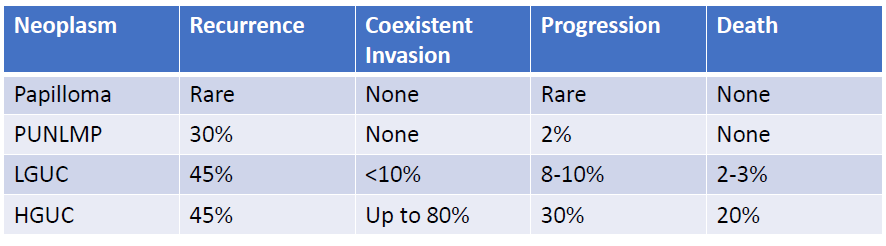

What is this histologically showing?
Papilloma
PUNLMP (Papillary urothelial neoplasm of low malignant potential)
Low-grade papillary urothelial carcinoma
High-grade papillary urothelial carcinoma
What is the most important prognostic factor for papilloma?
Grade
Based on architectural and cytologic features
Which papillary urothelial neoplasm has the lowest malignant potential?
Papilloma
What does PUNLMP stand for?
Papillary urothelial neoplasm of low malignant potential
What is urothelial carcinoma in situ (CIS)?
A flat malignant urothelial lesion in which malignant cells are confined above the basement membrane without invasion
Can “flake off” into the luminal space

What characteristic of urothelial CIS allows malignant cells to be detected in urine cytology?
Loss of cellular cohesiveness causes malignant cells to shed into the urine

Is urothelial CIS typically solitary or multifocal?
Multifocal
What percentage of untreated urothelial CIS progresses to invasive cancer?
Approx. 50-75%
How is urothelial CIS commonly treated?
BGC (immunotherapy) treatment

What is this?
Invasive urothelial carcinoma
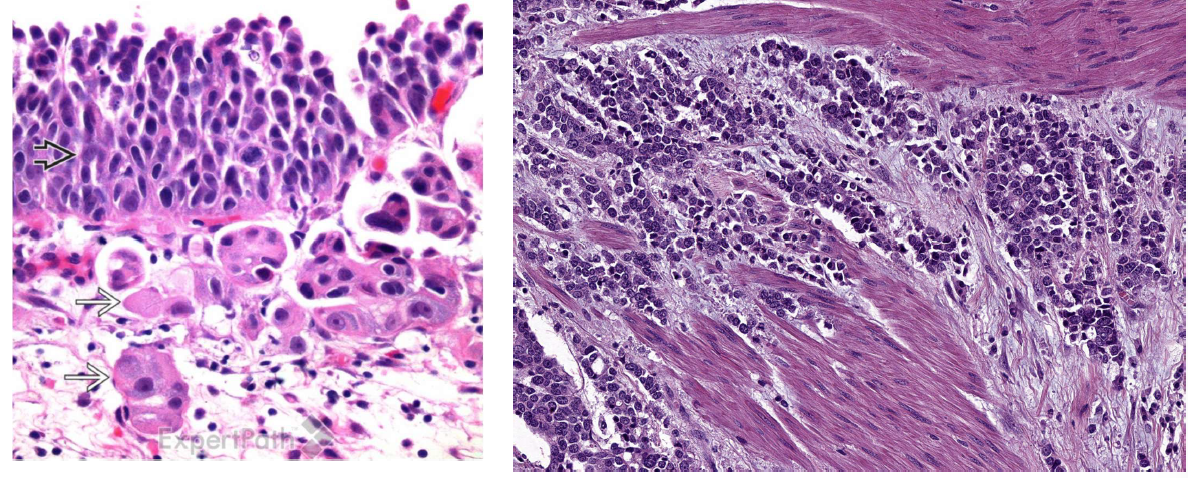
What is this showing histologically?
Invasive urothelial carcinoma
What is the most important prognostic factor once urothelial carcinoma becomes invasive?
Extent/stage of invasion at the time of diagnosis
Where can urothelial carcinoma arise?
Anywhere lined by urothelium, including the:
Bladder
Ureter
Renal pelvis
What is a characteristic behavior of bladder urothelial carcinoma after excision?
A strong tendency to recur
Recurrence may occur at a site different from the original tumor
How do low-grade and high-grade urothelial carcinomas differ in behavior?
Low grade: Recur but NO invasion
High grade: Concurrent or subsequent invasion
What is the typical treatment for localized papillary bladder tumors?
Transurethral resection
How are CIS and high-grade papillary bladder tumors commonly treated?
BCG immunotherapy ± intravesical chemotherapy
What treatment is generally used for muscle-invasive bladder carcinoma?
Radical cystectomy
Also useful for BCG resistant CIS/HGUC
Cystoprostatectomy
Radiation and/or chemotherapy as appropriate
What treatment is generally used for metastatic bladder carcinoma?
Systemic chemotherapy
Understand penis anatomy

What is hypospadias?
An abnormally positioned urethral opening on the ventral surface of the penis
Common, 1 in 300 male live births
Where are penis malformations most common?
In the distal urethral orifice
What embryologic defect causes hypospadias?
Failure of the urethral folds to close
What congenital anomaly is associated with hypospadias?
Undescended testis (cryptorchidism)
What complications can hypospadias cause?
Urinary obstruction
Infertility
What is epispadias?
An abnormally positioned urethral opening on the dorsal surface of the penis
Less common penis malformation
What embryologic abnormality causes epispadias?
Abnormal positioning of the genital tubercle
What congenital condition is strongly associated with epispadias?
Bladder exstrophy
A rare birth defect where the bladder develops outside the fetus's abdomen and is turned inside out
What is balanitis?
Inflammation of the glans penis
What is balanoposthitis?
Inflammation involving the prepuce (foreskin) and glands
What organisms can cause balanitis/balanoposthitis?
Fungal (Candida)
Anaerobic bacteria
Gardnerella
What is smegma?
Accumulated desquamated epithelial material associated with poor hygiene
Particularly in uncircumcised males
What is phimosis?
Inability to easily retract the prepuce