Resting potential.
 Call Kai
 Learn
Learn Practice Test
 Spaced Repetition
 Match
Match Flashcards
 Knowt Play
1/5

Earn XP
Description and Tags
https://www.youtube.com/watch?v=1FsLLtwU6CY
Name | Mastery | Learn | Test | Matching | Spaced | Call with Kai | Chat |
|---|
No analytics yet
Send a link to your students to track their progress
6 Terms
Whats a resting state
What happens in a neurone when an impulse is not being transmitted is called the resting state.
Key idea about resting neurone
The inside of the membrane has a negative charge compared to the outside, they say the membrane is polarised. The value of this charge difference is called the resting potential.
What is the value of the resting potential.
A value of -65mv (millivolts)
How is the resting potential produced.
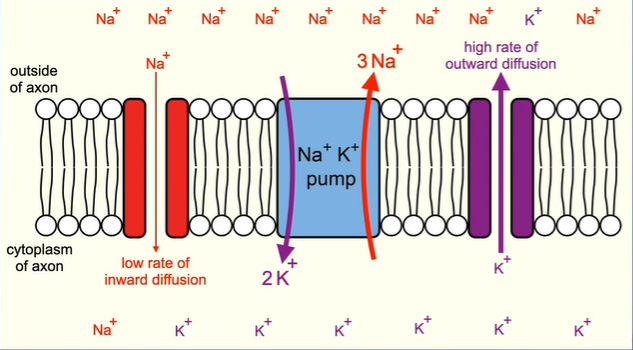
Sodium potassium pumps use active transport (needs ATP) to move 3 Na+ out of the neurone for every 2 K+ moved in. This means number of pos ions outside the membrane is greater than inside.
This means theres a higher concentration of Na+ ions outside the membrane than inside, higher concentration of potassium ions inside the membranes than outside
What are the ion channels that are randomly switch between open or closed.
The Na+ channels are mainly closed, so we have a low rate of diffusion of sodium ions into the axon.
The potassium ion channels are mainly open , so we have a high rate of diffusion of potassium ions out of the axon. (facilitated diffusion)
This outward diffusion of potassium ions makes the inside of the membrane more negative compared to the outside.
What is resting potential
When the membrane is polarised and the voltage across it is -70mV when it is at rest.