PSYCH NOTES UNIT 4 AOS 1: demand and importance of sleep
 Call Kai
 Learn
Learn Practice Test
 Spaced Repetition
 Match
Match Flashcards
 Knowt Play
1/31

There's no tags or description
Looks like no tags are added yet.
32 Terms
Sleep
Regular, naturally occurring ASC, loss of awareness, disengagement with internal and external stimuli. Multiple cycles of REM and NREM (known as Sleep Cycles).
Experience of sleep is subjective, characterised by:
· Reduced ability to control behaviour
· Less accurate understanding of the passage of time
· Perceptual and cognitive distortions
· High level of brain activity
· Low levels of physical activity
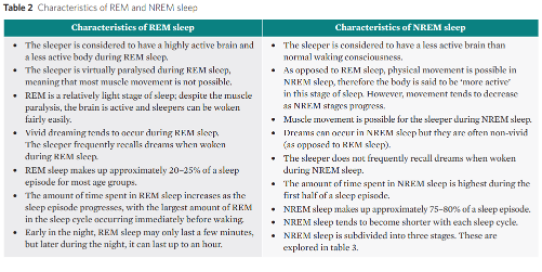
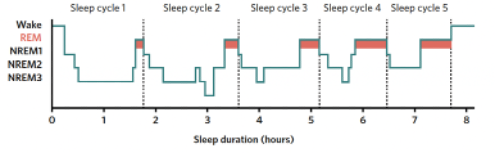
Sleep cycle is approx 90 minutes that repeats progressing through REM & NREM.
Suggest two reasons why sleep is categorised as an altered state of consciousness (2 marks)
Sleep is considered an ASC as:
those who are asleep are not aware of the passage of time passing
or aware of their environment around them,
which those in a normal waking consciousness are.
Divided into 3 stages of NREM sleep:
NREM stage 1: Awake to light sleep. Experience of hypnagogic state- feeling of floating, falling/sudden jerk. Loses awareness of self but aware of faint sounds in environment. Sleeper easily woken in this stage.
NREM stage 2: relatively light sleep. Spend majority of time in this stage. Considered ‘truly’ asleep.
NREM stage 3: deep stage of sleep. Difficult to wake sleeper. Woken in this stage = feelings of drowsy & disorientated. Sleepwalking & sleep talking most likely to occur.
Ways to measure sleep:
Electroencephalograph (EEG), Electromyograph (EMG), Electro-oculography (EOG), Sleep Diaries, Video Monitoring.
Sleep measures can be disruptive & invasive and therefore may not provide a true reflection of individuals sleep patterns.
EEG, EOG & EMG’s vs Sleep diaries
objective measures. Provide reliable, unbiased quantitative data. Do not provide qualitative detail.
vs subjective measures: Accuracy & reliability may be limited.
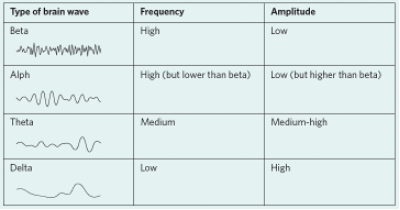
Brain Waves (patterns):
Vary in frequency (rate) and amplitude (height). Frequency & Amplitude indicate what state of consciousness an individual is experiencing. EEG show higher frequency & lower amplitude when in NWC and lower frequency & higher amplitude during an ASC.
Strength | Weakness |
· Useful for sleep studies. · Diagnosis of patients with brain damage/neurological or mental disorder | · Neural activity under thick skull. · Not entirely precise · Does not pinpoint functional/dysfunctional areas of brain |
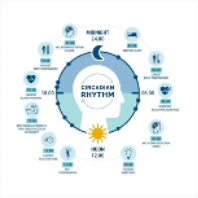
Circadian Rhythms: Sleep wake Cycle:
biological and behavioural changes that occur as a part of a cycle, last around 24 hours. Sleep-Wake Cycle (24-hour cycle of time spent sleeping & time spent awake/active).
Ultradian Rhythms: Sleep cycles of REM & NREM sleep.
Biological and behavioural changes that occur in a cycle that lasts less than 24 hours. Include heart rate, digestion, blood pressure, some hormone secretions, appetite and a sleep cycle (90 mins).
Sleep cycle and sleep episode
Sleep Episode: full duration of time spent asleep from falling asleep to waking. (8 hrs)
Sleep cycle: Repeated, approx. 90-minute period of where it progresses through REM & NREM stages. Sleep cycle is example of a ultradian rhythms due to repeat in physiological activity.
Suprachiasmatic Nucleus:
Area of the Hypothalamus, responsible for regulating an individual's sleep-wake pattern, by playing a key role in regulating sleep-wake cycle (internal body clock).
At specific times in a 24-hour day, it sends signals to regulate various activities in body and keep it functioning to a daily schedule of sleep and wakefulness.
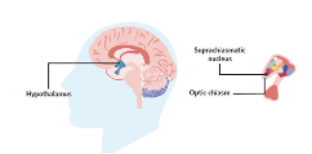
Suprachiasmatic Nucleus as the internal clock
The SCN can function independently to maintain an approximately 24-hour cycle because of a precise feedback loop of gene expression and inhibition. However, it is influenced by info from both external and internal cues:
· External cues (zeitgebers) = presence or absence of light, exercise, social activity, eating patterns and temperature.
· Internal cues= information that originates within the body i.e. suppression of genes.
Suprachiasmatic Nucleus & Hormones:
Internal/External cues dictate messages that SCN sends to pineal gland in brain.
- Pineal gland: responsible for the release of melatonin.
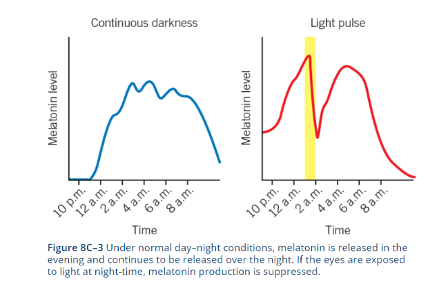
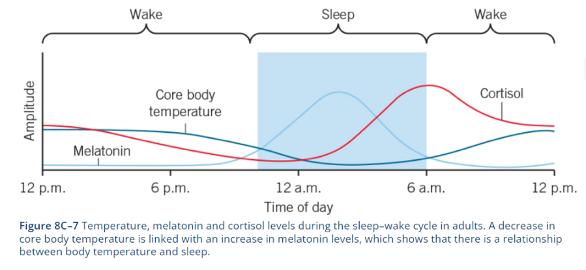
- Melatonin: hormone released to induce sleep as a part of the sleep wake cycle. Levels around 8-9pm start to induce calmness which aims to promote sleepiness. Usually leading for someone wanting to sleep around 10/11pm and peaks between 2-4am. Does not directly induce sleep but promotes a state of calm and relaxation.
- Cortisol: responsible for increasing alertness and maintaining heightened arousal, produced by the adrenal gland, not the SCN.
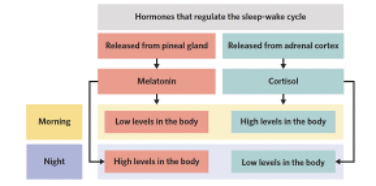
Suprachiasmatic Nucleus & light :
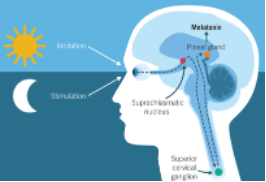
Light-sensitive neurons in the retinas of the eyes detect incoming light and send messages to the brain’s SCN about the amount of light in the surroundings.
- At night-time: eyes detect no light, SCN sends a signal to pineal gland, resulting in the pineal gland releasing melatonin, inducing sleepiness and decreases cell activity.
- During the day: eyes detect more light, SCN sends inhibitory messages to the pineal gland, resulting in suppression of melatonin release by the pineal gland, increases cell activity in the body, resulting in wakefulness during the day.
Process regulates when you go to sleep and wake up, but a different process regulates how much you sleep. With light cues from sun reliably cycling every 24 hours, circadian rhythm can undergo daily resetting that keeps a person’s sleep (wake cycle aligned to a 24-hour day). If these light cues are absent, circadian rhythm tends to run free (cycle a little longer than 24 hours).
Sleep across the lifespan:
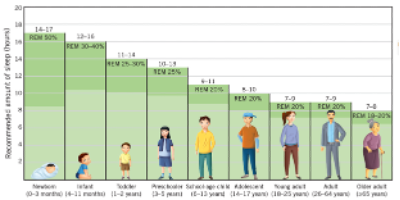
Sleep requirements change because of the change in physical and cognitive needs throughout lifespan. from infancy onward rem to nrem cycle is 20:80.
REM- important for cognitive development
NREM- important for physiological rest
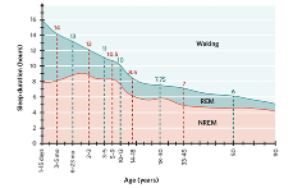
Characteristics of Sleep: Neonatal: 1-15 days old:
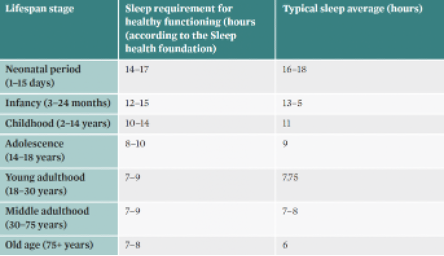
Newborns do not have an established circadian rhythm, sleeping patterns are erratic, with their sleep distributed across the full 24-hour day. Sleep duration is the highest it will ever be. (approx. 16 hours). 50/50% of each sleep episode is REM/NREM sleep.
Characteristics of Sleep: Infancy: 3-24 months of age:
From about 4 months, an infant’s sleep becomes more nocturnal. Begin to have a consistent circadian rhythm. Sleep duration decreases to approximately 13.5 hours. Proportion of REM & NREM sleep in sleep episode changes to 35% & 65% respectively.
Characteristics of Sleep: Childhood: 2- 14 years:
Sleep period decreases again to approximately 11 hours. NREM sleep period increases to 80% per sleep episodes. Variations of the amount of REM & NREM as this age period is quite expansive.
Characteristics of Sleep: Adolescence: 14-18:
Experience a shift in their circadian rhythm - a biological delayed sleep onset; they may not feel tired until later in the evening and wake later. This can result in a delayed sleep phase syndrome. Sleep period duration decreases to approximately 9 hours. REM & NREM periods remain consistent in each sleep episode - approximately 20% & 80%.
Characteristics of Sleep: Young Adulthood & Middle Adulthood: 18-30 (young adulthood) & 30-75 (middle adulthood):
Circadian rhythm returns to more normal timing, and most healthy adults experience a consistent circadian rhythm if they are following a regular routine with relatively stable bedtimes and wake times. Sleep period duration decreases to 7.75 hours. REM & NREM sleep consistent from adolescence.
Characteristics of Sleep: Old Age: 75+:
Older adults may prefer an earlier bedtime and therefore an earlier waking in the morning and may experience advanced sleep phase syndrome: a biological shift forward in sleep-wake cycle. Duration of sleep decreases to approx. 6 hours. REM & NREM still consistent from previous age groups.
Sleep Deprivation can be understood in 2 categories:
· Full Sleep Deprivation: no sleep within a 24-hour period.
· Partial Sleep Deprivation: has sleep for some duration within a 24 hour period, but duration is too short or has poor quality of sleep.
Negative effects on individuals functioning ability. Based on the individuals’ needs as some may require greater duration of sleep to feel fully rested.
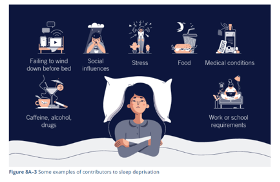
Effects of Sleep Deprivation
Adverse effects on emotions, behaviours and ability to think clearly, these are described as:
Affective (Experience, regulation and expression of emotions) effects: changes in emotions and emotional responses.
· Poor emotion regulation.
· Irritability & moodiness
· Reduced ability to cope with stress
· Increase in aggression
Behavioural effects: changes in actions and ability to control them that arise.
· Increased likelihood of risk-taking behaviour
· Fatigue/lack of energy
· Slowed reactions
· Reduced motor control
· Involuntary lapses into microsleep
Cognitive (mental process in individual performance) effects: changes in mental process from sleep deprivation.
· Reduced concentration
· Diminished ability to perform cognitive tasks
· Impaired decision-making & problem solving
- Reduced retention of information
- Impaired visual and spatial ability
Delayed Sleep Phase Syndrome (DSPS):
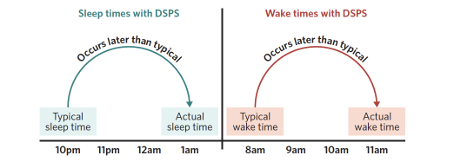
Sleep rhythm disorder where sleep and waking occur later than usual, misalignment between internal and external cues. Causing melatonin secretion to occur later and therefore sleep wake time occur later. Must experience for at least 3 months for official diagnosis. Other than age, some predisposing risk factors for DSPS include a longer than average circadian period and an increased sensitivity to light.
Advanced Sleep Phase Disorder (ASPD):
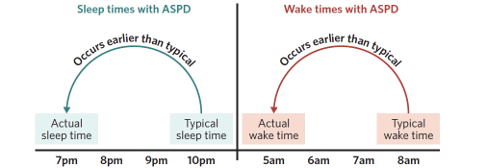
Sleep rhythm disorder, sleep and waking occur earlier than usual, misalignment between internal and external cues. Causing melatonin secretion to occur earlier and therefore sleep wake time occur earlier. By going to bed early and then waking early, a person is not exposed to the regular evening low light and morning bright light signals, maintaining the disorder.
Shift Work:
Impact on the circadian rhythm as they are continuously adapting their sleep to the environment. Shift work is a cause of sleep problems, rather than a sleep disorder.
· Insomnia
· Fragmented sleep
· Circadian rhythm phase disorder
· Quality/Quantity of sleep.
Caused by problems with external Cues. The consequences include poor performance at work, interpersonal problems, increased risk of accidents and poor mental wellbeing, can lead to other mental disorders such as depression and substance use disorders. Links between prolonged shift work and physical health problems (gastrointestinal disorders, cardiovascular disease, diabetes and cancer).
Bright Light Therapy as treatment (BLT):
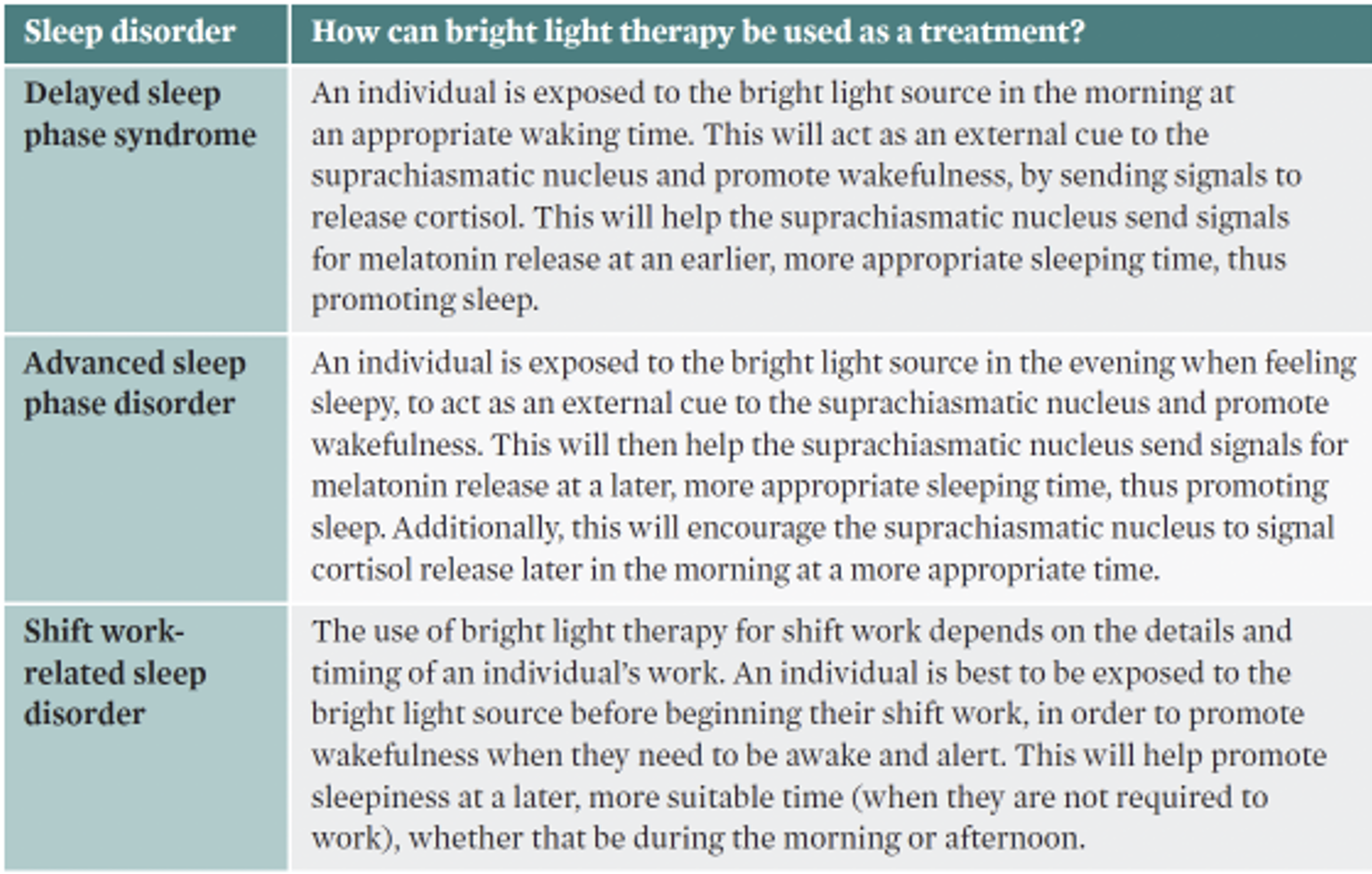
Is a method used to adjust an individual’s circadian rhythm, involve using a light lamp or glasses to expose to safe amounts of high-intensity light. Works to readjust the circadian rhythm.
BLT helps to delay/shift/realign the circadian rhythm, which increases alertness during time relevant, also makes it easier for person to fall/stay asleep during when needed.

How can bright light therapy be used as a treatment?
Improving sleep: Sleep hygiene:
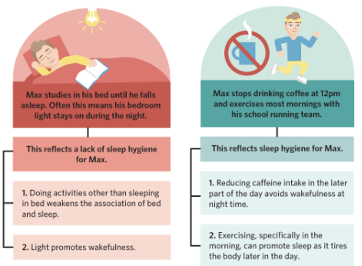
Practices and habits that promote individuals sleep patterns, beneficial as it improves sleep quality and quantity. Sleep hygiene improves all sleep wake patterns.
Involves: Time, Sound, Light, Comfort, Technology, Associations with bed, Exercise.
Sleep hygiene & Mental Wellbeing:
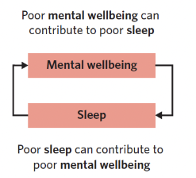
Research suggests that there is a link between poor sleep and mental illness. Good sleep will therefore reduce the likelihood of mental health problems and promote mental wellbeing.
Sleep and Mental wellbeing= bidirectional relationship.
Zeitgebers- Daylight & Blue Light:
Daylight: typical light an individual is exposed to during the day. The ability of the circadian system to resynchronise daily to keep in sync with the external environment.
Invention of artificial lighting, Blue light: type of light that can be emitted both naturally and artificially, light spectrum that is emitted from smartphone screens, computer monitors, televisions, LED and fluorescent light bulbs, Sun.
Zeitgebers- Temperature:
The degree of external heat in the environment that can influence both quality and quantity of sleep. Extreme temperatures (very high or very low) are not good for sleep quality and quantity. Body temperature is a biological mechanism regulated on a 24-hour circadian rhythm, controlled by SCN.
Begins to decrease in early evening, with sleep onset occurring when core body temperature is at its greatest rate of decline. An increase in blood flow to skin results in skin warming and so heat is lost from the body and body temperature drops. The lowest body temperature occurs at about 2 hours after sleep onset.
Suggested link between a cool room temp and experiencing improved quality and quantity of sleep. Ideal room temperature for sleep onset is 19–21°C. BUT ideal skin and bed microclimate is 31–35°C during sleep. Combination of a cool room and warm bedding is an easy way that most people can promote sleep.
Zeitgebers- Eating & Drinking Patterns:
Refers to when, what and how much food/drink is consumed. Can impact the quality and quantity of our sleep. The SCN is not largely influenced by the timing of meals, provided enough food is ingested. However, SCN is affected by long-term severe food deprivation.
| Impact |
What we eat/drink | Some foods can negatively impact sleep & some can positively impact sleep · Caffeine (shows effects on sleep quality even when consumed up to 6hrs before sleep onset!) · Alcohol · Spicy foods · High sugar/high fats |
When we eat/drink | Eating closer to sleep can make it harder to fall asleep due to stimulation of digestive system - eating meals within 3–4hrs of the onset of sleep can |
How much we eat/drink | Going to sleep hungry can lead to poorer sleep quality/quantity additionally, going to sleep overly full can impair sleep patterns. |