AH 3175E Exam 1 Notes
 Call Kai
 Learn
Learn Practice Test
 Spaced Repetition
 Match
Match Flashcards
 Knowt Play
1/346

Earn XP
Description and Tags
Exam notes for the 10/6/26 exam in AH 3175E. Multiple choice is recommended for learning.
Name | Mastery | Learn | Test | Matching | Spaced | Call with Kai | Chat |
|---|
No analytics yet
Send a link to your students to track their progress
347 Terms
Environmental health
all the physical, chemical, and biological factors external to a person, and all the related factors impacting behaviors. It encompasses the assessment and control of those environmental factors that can potentially affect health. It is targeted towards preventing disease and creating health-supportive environments
Environment
The circumstances, objects, and conditions by which one is surrounded
public health
All that which is external to the individual/host. The environment can be divided into physical, biological, social, and cultural factors – any or all of which can influence health status in populations
Environmental Epidemiology
The study of patterns of illness among human populations and the factors that might be responsible for influencing these patterns. Associations between exposure to environmental agents and subsequent development of disease
Environmental Chemistry
The study of the sources, reactions, transport, effects, and fates of chemical species in water, soil, air, and living environments
Toxicology
The study of the causal mechanisms between exposure and subsequent development of disease.
the study of the adverse effects of chemical, physical or biological agents on living organisms and the ecosystem, including the prevention and amelioration of such adverse effects
Environmental Engineering
The study of factors and implemented strategies that govern environmental quality and reduce exposure to environmental hazards. Understanding exposure assessment scenarios.
Preventive Medicine
Factors and implemented strategies that govern and reduce disease development
Environmental Law
development of appropriate legislation and regulations to protect the environment and public health
Determinants of Health

environmental health challenges
Physical inactivity, Driving, Traffic, Air pollution, Lung disease, Heat Stress, Motor vehicle and Pedestrian Injuries, Water quality, Mental Health
Disability Adjusted Life Year (DALY)
The loss of the equivalent of one year of full health
Leading global causes of DALYs

DALY
Disability Adjusted Life Year
YLD
Years lived with disability
YLL
Years Life Lost
Environmental Agents
Chemicals or factors in the environment to which humans are exposed that may cause adverse health effects
Epidemiology
The study of patterns of illness among human populations and the factors that might be responsible for influencing these patterns. Relies on mathematical computations and statistics to make deductions based on these patterns
disease clusters
A group of individuals develop the same disease in frequency that appears too large to be due to coincidence
Superfund site
Government recognizes contamination in the region and is able to link which people who induced the contamination
Fundamental Assumptions of Epidemiology
Disease does not occur in a vacuum. Disease is not randomly distributed throughout a population. Epidemiology uses a systematic approach to study the differences in disease distribution in subgroups, allowing for the study of causal and preventive factors
Environmental Epidemiology
The study of disease and health conditions occurring in the population that are linked to environmental factors
various study designs of Environmental Epidemiology
Cross-sectional, Ecological, Case-control, Cohort
temporal factors of Environmental Epidemiology
Cross-sectional, Prospective, Retrospective
Cross-Sectional Studies
An “observational” design that surveys exposures and disease status at a single point in time (a cross-section of the population)

Prospective Studies
Looks forward, looks into the future, examines events that occur. Follows a condition, concern, or disease into the future.

Retrospective Studies
Looks backward in time to study events that have already occurred

Ecological Study
Investigates the relationship between health outcomes and exposures at the population level, rather than focusing on individual cases.
Researchers analyze entire groups, defined by characteristics like geography, socioeconomic status, or ethnicity, to see if there are correlations between these groups and the factors of interest
Weakness – while effective for comparing general trends between population groups (e.g., two similar towns, one located near a Superfund Site, one not near contamination) these studies lose the fine-scale data about the individual and other potential compromising/compounding factors
Case – Control Study
An observational design comparing exposures in disease cases versus healthy controls from the same population, Exposure data is collected retrospectively, Most feasible design when the disease outcome is rare
Cohort Study
An observational study that follows a well-defined group of people (the cohort) over time, Researchers are interested in how exposure to a certain factor (risk factor, environmental condition, etc.) influences the development of a specific health outcome (disease, mortality, etc.) within the cohort.
Strengths of Cohort Study
Exposure status determined before disease detection
Subjects selected before disease detection
Can study several outcomes for each exposure
Limitations of Cohort Study
Expensive and time-consuming
Inefficient for rare diseases or diseases with long latency
Difficulty of cohort participant retention to “follow-up” communication issues
Criteria of causal association
Consistency – repeated result from exposure to agent factor
Specificity – specific result from exposure to agent factor
Temporality – cause (i.e., exposure) before effect, Biological gradient – dose-response curve
Plausibility – biologically plausible
Coherence – data should not contradict the knowledge of the disease
Incidence
The occurrence of new disease or mortality within a defined period of observation (i.e., set time period) within a specific population
Prevalence
the measure of disease frequency in the context of the existing cases of disease
Incidence
_________ = # new cases / # of persons at risk
Prevalence
__________ = # of cases present / # persons in the population
Factors Making Environmental Disease Difficult to Identify
Latency
Multi-factorial etiology
Disease non-specificity
Individual characteristics
Changes in response with changing dose
Mixed exposure
Latency
Long period of time between exposure and response
requiring lengthy follow-up (e.g., 20 – 25 years for certain cancers)
Multi-factorial etiology
Multiple factors influence the occurrence & severity of disease
Disease non-specificity
Most diseases have multiple causes besides environmental agents, though the disease “looks” the same however it was produced
Individual characteristics
Susceptibility (genetic factors) & effect modifiers (e.g., diet, habits, health, medications)
Changes in response with changing dose
Because of data collection processes, dose-response relationships are not accounted for in grouped epidemiological studies, leading to cohorts with heterogeneous exposure levels
Mixed exposures
Multiple agent exposures produce multiple diseases and synergisms
Molecular epidemiology
Incorporation of biomarkers into analytic epidemiologic research
Biomarkers
Chemical or cellular alterations that are measurable in biological media, such as human tissues, cells, or fluids
Biomarkers of Internal Dose
Direct measurement of toxic chemicals or their metabolites in cells, tissues, or body fluids
Biomonitoring
The utilization of biomarkers in the measurement of the body burden of toxic chemical compounds, elements, or their metabolites in biological materials
Exposome
the measure of cumulative environmental influences and associated biological responses throughout lifespan, including exposures from the environment, diet, behavior, and endogenous process
External exposome
sensor technologies now exist that capture pollutants, Exercise, Stress, Circadian thythms, Location, Air/water sampling with analysis by mass spectrometry
Environmental Toxicology
Allows the prediction of chemical toxicity and the synthesis of non-toxic
analogs
Elucidates the routes of selective toxicity
Details the cause and progression of disease state
Enables the design of antidotal therapies
Assesses health risk and informs regulatory limits
Informs care providers while monitoring exposed populations
Adverse effects
Damages to either the survival or normal function of the individual.
Xenobiotic
A chemical compound (e.g. pesticide, drug, or carcinogen) that is foreign (Greek ____) to a living organism.
Toxicant
Substances that produce any adverse biological effects of any nature. Must be chemical or physical in nature.
Toxin
Specific molecules and proteins that are produced by living organism (e.g. mushroom toxin)
Poison
Toxicants that may cause death or illness in very small amounts.
Additive
simple combination of components. 1 + 1 = 2
Antagonistic
one acts nullify the other, which can be protective or harmful. 1 + 1 = 0
Coalitive
agents acting together have a toxic effect, individually do not 0 + 0 = 1
Potentiating
one makes the other have a stronger effect 0 + 1 = 1
Synergistic
combination is more than additive. 1 + 1 > 2
Dose
The quantity of the substance received by the organism at one time.
Toxicity Dependents
Dose
Type of Substance
Frequency of Exposure
Organism
Administered or applied dose
The amount presented to an absorption barrier and available for absorption
Does not necessarily mean having yet crossed the outer barrier/boundary of the organism
Absorbed dose
The amount crossing a specific absorption barrier through uptake processes
Example barriers include skin, lungs, and digestive tract
Internal dose
A more general term denoting the amount absorbed without respect to specific absorption barriers
Gram
typical unit used to express dose
Body weight
For both “effective dose” and “toxic dose” studies, doses are standardized based on ______
Median Lethal Dose (LD50)
The Benchmark of Toxicity
Dose – Response Relationship
The link between the amount of a substance an organism is exposed to (the dose) and the biological effect it has (the response)
Can establish the lowest dose where an objectively measurable effect first occurs (threshold level)
Establishes a quantitative relationship between the dose and the response
Provides the basis for establishing a causal relationship between the dose and the response
Provides information to assess the relative toxicity of a chemical when compared with others tested under similar conditions of exposure
No Observed Adverse Effect Level (NOAEL)
Highest dose where there is not an observed toxic or adverse effect
Lowest Observed Adverse Effect Level
Lowest dose at which there is an observed toxic or adverse effect
Dose-Response Curve

Threshold dose
The lowest dose that produces an (adverse) effect
slope of a dose
The part of the response curve that rises most rapidly, representing the change in response intensity per unit increase in dose.
Therapeutic Index
LD50/ED50E
Effective Dose
ED
Lethal Dose
LDT
Toxic Dose
TD
Dose-Response Relationship
What is the relationship of this graph

True
True or False, a dose can be a single event
False
True or False: a dose can be a one time multiple event
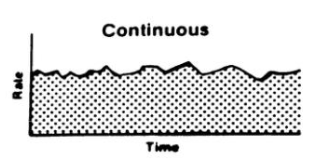
Continuous
What type of exposure-time scenario is this?
Intermittent
What type of exposure-time scenario is this?

Cyclic
What type of exposure-time scenario is this?

Random
What type of exposure-time scenario is this?

Concentrated
What type of exposure-time scenario is this?

_________ = Intensity x frequency x duration
What is the equation for exposure?
Scientific Validity of Toxicilogy
What are these a standard for?
1. A method is needed to objectively measure an adverse response.
2. The adverse response occurs after the dose is administered.
3. The adverse response is due solely to the dose.
4. The type of adverse response(s) measured is the same or similar
for each individual or in vitro (meaning “within glass,” term used for
cellular studies) system that is used for testing.
5. The intensity of the adverse response is proportional to the dose.
in vivo
What is the latin definition for laboratory animal studies
in vitro
What is the latin definition for cellular assays
Toxic effects of an agent
What determinants are these for?
• The nature of the hazardous agent
• The dose or quantity to which the individual is exposed
• The pathway(s) of exposure
• The pattern of exposure
• The duration of exposure
Uncertainty factors
Used to account for species difference, human-to-human variability, and study design parameters
reference dose
maximum acceptable oral dose of a toxic substance, below which no adverse non-cancerous health effects should result from a lifetime of exposure
RfD
What is this equation for?

Threshold Dose Response - RfD Determination
What graph is this?

Acute, Subacute, Subchronic, Chronic
What are the four basic types of exposure duration?
Natural (Biological, Physical, Chemical), Anthropogenic (Chemical, Physical)
What are some Sources (Agents) of Environmental Exposure?
Vectors (Air, water, food, soil)
What are some Transporters & Fates of Environmental Exposure?
Dose to Target, Susceptibility, Effect, Continuum
What are some Health Effects of Environmental Exposure?