Lecture 9~ Earnings Differences: Labor Market Discrimination, Competition, Choice and risk (empirical evidence)
 Call Kai
 Learn
 Practice Test
 Spaced Repetition
 Match
 Flashcards
 Knowt Play
1/25

There's no tags or description
Looks like no tags are added yet.
26 Terms
TOPIC 1] Pay Gaps & Discrimination
Subtopic a) RESIDUAL METHOD
Describe the Residual Method
Analyze differences in wages (W) and determine how much of those differences are explained by characteristics (X’s), any differences unaccounted for by X variables such as education or experience are equated to discrimination
Residual Method Example

What could lead to overestimation (upward bias) in this data? (3)
1) Missing data- on the job qualifications (OJT, college major, etc.)
2) Unobservable determinants of productivity- workplace effort, motivation, attitude
3) omitted variable bias- discrimination could be overestimated if men possess more of the omitted traits (higher paying college majors)
What could lead to underestimation (downward bias) in this data?
1) Interpersonal skills omitted
2) Feedback effect- employer discrimination—such as lower pay, biased evaluations, or fewer promotions—discourages women from investing in skills or competing for advancement, which in turn reinforces employers' stereotypes and widens gender gaps over time.
3) Attitudes towards negotiation
Subtopic B) Oxaca Decomposition
How does the Oxaca decomposition differ from the residual method?
This method acknowledges that pay differences may be caused by differences may be caused by differences in underlying traits (experiences) as well as differential labor narjet returns to these traits.
Gender Pay Gap

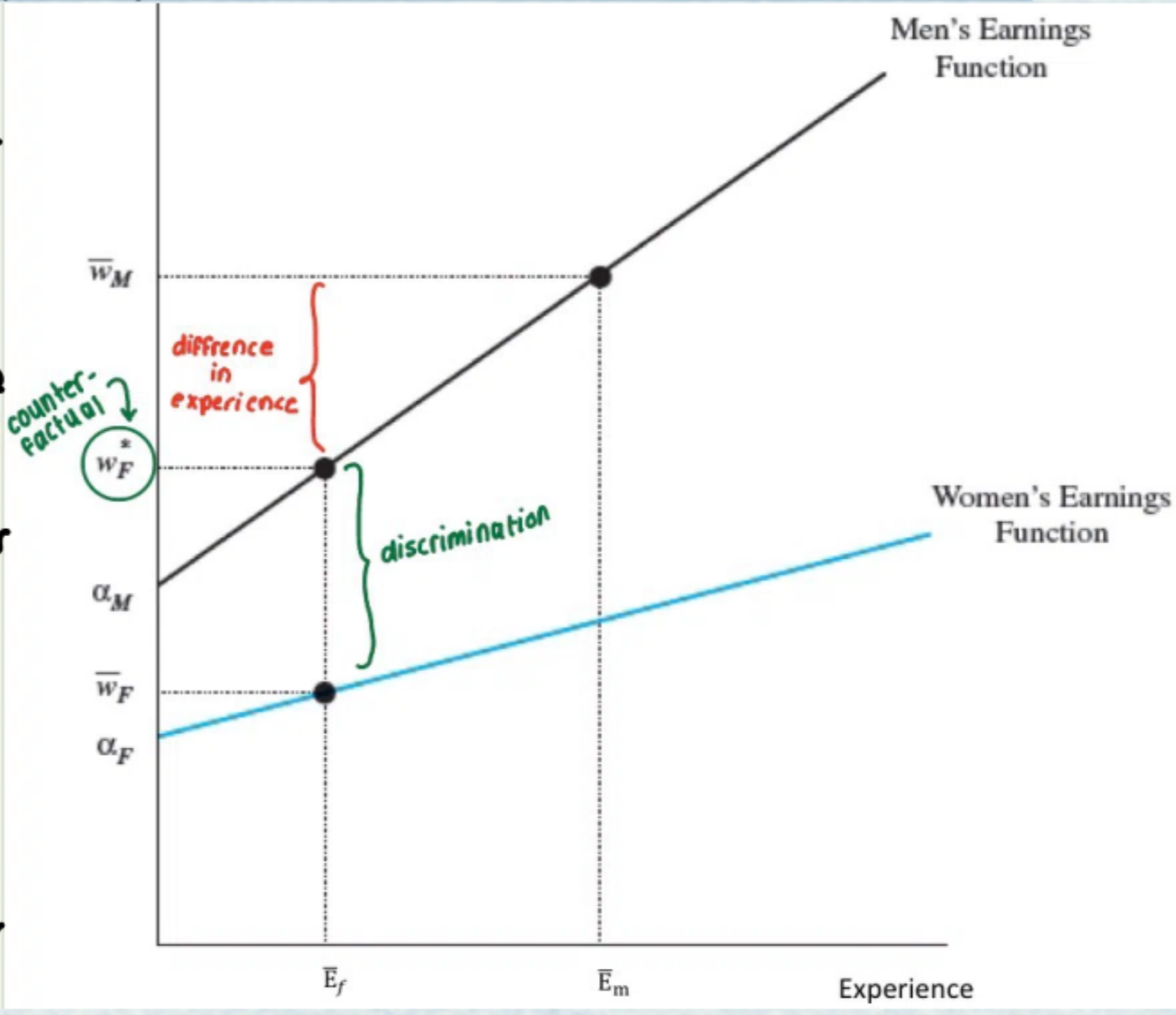
Discrimination
differential treatment (in terms of wages) of individuals who have the same (observable) productivity related characteristics.
Counterfactual
would be wages in the absence of discrimination.
Ex: wage structure faced by males would also apply to females if discrimination did not exist and vice versa.
Group wage equation variables identification

What is wage equation for a man, women, and the raw wage differential equation

Wage differential written to decompose wage gap

Oxaca Decomposition Graphically
Limitations of Oxaca Decomposition
1) Omitted variables bias- many important determinants of earning unobservable (school quality, ability, effort, ambition)
2) Does not account feedback from labor market discrimination- differences in characteristic s may be due to anticipated (future) market discrimination.
TOPIC 2] EMPIRICAL EVIDENCE ON DISCRIMINATION
3 types of studies and describe what they are
1) audit studies- identical (except for in regard to gender and race) and real individuals apply for jobs differences in treatment signal discrimination.
2) correspondance studies- researchers send identical resumes or applications (except names that may signal gender/race) and measure differences in call backs.
3) Naturalistic studies- research methods that examine real-world economic behavior and outcomes in their natural settings without the researcher intervening, manipulating variables, or creating fake applicants.
Audit studies example (Ayers & Siegelman- 1995)
When real individuals go into the car dealership and try to bargain (using identical bargaining methods), White men are quoted better prices than white women, Black men, and Black women.
Correspondance studies example (Bertrand & Mullainathan- 2004)
Send 5000 fictitious resumes signaling race and gender but otherwise identical, Black Applicants receive fewer call backs.
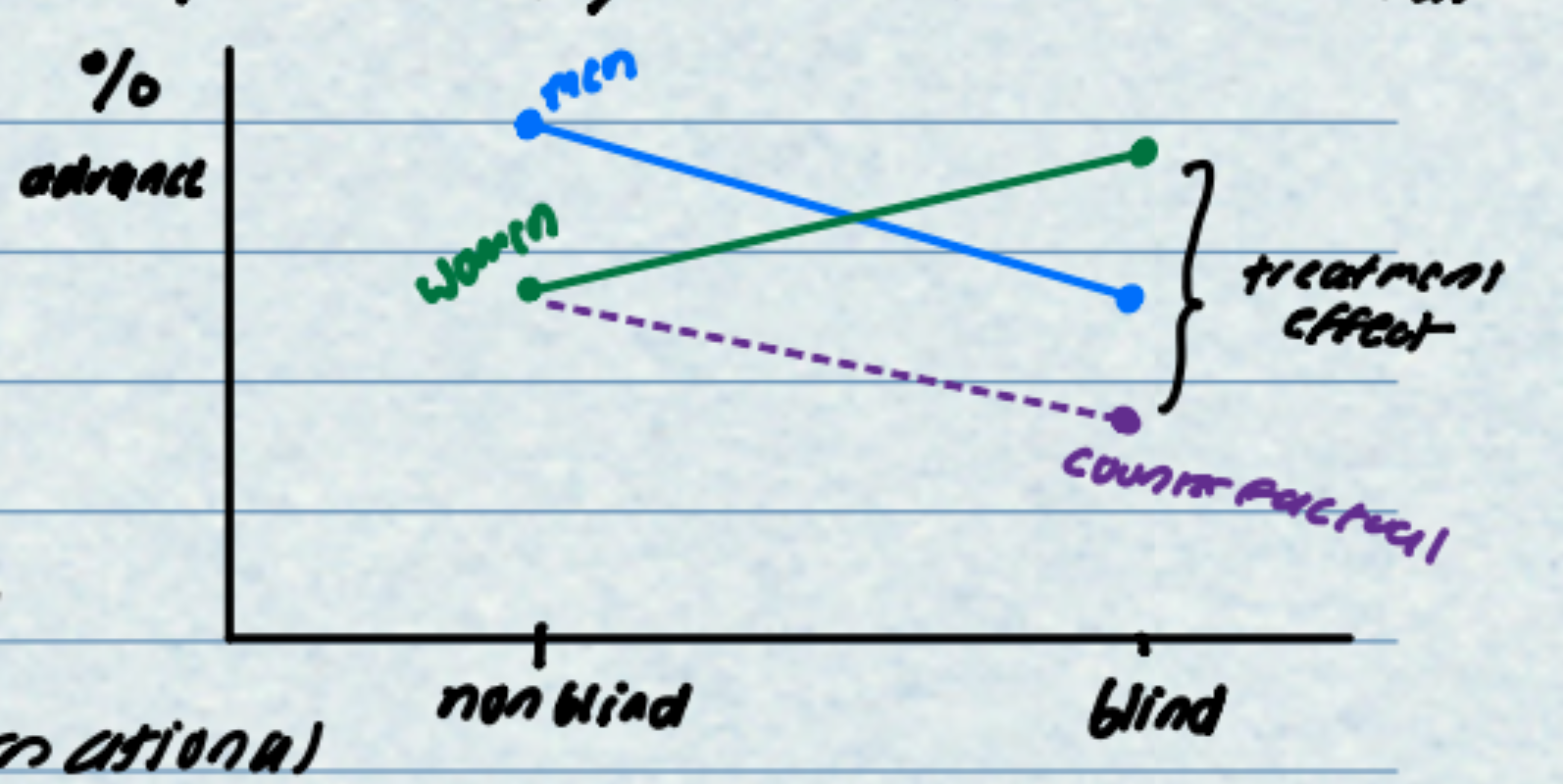
Naturalistic/single blind study example (Goldin & Rouse 2001)
blind studies- studies that deal with individuals in real-life situations, but keep the identity of the individuals hidden from the “other party.”
Aimed to understand if there is a gender preference in orchestra auditions & if blind screening helps. They found that women generally do better in the blind rounds (among the group that did both types).
TOPIC 3] Does Competition Eliminate Discrimination (Black, 1999)
Rationale behind this idea
Applies to taste based discrimination. Researchers analyzed 2 cases in which (1) international trade opens and (2) the bank sector becomes disregulated both leading to inceeased compeititon.
International trade

Banking sector

Results from this theory
Trade induced competition reduced pay differences between men & women, but this is because everyone experienced a pay decline (men more than women).