Breast, Axillae, Reproductive Cancer Screening Vocab
 Call Kai
 Learn
 Practice Test
 Spaced Repetition
 Match
 Flashcards
 Knowt Play
1/27

There's no tags or description
Looks like no tags are added yet.
28 Terms
Tail of Spence
extension of breast tissue from the upper outer quadrant that extends into the axilla

gynecomastia
-enlargement of one or both breasts in the male
-most prevalent during puberty, among older adult men or men who are overweight
-must consider breast cancer - it is rare in men, but the most common initial symptom is a breast mass
-typically unilateral although can be bilateral
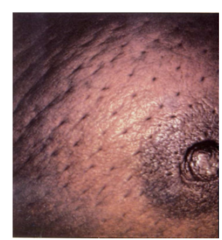
peau d'Orange
-skin appearance characterized by dimpling or an orange peel-like texture on the breast surface
-indicator of breast cancer*
areolae
pigmented circular area of skin that surrounds the nipple on the breast
nipple inversion
condition where the nipple is pulled inward rather than projecting outward from the breast surface
nipple retraction
a nipple that is pointing or pulled in a different direction suggests malignancy
Paget's disease
-rare type of breast cancer that affects the nipple and areola, characterized by eczema-like skin changes
supernumerary nipple
an extra nipple (also called accessory nipple or polythelia) that develops along the embryonic mammary ridge, also known as the "milk line"
clinical Breast Exam (CBE) components
Palpation:
- Use finger pads of first
two or three fingers
- Apply gentle pressure
to systematically
palpate all 4 quadrants
- Include tail of spence
- Slide from one area to
another; do not lift your
fingers from the chest
wall during palpation
- Do not compress
breast tissue against rib
cage
Risk Factors for Breast Cancer
■ Females account for 99%
■ Age: Increases with age (peak incidence 65-84)
■ Race: White women have highest incidence
■ Genetic: BRCA1/BRCA2 account for 5-10% in
women
■ Family History: First degree relative (maternal or
paternal) especially before age 50; highest if
mother or sister
■ Personal Medical History: previous breast
cancer
■ Reproductive History: early menarche, later
menopause; nulliparity; 1st pregnancy after age
30
■ Breast Density: harder to see on mammogram
■ Estrogen replacement:
■ Physical Inactivity
■ Alcohol intake (2-5 drinks/day)
■ Obesity
Risk Factors for Testicular Cancer
■ Age (highest incidence in young men ages 20-34)
■ Cryptorchidism (undescended testicle)
■ Family history: increased risk if father or brother had
testicular cancer
■ History of testicular cancer in the other testicle
■ Race (highest incidence white men)
Risk Factors for Ovarian Cancer
■ Strong family history of ovarian cancer
■ Personal history of breast cancer
■ BRCA1, BRCA2 gene mutations
■ Pelvic Inflammatory disease
■ Nulliparity
■ Obesity
■ Estrogen for postmenopausal hormone replacement therapy
■ Age (increased risk with aging)
Risk Factors for Cervical Cancer
■ Persistent infection with HPV
■ Sexual intercourse at an early age and a lifetime history of multiple sex
partners or partners with multiple sexual partners
■ Suppressed immune system
■ Cigarette smoking
■ Multiple childbirths
■ Long-term use of oral contraceptives
■ Obesity
■ Family history of cervical cancer
Risk Factors for Prostate Cancer
■ Age: 56% of new cases occur in men over age 65
■ Race: AA men have the highest incidence of prostate
cancer
■ Family history: first-degree relative with prostate cancer
■ Dietary intake: High dietary fat, high dairy and calcium
intake
■ Genetic: Lynch syndrome, BRCA1, BRCA2
cryptorchidism
undescended testes - a condition where one or both testicles have not descended into the scrotum
breast awareness
-performed once a month
-performed on a fixed date each month, or
several days after menses has ended
-avoid completing during menstruation or
ovulation
-use calendar/app for monthly reminder
-the key is to report changes to a health
care provider
breast self-exam
-self exams should not replace annual exams
by professionals when recommended
circular method
systematic breast palpation technique where the examiner moves in concentric circles from the outer breast tissue inward toward the nipple, or from the nipple outward in widening circles
wedge method
systematic breast palpation technique where the examiner palpates in straight lines radiating outward from the nipple like spokes of a wheel or wedges of a pie
vertical strip method
systematic breast palpation technique where the examiner palpates the breast in vertical lines moving up and down from the clavicle to the inframammary fold, covering the entire breast from sternum to midaxillary line
witch's milk
small amount of watery or milky nipple discharge that occurs in approximately 5% of neonates during the first month of life
thelarche
beginning of breast development during puberty, marking the onset of female secondary sexual characteristics
menopause
the cessation of menses, defined retrospectively 12 months after the final menstrual period in the absence of other conditions
menarche
the first menstrual period, marking the beginning of menstruation during puberty
subareolar masses
-unilateral or bilateral; generally transient and disappear within a year; firm and sometimes tender
fibroadenoma
-mass of glandular and fibrous tissue; round, rubbery, mobile,
nontender
-does not change with menstrual cycle

fibrocystic breast disease
-1 or more palpable masses that are round, well-
delineated, mobile, tender
-cysts fluctuate in size and tenderness with menstrual cycle
mastitis
inflammation of the breast tissue