Food Tech - Term 3/4 revision
 Call Kai
 Learn
Learn Practice Test
 Spaced Repetition
 Match
Match Flashcards
 Knowt Play
1/43

There's no tags or description
Looks like no tags are added yet.
Name | Mastery | Learn | Test | Matching | Spaced | Call with Kai | Chat |
|---|
No analytics yet
Send a link to your students to track their progress
44 Terms

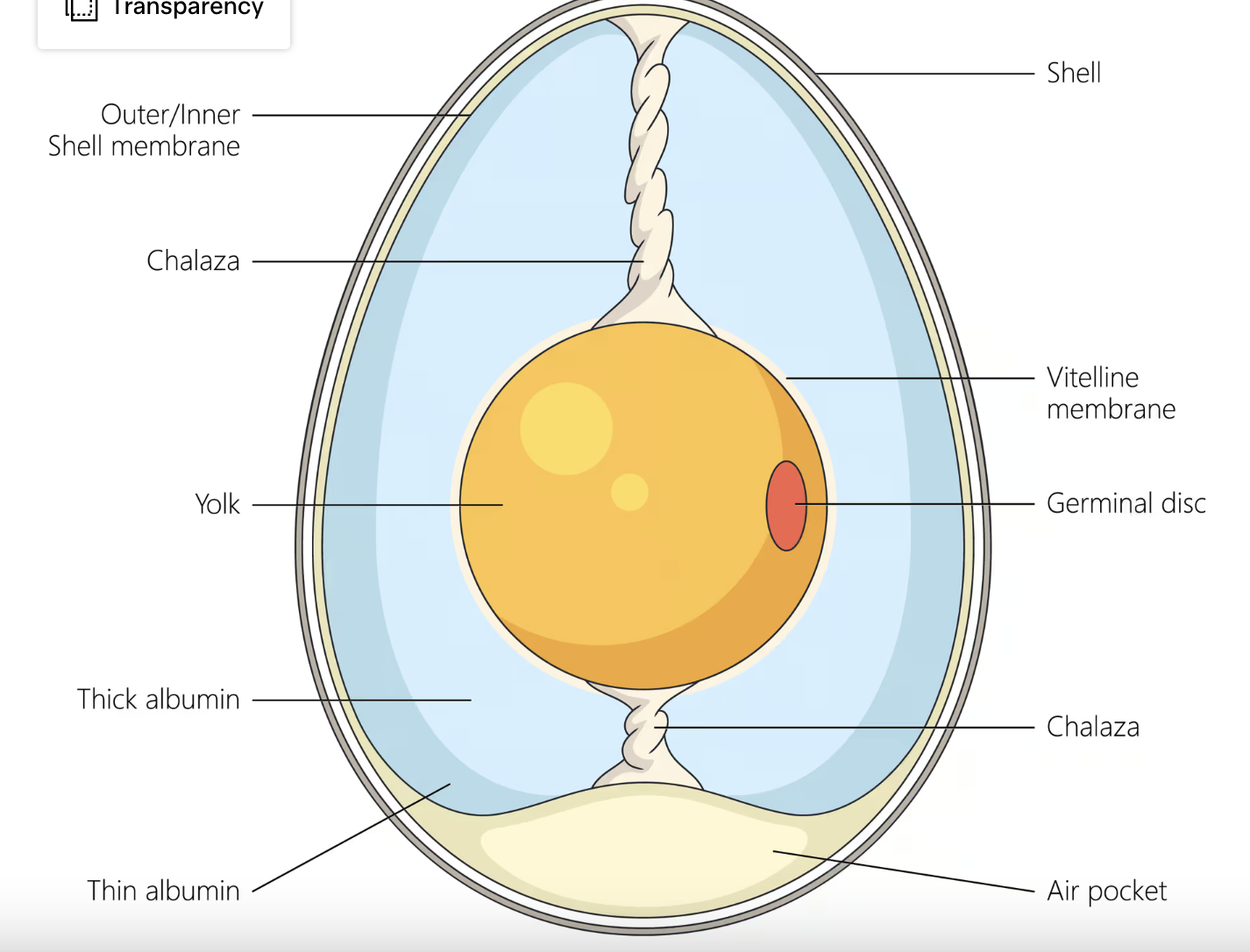
Fill in the blanks - anatomy of an egg
yolk
albumen
chalazae
germinal disk
vitelline membrane
air cell
inner and outer membranes
Function of egg shell
protect the embryo from physical damage
blocks bacteria from external sources/environment
facilitates transport of gases and water
egg yolk function
supplies vital nutrients, fats and energy to feed and support the growing embryo.
egg white
protects the delicate yolk and provides essential proteins and water for the embryo
Why are fresh eggs difficult to shell
Fresh eggs have a lower pH level, and they have more acidic whites, which stick to the membrane more.
Factors that determine the colour of the yolk
They are determined by carotenoids - natural yellow, orange and red pigments that hens absorb from their diet, which passes from their bloodstreams into the eggs. Other factors include age, as old hens usually lay paler egg yolks, changes in environment and season can influence yolk colour.
How should eggs be stored
Eggs should be kept in their original carton on a main interior shelf with the pointy top faced downwards to keep the air sacs, and don’t wash eggs before use.
How to determine the age of an egg through foam, air sacs, whites, yolk
Fresh eggs have small air sacs whilst old ones have larger sacs.
Fresh eggs have a thicker albumen that stays close to the yolk, whilst old ones are watery.
If the yolk stands tall and is plump then it is fresh. If the yolk is old then it will be flatter and larger.
For fresh eggs, it takes longer to whip into a foam, but is more stable, whilst old eggs can easily be whipped into a foam, but it will collapse fast as the foam is thin.
How to test an egg for freshness
You can tell how old an egg is from whether or not it floats, if it floats it means that it is old. Floating is caused by a variety of reasons. Fresh eggs have small air sacs whilst old ones have larger sacs.
Five functions of egg in cooking
To bind ingredients together, emulsifying fats and liquids, thickening sauces, egg wash to add a nice brown shell and facilitate Maillard reaction, adding moisture or colour to dishes.
Describe foamy state of whipping egg whites
Description: Thin bubbly liquid, with the bottom of the bowl still watery.There are lots of visible and loose air bubbles that look like soap.

Describe soft peaks state of whipping egg whites
foamy, cloud-like with a peak that is droopy when the beaters are lifted. Much more opaque than foamy state.

Describe stiff peaks state of whipping egg whites
smooth, glossy, can hold up their shape, the peak stands up without bending over.

Describe overbeat/dry state of whipping egg whites
grainy, clumpy and dull. It looks curdled like broken styrofoam, as the air bubbles are broken.
Why is it important that when beating egg whites to ensure there is no yolk or grease in the mixture?
The yolks have fats which could also come from a greasy/dirty mixing bowl. This will not let the air be integrated into the egg whites, as the fats will destroy the structure that holds the air bubbles with lipids coating the proteins in the egg whites. If yolks are whipped with the eggs it will result in a flat mixture instead of stiff peaks.
Why are the best foams made with room temperature eggs?
Room temperature eggs are optimal for making whipped egg whites because they have less tension and more relaxed proteins allowing them to trap air in faster.
Room temperature egg whites allow them to expand faster into a fluffier foam.
Explain the decisions that need to be made when carrying out aeration?
Aeration means:
- deciding how to keep the egg whites separated from the yolks to ensure no fats are
mixed in.
- Deciding on the temperature of eggs to use. Room temperature should be used.
- Deciding what state of the foam should be used: foamy, soft, stiff etc. depending on what
type of product being baked.
- Deciding when to add the sugar - sugar delays denaturation
Why is a low temperature important for making meringues?
dehydrates the product slowly without scorching or deflating the meringues.
High heat would cause the water content to turn to steam rapidly, causing the products to expand and crack the delicate surface.
A slow baking time ensures that the meringues retain their white colour as the maillard reaction can happen when the sugar caramelises at higher temperatures.
Are eggs a good source of nutrition?
Eggs are an excellent source of nutrition.
They contain all the 9 essential amino acids that human bodies are incapable of making, which help with muscle growth and repair.
The albumen of eggs consists of mainly just water and protein
The yolk has various micronutrients and fats, such as choline: a nutrient important for brain development, memory and nervous system function.
They are also good for eye health.
Design process command terms
design process command terms
Define ‘Brief’
A set of instructions, rules and goals given to a chef for a specific project/task.
Define ‘Criteria’
A list of requirements that outline the parameters of the task, including the constraints, considerations that must be followed for the task to be completed well.
Define ‘Considerations’
Factors that must be thought about for a successful production, but they are flexible and can be altered by the chef.
Define ‘constraints’
Rigid boundaries that make up the design brief. They are non-negotiable and you must work within them.
Name the five stages of Design Process
Investigate
Generate
Plan and Manage
Produce
Evaluate
What is investigate?
phrase where ideas are being discovered and different types of products, recipes, flavour combinations, structure, size, and other sensory properties explored.
includes visuals
What is generate?
Brainstorming and ideation phase where the goal and context is defined as intended product becomes clearer and consider a range of ideas on presentation and feasibility.
includes visuals
What is plan and manage?
Develop the recipe for the production, prepare your time plan and complete food order.
What is produce?
Make the product, consider culinary techniques, health and hygiene requirements within course of productions.
What is evaluate?
Individually reflect on the design brief steps to conclude on the level of success of the product. Consider:
Were the constraints and considerations achieved?
Were you happy with the recipe and product
What things did you learn?
Did you enjoy this task?
What would you do differently in the future?
What is the Australian Guide to Healthy Eating?
-Is a food selection guide.
-Visually represents the proportion of the five food groups recommended for consumption each day through wedges that ‘make up a plate’
-Developed by the Department of Health (Australian Government)
What are the Australian Dietary Guidelines?
Created and run by the Australian Government.
Provide advice relating to the types and amounts of foods and food groups that will help Australians to develop healthy dietary patterns reduce the risk of diet-related conditions.
Designed for the average healthy population.
GUIDELINE 1 | To achieve and maintain a healthy weight, be physically active and choose amounts of nutritious food and drinks to meet your energy needs. |
GUIDELINE 2 | Enjoy a wide variety of nutritious foods from the five groups every day and drink plenty of water. |
GUIDELINE 3 | Limit intake of foods containing saturated fat, added salt, added sugars and alcohol. |
GUIDELINE 4 | Encourage, support and promote breastfeeding. |
GUIDELINE 5 | Care for your food; prepare and store it safely. |
Define functional properties of food?
The physical and chemical properties of ingredients that impact food processing and preparation. Functional properties play a crucial role in the sensory properties of food (texture, appearance, aroma, flavour, taste)
Functional properties of food: aeration
The process of incorporating air into products to increase the volume and create a light, airy texture.
Food can be aerated by
- biological ingredients (yeast)
- chemical ingredients (bi-carb, baking soda)
- mechanical actions (sifting, creaming, whisking, beating)
Is seen in pastries (using oil, butter to trap air between pastry layers allowing them to expand and separate, creating lightness and crispiness), scones (rubbing in the butter), ice cream (churning ice cream incorporates air into mixture - makes ice cream less cold to the palate)
Functional properties of food: denaturation
describes the permanent structural change of proteins molecules in food.
can occur through the application of heat, mechanical actions, acids.
E.g. poached eggs, marinated meat, beaten egg whites.

Functional properties of food: maillard reaction
turns food brown, creates pleasant, volatile, aromatic compounds
reaction between amino acids in proteins and sugars or starch
begins at 154 degrees celsius
can be seen when sauteing, baking in the oven
e.g making a pie in oven, cakes, roast meat.
Functional properties of food: coagulation
next step of denaturation
occurs when there is a permanent change of liquid to solid: unfolded denatured proteins clump/stick together into a thick mass from the addition of heat, acids.
denatured proteins forms a structure that retains water - semi liquid, becoming firm and holding shape.
e.g. grilled meat, quiche, boiled eggs, custard (yolk coagulates when heatened, turning a liquid custard into a velvety texture)
What are proteins?
-Essential part of diet
-Made up of organic chemical called amino acids
-Foods containing protein is broken down during digestion into amino acids
-Different food sources contain different groups of proteins, which are made up of various arrangements and amounts of amino acids.
What are the main components of eggs in brownies
Water: 76% of the egg is water, being the main source of liquid in the brownie batter.
Protein: Eggs are made up of proteins that coagulate when heated and provide structure to brownies.
Fats & Emulsifiers: Egg yolks contain emulsifiers such as lecithin (about 10%). Emulsifiers make it easier to combine fats and water to get a smooth, homogeneous batter. Egg yolks also contain fat which adds richness and flavour.
What happened if eggs were skipped in brownies:
Thick batter: Paste-like consistency
Grainy texture: Without the moisture from the eggs, the sugar won’t dissolve in the batter and you’ll end up with a gritty, unpleasant texture. You also won’t get to enjoy the shiny crust on the surface of the brownie without enough liquid. You’ll be left instead with a surface full of holes (pictured below).
Greasy product: The batter and baked product will feel very greasy since there isn’t enough water to balance out all the fat added from the butter and chocolate.
Hard cookie: The lack of moisture in the batter will lead to a dry sandy bar that hardens significantly if slightly overbaked or chilled.
Overwhelming flavor: The flavor of the butter will be extremely enhanced.
What it starch gelatinisation
The starch in flour will absorb the water in the batter and start to swell up and soften with the heat. The batter will then thicken and set, giving the brownies structure.
What happens if more eggs are added to brownies
Adding more eggs = more batter
Cakier texture: Eggs play an important role in the cakey versus fudgy brownie debate. The more eggs you add, the lighter and cakier your brownie will be. We mentioned previously that eggs are primarily composed of water. This water will turn to steam in the oven, helping your brownie rise. The additional liquid provided by using more eggs also contributes to better starch gelatinization leading to a more cakey texture.
Brownies with more egg deflate less after baking, as the liquid (coagulated proteins) helps it manage its weight.