Chem 130 Part 2
 Call Kai
 Learn
Learn Practice Test
 Spaced Repetition
 Match
Match Flashcards
 Knowt Play
1/76

There's no tags or description
Looks like no tags are added yet.
Name | Mastery | Learn | Test | Matching | Spaced | Call with Kai | Chat |
|---|
No analytics yet
Send a link to your students to track their progress
77 Terms
Periodic Law
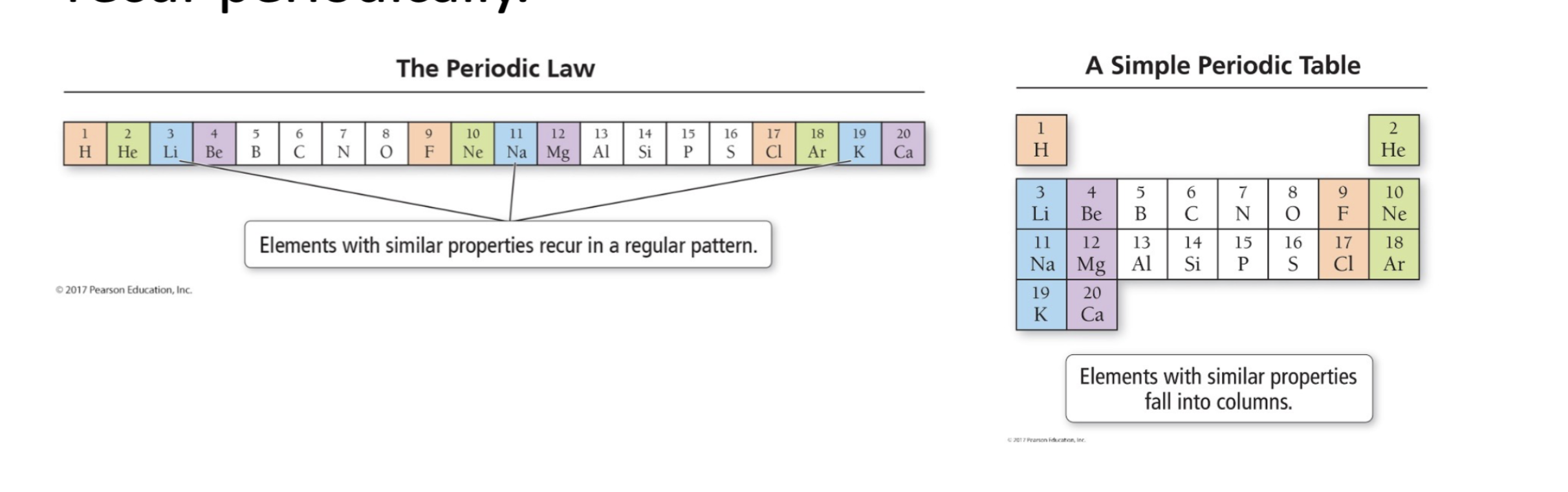
This is when the elements are arranged in order of increasing mass, certain sets of properties recur periodically. Or this is when chemical elements are arranged in order of their increasing atomic number (the number of protons) their physical and chemical properties repeat in a regular, predictable pattern.
This happens because as you move across a row (period) on the periodic table, you fill up an electron shell. Once that electron shell is completely full, the next electron must start a brand-new, empty shell on the nest row down.
Because this “reset” happens at regular intervals, elements stacked in the same vertical column (group) end up with the exact same number of outer electrons (valance electrons).
And because an atom’s outer electrons dictate how it bonds and reacts with other chemicals elements in the same column naturally share similar behaviors and properties.
Mendeleev predictions and inaccuracies
Dmitri Mendeleev originally organized his periodic table by increasing atomic mass, however the true importance was his prioritization of chemical properties over strict mass order.
Specifically when certain elements did not fit the patterns of their vertical columns (As vertical columns were families of elements that shared the exact same chemical and physical properties, like reactivity. However as Mendeleev laid the elements out in order of mass, he came across issues where the next level of elements had a completely different property than the column it landed in), he acted to switch their postions and left blank gaps in his table, proposing that undiscovered elements would eventually fil the gaps with exact matching traits.
Or when two adjacent elements were right next to each other, but if he placed them strictly by weight, they would sit in column where they didn’t belong chemically. Therefore he assumed also that the calculated atomic weighted of his era were simply wrong. So he initially swapped heaver elements before the lighter ones so they would match the property of their column.
Decades later, scientists discovered protons and transitioned to organizing the periodic table by atomic number (the number of protons) rather than mass. This fundamental shift proved Mendeleev completely correct in his placement choices; as it resolved anomalies where heavier elements naturally belong before lighter ones
Modern periodic table; Periods
In this organization for elements, it is primary arranged in order of increasing atomic number, from left to right and top to bottom, specifically:
______: (Horizontal rows): There are 7 ______ in the table. Moving from left to right across a _______ the atomic number increases by one for each element, and as you down a ______ that is when you add a new electron shell (n = 1, n = 2, n = 3, etc)
_______ or ________ ( vertical column): These are 18 _____ in the periodic table. Elements in the same vertical column share similar chemical properties and have the same number of valence electrons (electron in their outermost shell) (due to periodic law)
_____ 1 : Has 1 valence electrons
______ 2: Has 2 valence electrons
_______ 13 to 18: Take the last digit of the group number or subtract 10 from the group number to find the valence electrons
____ 13: Has 3 valence electrons
_____ 14: Has 4 valence electrons
_____15: Has 5 valence electrons
_____16: Has 6 valence electrons
_____17: Has 7 valence electrons
_____18: Has 8 valence electrons
For _____ 3 to 12 (these are transition metals)
The middle block of the table do not follow this simple group number rule because their electron configuration involve inner d-orbitals. Finding their valence electrons requires wiring out their full electron configuration.

Electron configuration and orbital diagram
Is the mathematical and symbolic notation that describes how electrons are distributed among an atom's atomic orbitals.
An ______ _______ is a visual representation of an electron configuration for an atom. It displays individuals orbitals as boxes or liens and indicated the presence and spin of electrons using upward and downward pointing arrows

How to write out electron configuration
How we write an electron configuration for an atom, is by taking not of how many electrons its has (relative to the number of protons it has), then form their we find out how many energy levels it has, its sub-shells (s, p, d, f) and superscript for electron counts each subhshells. We can use the period table to help write this.
The important things to remember is:
s subshell: Has one orbital (1)therefore it can hold up to 2 electrons
p subshell: Has three orbitals (3) therefore it can hold up to 6 electrons
d subshell: has five orbitals (5) therefore it can hold up to 10 electrons
f subshell: has seven orbitals (7) therefore it can hold up to 17 electrons
How to write it:
Find your elements atomic number (this equals the total number of electrons in a neutral atom)
Follow the atomic numbers: So start with hydrogen, and move across the periods, in order, counting the elements as you go.
As you pass through each block, you write down the row number, the block letter, and how many spaces you moved through that block (written as an exponent). This represent the electrons filling up those orbitals
Compound as you go: You keep adding these blocks together in order until you finally land on your target element
The D-block exception: Remember that golden rule for the d-block—always subtract 1 from the row number for its energy level (for example, if you are in the 4th row, the d-block is actually written as 3d)
The f-block exception: remember these rule that if you pass through the f-block, always subtract 2 from the row number. So if you are in the 6th row, the f-block is written as 4f.


How to write a orbital diagram
How we write this Is:
boxes would represent individual orbitals
Arrows ( ↑ or ↓) represent electrons and their spin (up or down)
Rule to draw an orbital
Fill low-energy orbitals (like 1s) before moving to higher energy ones (like 2s, 2p, 3s)
Remember each orbital box can hold at most two electrons
In an orbital has two electrons, their arrow must point in opposite directions to show opposite spin
Lastly, for orbitals with the same energy level, put one electron in each box with the same spin before pairing them up with a second arrow

Pauli exclusion principle
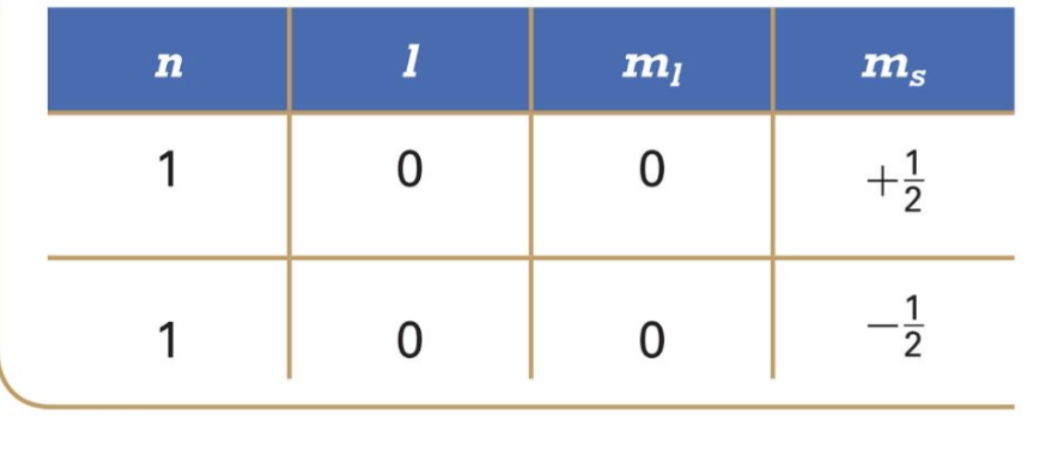
This states that no two electrons in the same atom can have the exact same set of four quantum numbers.
This means that an atomic orbitals can hold a maximum of two electrons, and they must have opposite spins (because that means they would share three sets of the principle quantum number, with their differing spin quantum numbers preventing them from violating this principle
Principle quantum number (n): Which defined the main energy level or shell of the electron
The angular momentum quantum number (l) so this defines the subeshell or shape of the orbital which is s, p, d, f.
The Magnetic quantum number (ml) defines the specific spatial orientation of the orbital. (l = o for S orbital, l = 1 for p orbital (-1, 0+ +1), l = 2 for d orbital and l = 3 for f orbitals)
The spin quantum number (ms) which defines the Intrinsic spin of the electron (either being +1/2 or -1/2)
Why electrons can’t have the same set of quantum numbers:
Because electrons are described mathematically by quantum wave functions. Because they are fermion though, their combined wave functions must be anti-symmetric, this means they can’t share those 4 quantum number. Cause if you tried to put two electrons into the identical set of all four quantum number, their wavefucntions would valence each other out to zero. This menas the state cannot exist.
Sublevel energy splitting in multi-electron
This refers to the phenomena where sub-shells (s,p,d,f) within the same principal energy level (like 2s and 2p) have different energy levels, breaking the degeneracy seen in single-electron systems like hydrogen (degeneracy means that multiple different quantum states share the exact same energy level)
This splitting is primarily caused by the simultaneous effects of Coulombic electron-electron repulsion, and the penetration and shelvings effects.
Therefore with any given principle energy level (n), the energy order of the subshells splits from lowest to highest energy as followed;
s < p < d < f
Therefore when writing complete electron configurations across different principal levels, you fill them using the Aufbau Principle (from lowest to higher energy overall). And also Because higher energy levels being to overlap, the absolute filing sequence follows this exact order:
1s<2s<2p<3s<3p<4s<3d<4p<5s<4d<5p<6s

Coulomb’s Law
This law states that the potential energy (V) between two charged particles is directly proportional to the product of their charges (+ or -) and inversely proportions to the distance between them.
Specifically:
For like chargers (between two electrons) the potential energy is positive and decreases as the particles get farther apart
For opposite charges (protons and electrons), the potential energy is negative and becomes more negative as the particles get closer together (which means it lowers because they are where they want to be)
The strength of the interaction increases as the size of the charges increases
The equation of Columbus law give:
F: The strength or magnitude of the electrostatic force (measured in newtons, N) (this tells you how hard two chargers are pushing or pulling on each other. So if the chargers are opposite, one positive the other negative, F is an attractive force, so they pull toward each other. If the chargers are the same, both positive or both negative, F is a repulsive force, so they push away from each other)
K: ______ constant
q1 and q1: are the amount of charge on each of the two particles (measured in coulombs C)
r: the straight line distance between the centers of the two charges (measured in meters) and it is squared
The impact of Columbus law:
In a multi-electron atom, energy sublevel splitting happens because of two complete Colombia forces; the nucleus-electron attraction and electron-electron repulsion. Due to their shapes s electrons “penetrate” closer to the nucleus than p or d electrons. Because s electrons minimize their distance ® to the nucleus and bypass some shielding from inner electrons they feel a stronger positive nuclear charge resulting in a lower more stable potential energy.

Electron shielding and Penetration
______ ______ is when inner electrons repeal outer electrons, reducing the attraction that outer electrons feel fro the nucleus. As a result, outer electrons experience a smaller effective nuclear charger (Zeff) than the actual nuclear charge.
________ describes how close an electron can get to the nucleus, based on its subshell. And orbitals _______ better from the same principle energy level in the pattern of s > p > d > f (this is because in penetration s orbitals have electron density at the nucleus so they penetrate the most, p orbitals penetrate less, and d and f orbitals penetrate even less). Since more _______ electrons feel a greater effective nuclear charge, they are held more tightly by the nucleus and therefore have lower energy.
This leads to energy sublevel splitting because these principle act to alter the effective nuclear charge experienced by electrons in different orbitals. Specifically in multi electron atoms, shielding leads to electron in outer level orbitals to experience less effective nuclear charge, causing their potential energy to be higher. And for penetration because s orbital penetrate closer to the nucleus it causes them to experience a higher Zeff and therefore less potential energy. This greater stability lower the potently energy of the s orbitals relative to other acting to break the energy degeneracy and spotting a singe principle shell into distinct, ordered sublevels.

In-depth explanation of electron penetration
Take sodium for example. The 1s, 2s, and 2p electrons are inner electrons, and the 3s electrons is an outer electron.
Now imagine the 3s electron, it isn’t moving in a fixed circle. It exists as a cloud of probability. Most of the time it’s relatively far away from the nucleus, but sometimes it can be found much closer.
When we say that the 3s electron penetrate, we mean that part of its electrons cloud extends into regions that are normally occupied by the inner electrons (so penetration is how much an electron can get inside the electron clouds of electors closer to the nucleus).
And because the 2s electron can get closer, it sometimes moves inside the region where many 1s electrons are located. Once it is there, the 1s electrons are no longer completely between it and the nucleus, so the 2s electrons feels a stronger pull from the nucleus.
The reason why the s orbital can penetrate the most is because s orbitals are spherical and have a maximum probability density direct at the nucleus, as they feature small inner bumps called local maxim in their wave function that place a portion of the electron density incredibly close to the center of the atom. However the other orbitals, since they have more complex lobed geometries, crucial they contain angular nodes at the nucleusl, meaning there is exactly a 0% change of finding a p, d, or f electron directly at the center of the atom. And as you move from p to d to f, the orbitals become increasing diffused ans track further from the nucleus.
Aufbau principle
This principle state that electrons fill the lowest-energy orbitals available before occupying higher-energy orbitals.
This happens because atoms naturally move toward the lowest possible energy state, making the atom more stable. However remember that the order of filing is not determined solely by distance from the nucleus. instead, it is deterred by the relative energies of the orbitals, which are influenced by shielding, penetration, and columns law.
Important thing to remember is the lower the value of the 1 quantum number (so the angular momentum quants number that determines the orbital shape) the less energy the sublevel has.

Hund’s rule
This principle states that when electrons are filling orbitals of equal energy within the same sublevel they will occupy separate orbitals with parallel spins before any paring occurs.
This happens because electrons are negatively charged and repel one another. By occupying different orbitals first, the electrons remain farther apart on average, which reduces electron-electron repulsion and lowers the energy of the atom.
However because electrons cannot have the same four quantum numbers (there can be no more than two electrons per orbital)
Core (inner) electrons vs Valence electrons
______ electrons are the electrons in the inner energy levels that are closer to the nucleus. These electrons are held very tightly because they experience a strong attraction to the nucleus and generally do not participate in chemical bonding.
_______ electrons are the electrons in the outermost occupied energy level of an atom. Because they are farther from the nucleus and are more shilled by the core electrons, they are less tightly held and can be gained, lost or shared during chemical reactions.
As a result, valence electrons determine an elemetn’s chemical properties, bonding behavior, and position in the periodic table.
Main group elements versus transition metal and how their valence electrons deiced on the periodic table
Main-group elements and transition metals differ in which electrons are consider valence electrons and how those valence electrons are identified from the periodic table. Main-group elements are found in Groups 1, 2, and 13-18 and their valence electrons are simply the electrons in the highest prince energy level (n). For these laments the group number directly you the number of valence electrons.
However for transition metals, found groups 3-12, are differ because both the outermost electrons and the nearby (n - 1) d electrons can participate in chemical reactions. As a result transition metals often have more than one possible number of valence electrons and can form ions with different charges. For example iron has the electron configuration of [Ar]4s²3d^6. While the 4s electrons are in the highest energy level, the 3d electrons are very close in energy and can also be involved in bonding. This is why you generally cannot determine the exact number of valence electrons for a transition metal just from its group number because the d electrons must also be considered.
Periodic Table organization
The periodic table is organized into s, p, d and f blocks and these depict where the valence electrons of the atom in the block in these subshell reside in and the amount of electrons in that orbital.
S-block (Group 1 and 2, plus Helium): This mirrors the filling of the s subeshell, which holds a maximum of 2 electrons (making the block 2 columns wide).
P-block (Group 13 to 18): This mirror the filling of the p subshell, which holds a maximum of 6 electrons (making the block 6 columns wide)
d-block (group 3 to 12 transition metals): Mirror the filling of the d subshell, which holds a maximum of 10 electrons
f-block (Lanthanides and Actinides, bottom rows): Mirrors the filling of the f subshell, which holds up to 14 electrons.
Additional organization include:
The group number of a main-group element is equal to the number of valence electrons for that element
The row number of a main group element is equal to the highest principle quantum number of that element
Remember the exception for the d-block (the highest principle quantum number would be row number subtract one for the d-block, however for the f-block it would start with the 4 then 5 for the principle quantum number)
Follow energy of orbitals: 1s 2s 2p 3s 3p 4s 3d 4p 5s 4d 5p 6s 4f 5d 6p
Also remember the amount of electrons in each energy level is determined by the following equation
2n² (n being the principle level, for example the first level it would be 2(1)², or the second level it would be 2(2)² both correspond to 2 and 8 electrons respectively)

Electron conjugations and Nobel case configurations and its impact of an atom elemental properties
A electron configuration of an atom impact an elements chemical behavior because it is determined primary by its valence electrons. Therefore elements in the same group (vertical column) have the same number of valence electrons, so they tend to form similar types of bonds. For example, all group 1 elements have one valence electron and readily lose that electron while all group 17 elements have seven valence electrons and tend to gain one, because their valence electron arrangements are similar, their chemical properties are also similar.
Nobel gases are exceptionally unreactive because they already posses a complete valence shell, meaning their outermost energy level is full. A full valence shell corresponds to a particularly stable, low energy electron configuration because ether is no energetic advance to gaining, losing or sharing electrons. As a result, Nobel gases rarely participate in chemical reactions.
Most main-group elements are reactive because they do not have a full valence shell. During chemical reactions atoms tend to gain, also or share electrons in roder to achieve an electron configuration similar to that of the nearest noble gas. This is often called acting a noble gas configuiron. For example sodium loses one electron to obtain the same electrons configuration as neon. Therefore, many chemical reactions can be understood as atoms rearrange electrons to reach the lower-energy, more stable electron configuration passersby the nearest Nobel gases.

Metals, Non-metals, Metalloids
These are three broad categories of elements that differ in their electron configurations, physical properties, and chemical behavior.
Metals are located on the left side and center of the periodic table and make up the majority of elements. Metals typically have only a few valence electrons, usually 1 to 3, and relatively low ionization energies, meaning they can lose electrons easily. Because their valence are not held very tightly, metals tend to form positive ions (cations ) during chemical reactions. These loosely held electrons can also move throughout the metal, which explains why metals are good conductors of electricity and heat. Metals are generally shiny, malleable, ductile, and reactive because loosing electrons allows them to achieve a more stable electron configuration.
Nonmetals are found on the upper right side of the periodic table, with hydrogen being an exception located on the left. Nonmetals usually have 4 to 8 valence electrons and hold their electrons much more tightly because they experience a higher effective nuclear charge (because their number of protons increases significantly across a period while the number of inner core electrons stays relatively the same). As a result, nonmetals tend to gain electrons or share electrons in chemical bonds rather than lose them. This is why many nonmetals form negative ions (anions) or covalent bond. ______ are generally poor conductors of heat and electricity and are often gases or brittle solids. Their high attraction for electrons is also why many nonmetals, such as fluorine and chlorine, are highly reactive.
Metalloids are located along the zigzag or staircase line that separates metals from nonmetals on the periodic table. These have properties intermediate between those of metals and nonmetals because their valence electrons are held with intermediate strength. They are often brittle like nonmetals (so more reactive), but can conduct electricity better than nonmetals, though not as well as metals. Because of this unique behavior, many metaolloids are semiconductors (so they have high temperature and conductivity) and are import in electron devices

Transition metals and inner transition metals
_________ metals (the d-block elements) and inner ________ metals (the f-block elements) often exhibit trends that differ from those of main-group elements because the energies of the ns and (n - 1)d or the ns and (n - 2) f orbitals, are very similar. (so the energies of a s orbitals in a given energy level, and the energies of the d orbitals in a energy level one less than the s orbital for the ________ metals and 2 less for the Inner ______ ______).
As a result, electron do not always fill orbitals exactly as predicted by the Aufbau principle. In certain atoms, such as Cr, Mo, Cu and Ag, an s electron is promoted to a d orbitals because a half-filled or completely filled s sublevel is more stable.
For example Chromium is actually [Ar]4s^1 3d^5 rather than [Ar]4s² 3d^4 (because of the jumping s electron). These exceptions occur because electron-electron interactions and orbitals energies make the half-filled or fully filled arrangement lower in energy.
Since these effects cannot always be predicted using simple filling rules along, the electron configuration of many transition metals must be determined experimentally.
Ion formation & Configuration
Ion formation occurs because atoms tend to move toward a lower-energy, more stable electron configuration, which is usually the electron configuration of the nearest Nobel gas.
Metals and many p-block metals typically have only a few valence electrons and can reach a noble gas configuration most easily by losing those electrons.
When at atoms loses electrons, it has more protons than electrons and becomes a positively charged on called a cation.
In contrast, p-block nonmetals usually have nearly full valence electrons shells and can achieve a noble gas configuration most easily by gaining electrons.
When an atom gains electrons, it has more electrons than protons and becomes a negation charged ion called an anion. Therefore, ion formation is driven by the tendency of atoms to attain, the stable, lower-energy electron configuration of the nearest Nobel gas.
For the ion formations and their written configuration is an element that has become an anion, add electron inducted by charge ^- ex: Cl^-1
For transition metals, they remove electrons to become a cation, from the highest n-value orbitals even if it is not the reverses of the order the electron were filled in. (So for example to write the electron configuration of this you remove electron from the orbitals with the highest Principe quantum number, before remove them from the inner d orbitals, even though the 4s orbitals was filled before the 3d.)
For main group cations you remove electron in the reverse order that they were added (This means to you would just follow the electron configruion to find out which electron was added last and where)

Paramagnetism vs Diamagnetism
These words describe how a substance behaves in the presence of a magnetic field, and the difference depends entirely on whether the substance contains unpaired electrons.
A ________ atom, or ion or molecule has one or more unpaired electrons in its orbits, because unpaired electrons posses magnetic moments, they are attracted to an external magnetic field.
In contrats, a _________ atom, ion, or molecule has all of its electrons paired. When _______ are paired, their magnetic effect cancel each there, so the substance is not attracted to a magnetic field and is actually very weakly repelled by one.
To determine whether a species of _________ or _________, you must first write its electron configuration, and orbitals diagram, and then check for unpaired. If at least one unpaired electron is present, it is ______; if all electron are pared, it is diamagnetic

Atomic radius
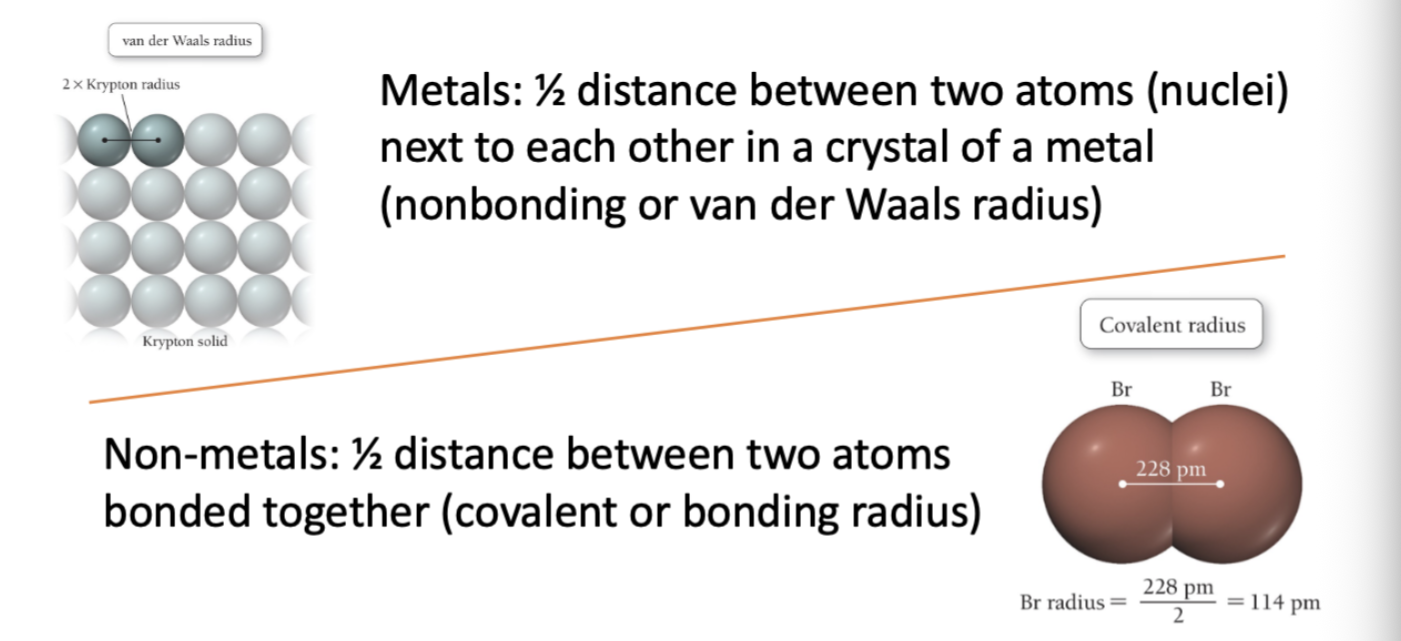
This is a measure of an atom’s size, even though electrons do not exist at fixed stances from the nucleus and instead occupy probability distributions called orbitals.
Because there is no share boundary when an atom ends, atomic radius must be determined experimentally from the distance between nuclei of atoms.
Specifically, for nonmetals, the atomic radius is usually defined as one-half the distance between the nuclei of two identical atoms that are covalent bonded together; this is called the covalent radius.
For metals, the atomic radius is defined as one-half the distance between the nuclei of two neighboring metals atoms in a metallic crystal (this is called the xonboindg or van der Waals radius)
These measurements provided a practical way to assign a size to atoms despite their diffusing clouds.
And remember the size of an atomic is controlled largely by the balance between the attraction of the nucleus for electrons and shielding produced by inner electrons, so there as the effective nuclear charge increases, electrons are pulled closer to the nucleus and the atomic radius.
Periodic trends in atomic size
Atomic radius decreases from left to right across a period because the number of protons in the nucleus increases while the added electron enter the same principle energy level. (since the inner electrons remain largely the same, the amount of shielding does not increases very much, as a result, the effective nuclear charge felt by the valence electron increases across the period. The stronger attraction between the nucleus and the valence electrons pulls the electron cloud closer to the nuclear, causing the atom to become smaller)
Atomic radius increases as you move down a group because each successive element has it valence electrons in a higher principle energy lev, which is farther from the nucleus. Although the nuclear charge also increases, many additional inner electrons are added between the nucleus and valence electrons. These inner electron provide shielding, reducing the effective nuclear charge felt by the outer electrons. As a result, the valence electrons are held less tightly and exist farther from the nucleus, causing atomic size down a group.

Atomic radii of an anion vs neutral atom
Anions are larger than their corresponds natural atoms because they have gained one or more electrons without gaining additional protons. The number of protons, and therefore the nuclear charge, remains the same, but there are now more electrons in the electron cloud. These extra electrons increase electron-electron repulsion within the valence shell, cause the electron cloud to spread out farther from the nucleus.
However for isoelectric spaces (atoms or ions with the same number of electrons), size depends on the number of protons. Since they all have the same electron configuration, the one with more protons exerts a stronger attract force on the electron and therefore has a smaller radius. (for example, F^-1, Ne, Na+ and Mg2+, and O2^-, are all isoelectronic with 10 electrons, but Mg²+ is the smallest because it has at the greater nuclear charge)

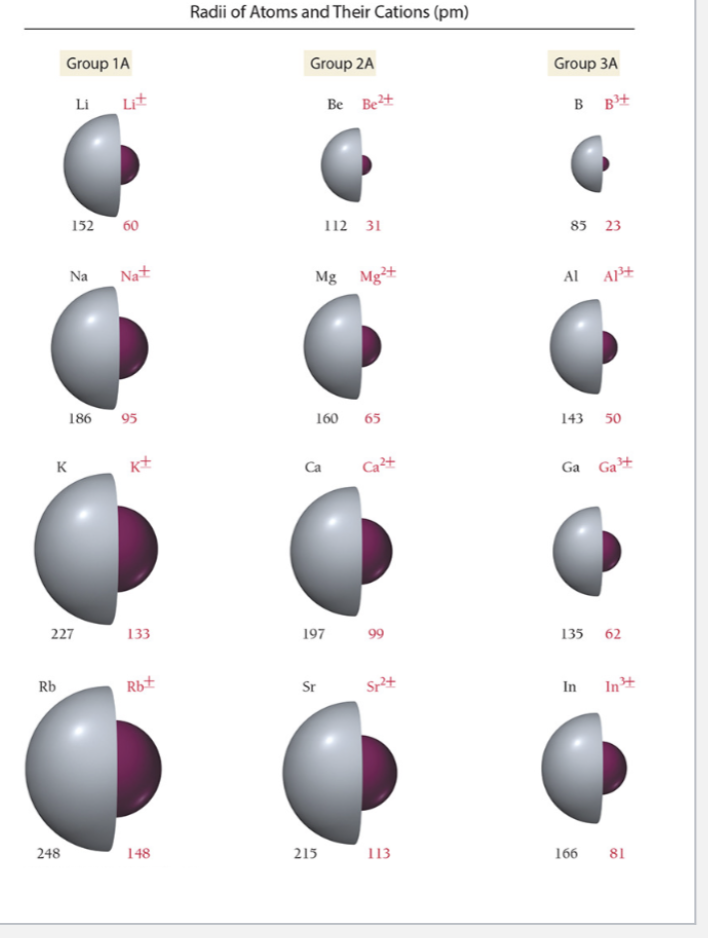
Atomic radii of a cations vs a neutral atom
Cations have a smaller atomic radius than their corresponding neutral atoms because they are formed by long one or more electrons. When electrons are removed, the number of protons in the nucleus stays the same, but there are fewer electrons experience the nuclear attraction. As a result, the remaining electrons feel a larger effective nuclear charge and are pulled closer to the nucleus.
In many cases, forming a cation also removed the entire outermost energy level, causing a significant dresses in atomic size. Additionally, the greater the positive charge on a cation, the smaller the ion tends to be because more electrons have ben removed and the remaining electrons experience a stronger attraction to the nucleus.
For isoelectronic species where all atoms or ions have the same number of electrons, size depends on the number of protons. Since the electron configuration is identical. the species with more protons pull the electrons closer to the nucleus as has the smaller radius.
Ionization Energy
This is the minus about of energy required to remove an electron from an atom or ion in the gas phase. Because energy must be supplied to overcome the attraction between the negatively charged electron and the positively charged nucleus, ionization is always an endothermic process.
The first ionization (I E1) removed the first electron from a neutral, while the second ionization energy (I E2) removed an electron from the resulting 1+ ion.
In general, the valence electron is removed first because it is farther from the nucleus and experience the weakest attraction. Successive ionization energies become larger because each electron is being removed from an increasing positive ion, where the reaming electrons are held more tightly.
The first ionization energy decreases down a group because the valence electrons occupy higher energy level that are farther from the nucleus are more shield by inner electrons. As a result they experience a weaker attraction to the nucleus and are easier to remove.
The first ionization energy generally increases across a periodic because the effective nuclear charge increases. since the valence electrons are in the same principle energy level but experience a strong attraction to the nucleus, more energy is required to remove them. Therefore, atoms on the right side of the periodic table tend to have higher ionization energies than atoms on the left side.

Exception to Periodic Trends in first Ionization energy
Although the general trend is that first ionization energy increases across a period, there are two imprint exceptions between Groups 2A and 3A and between groups 5A and 6A.
The 2A to 3A exceptions occurs because the electrons removed from a group 3A element is in a p orbital rather than an s orbitals. For example beryllium is 1s²2s² while boron boron is 1s²2s²2p^1. The 2 p electron in boron has less penetration than a 2s electrons, so it experiences a smaller effective nuclear charge and is held less tighly by the nucleus. As a result less energy is required to remove the electron from boron, making borons first ionization energy lower than beryllium’s despite boron being farther to the right of the periodic table.
The 5a to 6a execution occurs because of electron pairing. Nitrogen has the electron configurations 1s²2s²2p³ giving it three unpaired electrons in separate p orbitals. Oxygen has the configurations 1s²2s²2p^4 which means one of the p orbitals contains a pair of electrons. The repulsion between the two electrons occupying the same orbitals makes one of them easier to remove. Therefore less energy is required to remove an electron from oxygen than from nitrogen, casing oxygen to have a lower ionization energy even though it is farther to the right in the period.

Periodic trends in second and third ionization energy
Sucession ionzation energies increases because after each electron is removed, the ion becomes more positively charged and the reaming electrons experiences a strong attraction to the nucleus. Since the number of protons stays the same while the number of electrons decreases, electron-electron repulsion is reduced and the electron could shrinks. As a result the remaining electrons are held more tightly and require more energy to remove
Therefore, there is a steady increase in ionization energy as valence electrons are removed one at a time. However, once all of the valence electrons have been removed, the next electron must come from an inner core energy level. Core electrons are much closer to the nucleus, experience a much larger effective nuclear charge, and are far more stable than valence electrons. Consequently, there is a dramatic jump in ionization energy when the first core electron is removed.
Difference between first, second and third ionization energy
First ionization energy (IE₁): energy needed to remove the first electron from a neutral atom.
Second ionization energy (IE₂): energy needed to remove the second electron from the resulting 1+1+ ion.
Third ionization energy (IE₃): energy needed to remove the third electron from the resulting 2+2+ ion.

Electron Affinity
This is the energy change that occurs when at atom in the gas phase gains an electrons. Unlike ionization energy, which involved removing an electron, electron affinity describe how much an atom’s wants to gain an electrons.
When adding an electron makes the atom more stable, energy is release the the EA is negative (exothermic). The more negative the electron affinity, the greater that atom’s tendency to gain an electron is.
In general, electron affinity become more negative from left to right across a period because the effective nuclear charge increases, causing the added electron to be attracted more strongly to the nucleus (so it wants an electron more).
Electron affinity generally becomes less negative (more positive) down a group because the added electron is placed farther from the nucleus and experiences more shielding.
High electron affinity: The atom strongly wants an electron. It releases a lot of energy when it gets one
Lower electron affinity: The atom does not want an electron as much, it releases very little energy, or sometimes even required energy to force the electron in.
Exceptions to electron affinity
The group 5A exception (Group 15: N, P, As, etc) occurs because these elements have half-filled p sublevels (p³) which are relatively stable. When an extra electron is added, it must pair with an existing electron of the p orbitals. This pairing creates electron-electron repulsion, making the addition of the electron less favorable. As a result, group 5A elements have a lower electron affinity than expected.
The group 2A exception (Group 2: Be, Mg, Ca, etc) occurs because the elements already have completely filled s sublevel. An added electron cannot enter the filled s orbital and must instead occur a higher energy p orbital. Since the electron is entering a higher-energy sublevel, the process is less favorable and the electron affinity is very low or sometimes even positive.
The group 8A exceptions (group 18: He, Ne, Ar, etc) occurs because Nobel gases already have completely filled valence shells which are exceptionally stable. An added electron would have to enter an entirely new, higher principal energy level. Because this retired energy and does not increases stability, Nobel gases have very small or positive electron affinities.

Metallic Character
This is a measure of how easily an atom loses its valence electrons to form a positive ion (cation). Because ionization energy is required to remove an electron, therefore is an inverses relationship between ionization energy and metallic characters.
If an atom has low ionization energy, its valence electrons are held less tightly, and can be removed easily, so the atom exhibits strong metallic characters. If an atom has high ionization energy its valence electron are held more tightly and can’t be removed easily so the atom exhibits weak metallic characters, and behaves more like a nonmetal. (where instead it attracts electrons)
Therefore as ionization energy decreases, metallic character increases.
On the periodic table, metallic characters increases as you move down a group because the valence electrons are farther from the nucleus and easier to remove, metallic character decrease as you move from left to right across a period because the effective nuclear charge increases and valence electrons are held more tightly. This is why the most metallic elements are found in the lower-left corner of the periodic table, while the lest metallic elements are found in the upper right corner.

Periodic Trend in Density
Density is the mass of a substance dived by its volume, so the periodic trends in density depend on both the mass of the atoms and how closely these atoms are packed together.
In generally, density tends to increase as you move down a group because atomic mass increases significantly. Although atomic size also increases down a group, the increases in mass is usually greater than the increases in volume, causing density to rise.
Across a period, the trend is less consistent because both atomic mass and atomic size change. For many metals, density increases toward the center of the transition metals because the atoms become more massive while remaining relatively closely packed. As a result, some transition metals such as osmium and iridium have extremely high densities.
The reason density does not show as clean a trend as atomic radius or ionization energy is that density depends on multiple factors: atomic mass, atomic size, crystal structure, and how tightly atoms are packed in the solid state. Therefore, while density often increases down a group and is generally highest among the transition metals, there are more exceptions than with other periodic trends.

A compound
This is defined as a substance made of two or more different elements that are chemically bonded together in fixed proportions.
Example water would be a compound because it contains hydrogen and oxygen chemically bonded together. Sodium chloride is a compound because it contains sodium and chlorine chemically bonded together.

Chemical bond
This is defined as an attractive force that holds atoms together in a compound by involving their valence electrons.
Atoms form chemical bonds because bonded atoms are usually at a lower potential energy and are therefore more stable than separate atoms, and in most cases atoms bond in order to achieve a more stable electron configuration, often similar to that of a noble gas.
Specifically why atoms act to engage in chemical bonds is they want to lower their potential energy (potential energy in atoms comes mainly from the attraction between negatively charged electrons and the positively charged nucleus. The closer an electron can exist to the nucleus while remaining in an allowed orbitals, the lower its potential energy. A lower energy arrangement is more stable. Therefore, when electrons are arranged in a way that allowed stronger electron-nucleus attraction and a more favorable distribution of electrons among orbitals, the total energy of the atoms decreases. A full valence shell also this stability because the available orbitals in that shell are filled in a particularly favorable way. The electrons have occupied the lowest-energy arrangement available for that energy level, and there is no way to rearrange them into an even lower-energy configuration. Because the atom is already in a relatively Loe-energy state, it has little tendency to gain, lose, or share additional electrons)
Ionic bonds versus covalent bonds
_____ and ______ bonds are two different ways that atoms can achieve a more stable electron configurations.
An _____bond forms between a metal and nonmetal when one or more electrons are transferred from the metal to the nonmetal. The metal loses electrons and becomes a positively charged ion called a cation, while the nonmetal gains those electrons and becomes a negatively charged ion called an anion. Because opposite chargers attract, the cation and anion are held together by strong electrostatic force, creating an ___ bond. For example, in sodium chloride NaCl, sodium loses an electron to become Na+ and chlorine gas gains that electron to become Cl- this transfer allowed both ions to achieve stable noble-gas electron configurations. (In a chemical formula, the sum of the charges of the positive ions, cations, must equal the sum of the charges of the negative ions, anions)
A ______ bond forms between nonmetals when atoms share electrons rather than transfer them. Nonmetals generally have high ionization energies, so neither atom can easily loose electrons. Instead, they share on ore more pairs of electrons, allowing each atom to count that shared electrons as part of its valence shell. This gives both atoms access to a more stable electron configuration without creating ions.

Chemical formula, empirical formula and molecular formula
A ________ _______ tells you which elements are present in a compound and how many of each element are present. The symbols represent the elements, and the subscript indicate the number of atoms of each element. When writing formulas the more metallic elements is generally written first, followed by the less metallic element. (for covalent bonds write the element further to the left on the periodic table first, or lower down in the same group) (for ionic bonds write the metal symbol first, than the nonmetal symbol) (remember a chemical formula is any formula that tell you the elements present in a compound and their amounts, the two main types follow)
A _______ formula gives the actual number of atoms present in a molecule
An ______ formula gives the simplest whole-number ratios of atoms in a compound. To find an empirical formula from a molecular formula, divided all subscripts by their greater common factor. For example, the molecular formula C4H8 has a greater common factor of 4, so its empirical formula is CH2. For CCL4, there is no common factor greater than 1, so the empirical formula is the same as the molecular formula.

Structural formula
This is a type of chemical formula that shows not only which atoms are present and how many there are, but also how the atoms are connected to each other through covalent bonds.
In a _____ ______, lines represent shared pairs of electrons, or covalent bonds, between atoms. To write a structural formula, first determine the central atoms (usually the least electronegative atom, excluding hydrogen), then connect atoms with a single bond and make sure each atoms has the approve number of bonds. Hydrogen forms 1 bond, oxygen usually forms 2, nitrogen usually forms 3, and carbon scaly forms 4 bonds.
it acts to convey the type and actual number of atoms as well as the arrange of the atoms in the molecule.

Ball-and-stick model and the space filling model
____and____ _____ shows atoms as balls and bonds as sticks connecting them. This modelm makes it easy to see which atoms are bonded together, the bond angles, and the overall molecular shape. However, it does not accurate represent actual sizes of atoms or the amount of space they occupy. Chemist use the this model primary to visualize bonding and molecular geometry.
____-_____ models show atoms as spheres whose sizes are proportional to their actual atomic radii. The spheres touch each other just as atoms do in a real molecule, giving a better representation of a molecules overall size and the amount of space it occupies. in a _____-______ models the bonds are not Cleary visibly because the atoms overlap, but it more accurately reflect what the molecule physically ooks like.

Lewis Dot model of an atom and how the chemical bond and octet rule apply to it.
The _____ model of bonding focuses only on valence electrons because these are the electrons involved in chemical bonding. In a _____ ______-__ structure, valence electrons are represented as dots around an element’s symbol. For example oxygen is in group 16 so it has 6 valence electrons and is draw with six dots around the symbol O. _____ structure held visualize how atoms, gain, lose, or share valence electrons when forming bonds.
The _____ rules states that the many atoms become more stable when they have 8 electrons in their outermost shell, giving them a noble-gas like electron configuration. Atoms that do not already have an _____ tend to gain, lose, or share electrons during bonding to achieve this stable arrangement (for example oxygen has 6 valence electrons, so it often forms two bonds or gains two electrons to reach an octet of 8 electrons)

Octet Rule exceptions
This octet rule is a useful guideline, but is is not a strict rule. While many atoms become more stable with 8 valence electrons, some elements are stable with fewer than 8 electrons in their outer shell. These exceptions occur because some atoms naturally achieve their lowest-energy configuration without having a complete octet. These include:
Hydrogen is the most important exceptions because it has only a 1s orbitals, which can hold a maximum of 2 electrons. Hydrogen can lose its single electron to form H+, gain and electrons to form H-, or share its electrons in a covalent bond. In all case , hydrogen aims for a stable duet (2 electrons). to an octet. Helium is also an exceptions because it outer shell is the first energy level, which can only hold 2 electrons. Therefore, helium is stable with a duet rather than an octet.
Lithium and beryllium commonly form ions bonds by losing their valence electrons. Lithium loses on electron to form Li+ while beryllium loses two electrons to form Be2+. By doing so they achieve the stable electron configuration of helium. In covalent bonds, beryllium often forms only two bonds, giving it four valence electrons around it rather than eight. This is still a stable arrangement for many beryllium compounds. (therefore Lithium and beryllium reach stable electron configuration either by achieve a full valence shell, resembling a noble gas, or by completing a subshell. For Lithium it is most stable when it loses its sine 2s electrons to form a Li+ cation which also it so have a compete 1s² subshell. For beryllium it is already stable in its element neutral state because its 2s sublevel is compete filled with varied electrons. It can Laos lose two electrons to form a ion with a 1s² helium-like configuration)
Boron is another common octet-rule exception. Boron can lose three electrons to form b³+ in ionic compounds, or it can form three covalent bonds. When borns forms three covalent bonds, it is surrounded by six valence electrons rather than eight. (Therefore, boron with 3 valence electrons it its outer shell, reaches stability by ending up with 6 valence electrons around itself rather than 8)
Ionic bonding; Formula Unit
A ________ ____ is the smallest whole-number ratio of ions that makes an ionic compound electrically neutral (so the total charge would be equal to zero). For example, NaCL has a ratio of 1:1 for Na+ and Cl- because their +1 and -1 charges cancel.
Ionic compounds form a repeating, three-dimensional network of positive and negative ions held together by electrostatic attraction (opposite charges attract) NaCl represents the ratio of ions through the network, not one separate molecule.
Atom transfer electrons to achieve a more stable outer electron shell, often with eight electrons (an octet). Sodium loses one electron, and chlorine gains one, producing oppositely charged ions that attract and form ionic compounds.
Ss remember electron transfer forms the ions, opposite charges attract and the ions combine in a ratio that makes the compound neutral.

Energetics of ionic bonds Formation
We know that ionization energy is endothermic (+496 kj/mol). For example sodium most absorb energy to lose an electron and form Na+. Therefore energy is required to remove the electron from the atom.
We also know that electron affinity is exothermic (-349 jk/mol) As chlorine releases energy when it gains an electron to form Cl-. However, the energy releases is less than the energy absorbed by sodium. so these two steps alone require a net energy input of (496 - 349) =147 +147 kg/mol
So then why is the formation of NaCl exothermic (-411 kj/ mol). Why this happens is when gaseous Na+ and Cl- ions come together to form solid NaCl, they releases a large amount of energy because opposite charges strongly attract each other. This energy release is associated with lactic energy and more than compensate for the energy required in the earlier steps. (this means that the energy released when the ions bonds together is vastly greater than the energy it took to break them apart in the first place. This massive release of energy leaves the final products, in a high stable, low-energy state, while the surrounded environment gets a surplus of heat)
Lattice energy
____ ______ measures the energy released when separate gaseous positive and negative ions come together to form a soldi ionic crystal. This energy releases make the crystal more stable because the oppositely charged ions attract each other and form a strong repeating 3d structure.
What determine _____ ______ is it depends on the ion chargers and the distance between the ions. The great that chargers, the stronger the electrostatic attraction and the greater the magnitude of lattice energy. The closer the ions are to each other, the stronger the attraction; therefore smaller ions generally produce greater ____ ______ when their chargers are the same.
How the Crystal lattice holds together is each positive ion (cation) is attracted to multiple surrounding negative ions (anions) and each negation ions is attracted to multiple positive ions. These attractions extend throughout the crystal, holding the entire 3D lattice together rather than forming separate Paris of ions.
Additionally, it is key toe remember that electrostatic attraction is nondirectional. This means that electrostatic attraction doesn’t act in just one specific direction or at one fixed angle. Each ion attract charred ions from differ direction through the crystal. This allows ionic compound to form extend 3d networks.

Ionic bonding theory verses reality
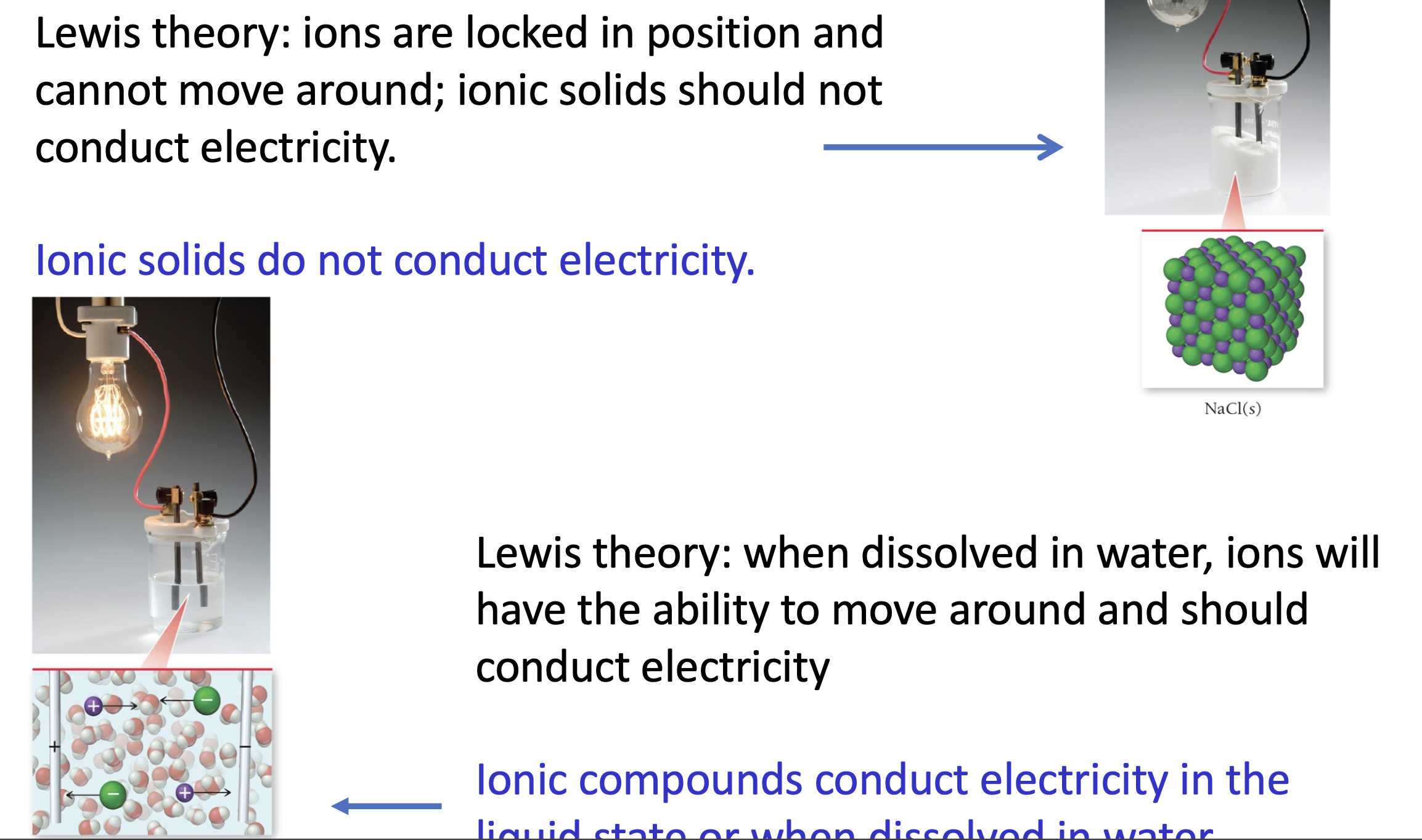
According to the lewis theory, ions occupy specific positions in a crystal lattice and are held together by strong electrostatic attractions, Moving them out of position required significant force, which explains why ionic solids are relatively hard compared with most molecular solids. However in reality ionic solids are brittle, meaning they shatter when stuck rather than bend. When a force shifts the layers of ions, ions with the same charge can become allied next to each other. These like chargers repel, destabilize the lattice and causing the crystals to break apart.
In a solid ionic crystal, the ions are locked into a fixed positions in the lattice. Although they have electrical charges, they cannot move freely to carry electric current. Therefore, solid ionic compound do not conduct electricity. However in relativity, when an ionic compound melts or dissolved n water, its ions can move freely. These mobile charged particle carry electric current. So ionic compound conduct electricity when motel or dissolved in water but not when solid.
Writing ionic compound rules
When writing out ionic compounds the rules include:
Ionic compound contains + and - ions, with the meals tending to form cations (so they lose electrons) and the nonmetals acting to form ions (as they attract electrons)
The sum of the chargers have to cancel out
The formula contains smallest whole number ratios of ions.
Ionic compound Naming
Some metals, such as sodium (Na+) and calcium (Ca2+) and aluminum (Al3+) from only one common ion charge (this mean that the atom always loses a specific, predicable number of valence electrons to achieve a stable electron configuration. Because losing that exact number of electrons is energetically favorable it does not reliably form other chargers). To name their ionic compound, write the metal name first, followed by the nonmetal named changed to end in -ide. For example NaCl is sodium chloride, and MgO is magnesium oxide. You do not use Roman numerals because the metal’s charge is predicable.
For metals that form more than one type of ion; some metals, especially transition metals such as iron and copper, can form ions with different charges. You mush use a Roman numeral like parentheses after the metal name to indicate its charge. For example FeCl2 is iron (ii) chloride because two Cl- ions have a total charge of -2 meaning Fe use be +2. FeCl3 is iron (III) chloride because three Cl- ions have a total share of -3, meaning Fe must have 3+. The roman numerals represents the metals charges, no the number of metal atoms.
Naming monatomic anion: A monatomic anion is a single nonmetal atom that has gained electrons and become negatively charged. To name it, change the elements ending to -de. For example Cl- is chloride and s²- is sulfide. When naming an ionic compound, say the cation name first and then the anion name second, such as MgCl2 = Magnesium chloride.
Naming polyatomic ions: a polyatomic ion is a group of covalent bonded atoms that carries an overall charge and behaves as a single ion in an ionic compound. Most polyatomic ion names stay the same when naming the compound. For example NaNO3 is sodium nitrate, and CaCO3, is calcium carbonate. (remember molecules in a covalent bond can have partial negative charges, because they do not share electrons equally, due to differing electronegativity. Sometimes polyatomic ion have an overall net negative charge, meaning the whole group has extra electrons)
Naming Oxyanions: these are polyatomic ions counting oxygen and noter element. Their names often depend on how much oxygen they contain. The ending -ate generally indicates more oxygen and -ite for ions with the same central element. For example No3- is nitrate and No2- is nitrate. Some families also use per- for the form with the most oxygen, and hypo-for the form with the least oxygen.
Naming oxyanions
These are negativity charged polyatomic ions (so is the non-metal part of the ionic compound, that is the part that changes names because the metal name stays the same, and this is a particle that is covalently bonded other nonmetals, specifically having oxygen in that bonded and they have an overall negative charge) that contain oxygen and another element. When an element forms a series of four oxyanions, the names tells you how the oxygen amount compare. The key is to remember that the prefixes and endings indicate the relative number of oxygen atoms, not the charge:
-ite (the fewest oxygen atoms)
-ite (fewer oxygen atoms, but more then the smallest amount)
-ate (more oxygen atoms)
-ate (most oxygen atoms)
The prefix include:
Hypo - means “less than” and this would be added to the polyatomic ion that has the fewest oxgyen’s in this series
Per- means “more than’ and this would be added to the polyatomic ion that has the most oxygen atoms in this series.
For example:
ClO- Hypochlorite
ClO2- Chlorite
ClO3- chlorate
ClO4- perchlorate
BrO- Hypobromite
BroO2- bromite
BrO3- bromate
BrO4- Perbromate
Hydrates
A hydrate is an ionic compound that has a specific number of water molecules incorporates into its crystal structure. These water molecules are called water of hydration. For example, CuSO4 × 5H2O is copper (II) sulfate pentahydrate, meaning each formulation unit of copper (II) sulfate is associated with five water molecules in the crystal.
How do you name hydrates:
First, name the ionic compound as usual
Then add a prefix to indicate the number of water molecules, followed by the word hydrate. The prefix tells you how many water molecules are presents
Mono Monohydrate
Di Dihydrate
Tri Trihydrate
Tetra Tetrahydrate
Penta Pentahydrate
Hexa Hexahydrate
Hemi (1/2)
Drawing Covalent Bonds
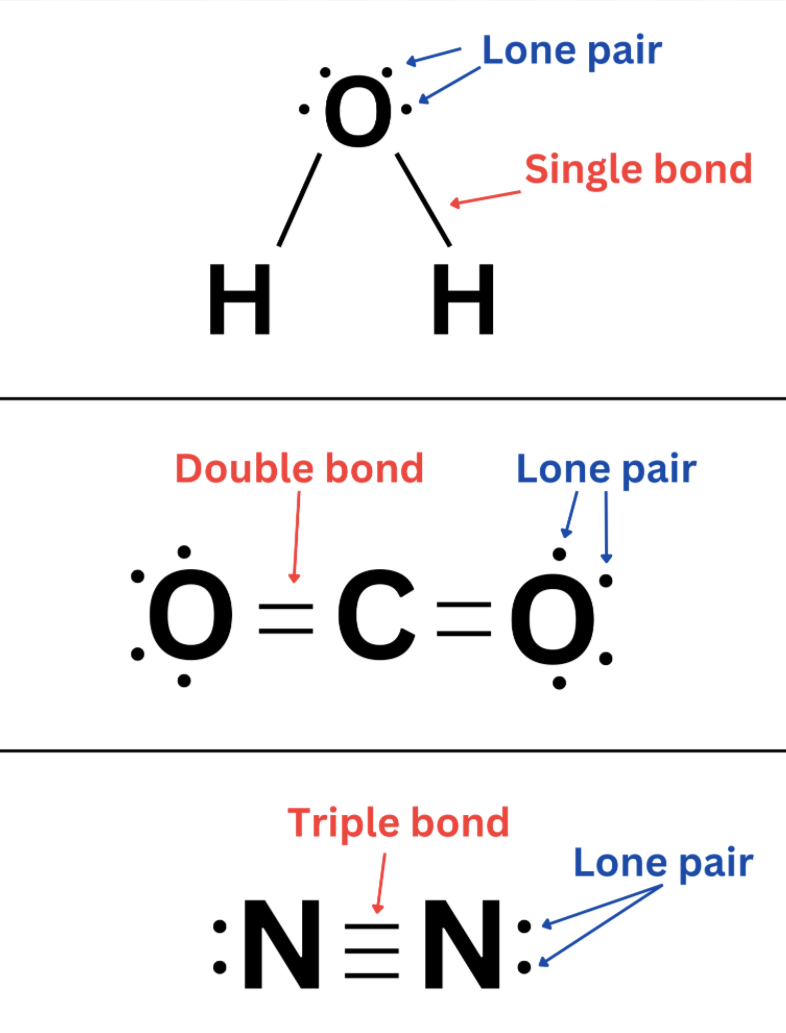
A single covalent bond forms when two atoms share one pair of electrons (2 electrons total). Sharing allows the atoms to achieve a more stable outer electron shell. For most atoms, this means an acted (8 electrons) hydrogen and other very small first-shell cases, such as helium, follow the duet rule (2 electrons). For example, H2 forms when two hydrogen atoms share on pair of electrons.
Double and Triple Covalent bonds: A double bond forms when two atoms share two pairs of electrons (4 electrons total), while a triple bond forms when they shared three parishes (6 electrons total). These bonds involve more shared electron Paris than a single bond. For example O2 has a double bond and N2 has a triple bond
The nonmetal atoms that can form multiple bonds:
Oxygen (o) form double bonds because it has six valence electrons and need two more to complete its octet
Carbon © forms double and tripe bonds because it has four valence electrons
Nitrogen (N) forms triple bonds because it has five valence electrons and need three more
Sulfur (S) and Phosphorus (P) can also participate in multiple bonding arrangements in various molecules.
Bonding pairs are electron pairs shared between two atoms to form a covalent bond. Lone pairs are electron pairs that belong to one atom and are not shared in a bond. In a lewis structure, bonding Paris are shown between atoms, while lone pairs are show around individual atoms. Both bonding and lone-pair electrons could when checking whether an atom has a full outer shell
Less theory and direction bonds and its predictions of individual molecules
In convent bonding, shared electrons are most stable in the region between the bonded atoms, attracting both nuclei and holding the atoms together.
This metas covalent bonds directional, which means that the positions of bonded atoms matter, which helps also determine a molecuel’s shape.
This different from ionic attraction which acts in all direction between oppositely charged ions.
Lewis theory also predict that many covalent compound form individual molecules rather than the extended 3d Ionic lattice found in ionic solids. For example, water consist of separate H20 molecules, with covalent bonds within each molecule. The atoms share electrons inside each molecule, rater the forming repeating network of positive and negative ions.
Naming binary molecular compounds
A molecular compound constitutes of two or more different nonmetals bonded by sharing electrons (covalent bonds). Unlike ionic compounds, its formula cannot usually be produced by balancing ion chargers. For example nitrogen and oxygen form several compounds (including, NO, NO2, N2O, and N2O2) because atoms can combine in different ratios)
Which element do we name first in a molecule: Usually we name the element Witi the smaller period table group number first. if both elements are in the same group, name the element wit the greater period (row) number first. For example, carbon is named before oxygen in CO2, so the name is Carbon dioxide.
How to use prefixes: Molecular compounds use prefixed to show how many atoms of each element are preset. These prefixed are imprint because the same two elements can form different compounds:
Mono
Di
Tri
Tetra
Penta
hexa
Hepta
Octa
Nona
Deca
How to actually name a molecular compound:
Name the first element using its normal element name, then name the second element using its root plus -ide. Add prefixed to indicate the number of atoms, following the rule about omitting mono- on the first element

Why do some atoms in molecules s com don’t form a full cutest
(including, NO, NO2, N2O, and N2O2) because atoms can combine in different ratios) (because for some atoms they have odd numbers of valence electron so sometimes it is physical impossible for every atom to satisfy a full set of 9 electrons when they form covalent bond. Take nitrogen for example it has 5 valence electron and oxygen has 6, totalling 11 electrons. They form a covalent bond — double bond —- to share electrons. The result is oxygen ends up with a full octet and nitrogen end up only with 7 electrons in its valence shell. This happens is because the octet rule is a guideline, not a law, so atoms tend to seek a stable configuration of 8 electrons but the rule breaks down when a molecule has an odd total number of valence electrons, However even though nitrogen falls short with 7 electros, the overall arrangement of NO has lower total energy than the separated atoms)
Molecular mass also called molecular weight
The ______ _____ is the total mass of all atoms in one molecule, measured in atom mass units. While the molar mass is the mass of one mole of those molecules, measures in gramps per mol (g/ mol)
How we calculate the ______ ____- of one molecule, is we would look at its chemical formula and we would add the atomic masses of each atom in the molecule, relative to their amount and the total in amu would be this value.
And we can use the ______ _____ of a molecule to understand how much one mole of that molecule would have, as that value is equivalent to it just in grams.
For example: One water molecule has a molecular mass of 18.02 amu, while one mole of water has a molar mass of 18.02 g/mol
The mass percent of an element in a compound
_____ _______ tells you what percentage of a compound’s total mass comes from a specific element. To calculate it, divided the total mass of that element in the compound by the compound’s total molar mass, then multiy by 100%
For example:
Calculate the percent calcium by mass in CaCO3
Find the molar mass of CaCO3
Ca: 1 × 40.08 =40.08 g/mol
C: 1 × 12.01 =12.01 12.01 g/mol
O: 3 × 16.00 = 40.00 g/mol
40.08 + 12.01 + 48.00 =100.09 g/mol (molar mass of CaCO3
Calculate the mass percent of calcium
There is one calcium atom in CaCo3, so calcium contributes 40.08 g/mol (equivalent to its atomic mass found on the periodic table).
So the Mass % of Ca = (40.08 / 100.09) * 100%
The total would be 40.04% Ca
Empirical Formula
An _______ _____ shows the simplest whole-number ratio of moles of each element in a compound.
it does not necessary show the actual number of atoms in one molecule, it shows the simplest ratio between them
The three ways to determine an _______ ______ is:
Percent compositions: The percentage of each element in the compound is given
Decomposition data; The mass of each element in the compound is given
Combustion analysis: A compound contain carbon and hydrogen is burned. The carbon is converted into CO2 and the hydrogen is converted in H20. These products help determine how much carbon and hydrogen were in the original sompound
Steps for finding an Empirical Formula:
Convert percentage to grams: if the problem gives percentage but not a samples mass, assume you have 100 g of the compound. this mesas the percentage easy to convert to grams (for example if a compound contain 24.5% carbon, assume you have 100 g of the compound, so 24.5g)
Convert grams to moles: Act to divided each elements mass by its molar mass to gets its moles ( 24.5 g C * (1 mol / 12.01 g C) = 2.03 mol C
Repeat this calculation for every element. You need moles because an empirical formula represents a ratio of atoms and moles let you compare the amount of each element.
Divided every mole about by the smallest mole amount, this will give you the simplest ratio between the element (for example if you called you have Carbon 2.04 mol, hydrogen 4.08 mol, and Oxygen 2.04 mol. You would dived the all the values by the smiles about 2.04. and you would get carbon 1, hydrogen 2, and oxygen 1. This ratio 1 : 2 : 1, so the empirical formula would be CH20. If a ratio is within 0.1 of a whole number you can generally round it to that whole number)
From Empirical to Molecular Formula
The molecular formula shows the actual number of atoms of each element in one molecule. The empirical formula shows the simplest whole-number ratio of those atoms.
Therefore the molecular formula is always a whole-number multiple of the empirical formula (Molecular formal = (Empirical formula) * n)
Steps for finding the molecular formal:
Step 1: Use the experimental data to determine the simplest whole-number ratio of the elements
Step 2: Calculate the empirical formula molar mass, so you would add all the atomic masses of all atoms in the empirical formal
Step 3: Calculate n, you would do this by doing the molar mass of the compound / divided by the empirical formula molar mass
The molar mass of the compound is usually given in the questions. The empirical formula molar mass is the value you calculate (remember the molar mass of a compound is the actual mass of one mol of the substance based on its true molecular formula, whereas the empirical formula molar mass is the sum of the atomic masses based on the simples whole-number ratio of the elements)
Multiply every subscript in the empirical formula by m and this gives you the molecular formula.
Combustion Analysis
This is a technique used to determine the empirical formula of a compound by burning a know mass of the compound and measuring the masses of the products formed.
when a compound contains carbon and hydrogen burns completely all the carbon in the original compound is converted into carbon dioxide and all the hydrogen in the original compound is converted.
By measuring the amours of CO2 and H2O produced, you can determine how much carbon and hydrogen were present in the original sample.
Steps for combustion analysis:
Calculate the mass of carbon: Use the mass of CO2 produced to calculate the mass of carbon in the original compound. Each mole of CO2 contains one mole of carbon so you would do
Mass CO2 × (12.01 / 44.01) (with 44.01 g / mol being the molar mass of CO2)
Calculate the mass of H20 produced to calculate the mass of hydrogen. Each mole of water contains two moles of hydrogen atoms
Mass of H = Mass H2O * 2.016 / 18.02 (with 18.0 g / mol being the molar mass of co2)
Convert the masses of carbon and hydrogen into moles
After that find the simplest whole-number mole ration (divided both mole amounts by the smaller amount, then multiply the ratios if need to obtain whole numbers) (for example if you get carbon being 1 and hydrogen being 1.5 multiply both b 2 to get a whole number so you get Carbon being 2 and hydrogen being 1.5)
Write the empirical formula; so use the final whole-number ratios as the subscript in the formula

Effective nuclear charge
This is the net positive charge than an electron experiences from the nucleus after account for the shielding effect of other electrons.
The nucleus contains positively charged protons, which attract negatively charged electrons. However electrons closer to the nucleus repeal electrons farther away, partially reducing the attraction those outer electron fell. This is called shielding.
The formula to find the ______ _________ would be:
Zeff = Z - s
Z is the number of protons in the nucleus
S = is the shielding effect from other electrons
For example: Consider sodium (Na) which has 11 protons, and the electron arrangement, 2, 8, 1
The 10 inner electrons shield the outer electron from some of the nucleus positive charge. Therefore, the outer electron experiences less than the full attraction of all the protons. So z = 11 and s = 10 (count the inner-shell electrons), This would equal +1. That means sodiums outer experiences an effective nuclear charge of approximately +1.
Now compared sodium with chlorine (Cl), which has 17 protons and the electron arrangement, 2, 8, 7. Their outer electrons occupy the same principle energy level, but chlorine has more protons. The shielding from inner electrons is similar, so chlorine generally has a greater effective nuclear charge acting on its outer electrons. (Z = 17 S =10 , 17 - 10 =7 +7. The electron in the outer shell experience an effective nuclear charge of +7)
Electronegativity and Bond Polarity
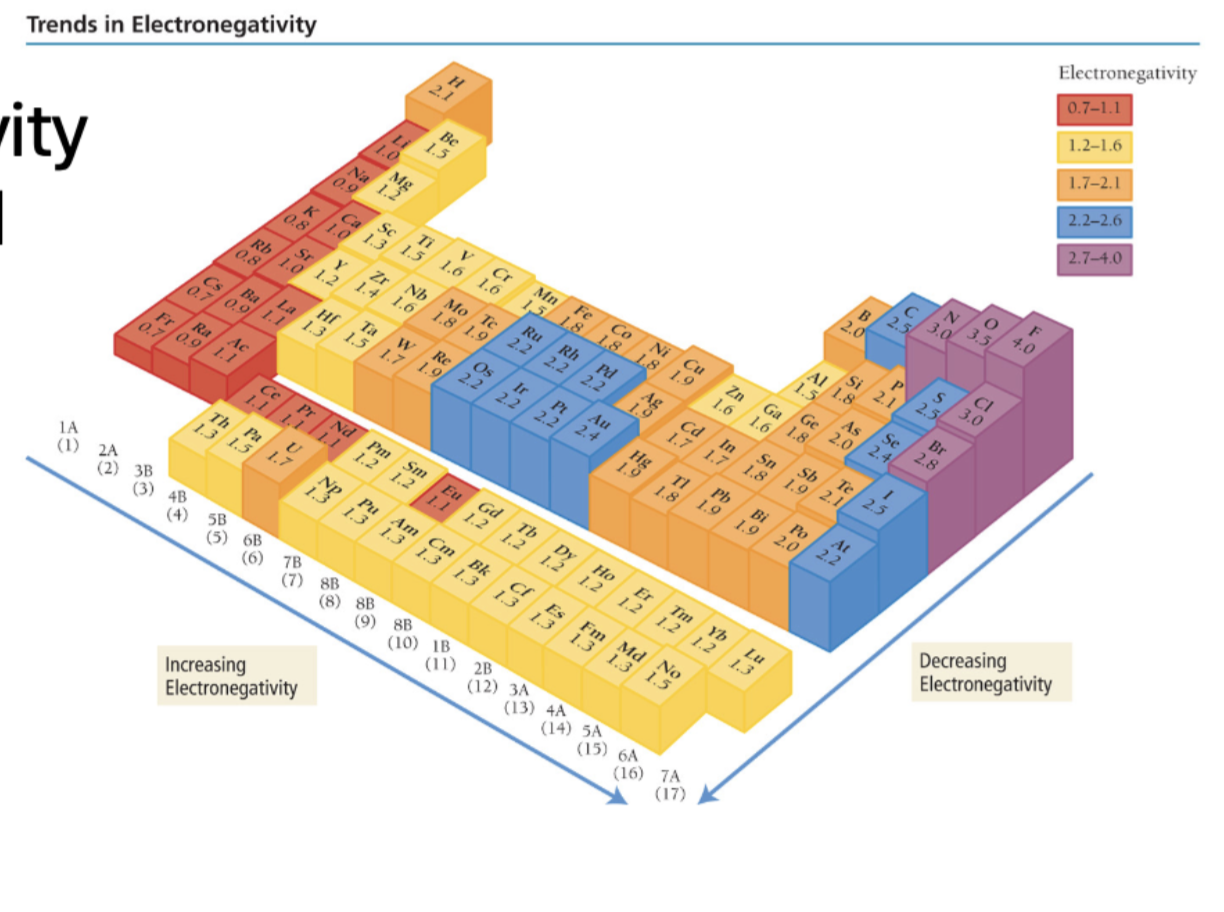
_________ is an atom’s ability to attract shared electrons toward itself when it is part of a chemical bond. When two atoms have the same _________ they share electrons equally forming a non-polar covalent bond. When one atom is more electronegative than the other, the shared electrons are pulled closer to the more electronegative atom, forming a polar covalent bond. If the electronegativity difference becomes very large, electrons are effectively transferred rather than shared, resulting in an ionic bond. Therefore, bonding exists on a specturm:
Non-polar covalent bond ——— Polar covalent —— ionic
_________ generally increases from left to right across a period because the effective nuclear charge increases. As the nucleus becomes more effective at attracting electrons, atoms become better at pulling shared electrons toward themselves.__________ generally decreases down a group because the valence electrons are father from the nucleus and experience more shielding form inner electrons. Therefore atoms become less effective at attracting shared electrons.
For example in the H-F bond, fluorine is much more electronegative than hydrogen, so it pulls the shared electrons closer to itself. This creates an uneven distribution of electron density. The fluorine becomes slightly negative because it has a greater share of the electrons, while the hydrogen become slightly positive because it has less electron density. These partial charge make HF a polar molecule (however a polar covalent bond does not involve complete electron transfer; the electrons are still shared but unequally)
The Pauling scale for electronegativity
The ______ _____ for electronegativity was developed by comparing bond energies.
The H-F bond is stronger than would be expected form simply averaging the H-H and F-F bond energies. This extra bond strength occurs because the unequal sharing of electrons creates electrostatic attraction between the partial positive and partial negative ends of the bond. Pauling use these energies different to develop numerical electronegative values for elements.
The effect of electronegativity Difference on Bond type
The bond polarity depends on the difference in electronegativity between two bonded atoms.
Electronegativity tells us how strongly an atom attracts shared electrons in a bond. If two atoms have very similar electronegativities, they share electrons nearly equally, producing a nonpolar covalent bond. As the electronegativity difference increases, the sharing becomes more unequal, creating a polar covalent bond. If the difference becomes very large, one atom effectively takes the electron from the other, resulting in an ionic bond. Therefore, bond polarity increases as the electronegativity difference between the bonded atoms increases.
A nonpolar covalent bond occurs when ΔEN is small (about 0.0-0.4). The electrons are shared almost equally because both atoms attract them with similar strength. A polar covalent bond occurs when ΔENΔEN is intermediate (about 0.4-2.0). The electrons are shared unequally, creating a partial positive charge (δ+) on one atom and a partial negative charge (δ−) on the other. An ionic bond occurs when ΔENΔEN is large (greater than about 2.0). In this case, electron transfer occurs, producing oppositely charged ions, as in NaCl.

% Ionic character
Percent _______ _______ describes how much a bond behaves like a ionic bond versus a covalent bond.
Most bonds are not 100% or 100% covalent. Instead, they fall somewhere in between. As the electronegativity difference between the two bonded atoms increases, the electrons are pulled more strongly toward one atom, causing greater charge separation. This makes the bond more ionic in character.
Therefore, percent ionic character increases as electronegativity difference increase. (for example a bond like HB4 has a relatively small electronegativity difference and a low ionic character, while bond like KF has a very large electronegativity difference a much higher ionic character)
How we measure ionic character is by doing (measured dipole moment of bond / dipole moment if electron were completely transferred) * 100%
Dipole moment is a measure of the separation of charge within a bond or molecule (when electrons are shared unequally, one end of the bond becomes partially negative and the other becomes partially positive. The greater this charge separation, the large the dipole moment.
A bond with a large dipole cement is more polar and generally has a greater percent ionic character. If electrons were completely transferred from one atom to another, the bond would have 100% ionic character.
Example of calculating it:
Electronegativity of H = 2.1
Electronegative of Cl = 3.0
3.0 - 2.1 =0.9 since 0.9 falls between 0.4 and 2.0, HCL has a polar covalent bond with modern ionic character
Or for example using the actual formula:
Measured Dipole moment ‘ 4.0 D
Dipole memento if electron were comely transferred = 5.0D
4.0 / 5.0 × 100 = 80%
So the bond Is 80% ionic character

Determine if a bond is nonpolar, polar, or ionic
You usually don’t calculate electronegative, instead you look it up on the periodic table that include electronegative values (this is listed on specialized reference or “data” periodic tables)
To find the electronegative difference you do:
EN1 - EN2 (the electronegativity of both the atoms)
Than the value is what you compare on the scale to determine if its non-polar, polar, or ionic

Writing Lewis structures for Molecules and polyatomic ions
The rules for writing lewis structures for molecules and polyatomic ions:
For writing Lewis structures, the goal is to distribute the valence electrons so that the atoms achieve the most stable electron configuration (usually an octet or duet)
The process being by drawing the skeletal structure, which shows how the atoms are connected
Hydrogen is always terminal (one the outside) because it can only form one bod, and highly electronegative atoms are usually terminal as well
The least electronegative atoms is typically placed in the center
Next, count the total number of valence electrons from all atoms, if the species is an anion, add electrons equal to the negative charge. If it is a cation, subtract electrons equal to the positive charge.
Place one bonding pair (2 electrons) between each connect atoms, then distribute the remaining electrons as lone Paris to complete the duets of hydrogen atoms and the octet of the outer atom first.
Any leftover electrons are placed on the central atom. If the central atoms still lacks on octet, convert lone Paris on surrounding atoms into double or triple bonds until the central atom obtains on octet
Finally check that the total number of electrons used match the total number calculated at the beginning
Remember that atom you prioritize is almost always the central atom to make an octet

Resonance structure
This occurs when more than one valid Lewis structure can be drawn for the same molecule or polyatomic ion without changing the arrangement of atoms.
The atoms stay in the same locations, but the positions of the electrons, particularly double bonds and lone Paris change.
Each indivduals’s lewis stucuture is called a resonance structure. However the molecule does not actually switch back and forth between these structures, instead the real molecule is a resonance hybrid, meaning the electrons are spread out over the molecule in a way that is intermediate between all the resonance structures.
This electron delocalization often makes the molecule more stable than nay single Lewis would suggest.
How do you know resonance exists:
A double bond that can be moved to another equivalent atom
Lone pairs next to a double bond
Polyatomic ions, such as NO^-3 CO3³-, and NO2^1- which commonly show resonance

Formal charge
This is used to determine which Lewis structure is the most reasonable. It is the charge an atom would have If all bonding electrons were shared equally between the bonded atoms.
Formal charge does not represent the actual charge on the atom; it is simply a way to evaluate and compare Lewis structures.
To calculate formal charge:
FC = Valence electrons− Assigned electrons
where Assigned electrons= lone-pair electrons+ 1/2(bonding electrons)
Formal charge guidelines
the sum of all formal charges in a neutral molecule must equal 0
the sum of all formal charges in a polyatomic ion must equal the ions charge
the best lewis structure has the smallest formal charges possible
negative formal charges should be on the more electronegative atom

Exceptions to the octet rule; free radicals
One exception to the oct rule would be Odd-electron species, also called _________ _______, and these contains an odd total number of valence electrons. Since electrons are placed in pairs whenever possible, it is impossible for every atom to have a complete octet. For example, CIO has an odd number of total valence electrons, so one electron must remain unpaired. As a result at least one atom will not have a complete octet. When drawing Lewis structures for ____ ______, the goal is to give octets to as many atoms as possible while correctly accounting for all electrons
The other exception would be incomplete octets: some atoms are stable with fewer than 8 electrons. Hydrogen follows the duet rule and is stable with only 2 electrons because the first energy level can hold only 2 electrons. Beryllium often forms compound where it has only 4 electrons around it, and boron is commonly stable with 6 electrons. For example, in BF3, boron forms three bonds and is surrounded by only 6 electrons. Although boron lacks an octet, BF3, is still a stable molecule, therefore do not force an octet on H, Be, or B when drawing lewis structures (So remember for Hydrogen (H) follows the duet rule, (Be) is stable with 4 electrons, Boron ( B) and Aluminum (Al) are stable with 6 electrons)
The last exception would be expanded octets, so elements in the third period and below can sometimes have more than 8 electrons around them. Example include phosphorus, sulfur, xenon, and other large atoms. because these atoms are larger and have access to additional orbitals, they can acclimate 10, 12, or even 14 electrons around the central atom. (so remember that any non-metal element located in period 3 or lower —-period 3, 4, 5, 6, etc—- on the periodic table can form an expanded octet. This is because elements in row 3 and beyond have access to vacant d-orbitals in their valence shells, allowing them to accommodate more than 8 electrons when bonding. For example, phosphorus frequency expands to 10 electrons (so 10 bonds), sulfur frequently expands to 10 or 12 electrons (up to 6 bonds), Chlorine, Bromine, iodine when acting as the central atom in polyatomic ions can, and Xenon can)


Bond energies and Bond lengths
______ ______ is the amount of energy required to break 1 mole of a specific bond in the gas phase. Because energy must be added to break a bond, bond breaking is always an endothermic process.
A bond with a higher bond energy is stronger because it take more energy to break.
For example, the H-F bond has a bond energy if 565 KJ/mol while the H-Cl bond has a bond energy of 431 kj/ mol, meaning the H-F bond is stronger. Bond energies are often reported as the average bond energies base the exact bond energy can vary slightly depending on the molecule it is in (for example, a C-H bond in one molecule may have a slightly different bond energy than the C-H bond in another molecule)
Bond _____ is the distance between the nuclei of two bonded atoms. In general, shorter bonds are stronger because the bonding electrons are closer to both the nuclei and Theodore a stronger attractive force, therefore it foster a relationship in which
Shorter bond - Strong bond — Higher bond energy
Longer bond — weak bond — Lower bond energy

Valence shell electron pair repulsion theory (VSEPR); Molecular geometry
This is used to predict the shape of molecules. It is based on the idea that electron groups around a central atom repel one another because they are all negatively charged. To minimize these repulsions and achieve the lowest-energy arrangement, the electron groups spread out as far apart as possible.
In VSEPR, each single bond, double bond, tripe bond, lone pair, or single unpaired electron counts one electron group ( Remember we only count the electron groups around the central atom) The shape of a molecule is deterred on the number of electron groups around the central atom.
Therefore:
2 electrons groups would mean the molecule would have a linear shape (the two electron groups arrange themselves 180 degree apart because that maximize separation (Linear)
3 electron groups around the central atom would mean these three group arrange themselves 120 degree apart in a flat triangle (Trigonal Planar)
4 electron groups around the central atom would mean that the four groups spread out in three dimensions(Tetrahedral)
5 electron groups around the central atom mean that the five groups arrange themselves in a shape with three atoms in a plane and two above and below the plane (Trigonal Bipyramidal)
6 electron groups around the central atom would mean that they would arrange themselves equally around the central atom (Octahedral)
In this depiction of atomic structure, it is reflective of Molecular geometry so it consider only the positions of the atoms (therefore we would not count the lone pairs


Valence shell electron pair repulsion theory (VSEPR) electron geometry
For the valence shell electron pair repulsion theory this is used to predict the shape of molecule. it is based on the idea that the electron groups around a central atom repel one another because they are all negatively charged. To minimize these repulsion and achieve the lowest-energy arrangement, the electron groups spread out as far apart as possible. This helps take lone pairs on the central atom into account.
When you are trying to depict the lone Paris the symbols that you use would be:
Remember when we are drawing these on paper since we can’t depict 3d what symbols that we use when drawing bonds to indicate how they go would be:
Straight Line use this means a normal bond that lies perfectly flat in the plane of the paper
Hatched/ Dashed Wedge used is means the bond is poiitng away from you going into the paper (this indicates that an atom or lone pair situated at the back of the 3D structure. For example, in a classical 3D tetrahedral molecule like methane, one of the hydrogen atoms will point backward away from the observer)
Solid Wedge use this means the bond is projecting toward you, coming out of the page (this represents an atom or lone pair pointing forward in from of the flat baseline. In a tetrahedral shape, this atom sticks forward directly next to the backward-pointing dashed bond)

Unique electron and molecular geometry to memorize
5 bonding pairs = trigonal bipyramidal
3 bonding pairs ; 1 lone pair = see saw
3 bonding pairs ; 2 lone pairs = T-shaped
2 bonding pairs ; 3 lone pairs = bent
6 bonding Paris = octahedral
5 bonding pairs 1 lone pair = square pyramidal
4 bonding pairs ; 2 lone pairs = square planar
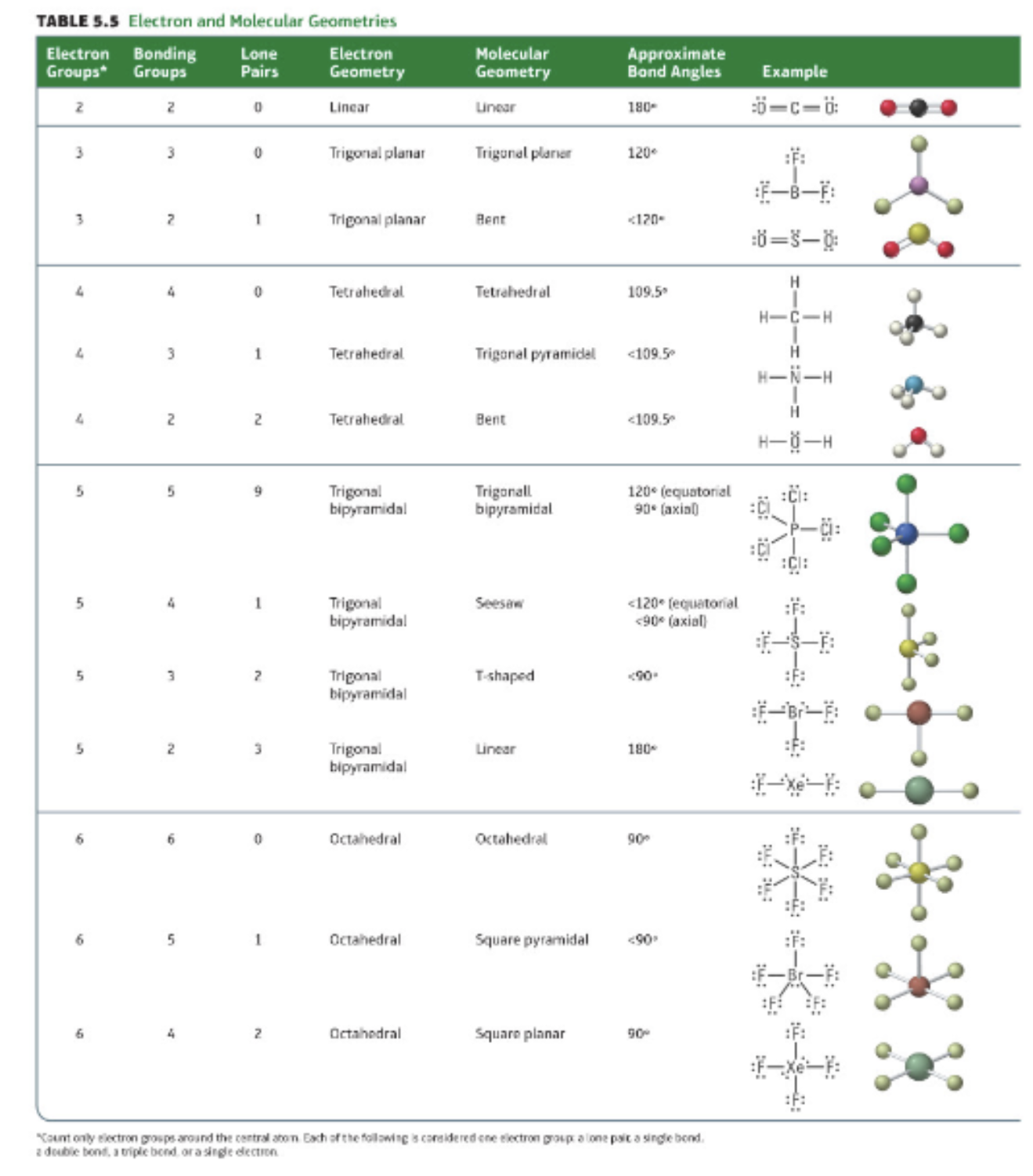
Molecular Geometries
The differs molecular geometries include:
Linear
Trigonal planar
Bent
Tetrahedral
Trigonal pyramidal
Trigonal bipyramidal
Seesaw
Octahedral
Square planar

Predicting the shapes of large molecules
You can help determine / predict the three-dimensional shape of a large molecular by examining its lewis structure.
The key principle is VSEPR theory, which helps you determine how atoms are arranged n space based on the repulsion between electrons groups.
So instead of trying to determine the shape of the entire molecule at once you would highlight the main interior atoms, as each interior atom can have its own local molecular geometry. The most import at ida is a large molecule does not necessarily have one simple geometric shape, You predict the geometry around each interior atoms severalty, then combine those local geometries to understand the molecules overall structure (we know interior atoms is would would check the connectivity, so the number of bonds, know of terminal atoms, such as hydrogen, halogens, like fluorine and chlorine, that are bonded to only one other atom. Interior atoms are bonded to two three, or four more other atoms forming the backbone or skeleton of the molecule)
You also need to understand the VSEPR theory, that states the electrons groups around a center toms repel one another and arrange themselves to minimize repulsion (electron groups include single bonds, double bonds, triple bond, and lone Paris). Then the method to use would be:
Draw or examine the lewis structure (identify the bonds and lone Paris around the atoms whose shape you are predicting)
Count the electron groups around that atom (each single, bond, double bond, tripe bond, and lone pari counts as one group)
Determine the elector geometry (use the total number of electron groups to determine their ideal arrangement)
Count the lone pairs on the atom (Lone pairs impact the molecular shape even though they are not atoms)
Name the molecular geometry Consider the positions of the atoms only, not the lone pairs)
Molecular polarity and shape and using that to find the net dipole moment to determine if the molecule is polar or nonpolar.
Molecular polarity describes how electrical charge is distributed throughout a molecule. When two bonded atoms have different electronegativity, they attract the shared bonding electrons with different strengths.
The more electronegative atom pulls the electrons closer to itself, creating an uneven distribution of electron density. This produces a bond dipole, meaning one end of the bond becomes partially negative and the other becomes partially positive.
A dipole moment is a measures of the separation of the positive and negative charge. It has both magnitude and direction, which makes it a vector quantity (so it measures how strong the charge separation is, it is calculated by multiplying the size of the charge by the distance between the charges q * d, and this is the magnitude aspect. The direction aspect is which way the polarity points. In chemistry the dipole arrow points fro the positive end toward the negative end. What it means when we say vector quantity, is because it has both a size, magnitude, and direction, individual bond dipoles act like arrow. if a molecule is symmetric, the arrow point in opposite directions and cancel each other to zero. If it is asymmetrical, like water, the arrows add up to give the molecule a net polarity)
To determine whether a whole molecule is polar, you must combine the dipole moments of all its polar bonds, taking their directions into account. This is called finding the net dipole moment. If the bond dipoles cancel completely the molecule has no net dipole moment and is nonpolar. If they do not calcite the molecule has a net dipole moment is polar.
The most important principle is that the molecular polarity depends on both the polarity of the bond, and the three-dimension shape of the molecule. You cannot determine the polarity of a molecule just by counting how many polar bonds it contains.

How to determine dipole arrows and add them up
In the slides the arrow represent bond dipoles. The arrow points toward the more electronegative atom, which is the end with the greater electron density and the partial negative charge.
The opposite end is partially positive. In many chemistry diagrams, the positive end of the dipole is marked with a small cross or plus sign.
The main idea is that a vector, is an arrow the show both a magnate (how much), and a direction (which way). In chemistry, bond dipole are vector because they have a strength and point words the more electronegative atom.
Think of the arrow as movement, right means positive and left means negative. The numbers tell you how strong each vector is
For example if the arrow point them same way you add the total, so their magnitudes because they reinforce each other
Then if arrows point the opposite ways, but one is stronger you subtract the bigger value from the smaller and the result points in the direction of the stronger vector.
Sometimes if the arrow are opposite and of the same magnitude they can cancel completely
However when arrow point in different direction you cannot simply add or subtract their numbers, you must account for both directions. This diagram uses the parallelogram method, in which you draw both arrows fro the same starting point, and them image a complete parallelogram. The diagonal from the starting point given the resultant vector.
How this all connect to molecular polarity is bond dipole work the same way as these arrows, each polar bond as a direction and strength you add the bond dipole together to find the molecules net dipole. If all the dipole cancel, the molecule is nonpolar, if the net dipole remains, the molecule is polar.