Interaction of Soil Reflectance with Earth
 Call Kai
 Learn
 Practice Test
 Spaced Repetition
 Match
 Flashcards
 Knowt Play
1/16

There's no tags or description
Looks like no tags are added yet.
17 Terms
What is Spectral Reflectance
Spectral reflectance is the ratio of reflected radiant energy (or flux) to incident radiant energy on a surface at a specific wavelength or small band of wavelengths
What is Volume Reflectance
Volume reflectance (also known as diffuse reflectance or body reflection) is the fraction of incident light that penetrates into the interior of a material, undergoes multiple internal scattering and absorption events, and eventually re-emerges from the surface
What are the factors affecting spectral reflectance of soil
1. Soil moisture content
2. Organic content
3. Structure (surface roughness and texture)
4. Mineralogical composition (e.g. Iron oxide content)
Why do we measure the spatial distribution of soil
For management of agricultural land and monitoring of environmental degradation. Coverage of bare earth varies over time (e.g. land management practices, phenological cycle)
How can remote sensing provide us with data on the interaction between EMR
and Soil
-Map soil aerial coverage, important for geomorphology, hydrology (runoff, infiltration)
-Estimates soil physiochemical properties, e.g. soil organic carbon (SOC), salinity, composition (clay, sand), nitrogen, soil moisture
How do sensors obtain soil reflectance data
Optical sensors measure the thin upper layer (crust) of the soil surface (few cm at most)
What two main categories can soil reflectance be divided into
Surface reflectance and volume scattering
How are soil reflectance profiles set out
Reflectance (y) plotted against wavelength (x). Magnitude of reflectance has a positive relationship with Wavelength

What role does soil moisture play
Plays important roles in plant growth and soil health, the hydrological system (water store) and local weather (evaporation & plant evapotranspiration)
How does soil moisture reduce light scattering and increase absorption
Water ‘coats’ soil particles and fills in airspaces, influencing the visible and NIR wavelengths and reducing reflectance\ brightness. This also impacts the shortwave infrared (SWIR) where water absorption is strongest

What is the correlation between moisture content and reflectance (+ at what bands)
-Inverse relationship between moisture content and spectral reflectance
-Higher moisture content results in decreased reflectance throughout the visible and near-infrared region, especially in the water-absorption bands at 1400 and 1900mm

Why are microwave sensors are typically used to measure soil moisture content
Microwave wavelengths are sensitive to soil moisture and operate day and night while seeing through cloud cover
What does particle size influence
Susceptibility to wind & water transport, leaching potential, water holding capacity and exchangeable nutrient supply
What is the correlation between soil reflectance and particle size
-Increase in soil reflectance with decreasing particle size
-Stronger at longer (e.g. SWIR) wavelengths than for shorter (visible)
-Smaller soil particles result in increased volume scattering
How are soil properties measured in Burkina Faso
Estimated using high spatial resolution satellite (RapidEye and Landsat), terrain/climatic data and laboratory soil samples
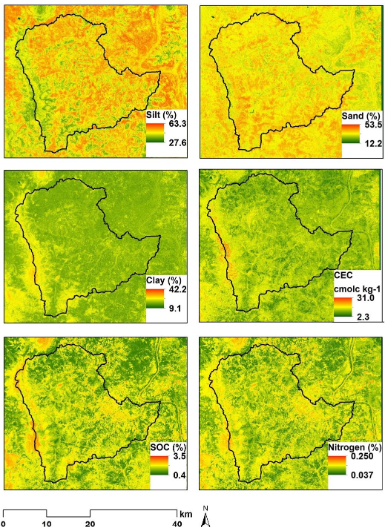
How were statistical models used in Burkina Faso
Develop relationships between the data and field measurements and could be combined with RS data to estimation soil properties spatially
What is the correlation between soil reflectance and iron oxide content
Higher reflectance in red wavelength and absorbs in blue, green and NIR wavelengths
