Central Dogma Quiz 2
 Call Kai
 Learn
 Practice Test
 Spaced Repetition
 Match
 Flashcards
 Knowt Play
1/19

There's no tags or description
Looks like no tags are added yet.
20 Terms
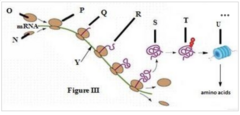
The antibacterial drug linezolid acts between these two letters on the translation infographic:
Q and R
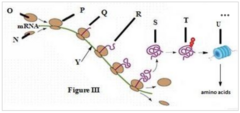
Ubiquitin is added to the structure corresponding to this letter on the translation infographic:
S

Refer to the following image of this gene segment ( dsDNA) -Which of the following is the correct protein sequence derived from this gene? You will need to use your codon table in your slides to answer this question.
NH2-MET-SER-CYS-GLU-COOH
From the peptide you selected from Question 3--how many nucleophilic side chains does it contan?
NH2-MET-SER-CYS-GLU-COOH
2

Refer tho the structure of the peptide shown: Click on the amino acid side chain that is likely to be phosphorylated in a post-translational modification.:
Tyrosine side chain - aromatic ring with -OH
Select all that apply
Three of the enzymes listed are classified as 'molecular erasers'. Pick three.
· Histone Deacetylase
· DNA Exonuclease
· Protein Phosphatase

How many amide bonds does this peptide consist of?
4
The formation of hemoglobin A1C from hemoglobin is an example of this post-transational modification:
Glycosylation

The peptide shown consists of these three amino acids:
tyrosine, lysine, serine
The processes of 3-polyadenylation, intron removal, and alternative splicing are associated with:
mRNA processing
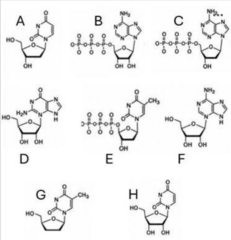
Select all that apply
Which of the following structures contain pyrimidine bases?
· A
· E
· G
· H
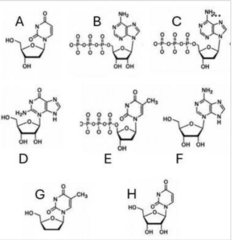
Select all that apply
Which of the following structures are classified as nucleosides?
· A
· D
· F
· G
· H

Which structure is converted to cAMP?
B

Which structure can be used as an HIV-Reverse Transcriptase inhibitor?
G

The following picture of Watson-Crick base pairing is INCORRECT because:
The hydrogen bonding is all wrong; there should be only 2 H-bonds
A Post-Translational Modification that is commonly called the "kiss of death" for proteins:
Ubiquitination
Select all that apply
Select two true statements regarding histone deacytlase (HDAC) or HDAC inhibitors:
· HDAC inhibition results in an open and transcriptionally active chromatin
· HDAC inhibition leads to the accumulation of acetylated histones
Which statement is false concerning the drug GALAFOLD (migalastat)?
It is a peptide analog
Choose the false statement regarding the Pfizer and Moderna mRNA vaccines for COVID-19
They are replicating mRNA constructs that enter host cell nucleus
The terms Peptidyl, Aminoacyl, and Exit sites are associated with this cellular process:
Protein Translation