PSY301 Lecture 10/11: Mediation analysis
 Call Kai
 Learn
Learn Practice Test
 Spaced Repetition
 Match
Match Flashcards
 Knowt Play
1/15

There's no tags or description
Looks like no tags are added yet.
Name | Mastery | Learn | Test | Matching | Spaced | Call with Kai | Chat |
|---|
No analytics yet
Send a link to your students to track their progress
16 Terms
Mediation
• A tri-variate unidirectional (thus causal) hypothesis:
What are the mechanisms of effect underlying a pre-established causal statistical relationship?
• A pre-established causal relationship between two variables (X, Y) is theorised to exist due to an intermediate third variable (Me)
• That’s why it’s also called as “theoretical” causal chain.
• The additional (third) variable that is hypothesised to have this effect is known as a “mediator” though is also sometimes referred to as an:
“intermediate variable” (Kraemer et al., 2001)
“explanatory link” (Rose, Holmbeck, Coakley, & Franks, 2004).

Refers to a situation when the relationship between a predictor variable and outcome variable can be explained by their relationship to a third variable (the mediator).
Moderation
• Another tri-variate unidirectional (thus causal) hypothesis:
Under what conditions/for whom/when is a pre-established statistical relationship evident?
Completely different from mediation
• The presence of a third “moderator” variable (Mo) is also termed:
a “causal interaction effect” (Wu & Zumbo, 2007)
an “effect-modifier” (Hinshaw, 2002)

Mediation ≠ Moderation

Statistical mediation analysis
• Quantifying specific causal pathways measured via specific variables which are assumed to be affected by the exposure and themselves affect the outcome
• Total effect
• Indirect (mediated) effect (red arrows)
• Direct effect (green arrow)


Mediator
A variable that is intermediate in the causal process relating an independent to a dependent variable.
Some Examples:
1) Intervention has beneficial effects on exercise which leads to reduced depression.
2) Tobacco prevention program promotes anti-tobacco norms which reduce tobacco use (MacKinnon et al., 1991)
3) Screening program increases identification of early stage cancer which reduces cancer deaths.
4) Wellbutrin (Bupropion) increases participant’s willingness to quit and selfefficacy which are associated with one month abstinence from tobacco (McCarthy et al., 2008)
Traditional mediation analysis
Tests for the following paths:
• Path A: The relationship between X and M

• Path C (“total effect” of X): The relationship between X and Y (without M in the model)

• Path B: The relationship between M and Y, controlling for X

• Path AB (“indirect effect” of X): The relationship between X and Y through M

Evidence for mediation (Baron & Kenny, 1986)
• Path A: (X → M ) is significant
• Path C (“total effect” X → Y) is significant.
• Path B (M → Y, controlling for X) is significant.
• Path C’ (“direct effect” of X → Y, controlling for M) is weaker than Path C
• Path AB (“indirect effect” of X → M → X) is significant
The limitations of traditional approach (Baron & Kenny, 1986)
• It assumes mediation only exists if certain steps are significant, but modern approaches show indirect effects can exist even when the total or direct effects are not significant.
• The procedure that requires several significant paths (X→M, M→Y, X→Y) reduces power and increases the chance of missing real indirect effects.
• The method focuses on whether regression paths are significant, but it does not formally test the mediation effect.
Modern alternatives to traditional approach
Bootstrapping (e.g., via PROCESS) or Structural Equation Modelling (SEM) are now recommended as they directly test and quantify the indirect effect with higher accuracy.
Partial mediation
The relationship between 𝑿 and 𝒀 is weaker but still significant with 𝑴 in the model
◦ Path C’ is still significant

Full mediation
The relationship between 𝑿 and 𝒀 is no longer significant with 𝑴 in the model
◦ Path C’ is no longer significant

How do we test for each?
Path A: (X → M ) is significant
Simple regression
Could also use correlation, but regression gives us more consistency in terms of coefficients (i.e., b or β)
How do we test for each?
Path C (“total effect” X → Y) is significant.
Path B (M → Y, controlling for X) is significant.
Path C’ (“direct effect” of X → Y, controlling for M) is weaker than Path C
Hierarchical Multiple Regression
Path C tested at Block 1 (X entered as a sole predictor of Y)
Path B and Path C’ tested at Block 2 (M entered as additional predictor)
How do we test for each?
Path AB (“indirect effect” of X → M → X) is significant
Sobel Test or Bootstrapping
Sobel Test (Sobel, 1982)
• a statistical test of the significance of the indirect effect (i.e., a × b, where a = path from predictor to mediator, b = path from mediator to outcome).
• It uses a normal theory approach, calculating a z-value for the indirect effect:
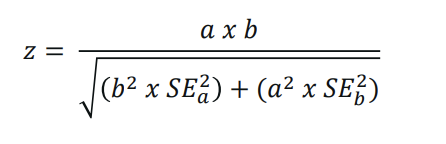
• If |z| is large enough (|z|> 1.96 for p < .05), the indirect effect is considered significant.
Bootstrapping method (Hayes)
A resampling technique.
• The data is resampled thousands of times (with replacement), and each time, the indirect effect (a x b) is recalculated.
• It generates an empirical sampling distribution of the indirect effect, from which we derive a Confidence Interval (CI)
• Making decision: If 95%CI does not pass 0, we conclude the indirect effect is significant.