AVE ECO + MAN EXAM 2
 Call Kai
 Learn
 Practice Test
 Spaced Repetition
 Match
 Flashcards
 Knowt Play
1/156

There's no tags or description
Looks like no tags are added yet.
157 Terms
grassland songbird decline
most widespread out of all NA bird groups.
grassland songbird decline percentages
48% are of conservation concern, 55% are in significant decline
western grasslands changes
went from grazing buffalo to fenced cattle. Fire suppression, habitat fragmentation and ag intensification changed the landscape. Conversion to non-native species occured
eastern grasslands changes
Fire suppression, agricultural intensification, conversion to non-natives, habitat fragmentation
bird conservation regions (BCR)
tallgrass, mixedgrass, shortgrass prairies, (central NA) desert grasslands, Pine (longleaf) savannah
grassland bird
a sp. adapted to or reliant on some variety of grassland habitat for part or all of its lifestyle. Can be resident or migratory
facultative grassland bird
part-time
obligate grassland bird
full-time (specialists)
Grassland bird life history
2-6 eggs, 11-13 day incubation, 8-12 days fledge, 1-2 nests (can be 3). Lifespan is 3-5 yrs (25-80% annual survival)
Grassland bird nest mortality
human induced, snakes, rodents, mid-size carnivores
Grassland bird mortality
raptors, exposure
Grassland bird breeding habitat requirements
variability in vegetation structure and composition, field size
Eastern Meadowlark breeding hab. requirements
tall grass, dense ground veg., litter cover
Grasshopper sparrow breeding hab. requirements
open grasslands, open patches, avoids extensive shrub cover
Dickcissel breeding hab. requirements
tall grass, dense cover, moderate litter depth.
Scale of habitat requirements of grassland birds
varies by spatial scale and animals selection of habitat; landscape vs. microhabitat scale
Savannah sparrow range
NA, northern breeding, southern nonbreeding, small southern patch of year round

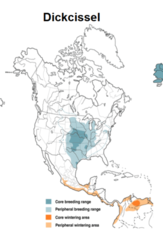
Dickcissel range
Winter in SA, core breeding in central US
Henslow's sparrow breeding range
SE US winter, N US breeding

Exotic forage grasses
Bermuda, Bahia, Fescue- very poor quality habitat. Sod forming, dense, hard to control, no nutritional value, no cover value
Native warm season grasses
big/little bluestem, Indiangrass, switchgrass, eastern gamagrass, broomsedge
clump grasses
spaces (near bare ground) in between clumps of grass allows movement (opposite of sod-forming, dense non-native grasses)
forbs
common ragweed, Illinois bundleflower, partridge pea, lance-leaves coreopsis, purple coneflower, black-eyed Susan, butterfly pea
restoring native grass communities
removal of cedars (mechanical, prescribed fire), planting
mechanical removal of non-native species
requires 1-2 herbicide applications usually in tandem with prescribed fire. non-native grasses must be COMPLETELY eradicated to be successful.
conventional seed spreader planting
must have good seed bed (soil exposed), spread seed (must use de-bearded seed), culti-pack (press seed into soil), success is highly variable

native grass drill planting
seeds placed into the ground, good seed-to-soil contact, fairly high success

Planting success time
doesn't always look good after the first growing season, wait until after the 2nd growing season to make an assessment
Planting failure reasons
1) planted too deep (1/8"-1/4" is best)
2) inadequate weed control
3) planted too late (mid april - early june optimal)
4) drill not properly calibrated
5) no patience
managing/maintaining native warm season grass
prescribed fire every 2-3 years, chemical control of hardwoods if needed, single pass strip disking if fire is not an option (will kill some plants), mowing is not a good choice (thatch build up, cover elimination)
other grassland habitat options
habitat buffers, pasture conversion, rotational grazing, corridor establishment
habitat buffers
noncrop herbaceous field margin communities. Strips of permanent vegetation to intercept pollutants and other environmental concerns
habitat buffer benefits
provides increased usable space, nesting hab., brood-rearing hab., roosting hab., holds birds on landscape. mainly consisting of grasses and forbs (shrub cover can be added)
types of buffer practices
Riparian buffers, grassed waterways, filter strips, shelterbelts, field borders
habitat buffer vegitation
natural regeneration (see what comes up): ragweed, goldenrod, foxtail. Native warm season grass MUST ELIMINATE EXOTIC FORAGE GRASSES
field border usage
must be used on multiple fields to be effective
habitat buffers and bobwhite quail
23% in breeding season abundance, 66% increase in fall density: may increase foraging efficiency for chicks
habitat buffers and winter sparrows
birds/ha significantly higher in bordered fields vs. non-bordered fields
common agricultural lands management
establishing native warm season grasses, strip disking, prescribed fire, herbicide applications
pastures/ old fields/ idle grassy areas management
working with nature: initial disturbance, see what comes up, spot spray to remove undesirables, examine the following season, spot spray to remove undesirables
pasture buffers
fencing out cattle; travel corridors, nesting habitat, roosting habitat, escape cover, thermal cover.

waterfowl wintering ecology
diverse, continental home range, distinct periods
annual waterfowl cycles
oct-mar (migration and winter, 58%), mar-june (nesting and brood rearing 25%), jun-oct (molt and postbreeding 17%)
wintering
following food, courtship, pair bonding. Building nutrient reserves, recovering from migration. Females and some males molt
waterfowl food requirements
carbs- seeds, tubers, acorns, nutrients- native weed seeds, inverts, protein- invertebrates
oct-nov waterfowl food avaliability
moist soil seeds, inverts, tubers, crops
dec-jan waterfowl food avaliability
flooded crops, acorns, moist soil seeds, tubers, crustaceans
jan-mar waterfowl food avaliability
inverts, crustaceans, moist soil seeds, flooded crops, acorns
waterfowl resources in winter
only so much time and energy available in each location, each day
DDT
hydroperiod determining wetland type: depth, duration, and timing
mudflats
result from drawdown or tides, very short-lived, can provide excellent crustacean and invert foraging
moist-soil wetland use
provides preferred annual seeds, invert and some crustacean foraging. Loafing habitat- safety in numbers, open courtship space
emergent marsh
used my waterfowl for feeding, roosting, and loafing. Excellent source of crustaceans and inverts. provides summer feeding and brood rearing for wood ducks
shrub/scrub swamp
used for loafing, roosting, feeding. Provide excellent crust and invert prod. Provides thermal cover, pair bond isolation
flooded bottomland hardwood
variable acorn production, limited annual seeds and inverts. secure roosting and loafing sites, inclement weather protection, pair bond isolation
greentree reservoirs
A forest stand flooded to create a seasonal wetland. does not flood until dormancy, early fall flooding can be detrimental, flooding should mimic natural hydroperiods. Alternate flooding regimes, times, and years
natural bottomland hardwoods
manage for diverse canopy structure, favor utilized red oaks. Opening are important for diverse foods and bird access
deep, open water
loafing and roosting, some food by submerged aquatic vegetation. Over 3' deep
flooded ag crops
important mid Dec- mid Feb. High energy, used to keep warm, overnight. Provides fat storage, DOES NOT PROVIDE ADEQUATE DIET
ag crop composition
contains- carbs, fatty acids, lipids, low protein. DOES NOT CONTAIN- vitamins and amino acids, essential minerals, adequate protein, balanced diet
habitat types and food production for waterfowl
moist-soil, ag crops, emergent marsh, BLH, scrub/shrub, DOW: most to least avaliability.

flooded waterfowl food deterioration
soybean, millet, corn degrade the most, paspalum, rice, smartweed maintain form the most

DED
duck energy days- food required to feed one duck for one day. # of dabbling ducks sustained in a given area for a given amount of time.
DED/acre
highest on rice, corn, moist soil habs., lowest on harvested crops and hardwoods.

nutritional contributions of food types for waterfowl
Mallards fed soybean and corn could not sustain weight, fed rice and millet they could. "Soybean, corn, and other ag crops do not provide a complete diet for waterfowl"

harsh weather and waterfowl
migrate south, seek wind blocking habitats, heat trapping habitats
evading predation and waterfowl
loafing, roosting habitats, hunting pressure
winding a mate and watefowl
diff spp. pair at different times, some pair for lime and some pair monogamously per season. Seek isolation
waterbird and molting
requires high protein, (feathers are 85%), invert foraging.
large wetland complexes (12-16 miles)
25% forested wetland, 44% flooded cropland (24% has no food value), 11% permanent wetland, 20% moist-soil

wintering waterfowl management key points
waterfowl need food diversity, different hab types provide diff food and cover. Habitat complexes can be used to meet all needs (12-16 mile radius). Requirements change daily, seasonally, and with weather
NRCS
Natural Resource Conservation Service woks in partnership with the American people to conserve and sustain natural resources on private lands
NRCS mission
to provide leadership in a partnership effort to help people conserve, improve, and sustain our natural resources and environment
why NRCS is important
1980's, 53% of wetlands in US lost. 60ac/hr lost in 1780's-1980's. Alabama has lost 50% of wetlands
hydrology restoration
construction to restore wetlands and allow management of period
hydrology restoration goals
provide a diversity of wetland types- large percentage developed for shallowly-flooded moist-soil-management
hydrology restoration requirements
topographic survey, biologist and engineer working together to design hydrology restoration
levee construction
for both flooding and draining- typically flashboard or full-round

What is microtopography?
Microtopography refers to small-scale variations in the landscape, such as ridges, swales, and depressional areas.
What historical events contributed to the formation of microtopography in riverine systems?
Historical flooding in riverine systems resulted in features like ridge/swale formations and braided channels.
What is the goal of creating microtopography?
The goal is to create additional variation in habitat, which provides environments for amphibians, shorebirds, wading birds, and resting waterfowl.
How is microtopography usually created?
Microtopography is usually created by excavation.
hydrology restoration as good habitat
does not alone back good habitat, it requires management
Food Security Act of 1985 and Amendments
"swampbuster" provisions deny USDA program benefits to landowners that convert wetlands for agriculture
Clean Water Act of 1972 and Amendments
section 404 authorized EPA and Corps to regulate certain activities in wetlands and other waters
NRCS agency responsibilities
identifies wetlands on ag lands and non ag lands for USDA participants
USDA participants
if land has an FSA farm and a tract number, they are a USDA participant
USACE responsibilities
identifies wetlands on non ag and non USDA program lands, perform jurisdictional determinations
role of USFWS and NOAA
evaluate impacts on fish and wildlife of all new federal projects, actions, and federally permitted projects. Provide consultation on trust species, provide technical assistance and review, upon request. Coordinate to update the National List of Plant Species that Occur in Wetlands (USFWS)
triggers for FSA 1985
planting an ag commodity on a wetland converted after 12/23/1985 or converting a wetland for the purpose, or to have the effect, of making production possible after 11/28/1990
trigger for CWA 1972
discharging dredge or placing fill in wetlands or other waters
swampbuster provisions and NRCS program participants
must adhere to both laws, can lose USDA benefits, must come to USDA anytime they might be impacting wetlands. Often have wetland determinations already completed by NRCS
CWA and USACE section 404
requires a permit to place fill or discharge dredge; permits are not issued if a practical alternative exists or impacts have no been minimized.
fill
"any pollutant which replaces waters of the US with dry land or which changes the bottom elevation of a water body". Includes rock, sand, soil, clay, plastics, construction debris, wood chips, and materials used to create any structure or infrastructure.
predation in an ecosystem
normal, natural component of ecosystem. Removes sick, diseased, injured. Keeps wild animals wild/wary, regulates prey populations. Predators are valuable hunting/trapping animals
predation removal
removing predators to increase prey populations is a legit management tool, but rarely reccomended
removing trapping methods
takes a tool out of the toolbox (foothold traps in Colorado)
why is predator removal not recommended?
not practical to do efficiently, has to be done correctly- access to correct land, time, resources. Many aspects of predators cannot be managed (hawks/owls, snakes are illegal to remove)
predation
consumption of one org. by another org. where org. consumed is alive when first attacked (true preds, grazers, parasitoids, parasites)
predation influences
weather (precipitation), habitat, prey, other prey sp., pred. comp., other pred sp. Habitat change and landscape context