multi store memory model
 Call Kai
 Learn
 Practice Test
 Spaced Repetition
 Match
 Flashcards
 Knowt Play
1/9

There's no tags or description
Looks like no tags are added yet.
10 Terms
who first described MSM
Atkinson and Schiffrin in 1968
3 unitary memory stores
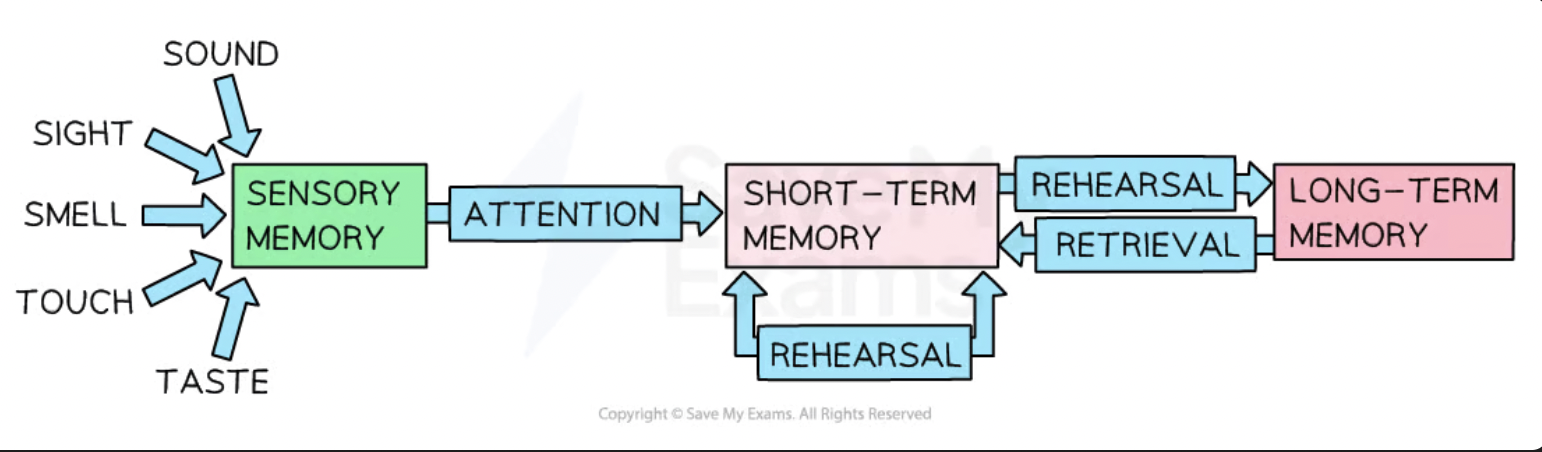
sensory register
where info is held at each of the senses
unlimited capacity
250ms duration
modality specific coding
constantly receives info but most remains there very briefly
STM
acoustic coding
15-30 sec duration
7+-2 capacity
LTM
semantic coding
unlimited capacity
unlimited duration
Attention
first step to remembering something
if a persons attention is focused on one of the sensory stored, data is transferred to STM
maintenance rehearsal
occurs when we repeat (rehearse) material in our head, over and over again.
Information stays in our STM as long as we rehearse it. If we rehearse it long enough, it passes into our LTM.
Retrieval
the process of getting info from LTM involves info passing back through STM
strength-case studies HM
HM had hippocampus removed and could no longer form new long term memories but his short term memory was unaffected
shows LTM and STM must be two separate stores
support theory
strength of MSM-Brain studies
P-there is evidence from brain scan studies
Ev-Experiments involving fMRI machines have shown that different areas of the brain are active during different memory tasks.
Ex-One region is active (shown by greater blood flow on a scan) when a participant is doing a short-term memory task and a completely different region of the brain is active during a long-term memory task.
weakness- LTM is too simplistic
Tulving 1994- found 3 types of LTM: semantic, episodic and procedural
episodic and semantic memories were from pre frontal cortex whereas procedural was from multiple brain regions
suggests LTM is shows as too simple and fails to consider diff types