Biol 214 Exam 3
 Call Kai
 Learn
 Practice Test
 Spaced Repetition
 Match
 Flashcards
 Knowt Play
1/64

There's no tags or description
Looks like no tags are added yet.
65 Terms
Operons
cluster of prokaryotic genes and associated regulatory sequences. Regulatory proteins bind to the regulatory sequences to control transcription.
can be controlled by more than 1 mechanism, and regulatory proteins may control more than one operon

Promoter
type of DNA regulatory sequence
where RNA polymerase binds to begin transcription
Transcription Unit
cluster of genes transcribed into a single mRNA
encodes proteins involved in the same function
Operator
regulatory DNA sequence in the operon
short segment where a regulatory protein binds
only in PORKARYOTES
negative inducible/repressible
negative refers to the repressor’s involvement
negative inducible = repressor taken off, and inducing transcription
negative repressible = repressor put on, repressing transcription
Positive inducible/repressible
positive refers to activator’s involvement
positive inducible = activator put on operator before polymerase, so polymerase can bind on promoter
positive repressible = activator removed from gene, so polymerase can’t bind
Lactose case study
low glucose = more cAMP
CAP does not bind to promoter in the absence of cAMP. With cAMP, CAP binds and increases RNA polymerase activity

lac vs trp operons
lac operon (inducible operon, usually turned off in the cell)
repressor synthesized in active form, so structural genes are not transcribed
Inducer allolactose inactivates the repressor, so structural genes are transcribed
trp operon (repressible operon, usually turned on in the cell)
repressor is synthesized in inactive form, so structural genes are transcriped
coreppressor (tryptophan) activates repressor (too much tryptophan = repress the gene making it)
active repressor blocks transcription of the operon

Eukaryotic gene regulation
involves complex switches in gene expression
activators and repressors
access to DNA is more complicated (chromatin, nucleosomes, histones)
Prokaryotic gene regulation
more direct interactions between regulators and RNA polymerase
inactive chromatin to active chromatin
acetylation by histone acetyltransferase (histone tails are usually not acetylated, and are wrapped around histone octamer)

More eukaryotic control elements
The transcription unit is the segment that is transcribed into the pre-mRNA; it contains the 5′ UTR (untranslated region), exons, introns, and 3′ UTR.
Immediately upstream of the transcription unit is the promoter, which often contains the TATA box.
Adjacent to the promoter and further upstream of the transcription unit is the promoter proximal region, which contains regulatory sequences called promoter proximal elements.
More distant from the gene is the enhancer, which contains regulatory sequences that control the rate of transcription of the gene.
Transcription of the gene produces a pre-mRNA molecule with a 5′ cap and 3′ poly(A) tail; processing of the pre-mRNA to remove introns generates the functional mRNA (see Chapter 15).

MAXIMAL transcription of a gene
a coactivator (multiprotein complex) bridges between activators at enhancer and promoter proximal regions, looping DNA
Interaction between activators and coactivator + proteins at promoter all stimulate max transcription
coactivator basically only in eukaryotes

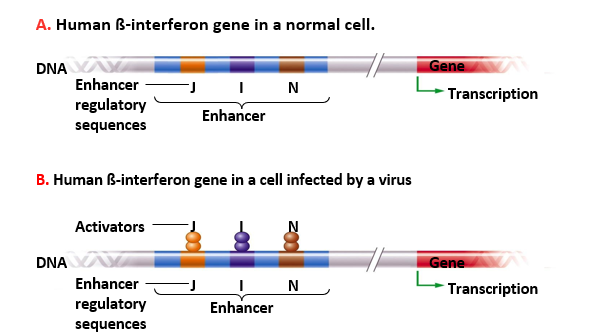
Virus infected cell……
usually no activators are bound to enhancer region
when virus infected, 3 diff activators bind to the 3 enhancer sequences and transcription occurs
How do activators increase transcription once bound to DNA?
attract and position RNA polymerase
release paused RNA polymerase from promoter
Accelerate binding and assembly of transcription
attract coactivators like the coactivator complex
How do repressors decrease transcription once bound to DNA?
Eukaryotic repressors do not compete w RNA polymerase for access to DNA
instead, they recruit co-repressors that:
mask activation site
interfere w transcription factors
remodel chromatin
Steroid hormones
a steroid hormone acts only on specific target tissues that have steroid hormone receptors in their cytoplasm
a single steroid hormone regulates all genes that have the same steroid hormone response element (where the steroid binds)
miRNA (micro RNA)
these regulate at least 1/3 of all genes (common form of regulation)
synthesized by RNA polymerase II and capped and adenylated in the nucleus and exported as dsRNA (folds back on itself to become a larping dsRNA)
Modified by Dicer in the cytoplasm (cut into a short dsRNA fragment) and loaded onto Argonaute protein to form RNA induced silencing complex (RISC)
passenger strand yeeted off
searches for complementary RNA sequences, helped by Argonaute
base pairing is usually at least 7 nucleotides in the 3’ UTR region of target mRNA
base pairing usually imperfect, meaning shorter half-life of mRNA, and that mRNA is translated more slowly (less gene expression)
miRNA has partial matches, physically blocks translation
broad regulation across multiple related genes

siRNA as cell defense
These are NOT encoded by the genes in the nucleus (come from viruses or transposons)
presence of dsRNA triggers RNAi (RNA interference) by attracting Dicer
Dicer chops up the dsRNA into small interfering RNA (siRNA)
siRNA is bound by Argonaute and other proteins to form RISC
one strand discarded (passenger), guide strand remains
RISC identifies complimentary siRNA—exact match = destruction
useful for highly specific gene knockdown (specific mRNA match)

Pythagoras and genetics
mystical vapors —> heredity
Aristotle heredity
recognized traits could skip generations - decided make semen sculpted menstrual blood into a fetus
For Darwin’s ideas on evolution to work…
heredity had to possess both constancy AND inconstancy, stability AND mutation
lol thought that the body has gemmules, that are passed on
Mendel heredity
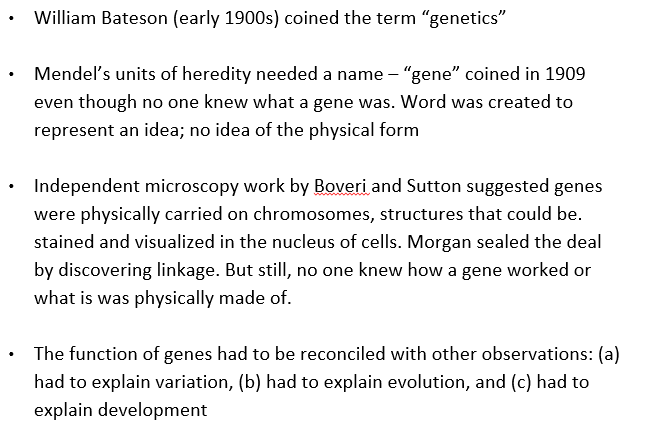
3 diff people rediscovered him

birth of genetics
Epistasis
a genetic phenomenon where the effect of one gene (or mutation) is masked, suppressed, or modified by the expression of one or more other genes located at different loci
basically one gene is suppressed
codominant and incomplete dominance
codominant = seperate but both shown
incomplete = mixed together
independent assortment
genes located on seperate chromosomes, or are so far apart that they act independently
complete linkage
genes are very close on same chromosome, and do not exhibit crossing over. Testcross reveals effects of linkage
incomplete linkage/crossing over/recombination
usually some crossing over which makes new combos of traits
epigenetics
changes in gene expression or phenotype that are potentially heritable but do not alter the underlying DNA base sequence
changes in methylation — usually near promoters
modifications of histone proteins
Methylation
Usually near promoter, repressing transcription
Histone modifications
addition of acetyl groups to histone tails destabilizes chromatin structure (increased transcription)
Addition of methyl groups to histone proteins can increase or decrease transcription depending on which amino acid is modified
Histones dissociate during replication and are divided during cell division. New histones synthesize to replace those that are missing

RNA in epigenetics
long noncoding RNA from Xist gene coats one of the X chromosomes in females, and suppresses transcription of it. The same X chromosome remains inactive when DNA replicates and the cell divides
cytoplasmic inheritance
mitochondria and chloroplasts have their own DNA
children receive nuclear DNA from both parents, but cytoplasmic organelles usually come from egg

genes involved in synthesis
are usually repressible (usually turned on but can be turned off)
genes involved in breakdown
are usually inducible (usually turned off but can be turned on)
how are eukaryotic genes organized
NOT operons (operons are prokaryotic genes)
they are composed of regulatory sequences that are lowk far away from the gene
transcription unitcontains 5’UTR, exons, introns, and 3’UTR
next to promoter is the promoter proximal region, which has regulatory sequences called promoter proximal elements
TATA box in promoter for binding (transcription factors are needed for RNA polymerase to bind)
Law of Segregation vs Independent Assortment
law of segregation:
each gamete gets one allele of a trait (each parent carries two alleles for the trait)
independent assortment:
different traits sort independently: seed shape and seed color are not related to each other
chi squared test
look at degrees of freedom and critical value. if x² is greater than critical, reject null.
null is always…the two things have no relation
degrees of freedom = (rows - 1)(column - 1) OR for bio purposes, # phenotypic categories - 1
FOR A POPULATION——degrees of freedom = # genotypes - # of alleles

Experiments that established genes were located on chromosomes
Sutton and Boveri
segregation and independent assortment
both genes and chromosomes appear in pairs in diploid organisms
Thomas Hunt MOrgan and Drosophila
using fruit flies, he crossed a male fly with white eyes with a wild type red eyed female. All offspring had red eyes, showing that white eyes was recessive.
In F2 generation, when breeding the F1 flies, the ratio was 3:1, but all white eyed flies were male.
could only be explained if the gene was physically on X chromosome
before mendel….and after
blending theory of inheritance (before):
offspring look a little like mom and a little like dad
after mendel:
characters are passed in discrete hereditary factors (genes)—particulate theory of inheritance
types of crosses
reciprocal cross—sexes of the parents are reversed to test sex-linkedness: male with trait A x female with trait B, instead of male with trait B x female with trait A
test cross—cross unknown organism with a homozygous recessive organism
self—cross with own organism
back cross—F1 generation x parent, or genetically similar individual (cherry picking traits)
pleiotropy
a genetic phenomenon where a single gene (or genetic variant) influences two or more distinct, and often seemingly unrelated, phenotypic traits
recombination frequences and distance on a gene
recombination frequency of 50% means genes are on seperate chromosomes, or the same chromosome, but very far apart (so they act like they’re independent)
Hardy-Weinberg
Allele and genotypic frequencies remain constant from generation to generation in the absence of evolutionary forces
no mutation
random mating
no gene flow
very large population size
no natural selection
F-statistics
quantitative measures used in population genetics to describe genetic structure, inbreeding, and allele frequency correlations across hierarchical or branching populations
genetic structure of populations can be described…
using genotypic frequencies
using allele frequencies
hardy weinberg implications
reproduction alone does not change allele frequencies
a single generation of random mating produces equilibrium genotypic frequencies
if a population is not in HW equilibrium, an assumption has been violated
measures of population variation
variance in allele frequency
observed heterozygosity
expected heterozygosity
F statistic
Forces of microevolution (opposite of HW)
mutation
migration
(immigration = increases variability within)
emigration = decreases variability between populations
genetic drift (decreases variability)
founder effect
bottleneck
natural selection
nonrandom mating
morphological species concept
idea that all individuals of a species share measurable anatomical traits that seperate them from other species
(they look diff)
biological species concept
groups of interbreeding natural populations that are reproductively isolated from other such groups
(can’t reproduce w another species)
ecological species concept
looks at species in terms of ecological niche
phylogenetic species concept
defined as a cluster of populations that emerge from the same small branch (recent evolutionary history)
reproductive isolating mechanisms—prezygotic isolating mecanisms
ecological: species live in diff habitats in same region
temporal: species breed at diff times of day/year
behavioral: signals of one species are not recognized by another
mechanical: diffs in structure of reproductive organs or other body parts prevent mating
gamete isolation: species have nonmatching receptors on gametes
reproductive isolating mechanisms—postzygotic isolating mecanisms
hybrid inviability: hybrids can’t complete development
hybrid sterility: hybrids cannot produce viable gametes
hybrid breakdown: hybrids have low survival or fertility
Complications with species concept….
subspecies
distinct populations of the same species that live in different geographic regions and look slightly different from one another (often in color, size, or pattern) due to local adaptations. However, they are still genetically similar enough to interbreed if they come into contact
clinal variation
Instead of distinct breaks between populations, traits change gradually along a geographic or environmental gradient (such as a gradual increase in body size as you move toward colder, higher latitudes). Populations at opposite ends look different, but they blend smoothly into one another across the landscape
ring species
Imagine a chain of populations arranged in a loop around a geographic barrier (like a mountain or desert). Neighboring populations can interbreed with each other, but by the time the loop closes and the "end" populations meet back up, they have diverged so much genetically that they can no longer reproduce with one another.
Allopatric speciation
geographic isolation (some barrier or splitting of population)
adaptive radiation: diversified into many new species to fit ecological niches
species cluster: A group of closely related, recently evolved species that share a common ancestor, typically resulting from a recent adaptive radiation event (like Darwin's finches).
Sympatric speciation
reproductive isolation between distinct subgroups that arise within one population
habitat differentiation: A subset of a population starts exploiting a new habitat, food source, or host within the same environment. Over time, reduces gene flow with the rest of the population (EX. apple maggot flies shifting from hawthorns to domesticated apples).
polyploidy: A major genetic mutation where an organism ends up with extra sets of chromosomes. Common in plants. A tetraploid mutant (4 sets) often cannot successfully reproduce with its diploid parents (2 sets), creating an instant genetic barrier and giving rise to a brand-new species in a single generation.
anabolic and catabolic
anabolic usually repressible (usually on, must be stopped)
catabolic usually inducible (usually off, must be activated)
recombination frequency
recombinant = traits not similar to parental ones (some new combination)

recessive epistasis
if you have _ _ bb, the bb will mask whatever the _ _ is
9:3:4 ratio instead of 9:3:3:1 for a dihybrid cross
dominant epistasis
Suppose a dominant allele (A) masks the second gene (B) or (b).
Any individual with at least one (A) allele (A_B_) and (A_bb) displays the exact same masked phenotype.
should be 12:3:1 ratio instead of 9:3:3:1
heterozygosity rates and hardy weinberg implications
When the observed heterozygosity in a population is lower than expected under Hardy-Weinberg equilibrium (HWE)—known as a heterozygote deficit— most likely inbreeding, positive assortive mating (prefer to mate with own kind)
when observed heterozygosity is higher, there may be some heterozygous advantage, or negative assortive mating
blood types
A, AB, B, O
M, MN, N (codominant, expressed simultaneously but seperate)