Economics for public policy week 1
 Call Kai
 Learn
 Practice Test
 Spaced Repetition
 Match
 Flashcards
 Knowt Play
1/24

Earn XP
Description and Tags
social welfare, social insurance, adverse selection, moral hazard
25 Terms

social surplus
consumer surplus- the benefit that consumers derive from consuming a good, above and beyond the price they paid for the good.
producer surplus- the benefit that producers derive from selling a good, above and beyond the cost of producing that good
social efficiency- the net gains to society from all activity in a market (the sum of consumer and producer surplus)- also known as total social surplus
when should a government intervene and when will government intervention increase social welfare?
when it can increase social welfare
social welare is the levle of well being in society and is determined by both how much gets produced and how it is distributed
government intervention increases social welfare when it can increase social inefficiency/surplus (making markets work better)
OR when it can achieve a more preffere distribution of resources.
achieving the competitive equilibrium relies on social efficiency being maximised (supply=demand), give examples of possible market failures.
markets fail when they do not achieve the competitive equilibrium although government intervention may be able to improve social effciency
possible market failures:
imperfect competition
imperfect or asymmetric information
individual failures
externalities
what does market failure look like (draw the consumer and producer surplus diagram and explain deadweight loss)
The competitive equilibriums is where supply and demand intersect (point z)
Social surplus at the competitive equilibrium is the sum of the pink and blue shaded areas- this is the highest it can be.
If quantity is restricted to Qr the social surplus is restricted to D+E meaning we have a deadweight loss of D+E
Deadweight loss is the loss of total economic welfare (consumer plus producer surplus) that occurs when a market moves away from its efficient outcome, so that some mutually beneficial trades no longer happen.

What is the second fundamental theorem of welfare economics
Society can attain any efficient outcome by suitably redistributing resources among individuals and then allowing them to freely trade
Equity-efficiency Trade-off
In practice we are not typically able to redistribute without reducing social efficiency which leads to the equity-efficiency trade off- trade off social efficiency (the total size of the economic pie) with increased equity (how the pie is distributed)
Out-of-work benefits as an example of the equity-efficiency trade off (with supply and demand diagram)
.without benefits the labour market is on competitive equilibrium x
.when the benefits are introduced, ewuity is increased by redistributing income, but labour supply falls leading to a new equilibrium y and deadweight loss
.As a result there is a trade-off between equity and effciency

How does the government intervene?
.provision of cash benefits: unemployment, disability, pensions, child benefits
.Direct spending of financing of public provision: provide goods and services directly (e.g. healthcare, national defence), pays for private provision (e.g. academy schools)
.Taxes and subsidies: taxes to raise revenue (on income, capital, consumption), Tax gods that are over-provided (e.g. carbon tax) and subsidized goods under-provided (e.g. bike to work scheme)
.Restrict or mandate private sale or purchase: restrict the private sale or purchase of over-provided goods (e.g. fuel efficiency requirements). or mandate the private purchase of under-provided goods (e.g. auto insurance)
What are the effects if interventions?
.Direct effects: The effects if individuals did not change their behaviour in response to the interventions
.Indirect effects: The effects that arise because individual change their behaviour in response to the interventions (sometimes called unintended effects) e.g. tax, UI (unemployment insurance)
How does the government intervene? (social protection)
.One of the main things government spends money on
.Policies that aim to protect everyone, especially the vulnerable by providing insurance against adverse events such as:
The NHS protects us against the risk of getting sick
Unemployment benefits protect us against the risk of involuntary unemployment
state pensions protect us from the risk of living longer than expected
disability insurance protects us against the risk of financial consequences of injury
Why does the government spend so much money on social protection?
.There are well developed private insurance markets however adverse selection prevents people from buying as much private insurance as they want as in some circumstances private insurance markets fail.
What is insurance?
Insurance allows you to smooth consumption so that you get the same amount whether you end up in the good or bad state of the world
Why do people value insurance?
people value insurance because it provides consumption smoothing.
.we usually assume that utility is increasing in consumption but the rate at which it increases is decreasing which means the marginal utility of income is higher when you have little income, and decreases as your income increases.
This means the transfer of consumption from periods when consumption is high (marginal utility of income is low), to periods when consumption is low (high marginal utility is high will increase utility
Individuals value and so will be paying for insurance in order to smooth consumption across states of the world (from good to bad times)
Example of consumption smoothing
I need £10 each day to buy food for my family
If I have £20 today and £0 tomorrow I will be better off by spending
£10 today and saving £10 to spend tomorrow than if I spend £20
today and have nothing for tomorrow
• I have transferred consumption from today, a period when consumption is high
(I have £20 to spend, and the marginal utility from spending an additional pound
is low), to tomorrow, a period when consumption is low (I have no money, and
the marginal utility of a pound is high
This is consumption smoothing.
Expected utility (and formula)
There is a possibility of an adverse event that lowers consumption levels as there is uncertainty about whether this adverse event will occur or not
Expected utility is the weighted sum of utilties across states of the world- the weights are the probabilities of each state occuring
Expected utility= (probability adverse event does not occur) x (Utility from consumption I get when the adverse event does not occur) PLUS (probability adverse event occurs) x (utility from consumption i get when the adverse event occurs)
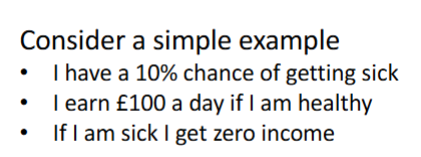
expected utility model question:
if we were to assume the function U() is increasing in consumption but at a decreasing rate it would mean i want to shift some consumption into the sate of the world where i am sick because this will increase my expected utility- this can be done by saving, borrowing or by purchasing insurance.

How to tell if an insurance market is competitive and works well
The firm charges a ‘fair’ insurance premium that is equal to its expected cost, p=0.10 x £100 = £10
My expected utility is:
EU = (0.9) U(100-p) + (0.1) U(100-p) = U(90) = 9.5
as a result I have been able to smooth consumption across states of the world
Therefore when insurance markets work then government doesn’t need to get involved.
When do insurance markets work?
Since individuals dont always have the same probability of getting sick, there is heterogeneity in risks across individuals e.g. lets say the sickly have a 10% probability of getting sick in comparison to the healthy that have 5% probability.
When there is symmetric information insurance companies will charge two different premiums and offer two different payouts each of which allows that type of person to fully insure themselves: pS = 0.10* £100 = £10 for the sickly, pH = 0.05* £100 = £5 for the healthy
What if there is asymmetric information within the insurance market?
.individuals know whether they are sickly or healthy however insurance companies cannot observe it meaning there is asymmetric information.
• imagine that insurance companies offer prices as before
• pS = £10 meant for the sickly
• pH = £5 meant for the healthy
Therefore if insurance companies cannot see who is healthy and who isnt everybody will buy the cheaper insurance meaning the insurance company will have to pay out the £10 cover for the sickly even though they paid £5
this will cause the insurance company to make a loss meaning this cannot be an equilibrium
what if there is asymmetric information and insurance companies offer a ‘fair’ price
say insurance companies offer a “fair” premium p = £7.5, which is the average of
the healthy and sickly premium
• this will be a bad deal for healthy people as they pay £7.5 for an expected claim
of £5 (0.05*100), so they won't purchase insurance
• this will be a great deal for sickly people as they pay £7.5 for an expected claim
of £10 (0.10*100), so they eagerly purchase insurance
• only high risk people will buy insurance
• this means insurers will make losses (£7.5 - £10), so the insurers will have to
raise the price
• this will drive more healthy people out of the market, and only sickly (very high
risk) people will buy insurance
• so again insurers make losses, and further raise prices, etc.
• until the market unravels, in the end no insurance is offered, even though
everybody is willing to pay a fair price for insurance
Adverse selection- private health insurance market how can the government address adverse selection?
.In private health insurance market with adverse selection, the market for insurance will typically unravel- no one will be able to buy insurance
The market failure here is because there is incomplete information about risk heterogeneity
The governenment can address adverse selection and improve market effciency by:
directly providing the insurance (e.g. universal healthcare)
mandating that everybody is required to purchase insurance (e.g. car insurance, private pensions, health insurance in some other countries)
Reasons government provide social insurance
.A market arises due to asymmetric information whic leads to adverse selection
.Redistribution: society wants to protect the most vulnerable by providing insurance, and to compensate unlucky or high-risk people.
.Another market failure is the presence of externalities, if you dont have the insurance this might have adverse consequences for me
.The administrative costs for public health care are small; administrative costs for private insurance are large
What are the effects of government intervention?- Moral hazard in insurance markets
Moral hazard refers to actions taken by insured individuals in response to insurance that increase the likelihood of adverse outcomes
e.g. If you receive unemployment benefits taht replace lost wages, you may not search as much for a new job, or if you have travel insurance you might be less careful with your camera on holiday
moral hazard increases the cost of providing insurance
Moral hazard and three types that play a particularly important role
Moral hazard exists with both private and social insurance whenever the insurer cannot perfectly monitor the person insured (asymmetric information)
Reduced percaution against entering the adverse state
increased odds of staying in the adverse state
increased expenditures when in the adverse state
Because of moral hazard insurers often do not offer full insurance- in both private and public insurance markets.
What can a government do to reduce moral hazard?
co-payments
Patient pays part of treatment- used in many countries in attempt to combat moral hazard
However this has downsides such as
. individual may delay treatment and then present themselves in a worse state of health leading to a higher cost of treatment
. avoiding treatment can have negative externalities
. inequity of linking access to healthcare to ability to pay
Regulation: the government picks treatments based on cost effectiveness
. This is what the UK does through the national institute for health and care excellence (NICE)