Bio2 Slides Exam 1
 Call Kai
 Learn
Learn Practice Test
 Spaced Repetition
 Match
Match Flashcards
 Knowt Play
1/156

There's no tags or description
Looks like no tags are added yet.
Name | Mastery | Learn | Test | Matching | Spaced | Call with Kai | Chat |
|---|
No analytics yet
Send a link to your students to track their progress
157 Terms
What is a character?
defined attribute of a single species
Highlight the main differences between homologous & analogous structures
Homologous
Common evolutionary history + shared CA
Analgous
independently acquired structures because of environmental pressures
No shared CA
convergent evolution
What is a polytomy in an phylogenetic tree?
2 or more descendant groups with unclear evolutionary relationships
What is the difference between a shared ancestral trait and a shared derived character?
Shared ancestral trait is not unique to clade, it originated in the ancestor. Derived is unique to a clade.
What is a monophyletic group in a phylogenetic tree?
A CA and all of its descendants (the ideal clade)
What is a paraphyletic group in a phylogenetic tree?
The common ancestor and some of its descendants
What is a polyphyletic group in a phylogenetic tree?
Distantly related species not including most recent CA
What is evolution?
changes in allele frequency in populations over time
Are viruses part of the domains of life?
No, they are considered non-living
Are viruses cellular? Also, can they reproduce?
Viruses are non-cellular and cannot reproduce, only replicate
All viruses are obligate intracellular parasites. What does this mean?
They invade susceptible host cells & use the host cells’s resources as well as processes
Do viruses have DNA or RNA?
They can have either DNA or RNA.
Explain the role of a capsid in viruses.
The capsid is the protein coat that surrounds the genetic material, determining the:
Shape of virus
plays role in attatchment
What is the capsid made of in viruses?
capsomere (protein subunit)
What is the envelope structure in viruses and do all of them have it?
It is the bilayer membrane outside the capsid obtained from the host cell during budding
not all viruses have it
How does host range or specificy differ between different viruses?
Some have narrow host ranges (even with specific tissues), while other have broad ranges
Explain the mechanism behind the specifity of viruses (why they are particular with what they infect)
They have viral surface proteins that connect to specific host receptor molecules
What does a virulent phage do and what cycle does it use?
Kills the host at the end of the cycle and utilizes the lytic cycle
SEQ LYTIC CYCLE
Attachment & Injection: the virus attatches self to the host cell and injects into it
The phage DNA remains separate from the host
Replication - The phage replicates its DNA
The phage makes its respective proteins by hijacking the host’s mechanism + self-assembly
The cell lyses, & phages exit
What cycles do temperate phages use?
Lysogenic & Lytic cycle
SEQ LYSOGENIC CYCLE
Attatchment + injection
phage dna intergrates self into host genome, it is a prophage now
host cell divides and DNA is passed onto host daughter cells
What 2 domains of life to prokaryotes belong to?
Archaea & Bacteria (which is what we are focusing on)
Which of these do prokaryotes have: nucleus, organelles, ribosomes?
Ribosomes
In prokaryotes, where is the cell wall located and what is its function?
It surrounds the plasma membrane and maintains cell shape
What are the 3 common prokaryotic cell shapes (and what maintains these shapes?)
cocci = spherical
bacilli = rod shaped
spirilli/spirochetes = spiral
The cell wall maintains the shapes
In prokaryotes (only bacterial prokaryotes) what is the cell wall made of?
Peptidoglycan, which is a polymer made of polypetides and sugars
When it comes to prokaryotic cell structure, what is the function of all these components:
Cell Wall
Capsule
Pili
Plasma membrane
Cytoplasm
Ribosome
flagellum
plasmids
nucleiod
Chrosome
Cell Wall: Maintains cell shape
Capsule: surrounds cell wall + protects against dehydration & phagocytosis
Pili: attatchment
Plasma membrane: letting things in/out of cell
Cytoplasm: cytosol + contents
Ribosome: protein synthesis
flagellum: locomotion
plasmids: small dna circles that have non-essential genes
nucleiod: unenclosed area where DNA is stored
Chromosome: DNA, always haploid (n)
What are the two stains used in a gram stain?
Crystal violet (purple) & safranin (pink)
If a bacterial cell wall is gram positive, what does that mean?
It means the cell wall has thick peptidoglycan, which traps crystal violet, and stains purple
If a bacterial cell wall is gram negative, what does that mean?
The wall has thin peptidoglycan and can’t trap crystal violet, therefore letting safranin show and staining pink.
CC positive/negative taxis
positive: movement towards the stimulus
negative: movement away from the stimulus
What are the 3 main parts of the bacterial flagellum?
The motor: the rings in the cell wall and plasma membrane
Hook
Filament

SEQ Bacterial flagellum function
H+ pumped out across PM by ETC → Form gradient → Diffuse into cell through motor → Produces force → Hook turns → Filament rotates —→ Now we moving!

SEQ binary fission (the process in which prokaryotes reproduce)
The single circular chrosome in the prokaryote cell is replicated
The FtsZ proteins then go to middle forming a Ftsz ring, then a septum
Cell fully splits, now we have 2 identical cells
What are the two main mechanisms of genetic diversity in prokaryotes?
A. Mutation + Rapid Reproduction
B. Genetic Recombination
SEQ/CC the 3 types of genetic recombination in prokaryotes
Transformation: external DNA taken up and integrated into genome
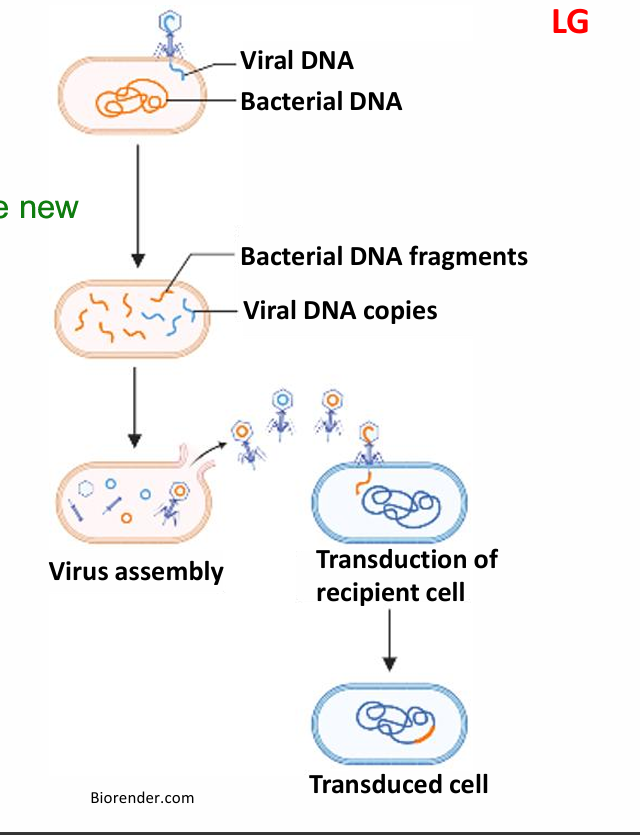
Transduction: During phage replication, an error occurs where a fragment of host DNA is packaged into the new phage. The new phage transfers that DNA to another cell, incorporating it into its genome.
Conjugation: Genetic info transferred between two living prok cells via a F factor in the form of a plasmid. F+ cell uses pilus to attatch to F- cell, making a mating bridge to transfer plasmid DNA.
What are the SDC (shared derived characteristics) of eukaryotes?
Nucleus
Endomembrane system (organelles)
Cytoskeleton: network of fibers
Mitochondria
What is the main process for evolution in eukaryotes and what are the two steps?
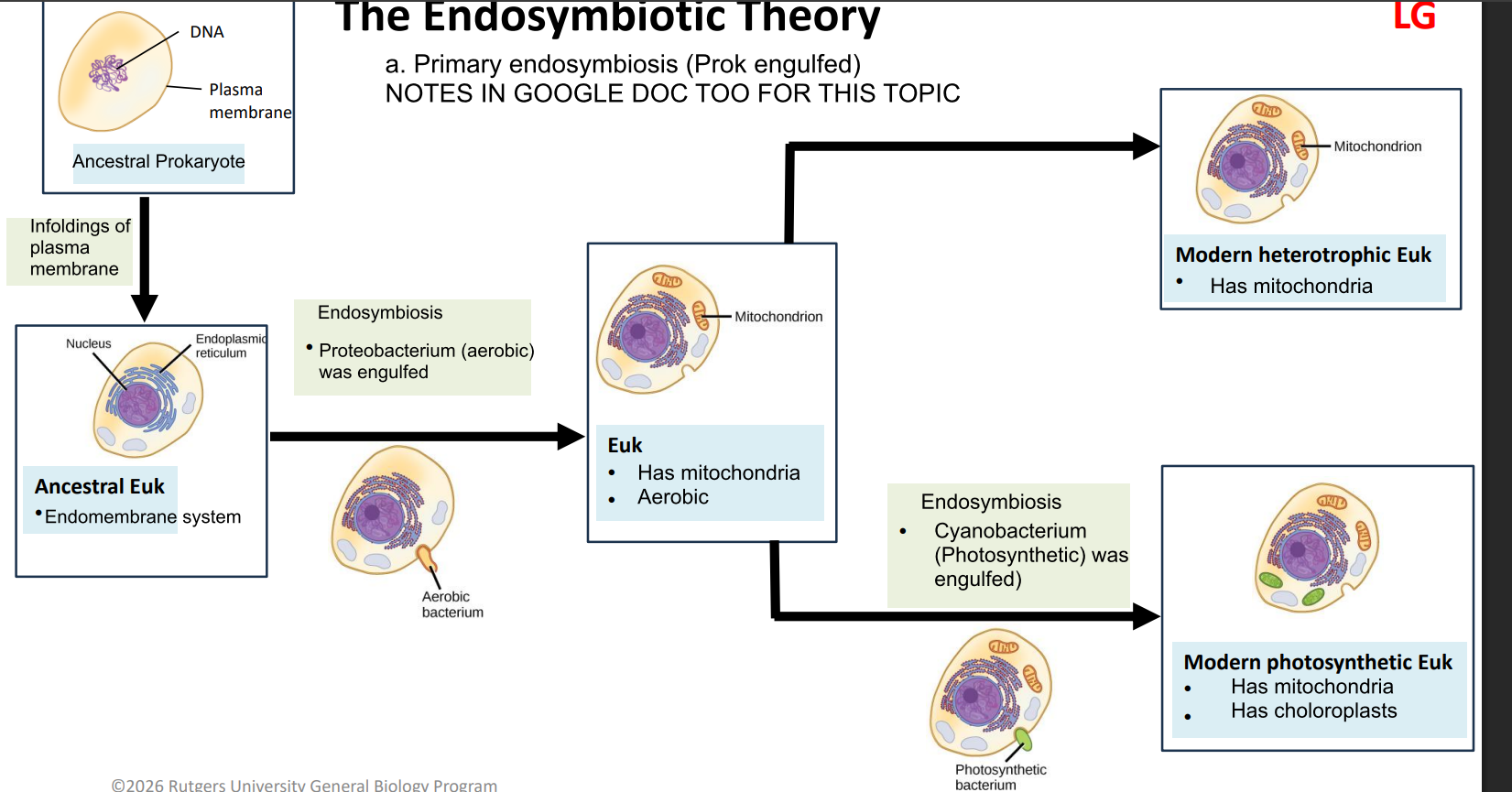
Main process: Serial Endosymbiosis
1st step: Primary Endosymbiosis (a prokaryote was engulfed)
2nd Step: Secondary Endosymbiosis (a eukaryote was engulfed)
SEQ Primary Endosymbiosis
An ancestral prokaryote enfolds its plasma membrane → gains endomembrane system, becomes ancestral eukaryote → then does endosymbiosis by engulfing aerobic proteobacterium → becomes modern heterotrophic eukaryote w/ mitochondria + is anaerobic → might do endosymbiosis again by engulfing photosynthetic cyanobacterium →becomes modern photosynthetic eukaryote w/ chloroplasts + mitochondria
SEQ Secondary Endosymbiosis (remember this occured in two lineages of protists)
A heterotrophic eukaryote engulfs a photosynthetic eukaryote → gains a secondary plastid
What are protists?
The “very first” eukaryotes that emerged before plants, animals, and fungi (still very complex)
Are protists unicellular or multicelluar?
Most are unicellular, but some are multicellular
Explain the 3 nutritional strategies of protists
Photoautotrophs: chloroplasts
Heterotrophs: organic molecules
Mixotrophs: photosynthesis & heterotrophic
Draw the tree of what the 3 biology domains look like

In the domain Eukarya, what is the main SDC?
Mitochondria
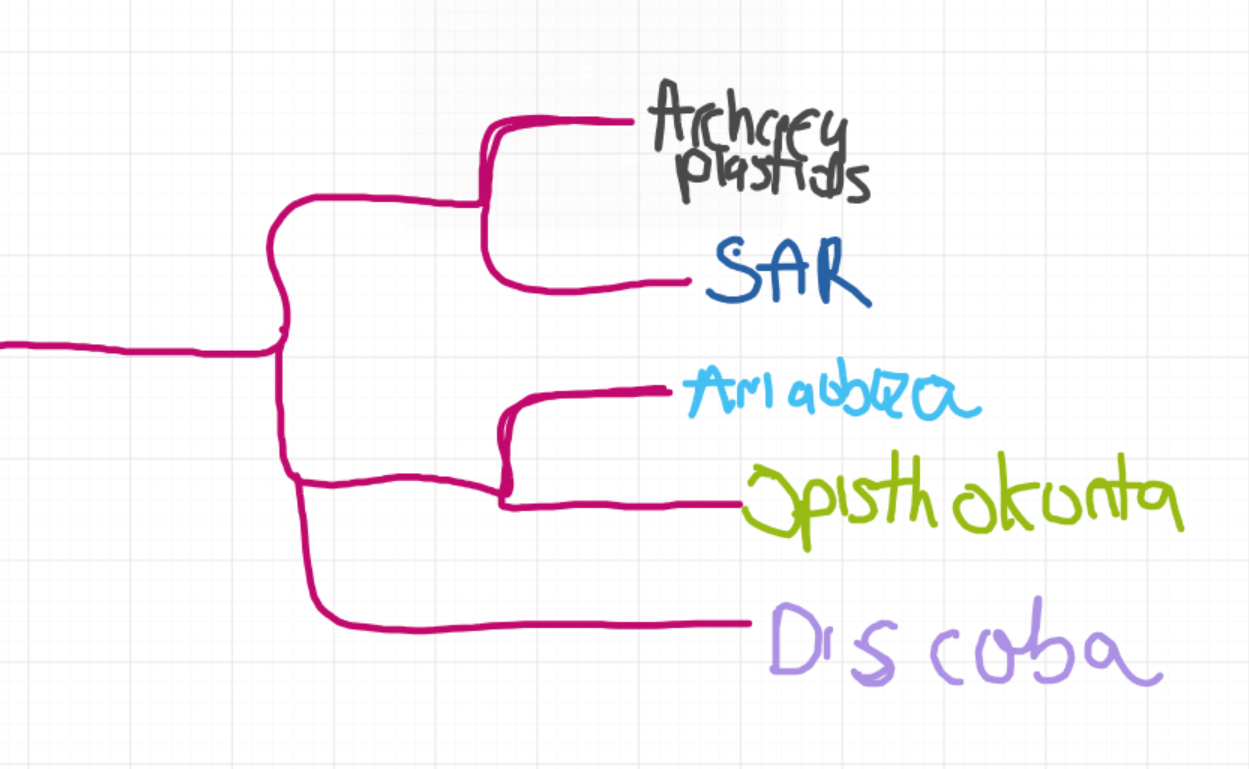
What are the 5 supergroups in Domain Eukarya? (use the mnemonic Archie..)
A - Archaeplastida
S - SAR
A - Amoebozoa
O - Opisthokonta
D - Discoba
Draw a tree of just the names of the 5 eukarya supergroups (nothing that’s in them). Which ones are sister taxa?
Archaeaplastids + SAR
Amoezoba + Opisthokonta
What is the SDC of Archeaplastids?
their chloroplast from primary endosymbiosis of a cyanobacterium —> whick makes them all photosynthetic
What is the SDC for SAR?
a secondary endosymbiosis plastid from red algae
What are the SDC for Amoebozoa?
GENETIC SIMILARITIES,
BLOB SHAPE,
PSEUDOPODIA: a temporary, cytoplasm-filled projection of a eukaryotic cell membrane used for movement and capturing food
What are the SDC for Opisthokonta?
Genetic similarities
Single, posterior flagellum
What is the SDC for Discoba?
a crystalline rod in the flagellum
What are the 4 types of Archeaplastids?
red algae
chlorophytes
charophytes
land plants
What makes red algae red? Also what eukaryotic supergroup do they fall under?
Phycoetherin is the red photosynthetic pigment responsible for the red color, and it absorbs blue and green light
Red algae falls under the Archaeplastida super group
What two types of Archaeplastidas classify as green algae?
Chlorophytes & Charophytes, who’s cholorplasts are very similar to land plants
What are the 3 types of SAR?
Stramenopiles
Alevolates
Rhizaria
What are the two main examples of stramenopiles? And what eukaryotic supergroup do they belong to?
Diatoms
brown algae (multicellular large protists, seaweed)
- Stramenopiles belong to the SAR super group
What are the two main examples of aleveolates? And what eukaryotic supergroup do they belong to?
Dinoflagelletes that have 2 flagella to spin
Apicomplexans (parasite)
What is the main examples of rhizaria? And what eukaryotic supergroup do they belong to?
Foraminiferans (forams), which have porous shells of CAC03
What are the two types of discoba?
Trypanosomes - Can cause African sleeping sickness
Euglenids
Have an additional SDC: 2 secondary endosymbiosis plastids from green algae
What are the two types of Amoebozoa?

What are the 3 types of Opisthokonta?
Animals & fungi are in this group
Nucleariids are also in this group ((protists, sister taxon fungi)
Choanoflagellelates (protists, sister taxon animals)
Now draw a complete pholygenetic tree of the Domain Eukarya with all supergroups, all examples, and all SDC of the 5 supergroups

Explain the origin of fungi. What were their ancestors like? When did their ancestors diverge from animals, and who do they share a sister taxon with?
They have a unicellular flagellated ancestor
ancestors of animals and fungi diverged 1-1.5 bya
sister taxa with nucleariids (hetetrophic protists)

When did fungi colonize land, and what was life on land like when they colonized it?
Fungi colonized land -635 mya
Life on land was “green slime”
Cyanobacteria
Protists
Fungi
What are two general SDCs for Fungi?
Chitlin (in cell wall)
Being absorptive heterotrophs (Rely on organic nutrients for their needs, Do not ingest food or digest inside body)
What domain and maybe supergroup do Fungi belong to?
THE DOMAIN EUKARYA WITHIN THE SUPERGROUP OPISTHOKONTA
What type of cell structure do Fungi have?
A eukaryotic cell structure & a cell wall
What are the basic building blocks of multicellular fungi, and what is their function?
Hyphae which are basically tubular cell wall segments, and they secrete hydrolases
What is mycelium(lia)?
A tangled mass of hyphae (the basic building blocks of fungi) that serves as a feeding network in multicellular fungi
SEQ the nutrition mechanism of Fungi
Secrete hydrolases
They break down polymers into monomers
Then absorb predigested molecules
CC The 3 Ecological Roles of Fungi
Decomposers: absorb nutrients from non-living organic material & break down matter
Mutualists: absorb nutrients from living host, but also provide benefit to host
Parasites: absorb nutrients from living host, but provide no benefit to host
What are the two main/overall SDC of fungi?
Cell wall made of chitin
Being absorptive heterotrophs
What are spores?
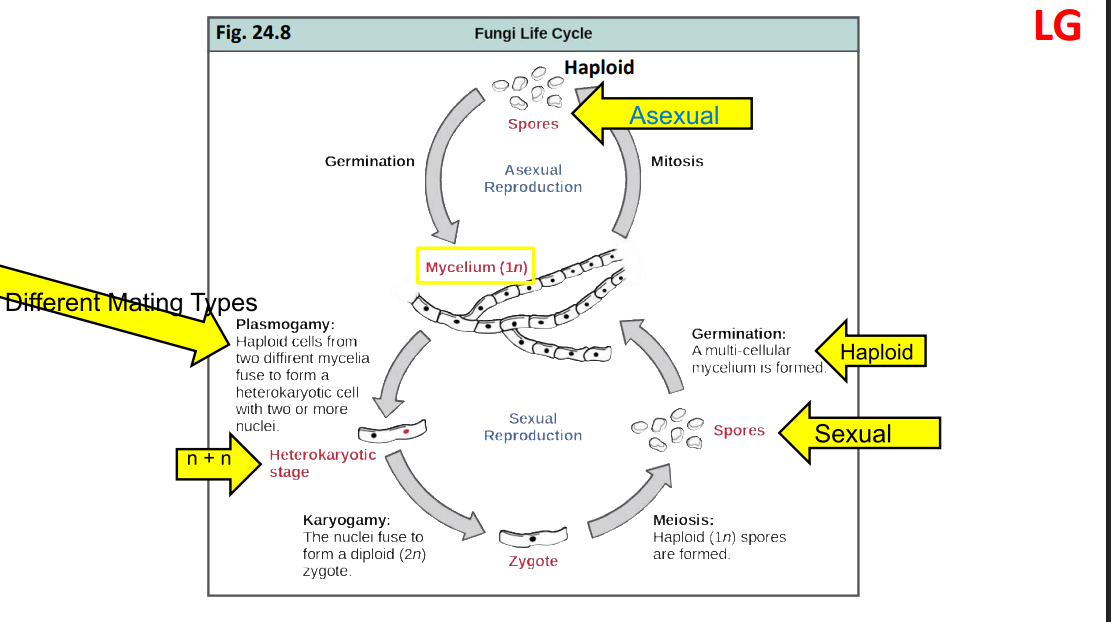
Spores are the haploid (n) reproductive units of fungi that can be reproduced se*ually or ase*ually
What are the two ways that spores can be produced?
Aerial hyphae → easy dispersal
Fruiting bodies (mushroom)
Question: How do fungal spores move on their own, and do they have flagella?
Answer: They are non-motile and do not have flagella, instead, they are dispersed by wind, H20, or animals.
Question: What type of environment do fungal spores require to thrive, and what happens if they land in such an environment?
Answer: A moist environment with plenty of nutrients.
If they land in an ideal environment like that, they → germinate → new mycelium
What are the two main types of fungi mentioned that participate in asexual reproduction, and how do they do it?
Filamentous fungi: Produce asexual spores by mitosis, like mold on bread
yeasts: Cell division or budding
SEQ Sexual Reproduction Of Fungi
If mycelia are two different mating types, when their hyphae produce pheromones, they will grow towards each other
Hyphae meet & fuse but nuclei do not fuse = plasmogamy —→ heterokaryon (n + n)
Then the (n+n)/heterokaryon mycelium grows, and the nuclei divide without fusing
Karyogamy: the nuclei finally fuse and produce a zygote (2n)
zygote then undergoes meiosis and produces haploid se*ual spores
What are the 5 fungal phyla and their corresponding SDCs? (use mmnemic)
Phylum chytridiomyctora (Chytrids)
SDC = Zoospores (flagellated spores)
Phylum Zygomycota
SDC =Zygospores (diploid, favorable env → undergo meiosis → spores (n)
Phylum Glomeromyctota
SDC = Arbuscular mycorrhizae (nutrients to 80% plants)
Phylum Ascomycota
SDC= Apscopores (produced in ascus)
Phylum Basidiomycota
SDC = Basidiospores (Produced on a basidium)
Explain the cell structure of animals.
Eukaryotic
No cell wall
SDC = Extracellular matrix (ECM)
Explain the 4 key points of organization for animals (cells..tissues..)
All animals are multicellular
All have specialized cells
Most animals have specialized tissues
Higher forms have specialized organs (ex. kidneys)
After animals sexually reproduce and a zygote (2n) is formed via meiosis, how does this zygote develop into a embryo? OR, SEQ EMBRYONIC DEVELOPMENT in animals.
Cleavage: Zygote undergoes mitotic divisions without cell growth
Blastulation: Zygote cleaves more and becomes a blastula (hollow ball of cells)
Gastrulation: Blastula folds inward on itself & expands into the blastocoel —> is now Gastrula (layers of embryonic tissue)
What is a body plan?
Set of morphological & developmental characters that represent key steps in animal evolution
What is the SDC that every species in Kingdom Animalia/Metazoa have?
ECM (Extracellular Matrix)
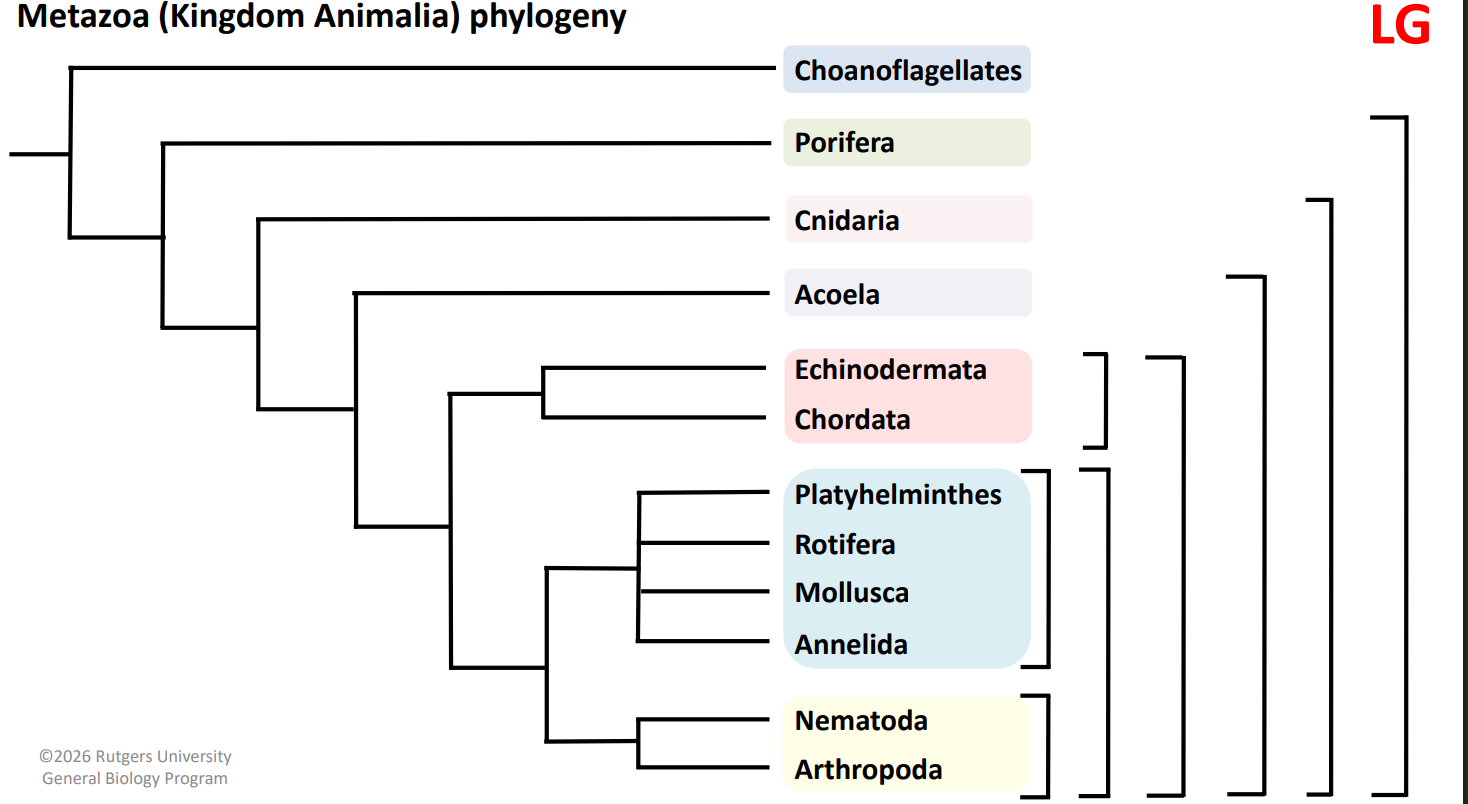
KNOW METOZIA (KINGDOM ANIMAL) DIAGRAM IN LG BY HEART, SDCS, CLADES, BASAL TAXONS - LABEL THIS DIAGRAM AND THEN CHECK YOUR LG FOR ANSWERS.
this info applies to tree:
What is the only species in Metazoa (Kingdom Animalia) that does not have specific tissues? And what group do the rest of the species that do have tissues fall under?
Porifera (sponges) do not have specific tissues, ONLY HAVE ECM (ancestral SDC), they are the basal taxon
Everything else does and is called Eumetazoa (“True animals”)
In Metazoa/Kingdom Animalia, what species has radial symmetry and diploblasty (define later), while the rest of the tree going down has bilatery symmetry and triploblasty?
Cnidaria
In embryonic tissue development for animals, what are these parts of the gastrula
- Two general germ layers:
-Name of the eventual gut:
-Name of opening to outside:
- Two general germ layers: Endoderm and ectoderm
-Name of the eventual gut: Archenteron
-Name of opening to outside: blastopore

What are the two types of gastrula, and what is a key unique feature that only one of them has?
Diploblastic - only endo & ecto layers
Triploblastic - endo, ecto, and mesoderm
UNIQUE: Has coelom, a fluid-filled space between the body wall & digestive tube
What are the 3 types of coelom?

SEQ ANIMAL DEVELOPMENT/NAME THE 3 MAIN PROCESSES. ALSO, WHAT DO DIFFERENCES IN THESE PROCESSES DETERMINE?
3 processes
Cleavage
Coelom formation
Fate of the blastopore
Differences in these processes separate the Nephrozoa (LAST MAJOR GROUP/CATEGORY IN METAZOA) into the protostomes & deuterostomes
CC Protosomes and deutorsonomes based on these categories: Cleavage, Coelom formation, Fate of the blastopore

What is the sister taxon of animals? (Keep in mind that animals belong to eukarya supergroup Opisthokonta)
Choanoflagelletes, which are protists
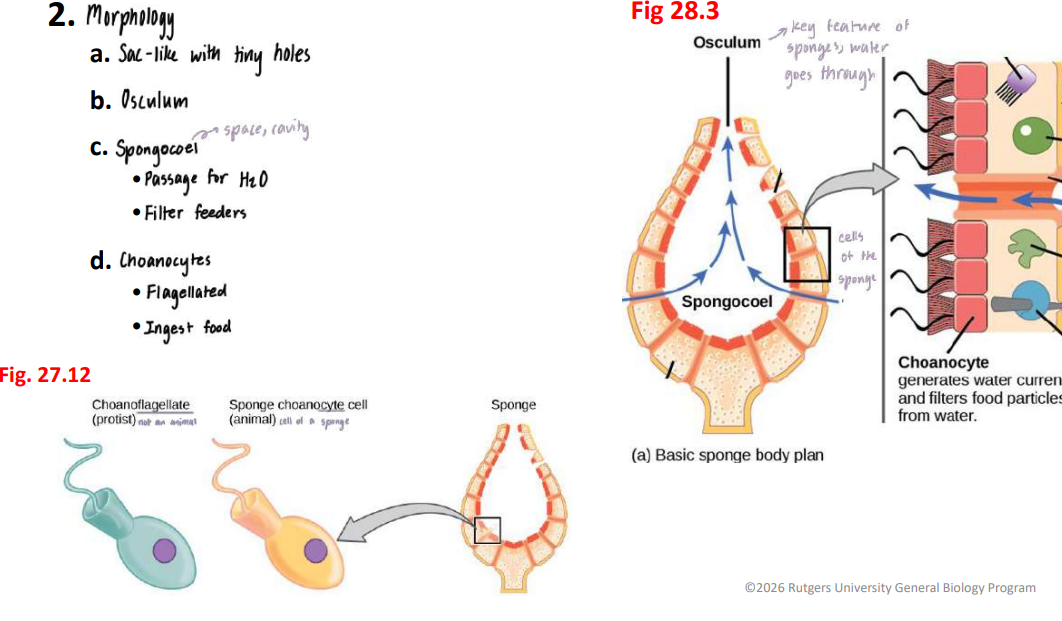
Explain the morphology of poriferia. also, what domain, subgroup, and category are they iN?
Morphology:
sac like with tiny holes
osculum where water passes through
has a spongocoel (space/cavity) that acts as a passage for h20 & filters feeders
made up of choanocytes (sponge cells) that are flagellated & ingest food
What is the SDC of phylum cnidaria (the basal eumatozeans!)
Cindocytes - specialized cells in the tentacles, which serve as defense & prey capture
ex. jellies, coral, sea anemonome

What is the Spiralia Clade in the Metazoa Tree under? And what are their shared & derived characters?
They are under Prostomia!

What are the 4 phylums in clade Spiralia?
platyhelminthes
rotiferia
mollusca
annelida
What are the two key features of Phylum Platyhelminthes under clade Spiralia? And what type of habitats do they live in?
Aceolomate - no coelom
They are flatworms (“helm”)
They are free-living or parasitic and live in hosts
What are the 3 key features of Phylum Rotiferia under clade Spiralia? And what type of habitats do they live in?
They are pseudocoelmates
they have a corona/crown
very smalll
they live in freshwater/marine, damp soil
